Fasting Rules
 Meat
Abstain
Meat
Abstain
 Fish
Abstain
Fish
Abstain
 Dairy
Abstain
Dairy
Abstain
 Oil
Abstain
Oil
Abstain
 Wine
Abstain
Wine
Abstain
Saints & Commemorations
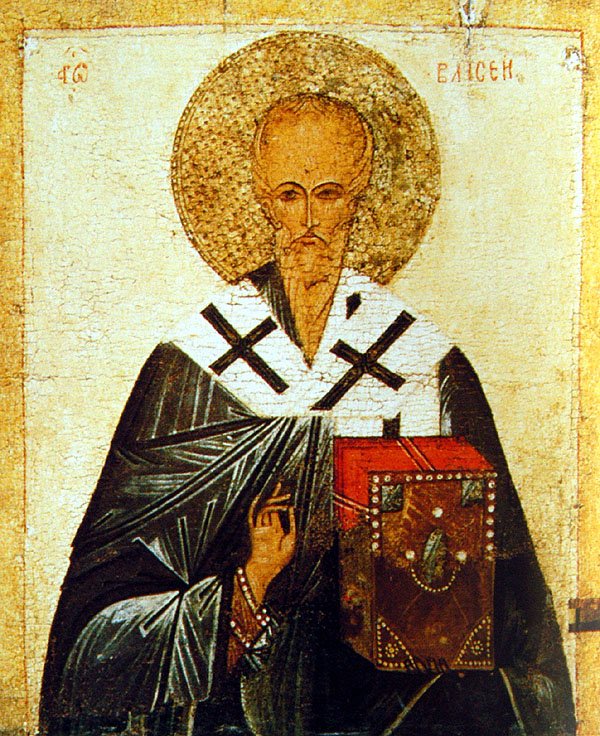
Hieromartyr Blaise, Bishop of Sebaste
The Hieromartyr Blaise (Blasius), Bishop of Sebaste, was known for his righteous and devout life. Unanimously chosen by the people, he was consecrated Bishop of Sebaste. This occurred during the reign of the Roman emperors Diocletian (284-305) and Licinius (307-324), fierce persecutors of Christians.
The Hieromartyr Blaise (Blasius), Bishop of Sebaste, was known for his righteous and devout life. Unanimously chosen by the people, he was consecrated Bishop of Sebaste. This occurred during the reign of the Roman emperors Diocletian (284-305) and Licinius (307-324), fierce persecutors of Christians. Saint Blaise encouraged his flock, visited the imprisoned, and gave support to the martyrs.
Many hid themselves from the persecutors by going off to desolate and solitary places. Saint Blaise also hid himself away on Mount Argeos, where he lived in a cave. Wild beasts came up to him and meekly waited until the saint finished his prayer and blessed them. The saint also healed sick animals by laying his hands upon them.
The refuge of the saint was discovered by servants of the governor Agrilaus, who had come to capture wild beasts to loose on the Christian martyrs. The servants reported to their master that Christians were hiding on the mountain, and he gave orders to arrest them. But those sent out found there only the Bishop of Sebaste. Glorifying God Who had summoned him to this exploit, Saint Blaise followed the soldiers.
Along the way the saint healed the sick and worked other miracles. Thus, a destitute widow complained to him of her misfortune. A wolf had carried off a small pig, her only possession. The bishop smiled and said to her, “Do not weep, your pig will be returned to you...” To the astonishment of everyone, the wolf came running back and returned his prey unharmed.
Agrilaus, greeting the bishop with words of deceit, called him a companion of the gods. The saint answered the greeting, but he called the gods devils. Then they beat him and led him off to prison.
On the next day, they subjected the saint to tortures again. When they led him back to the prison, seven women followed behind and gathered up the drops of blood. They arrested them and tried to compel them to worship the idols. The women pretended to consent to this and said that first they needed to wash the idols in the waters of a lake. They took the idols and threw them in a very deep part of the lake, and after this the Christians were fiercely tortured. The saints stoically endured the torments, strengthened by the grace of God, their bodies were transformed and became white as snow. One of the women had two young sons, who implored their mother to help them attain the Kingdom of Heaven, and she entrusted them to the care of Saint Blaise. The seven holy women were beheaded.
Saint Blaise was again brought before Agrilaus, and again he unflinchingly confessed his faith in Christ. The governor ordered that the martyr be thrown into a lake. The saint, going down to the water, signed himself with the Sign of the Cross, and he walked on it as though on dry land.
Addressing the pagans standing about on shore, he challenged them to come to him while calling on the help of their gods. Sixty-eight men of the governor’s retinue entered the water, and immediately drowned. The saint, however, heeding the angel who had appeared to him, returned to shore.
Agrilaus was in a rage over losing his finest servants, and he gave orders to behead Saint Blaise, and the two sons of the woman martyr entrusted to him. Before his death, the martyr prayed for the whole world, and especially for those honoring his memory. This occurred in about the year 316.
The relics of the Hieromartyr Blaise were brought to the West during the time of the Crusades, and portions of the relics are preserved in many of the lands of Europe [and his memory traditionally honored there on February 3].
We pray to Saint Blaise for the health of domestic animals, and for protection from wild beasts.
Troparion - Tone 4
By sharing in the ways of the Apostles, / you became a successor to their throne. / Through the practice of virtue, you found the way to divine contemplation, O inspired one of God; / by teaching the word of truth without error, you defended the Faith, / even to the shedding of your blood. / Hieromartyr Blaise, entreat Christ God to save our souls.
Kontakion - Tone 2
Godly shoot, unfading flower, / most fruitful branch of Christ the Vine, God-bearing Blaise, / fill with joy those who in faith honor your memory / as you unceasingly intercede for us all.
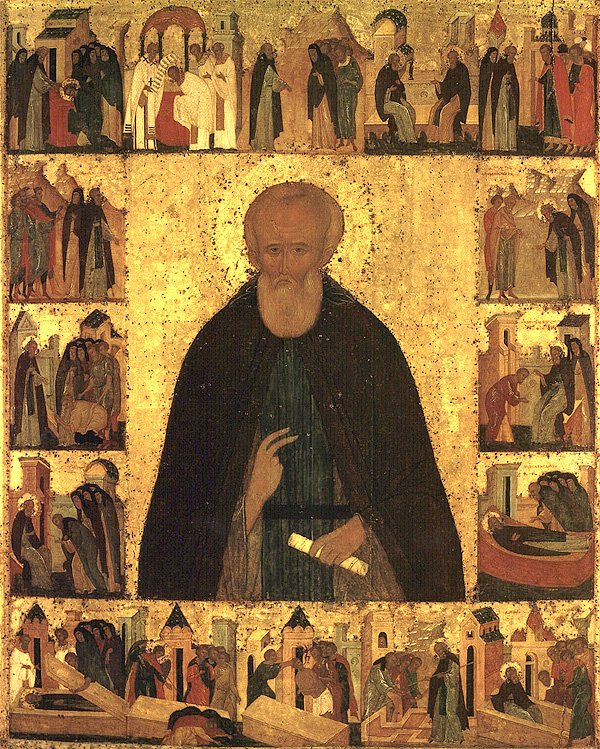
Venerable Demetrios, Wonderworker of Priluki, Vologda
Saint Demetrios (Dēmḗtrios) of Priluki, Wonderworker, was born into a rich merchant’s family in Pereyaslavl-Zalessk. From his youth the saint was uncommonly handsome. Receiving monastic tonsure at one of the Pereyaslavl monasteries, the saint later founded the Saint Nicholas cenobitic monastery on the Saints Boris and Gleb Hill at the shore of Lake Plescheevo near the city, and became its igumen.
In
Saint Demetrios (Dēmḗtrios) of Priluki, Wonderworker, was born into a rich merchant’s family in Pereyaslavl-Zalessk. From his youth the saint was uncommonly handsome. Receiving monastic tonsure at one of the Pereyaslavl monasteries, the saint later founded the Saint Nicholas cenobitic monastery on the Saints Boris and Gleb Hill at the shore of Lake Plescheevo near the city, and became its igumen.
In 1334 Saint Demetrios first met with Saint Sergius of Radonezh, who had come to Pereyaslavl to see Metropolitan Athanasius. From that time, he frequently conversed with Saint Sergius and became close with him. The fame of the Pereyaslavl igumen was so widespread that he became godfather to the children of Great Prince Demetrios Ioannovich. Under the influence of the Radonezh wonderworker, Saint Demetrios decided to withdraw to a remote place, and went north with his disciple Pachomius.
In the Vologda forests, at the River Velika, near the Avnezh settlement, they built a church of the Resurrection of Christ and they prepared to lay the foundations for a monastery. The local inhabitants were fearful that if a monastery were built there, their village would become monastery property. They demanded that the monks leave their territory, and wishing to be a burden to no one, they moved farther away.
Not far from Vologda, at the bend of a river in an isolated spot, Saint Demetrios decided to form the first of the cenobitic monasteries of the Russian North. The people of Vologda and the surrounding gladly consented to help the saint. The owners of the land intended for the monastery, Elias and Isidore, even trampled down a grain field, so that a temple might be built immediately. In 1371 the wooden Savior cathedral was built, and brethren began to gather.
Many disciples of the monk came there from Pereyaslavl. Saint Demetrios combined prayer and strict asceticism with kindliness. He fed the poor and hungry, he took in strangers, he conversed with those in need of consolation, and he gave counsel. He loved to pray in solitude. His Lenten food consisted of prosphora with warm water. Even on feastdays, he would not partake of the wine and fish permitted by the Rule. Both winter and summer he wore an old sheepskin coat, and even in his old age he went with the brethren on common tasks. The saint accepted contributions to the monastery cautiously, so that the welfare of the monastery would not be detrimental to those living nearby.
The Lord granted His servant the gift of clairvoyance, and he attained a high degree of spiritual perfection. Saint Demetrios died at an advanced age on February 11, 1392. The brethren approaching found him as though asleep, and his cell was filled with a wondrous fragrance.
Miracles from the relics of Saint Demetrios began in the year 1409, and during the fifteenth century his veneration spread throughout all Rus. And no later than the year 1440, the Priluki monk Macarius recorded his Life (Great Reading Menaion, February 11) based on the narratives of Saint Demetrios’s disciple Igumen Pachomius.
Troparion - Tone 1
You received grace from God, O glorious Dēmḗtrios, / and you were strengthened by His power; / you lived according to the Gospel, / therefore you obtained a reward from Christ for your labors, O most blessed one. / Pray to Him for the salvation of our souls.
Kontakion - Tone 8
From your youth, O Venerable one, you took up your cross and followed Christ, / exhausting your flesh by prayers and fasting, by vigils, and by suffering evils. / Therefore, the All-Seeing Eye, beholding your works, glorified you with miracles / and taught everyone to cry out to you, “Rejoice, Father Dēmḗtrios, adornment of fasters.”
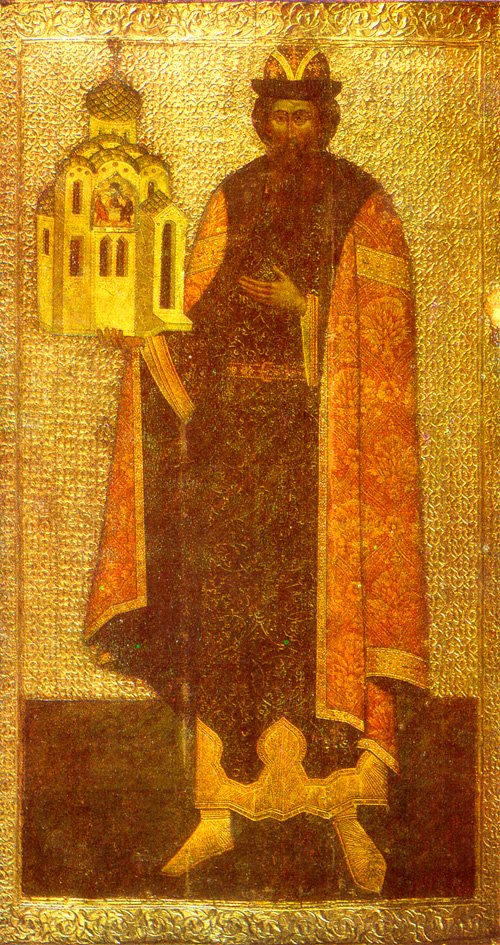
Saint Vsevolod (in Baptism Gabriel), Wonderworker of Pskov
Holy Prince Vsevolod of Pskov, in Baptism Gabriel, a grandson of Vladimir Monomakh, was born at Novgorod, where in the years 1088-1093 and 1095-1117 his father ruled as prince. His father was the holy prince Saint Mstislav-Theodore the Great (April 15). In the year 1117, when Great Prince Vladimir Monomakh gave Mstislav Kievan Belgorod as his “udel” (land-holding), practically making him co-ruler, young Vsevolod remained as his father’s vicar in the Novgorod principality.
Holy
Holy Prince Vsevolod of Pskov, in Baptism Gabriel, a grandson of Vladimir Monomakh, was born at Novgorod, where in the years 1088-1093 and 1095-1117 his father ruled as prince. His father was the holy prince Saint Mstislav-Theodore the Great (April 15). In the year 1117, when Great Prince Vladimir Monomakh gave Mstislav Kievan Belgorod as his “udel” (land-holding), practically making him co-ruler, young Vsevolod remained as his father’s vicar in the Novgorod principality.
Holy Prince Vsevolod did much good for Novgorod. Together with the Archbishop of Novgorod, Saint Niphon (April 8), he raised up many churches, among which were the cathedral of the Great Martyr George at the Yuriev monastery, and the church of Saint John the Forerunner at Opokakh, built in honor of the “angel” (i.e. patron saint) of his first-born son John, who had died in infancy (+ 1128).
In his Ustav (Law code) the prince granted a special charter of lands and privileges to the cathedral of Holy Wisdom (Hagia Sophia) and other churches. During a terrible famine, he exhausted his entire treasury to save people from perishing. Prince Vsevolod was a valiant warrior, he marched victoriously against the Yam and Chud peoples, but he never took up the sword for lucre or power.
In 1132, upon the death of holy Great Prince Mstislav, Vsevolod’s uncle Prince Yaropolk of Kiev fulfilled the last wishes of his brother and transferred Vsevolod to Pereyaslavl, then regarded as the eldest city after Kiev itself. But the younger sons of Monomakh, Yuri Dolgoruky and Andrew Dobry, were apprehensive lest Yaropolk make Vsevolod his successor at Kiev, and so they marched out against their nephew. Hoping to avoid internecine strife, Saint Vsevolod returned to Novgorod, but was received there with disaffection. The Novgorodians felt that the prince had been “raised” by them and should not have left them earlier. “Vsevolod went to Rus, to Pereslavl,” noted the Novgorod chronicler, “and kissed the cross against the Novgorodians, saying, ‘I will kill you.’”
Striving to restore good relations with Novgorod, the prince undertook a victorious campaign against the Chud people in 1133, and he annexed Yuriev to the Novgorod domain. But a harsh winter campaign in 1135-1136 against Suzdal was unsuccessful. The stubborn people of Novgorod would not heed their chastisement by God, and they could not forgive the prince for their defeat. The assembly decided to summon a prince from the hostile Monomakh line of the Olgovichi, and they condemned Saint Vsevolod to banishment. “You suffered exile at the hands of your own people,” we sing in the troparion to the saint. For a month and a half they held the prince and his family under guard at the archbishop’s palace. When Prince Svyatoslav Olgovich arrived on July 15, 1136, Vsevolod was released from his captivity.
Vsevolod went again to Kiev, and his uncle Yaropolk gave him the Vyshgorod district near Kiev, the place where Saint Olga (July 11) had lived in the tenth century during the rule of her son Svyatoslav, “preferring the cities of Kiev and Pskov.” Saint Olga came to the defense of her descendant in 1137 when the people of Pskov, recalling the campaigns of the Novgorod-Pskov army led by the prince, invited him to the Pskov principality, the native region of Saint Olga. He was the first Pskov prince, chosen by the will of the Pskov people.
Among the glorious works of Saint Vsevolod-Gabriel at Pskov was the construction of the first stone church dedicated to the Life-Creating Trinity, replacing a wooden church from the time of Saint Olga. On the icons of the saint, he is often depicted holding the church of the Holy Trinity.
Saint Vsevolod ruled as prince at Pskov for only a year. He died on February 11, 1138 at the age of forty-six. All of Pskov gathered at the funeral of the beloved prince, and the chanting of the choir could scarcely be heard over the people’s wailing.
The people of Novgorod sent an archpriest from the Sophia cathedral to take his holy relics back to Novgorod. The prince, however, did not want his body to rest in Novgorod. He would not allow Pskov to be deprived of his relics by the people of Novgorod, who had driven him out, and the coffin would not move from the spot. The Novgorod people wept bitterly and repented in their misfortune. Then they asked to be given just a small piece of his relics “for the protection of their city.” Through their prayers a fingernail fell from the saint’s hand. The Pskov people put Saint Vsevolod into the temple of the holy Great Martyr Demetrius. Beside the grave they placed the military armaments of the prince, a shield and sword, in the shape of a cross, with the Latin inscription, “I will yield my honor to no one.”
On November 27, 1192, the relics of holy Prince Vsevolod were uncovered and transferred into the Trinity cathedral, in which a chapel was consecrated in his honor.
The deep spiritual bond of the city of Saint Olga with the holy Prince Vsevolod was never broken. He always remained a Pskov wonderworker. At the siege of Pskov by Stephen Bathory in 1581, when the walls of the fortress were already breached and the Poles were ready to rush into the city, they brought the holy relics of Prince Vsevolod from the Trinity cathedral to the place of battle, and the enemy withdrew.
On April 22, 1834, on the first day of Pascha, the saint’s holy relics were solemnly transferred to a new shrine in the main church of the cathedral.
At the appearance of the wonderworking Pskov-Protection Icon (October 1), holy Prince Vsevolod-Gabriel stood among the heavenly defenders of Pskov.
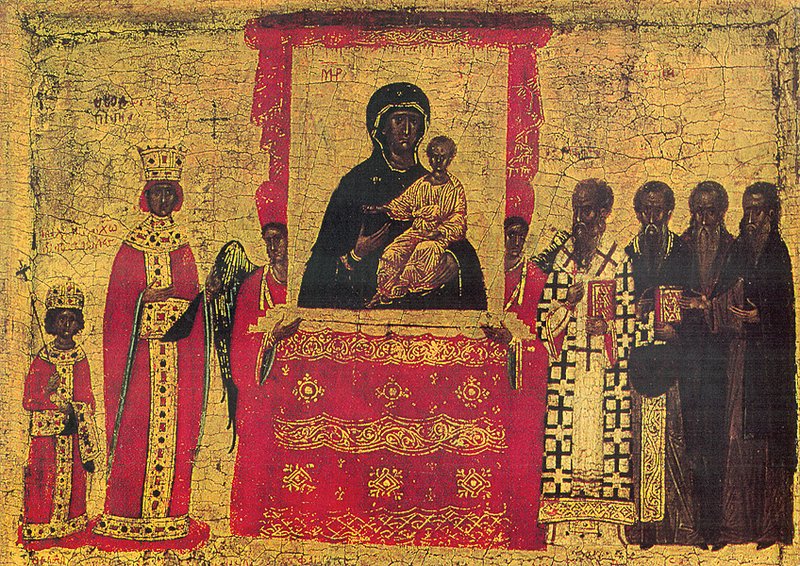
Righteous Theodora, wife of Emperor Theophilus the Iconoclast
Holy Empress Theodora was the wife of the Byzantine emperor Theophilus the Iconoclast (829-842), but she did not share in the heresy of her husband and secretly venerated the holy icons. After the death of her husband, Saint Theodora governed the realm because her son Michael was a minor.
She convened a Council, at which the Iconoclasts were anathematized, and the veneration of icons was reinstated.
Holy Empress Theodora was the wife of the Byzantine emperor Theophilus the Iconoclast (829-842), but she did not share in the heresy of her husband and secretly venerated the holy icons. After the death of her husband, Saint Theodora governed the realm because her son Michael was a minor.
She convened a Council, at which the Iconoclasts were anathematized, and the veneration of icons was reinstated. Saint Theodora established the annual celebration of this event, the Triumph of Orthodoxy, on the first Sunday of the Great Fast. Saint Theodora did much for Holy Church and fostered a firm devotion to Orthodoxy in her son Michael.
When Michael came of age, she was retired from governing and spent eight years in the monastery of Saint Euphrosynē, where she devoted herself to ascetic struggles, and reading books that nourished her soul.
A copy of the Gospels, copied in her own hand, is known to exist. She died peacefully around the year 867.
In 1460, her relics were given by the Turks to the people of Kerkyra (Corfu).
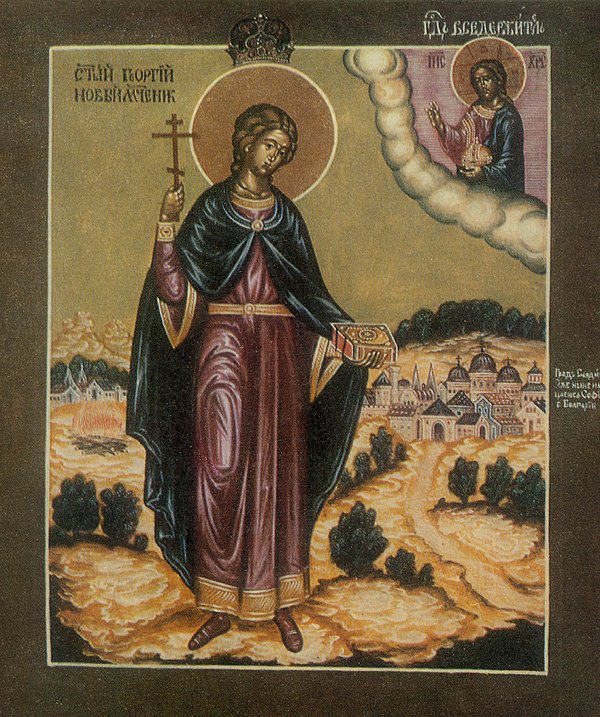
Saint George, New Martyr of Sofia
The Holy Martyr George the New was born into an illustrious Bulgarian family, living in the capital city of Bulgaria, Sredets (now the city of Sofia). Saint George’s childless parents, John and Mary, in their declining years entreated the Lord to send them a child. Their prayer was answered, and they baptized the infant with the name of the holy Great Martyr George (April 23).
The Holy Martyr George the New was born into an illustrious Bulgarian family, living in the capital city of Bulgaria, Sredets (now the city of Sofia). Saint George’s childless parents, John and Mary, in their declining years entreated the Lord to send them a child. Their prayer was answered, and they baptized the infant with the name of the holy Great Martyr George (April 23).
Young George received a fine upbringing, he attentively studied the Holy Scriptures, and he was pious and chaste. His parents died when George was twenty-five. At that time Bulgaria found itself under the rule of the Turks, who forcibly converted Christians to Islam.
Once, several Moslems tried to convert George. They put a fez on the saint’s head. This is a red circular hat which Moslems wear to enter their house of prayer. But George threw the fez on the ground. The Turks brought the martyr to their governor with beatings and abuse.
The governor was impressed with Saint George’s appearance and bearing, and he urged him to accept Islam, promising honors and wealth from Sultan Selim (1512-1520). The saint boldly and steadfastly confessed his faith in the Lord Jesus Christ, and reproached the errors of Islam. The governor in a rage gave orders to beat Saint George with rods, but the saint persevered in his confession of faith in Christ.
The governor ordered the tortures to be increased. The passion-bearer bore all his sufferings, calling on the Lord Jesus Christ for help. Then they led the martyr through the city to the beat of a drum and shouts: “Do not insult Mohammed nor abase the Moslem faith”.
Finally, a large fire was lit in the city, to burn Saint George. Weakened by his wounds, the saint fell to the ground. They threw him into the fire still alive, and they threw corpses of dogs on top of him so that Christians would not be able to find the relics of the martyr.
Suddenly, a heavy rain fell and extinguished the fire. With the onset of darkness, the place where the body of the martyr was thrown was illumined with a bright light. They gave permission to a certain Christian priest to take the venerable relics of the martyr for burial. Informed about the occurrence, Metropolitan Jeremiah and his clergy went to the place of execution. In the ashes of the fire they located the body of the holy Martyr George and carried it to the church of Saint George the Great Martyr in the city of Sredets.
On May 26, 1515 the holy relics of Saint George were removed from the grave, placed in a coffin, and then brought into the church, where they have remained ever since. The Church honors Saint George twice during the year: on February 11, the day of his martyrdom, and on May 26 , the uncovering of his holy relics.
Troparion - Tone 4
Your holy martyr George, O Lord, / through his sufferings has received an incorruptible crown from You, our God. / For having Your strength, he laid low his adversaries, / and shattered the powerless boldness of demons. / Through his intercessions, save our souls!
Saint Gobnata of Ballyvourney
Saint Gobnata was born in Co.Clare at the end of the fifth, or the beginning of the sixth century. Later she fled to the Aran Islands to escape from some enemy. An angel appeared to her one day and told her to leave that place and to keep walking until she found nine white deer. She saw three white deer at Clondrohid, Co.
Saint Gobnata was born in Co.Clare at the end of the fifth, or the beginning of the sixth century. Later she fled to the Aran Islands to escape from some enemy. An angel appeared to her one day and told her to leave that place and to keep walking until she found nine white deer. She saw three white deer at Clondrohid, Co. Cork, and decided to follow them. Then at Ballymakeera, she saw six white deer. Finally, at Ballyvourney she came upon nine white deer grazing in a wood. There she was given land for a women’s monastery by her spiritual Father Saint Abban of Kilabban, Co. Laois (March 16), and he installed her as abbess. Excavations in 1951 proved that indeed there had been an early Christian settlement on the site.
Saint Gobnata was renowned for her gift of healing, and there is a story of how she kept the plague from Ballyvourney. She is also famous for her skill as a bee-keeper.
One day, Saint Gobnata was watching from a hill overlooking a valley as an invading chieftain and his army came through, destroying crops and driving off cattle. She sent the bees to attack them, and they were thrown into such confusion that they left without their plunder.
The holy virgin Saint Gobnata fell asleep in the Lord on February 11. The exact year of her death is not known, but it probably occurred in the sixth century. Although she is regarded as the patron saint of Ballyvourney, she is venerated throughout southern Ireland. There are churches dedicated to her in Waterford and Kerry, for example, and she is also revered in Scotland.
Troparion - Tone 8
By a flood of tears you made the desert fertile, / and your longing for God brought forth fruits in abundance. / By the radiance of miracles you illumined the whole universe! / O our holy mother Gobnata, pray to Christ our God to save our souls!
Scripture Readings
☩Epistle
1 John 3:21-4:6
21
Beloved, if our heart condemn us not, then have we confidence toward God.
22
And whatsoever we ask, we receive of him, because we keep his commandments, and do those things that are pleasing in his sight.
23
And this is his commandment, That we should believe on the name of his Son Jesus Christ, and love one another, as he gave us commandment.
24
And he that keepeth his commandments dwelleth in him, and he in him. And hereby we know that he abideth in us, by the Spirit which he hath given us.
1
Beloved, believe not every spirit, but try the spirits whether they are of God: because many false prophets are gone out into the world.
2
Hereby know ye the Spirit of God: Every spirit that confesseth that Jesus Christ is come in the flesh is of God:
3
And every spirit that confesseth not that Jesus Christ is come in the flesh is not of God: and this is that spirit of antichrist, whereof ye have heard that it should come; and even now already is it in the world.
4
Ye are of God, little children, and have overcome them: because greater is he that is in you, than he that is in the world.
5
They are of the world: therefore speak they of the world, and the world heareth them.
6
We are of God: he that knoweth God heareth us; he that is not of God heareth not us. Hereby know we the spirit of truth, and the spirit of error.
☩Gospel
Mark 14:43-15:1
43
And immediately, while he yet spake, cometh Judas, one of the twelve, and with him a great multitude with swords and staves, from the chief priests and the scribes and the elders.
44
And he that betrayed him had given them a token, saying, Whomsoever I shall kiss, that same is he; take him, and lead him away safely.
45
And as soon as he was come, he goeth straightway to him, and saith, Master, master; and kissed him.
46
And they laid their hands on him, and took him.
47
And one of them that stood by drew a sword, and smote a servant of the high priest, and cut off his ear.
48
And Jesus answered and said unto them, Are ye come out, as against a thief, with swords and with staves to take me?
49
I was daily with you in the temple teaching, and ye took me not: but the scriptures must be fulfilled.
50
And they all forsook him, and fled.
51
And there followed him a certain young man, having a linen cloth cast about his naked body; and the young men laid hold on him:
52
And he left the linen cloth, and fled from them naked.
53
And they led Jesus away to the high priest: and with him were assembled all the chief priests and the elders and the scribes.
54
And Peter followed him afar off, even into the palace of the high priest: and he sat with the servants, and warmed himself at the fire.
55
And the chief priests and all the council sought for witness against Jesus to put him to death; and found none.
56
For many bare false witness against him, but their witness agreed not together.
57
And there arose certain, and bare false witness against him, saying,
58
We heard him say, I will destroy this temple that is made with hands, and within three days I will build another made without hands.
59
But neither so did their witness agree together.
60
And the high priest stood up in the midst, and asked Jesus, saying, Answerest thou nothing? what is it which these witness against thee?
61
But he held his peace, and answered nothing. Again the high priest asked him, and said unto him, Art thou the Christ, the Son of the Blessed?
62
And Jesus said, I am: and ye shall see the Son of man sitting on the right hand of power, and coming in the clouds of heaven.
63
Then the high priest rent his clothes, and saith, What need we any further witnesses?
64
Ye have heard the blasphemy: what think ye? And they all condemned him to be guilty of death.
65
And some began to spit on him, and to cover his face, and to buffet him, and to say unto him, Prophesy: and the servants did strike him with the palms of their hands.
66
And as Peter was beneath in the palace, there cometh one of the maids of the high priest:
67
And when she saw Peter warming himself, she looked upon him, and said, And thou also wast with Jesus of Nazareth.
68
But he denied, saying, I know not, neither understand I what thou sayest. And he went out into the porch; and the cock crew.
69
And a maid saw him again, and began to say to them that stood by, This is one of them.
70
And he denied it again. And a little after, they that stood by said again to Peter, Surely thou art one of them: for thou art a Galilean, and thy speech agreeth thereto.
71
But he began to curse and to swear, saying, I know not this man of whom ye speak.
72
And the second time the cock crew. And Peter called to mind the word that Jesus said unto him, Before the cock crow twice, thou shalt deny me thrice. And when he thought thereon, he wept.
1
And straightway in the morning the chief priests held a consultation with the elders and scribes and the whole council, and bound Jesus, and carried him away, and delivered him to Pilate.
Liturgical data sourced from OCA.org and orthocal.info