Fasting Rules

Meat allowed Meat Allowed
Fish allowed Fish Allowed
Dairy allowed Dairy Allowed
Oil allowed Oil Allowed
Wine allowed Wine Allowed

Saints & Commemorations

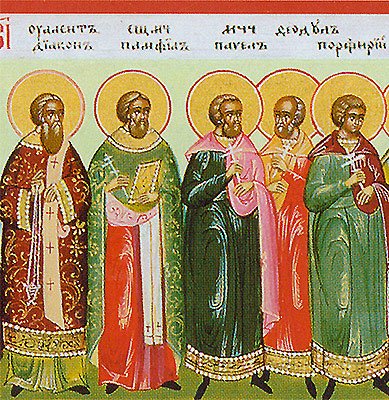
Martyrs Pamphilius the Presbyter, Valens the Deacon, and those with them, at Caesarea in Palestine

Martyrs Pamphilius the Presbyter, Valens the Deacon, and those with them, at Caesarea in Palestine

The Holy Martyrs Pamphίlios the Presbyter, Valens the Deacon, Paul, Porphyrios, Séleukos, Theódoulos, Julian, Samuel, Elias, Daniel, Jeremiah, and Isaiah suffered martyrdom during the reign of Emperor Diocletian (284 – 305) at Caesarea in Palestine. The holy Martyr Pamphίlios, a native of the city of Beirut, was educated at Alexandria, after which he was ordained as a priest at Caesarea. He de The Holy Martyrs Pamphίlios the Presbyter, Valens the Deacon, Paul, Porphyrios, Séleukos, Theódoulos, Julian, Samuel, Elias, Daniel, Jeremiah, and Isaiah suffered martyrdom during the reign of Emperor Diocletian (284 – 305) at Caesarea in Palestine. The holy Martyr Pamphίlios, a native of the city of Beirut, was educated at Alexandria, after which he was ordained as a priest at Caesarea. He devoted much labor to collating manuscripts and correcting the copyists' errors in the manuscripts of the New Testament. These texts were copied and distributed to anyone who wanted them. Thus, many pagans were converted to Christ by them. His works were gathered into the extensive library of spiritual books available for the enlightenment of Christians. Saint Jerome (IV-V century) had deep respect for Saint Pamphίlios and considered himself fortunate to have located and acquired several of his manuscripts. Actively assisting Saint Pamphίlios in proclaiming the faith in Christ were Saint Valens, a Deacon of the Church, and Elias, a man stooped with age and well-versed in the Holy Scriptures, and Saint Paul, ardent in his faith and love for Christ the Savior. All three were imprisoned for two years by Urban, the governor of Palestinian Caesarea. During the rule of his successor Firmilian, 130 Christians were sentenced in Egypt and sent to Cilicia (Asia Minor) to work in the gold mines. Five young brothers accompanied them to the place of exile. On their return to Egypt they were detained at Caesarea and thrown into prison for confessing Christ. These young men appeared before Firmilian, together with those previously imprisoned incarcerated: Saints Pamphίlios, Valens and Paul. The five Egyptian youths took the names of Old Testament Prophets, Elias, Jeremiah, Isaiah, Samuel, and Daniel. Asked where they were from, the youths said that they were citizens of Jerusalem, meaning the heavenly Jerusalem. Firmilian knew nothing of such a city, since Jerusalem had been razed to the ground by Emperor Titus in the year 70. Emperor Hadrian (117-138) built a new city on the site, which was called Aelia Capitolina. Firmilian tortured the youths for a long time, trying to learn the location of this unknown city, and he tried to persuade them to apostatize. Accomplishing nothing, the governor sentenced them to be beheaded with a sword, along with Pamphίlios, Valens, and Paul. Before this took place, one of Pamphilios' servants endured suffering. This was the eighteen-year-old youth Porphyrios, who was meek and humble. He had heard the death sentence for the condemned martyrs, and asked the governor for permission to bury the bodies after their execution. Because of this he was also sentenced to death, and was thrown into a fire. A pious Christian named Séleukos, a former soldier, praised the deeds of the Martyrs. He went to Pamphίlios and told him of the martyric death of Saint Porphyrios. He was arrested by soldiers and, on Firmilian’s orders, he was beheaded with a sword, together with the others. One of the governor’s servants, Theódoulos, was a man of venerable age, and a secret Christian. He met the Martyrs as they were being led to execution. He embraced them and asked them to pray for him. Soldiers brought him before Firmilian, at whose orders he was crucified. The young Julian, a native of Cappadocia who had come to Caesarea, saw the bodies of the Saints which had been thrown to wild beasts without burial. Julian knelt down and venerated the bodies of the sufferers. Soldiers apprehended him and took him to the governor, who condemned him to be burnt alive. The bodies of all twelve Martyrs remained unburied for four days, but neither beasts nor birds would touch them. Embarrassed by this situation, the pagans permitted the Christians to take the bodies of the martyrs and bury them. Although these twelve Martyrs came from various places, they were also united by their love for Christ, and from Him they received unfading crowns of glory.

Troparion - Tone 4

Your holy martyrs, Pamphilius and his companions, O Lord, / through their sufferings have received incorruptible crowns from You, our God. / For having Your strength, they laid low their adversaries, / and shattered the powerless boldness of demons. / Through their intercessions, save our souls!

Kontakion - Tone 4

Faced with terrible sufferings, / the fearless athletes of the Lord rejoiced; / they conversed with one another ignoring the flesh. / Therefore, they have inherited eternal glory, / ever praying for us who praise their struggles.
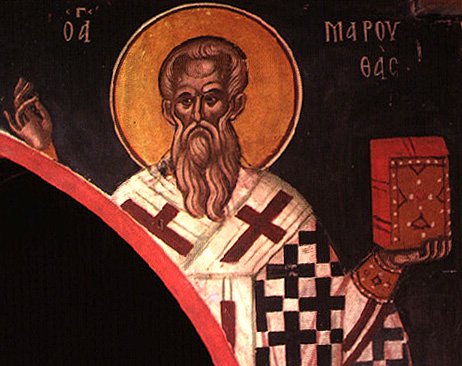
Saint Maruthas, Bishop of Martyropolis in Mesopotamia

Saint Maruthas, Bishop of Martyropolis in Mesopotamia

Saint Maruthas was Bishop of Tagrith (Martyropolis), a city which he founded between the Byzantine Empire and Persia. He was famed for his knowledge and his piety, he wrote about the martyrs, and he suffered for his faith in Christ under the Persian emperor Sapor. He also left behind other works in the Syrian language, among which the most famous are: “Commentary on the Gospel,” “Verses of Maruthas,” “Liturgy of Maruthas” and “The 73 Canons of the Ecumenical Council at Nicea” (325) with an account of the acts of the Council. In the year 38 Saint Maruthas was Bishop of Tagrith (Martyropolis), a city which he founded between the Byzantine Empire and Persia. He was famed for his knowledge and his piety, he wrote about the martyrs, and he suffered for his faith in Christ under the Persian emperor Sapor. He also left behind other works in the Syrian language, among which the most famous are: “Commentary on the Gospel,” “Verses of Maruthas,” “Liturgy of Maruthas” and “The 73 Canons of the Ecumenical Council at Nicea” (325) with an account of the acts of the Council. In the year 381 Saint Maruthas participated in the Second Ecumenical Council at Constantinople, convened against the heresy of Macedonius. In 383, he attended the Council of Antioch against the Messalians. During the years 403-404 Saint Maruthas set off to Constantinople to plead with the emperor Arcadius to protect Persian Christians. He was twice sent by the emperor Theodosius the Younger to the Shah Izdegerd to secure the peace between the Empire and Persia. In the year 414 Saint Maruthas, having done his duty as envoy to the court of Izdegerd, persuaded the Shah to a favorable disposition towards Christians, and he assisted greatly in the freedom of Christians in Persia. He rebuilt Christian churches razed during the persecution by the Persian ruler Sapor. He also located relics of saints who had suffered martyrdom and transferred them to Martyropolis. He died there in 422. The relics of Saint Maruthas were later transferred to Egypt and placed in a skete monastery of the Mother of God.

Troparion - Tone 4

In truth you were revealed to your flock as a rule of faith, / an image of humility and a teacher of abstinence; / your humility exalted you; / your poverty enriched you. / Hierarch Father Maruthas, / entreat Christ our God / that our souls may be saved.

Persian Martyrs in Martyropolis in Mesopotamia

No information available at this time.

Troparion - Tone 4

Your holy martyrs O Lord, / through their sufferings have received incorruptible crowns from You, our God. / For having Your strength, they laid low their adversaries, / and shattered the powerless boldness of demons. / Through their intercessions, save our souls!

Saint Flavian, Archbishop of Antioch

Saint Flavian, Archbishop of Antioch, was a contemporary of Saint John Chrysostom. He attempted to obtain from the emperor Theodosius (379-395) a pardon for the citizens of Antioch, who had angered the emperor by destroying his statue. Saint Flavian’s death was peaceful and without illness. He is also commemorated on September 27.

Troparion - Tone 4

In truth you were revealed to your flock as a rule of faith, / an image of humility and a teacher of abstinence; / your humility exalted you; / your poverty enriched you. / Hierarch Father Flavian, / entreat Christ our God / that our souls may be saved.

New Martyr Elias

The Holy New Martyr Elias (Nikolayevich) was born in a Moscow village in the XIX century. He studied at the Moscow Theological Academy and married a devout woman named Eugenia. Then he was then ordained as a priest and served in the small church of a poorhouse, and in the parish of Saint Nicholas Tolmachev in Moscow, before the October revolution of 1917 broke out. The Holy New Martyr Elias (Nikolayevich) was born in a Moscow village in the XIX century. He studied at the Moscow Theological Academy and married a devout woman named Eugenia. Then he was then ordained as a priest and served in the small church of a poorhouse, and in the parish of Saint Nicholas Tolmachev in Moscow, before the October revolution of 1917 broke out. Saint Elias was a most pious priest. His church was a beacon of spiritual light for many believers. He was married, but he lived an ascetical life. In 1932 the Soviet secret police arrested and imprisoned him. He was exiled to the Krasnaya Visera River region. Matushka Eugenia spent the entire night in prayer and tears. But in the morning she fell asleep and then she saw the Theotokos in a dream, who told her not to be afraid. Two years later, Matushka Eugenia visited him at his place of exile and brought him a Gospel and a small vial of holy water. The guards confiscated the Gospel. When they asked her what was in the vial, she replied that for them it was plain water, but for herself and her husband it was sacred, their medicine. The Saint looked as if he had been tortured. They did not allow him to serve, and this caused him immeasurable grief. He began to tell Eugenia of his martyrdom. When they brought him and many others to the place of exile, they were forced to walk on the surface of the melting snow. The thin layer of ice was breaking up beneath their feet and the "convicts" were sinking in the snow up to the waist. Wet to the bone, with nothing to eat or drink all day, they were forced to spend the night inside a hut. The exhausted men immediately fell to the floor and fell asleep as if dead. Only the Saint stayed awake. Around midnight he cried from the depths of his heart: "Lord, why have you forsaken me? I have served you so faithfully. I devoted my entire life to You. How many times have I read the Akathist Hymn and the Canons? I served in the church with reverence. Why, O Lord, have You forsaken me, and why do I suffer so much? O Most Holy Theotokos, Holy Hierarch Nicholas, Holy Father Seraphim, and all the Saints of God! After all my prayers to you, why am I tormented so much?" Suddenly a divine visitation, like a flame, touched his aching soul and flooded it with otherworldly consolation. The light of faith secretly illumined his heart and ignited in him an inexpressible and irresistible love for Christ, which, as the Apostle Paul says, "he heard unspeakable words which no man may utter." 1 When dawn came, he was a young man, born again as if he had been baptized in fire. As he bade farewell to Matushka Eugenia, the Saint said to her: "You know, my heart is ablaze for Christ. I think I came here to understand that there is absolutely nothing better, nothing more wonderful than He. I wish to die for Him!" When Matushka arrived back in Moscow, she learned that there had been a fire in the concentration camp and that Saint Elias was burned along with eleven other Christians.

Scripture Readings

Epistle

3 John 1:1-15

1 The elder unto the wellbeloved Gaius, whom I love in the truth.
2 Beloved, I wish above all things that thou mayest prosper and be in health, even as thy soul prospereth.
3 For I rejoiced greatly, when the brethren came and testified of the truth that is in thee, even as thou walkest in the truth.
4 I have no greater joy than to hear that my children walk in truth.
5 Beloved, thou doest faithfully whatsoever thou doest to the brethren, and to strangers;
6 Which have borne witness of thy charity before the church: whom if thou bring forward on their journey after a godly sort, thou shalt do well:
7 Because that for his name’s sake they went forth, taking nothing of the Gentiles.
8 We therefore ought to receive such, that we might be fellowhelpers to the truth.
9 I wrote unto the church: but Diotrephes, who loveth to have the preeminence among them, receiveth us not.
10 Wherefore, if I come, I will remember his deeds which he doeth, prating against us with malicious words: and not content therewith, neither doth he himself receive the brethren, and forbiddeth them that would, and casteth them out of the church.
11 Beloved, follow not that which is evil, but that which is good. He that doeth good is of God: but he that doeth evil hath not seen God.
12 Demetrius hath good report of all men, and of the truth itself: yea, and we also bear record; and ye know that our record is true.
13 I had many things to write, but I will not with ink and pen write unto thee:
14 But I trust I shall shortly see thee, and we shall speak face to face. Peace be to thee. Our friends salute thee. Greet the friends by name.

Gospel

Luke 19:29-40, 22:7-39

29 And it came to pass, when he was come nigh to Bethphage and Bethany, at the mount called the mount of Olives, he sent two of his disciples,
30 Saying, Go ye into the village over against you; in the which at your entering ye shall find a colt tied, whereon yet never man sat: loose him, and bring him hither.
31 And if any man ask you, Why do ye loose him? thus shall ye say unto him, Because the Lord hath need of him.
32 And they that were sent went their way, and found even as he had said unto them.
33 And as they were loosing the colt, the owners thereof said unto them, Why loose ye the colt?
34 And they said, The Lord hath need of him.
35 And they brought him to Jesus: and they cast their garments upon the colt, and they set Jesus thereon.
36 And as he went, they spread their clothes in the way.
37 And when he was come nigh, even now at the descent of the mount of Olives, the whole multitude of the disciples began to rejoice and praise God with a loud voice for all the mighty works that they had seen;
38 Saying, Blessed be the King that cometh in the name of the Lord: peace in heaven, and glory in the highest.
39 And some of the Pharisees from among the multitude said unto him, Master, rebuke thy disciples.
40 And he answered and said unto them, I tell you that, if these should hold their peace, the stones would immediately cry out.
7 Then came the day of unleavened bread, when the passover must be killed.
8 And he sent Peter and John, saying, Go and prepare us the passover, that we may eat.
9 And they said unto him, Where wilt thou that we prepare?
10 And he said unto them, Behold, when ye are entered into the city, there shall a man meet you, bearing a pitcher of water; follow him into the house where he entereth in.
11 And ye shall say unto the goodman of the house, The Master saith unto thee, Where is the guestchamber, where I shall eat the passover with my disciples?
12 And he shall shew you a large upper room furnished: there make ready.
13 And they went, and found as he had said unto them: and they made ready the passover.
14 And when the hour was come, he sat down, and the twelve apostles with him.
15 And he said unto them, With desire I have desired to eat this passover with you before I suffer:
16 For I say unto you, I will not any more eat thereof, until it be fulfilled in the kingdom of God.
17 And he took the cup, and gave thanks, and said, Take this, and divide it among yourselves:
18 For I say unto you, I will not drink of the fruit of the vine, until the kingdom of God shall come.
19 And he took bread, and gave thanks, and brake it, and gave unto them, saying, This is my body which is given for you: this do in remembrance of me.
20 Likewise also the cup after supper, saying, This cup is the new testament in my blood, which is shed for you.
21 But, behold, the hand of him that betrayeth me is with me on the table.
22 And truly the Son of man goeth, as it was determined: but woe unto that man by whom he is betrayed!
23 And they began to enquire among themselves, which of them it was that should do this thing.
24 And there was also a strife among them, which of them should be accounted the greatest.
25 And he said unto them, The kings of the Gentiles exercise lordship over them; and they that exercise authority upon them are called benefactors.
26 But ye shall not be so: but he that is greatest among you, let him be as the younger; and he that is chief, as he that doth serve.
27 For whether is greater, he that sitteth at meat, or he that serveth? is not he that sitteth at meat? but I am among you as he that serveth.
28 Ye are they which have continued with me in my temptations.
29 And I appoint unto you a kingdom, as my Father hath appointed unto me;
30 That ye may eat and drink at my table in my kingdom, and sit on thrones judging the twelve tribes of Israel.
31 And the Lord said, Simon, Simon, behold, Satan hath desired to have you, that he may sift you as wheat:
32 But I have prayed for thee, that thy faith fail not: and when thou art converted, strengthen thy brethren.
33 And he said unto him, Lord, I am ready to go with thee, both into prison, and to death.
34 And he said, I tell thee, Peter, the cock shall not crow this day, before that thou shalt thrice deny that thou knowest me.
35 And he said unto them, When I sent you without purse, and scrip, and shoes, lacked ye any thing? And they said, Nothing.
36 Then said he unto them, But now, he that hath a purse, let him take it, and likewise his scrip: and he that hath no sword, let him sell his garment, and buy one.
37 For I say unto you, that this that is written must yet be accomplished in me, And he was reckoned among the transgressors: for the things concerning me have an end.
38 And they said, Lord, behold, here are two swords. And he said unto them, It is enough.
39 And he came out, and went, as he was wont, to the mount of Olives; and his disciples also followed him.
Liturgical data sourced from OCA.org and orthocal.info