Today

Fasting Rules

Meat not allowed Meat Abstain
Fish not allowed Fish Abstain
Dairy not allowed Dairy Abstain
Oil not allowed Oil Abstain
Wine not allowed Wine Abstain

☦ Saints & Commemorations

St Porphyrius, Bishop of Gaza
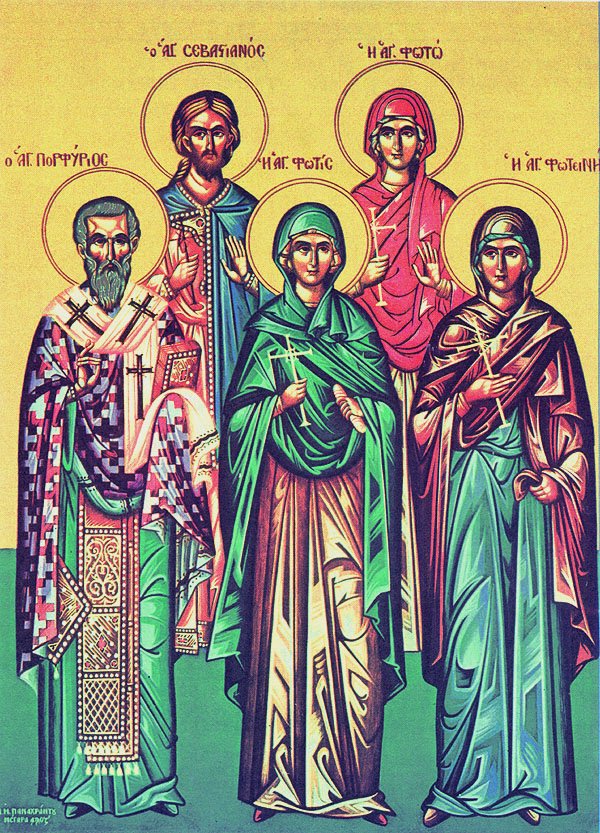
He was born to a wealthy, noble family in Thessalonica around 347. Filled more and more with a yearning for God, he abandoned his worldly possessions and traveled to Egypt, living for five years as a monk at Sketis. From there he went to Palestine, where he lived for another five years in a cave in the Jordan desert. He was born to a wealthy, noble family in Thessalonica around 347. Filled more and more with a yearning for God, he abandoned his worldly possessions and traveled to Egypt, living for five years as a monk at Sketis. From there he went to Palestine, where he lived for another five years in a cave in the Jordan desert. Suffering from a severe ailment, he was forced to move to Jerusalem; there he was suddenly and completely cured following a vision on Golgotha, in which he saw the Good Thief come down from the cross to lead him to Christ, who gave the Cross into his keeping. Porphyrius took up the trade of a shoemaker in Jerusalem to provide for his few needs. His humility and charity became so well-known that the Bishop of Jerusalem ordained him to the priesthood at the age of forty-five, and made him Stavrophylax, keeper of the True Cross of the Savior — thus fulfilling Porphyrius’ vision on Golgotha. Three years later, much against his will, he was elected Bishop of Gaza. Throughout his episcopate he was persecuted by the pagans who still dominated the life of that city — though he was able to convert many of them by his own example of holiness, and by the many miracles that were wrought through his intercessions. Once, when the city was suffering from a long drought, the Saint gathered the city’s Christians (who numbered no more than 280), told them to fast, and celebrated an all-night vigil. The next morning, as the Bishop and his entire flock went in procession through the city it began to rain. At this, 127 pagans were converted. When the pagans’ violent attacks continued, Porphyrius appealed to the Emperor Arcadius for an edict closing of the pagan temples in Gaza. With the support of St John Chrysostom the edict was issued. When the Imperial representatives entered Gaza, accompanied by Bishop Porphyrius bearing the Cross, the statue of Aphrodite in the city’s main temple shattered into pieces. Eight temples were destroyed, and a Church was built on the site of the largest. Hundreds of pagans embraced the Faith and, after instruction, were baptized by the Saint. After twenty-five years as bishop, during which he had seen his see transformed from a small flock of beleaguered Christians into a Christian territory, Saint Porphyrius reposed in peace in 420.
Saint Porphyrius, Bishop of Gaza

Saint Porphyrius, Bishop of Gaza

He was born to a wealthy, noble family in Thessalonica around 347. Filled more and more with a yearning for God, he abandoned his worldly possessions and traveled to Egypt, living for five years as a monk at Sketis. From there he went to Palestine, where he lived for another five years in a cave in the Jordan desert. He was born to a wealthy, noble family in Thessalonica around 347. Filled more and more with a yearning for God, he abandoned his worldly possessions and traveled to Egypt, living for five years as a monk at Sketis. From there he went to Palestine, where he lived for another five years in a cave in the Jordan desert. Suffering from a severe ailment, he was forced to move to Jerusalem; there he was suddenly and completely cured following a vision on Golgotha, in which he saw the Good Thief come down from the cross to lead him to Christ, who gave the Cross into his keeping. Porphyrius took up the trade of a shoemaker in Jerusalem to provide for his few needs. His humility and charity became so well-known that the Bishop of Jerusalem ordained him to the priesthood at the age of forty-five, and made him Stavrophylax, keeper of the True Cross of the Savior — thus fulfilling Porphyrius’ vision on Golgotha. Three years later, much against his will, he was elected Bishop of Gaza. Throughout his episcopate he was persecuted by the pagans who still dominated the life of that city — though he was able to convert many of them by his own example of holiness, and by the many miracles that were wrought through his intercessions. Once, when the city was suffering from a long drought, the Saint gathered the city’s Christians (who numbered no more than 280), told them to fast, and celebrated an all-night vigil. The next morning, as the Bishop and his entire flock went in procession through the city it began to rain. At this, 127 pagans were converted. When the pagans’ violent attacks continued, Porphyrius appealed to the Emperor Arcadius for an edict closing of the pagan temples in Gaza. With the support of St John Chrysostom the edict was issued. When the Imperial representatives entered Gaza, accompanied by Bishop Porphyrius bearing the Cross, the statue of Aphrodite in the city’s main temple shattered into pieces. Eight temples were destroyed, and a Church was built on the site of the largest. Hundreds of pagans embraced the Faith and, after instruction, were baptized by the Saint. After twenty-five years as bishop, during which he had seen his see transformed from a small flock of beleaguered Christians into a Christian territory, Saint Porphyrius reposed in peace in 420.

Troparion - Tone 4

Who can tell of your labors and illnesses leading to godly devotion, O Father? / For you labored incessantly day and night, cleansing Gaza of its wickedness, / and planting piety; / therefore, as the protector of your flock, O Porphyrios, / entreat Christ God for the salvation of our souls.

Kontakion - Tone 2

Adorned with the royal purple of your virtues, / you were glorious as a hierarch and shone forth resplendently, O wise Porphyrios. / You were excellent in word and deed / strengthening all with the grace of godliness. / Since you always serve Christ, do not cease to pray for the world.

St Photini the Samaritan Woman, and those with her (66)

She was the Samaritan Woman who met Christ at Jacob’s Well (John ch. 4). She repented, and told her townsmen that she had met the Christ, for which she is sometimes called the first to proclaim the Gospel of Christ. She converted her four sisters (Phota, Photis,Parasceva, and Cyriaca), and her sons (Victor and Joses), and all of them became tireless evangelists for Christ. A She was the Samaritan Woman who met Christ at Jacob’s Well (John ch. 4). She repented, and told her townsmen that she had met the Christ, for which she is sometimes called the first to proclaim the Gospel of Christ. She converted her four sisters (Phota, Photis,Parasceva, and Cyriaca), and her sons (Victor and Joses), and all of them became tireless evangelists for Christ. After the martyrdom of the holy Apostles Peter and Paul, she traveled to Carthage to proclaim the Gospel there. She, with her Christian sisters and sons, all met martyrdom under the persecutions of Nero. She is also commemorated on the Sunday of the Samaritan Woman during the Paschal season.

Venerable Sebastian of Poshekhonye

Saint Sebastian of Sokhota, Poshekhonye, founded a monastery in honor of the Transfiguration of the Lord, located at the River Sokhota, 90 versts from the city of Romanov (now Tutaev) in the Yaroslav district. The monks of the monastery themselves cultivated the soil and ate through the work of their own hands. Saint Sebastian of Sokhota, Poshekhonye, founded a monastery in honor of the Transfiguration of the Lord, located at the River Sokhota, 90 versts from the city of Romanov (now Tutaev) in the Yaroslav district. The monks of the monastery themselves cultivated the soil and ate through the work of their own hands. The founder of the monastery taught the ascetics this by his own example and guidance. Saint Sebastian reposed about the year 1500. The Transfiguration monastery on the River Sokhota was later annexed to the Cherepovets Ascension monastery, and in 1764 closed down. In the mid-nineteenth century a stone church was built over the relics of Saint Sebastian. The saint is also commemorated on December 18.

Troparion - Tone 8

By a flood of tears you made the desert fertile, / and your longing for God brought forth fruits in abundance. / By the radiance of miracles you illumined the whole universe! / O our holy father Sebastian, pray to Christ our God to save our souls!

Martyr Christodoulos

Saint Christodoulos was martyred with swords. We have no other details about his life. He is mentioned only in the Synaxaristes of Saint Νikόdēmos of the Holy Mountain.

Troparion - Tone 4

Your holy martyr Christodoulos, O Lord, / through his sufferings has received an incorruptible crown from You, our God. / For having Your strength, he laid low his adversaries, / and shattered the powerless boldness of demons. / Through his intercessions, save our souls!

New Martyr John Kalphes, the Apprentice

The Holy New Martyr John Kalphes (the Apprentice) lived in a suburb of Constantinople, called Galata. He was a cabinetmaker by profession, and he had acquired great skill in his craft, so that important officials made use of his services. He was entrusted with the inner adornment of the sultan’s palace. The Holy New Martyr John Kalphes (the Apprentice) lived in a suburb of Constantinople, called Galata. He was a cabinetmaker by profession, and he had acquired great skill in his craft, so that important officials made use of his services. He was entrusted with the inner adornment of the sultan’s palace. Saint John Kalphes was distinguished for his Christian charity, he provided for orphans and those locked up in prison, and many turned to him for help. One time a certain dignitary asked Saint John to take on his nephew as an apprentice. He agreed, and the youth received an honorable position at court upon the completion of his apprenticeship. Once, encountering his former teacher and benefactor, he asked Saint John what it says in the Christian books about their “prophet” Mohammed. Saint John did not want to answer his question, but because of the persistent demands of the youth, he declared that Mohammed was a mere mortal, an uneducated man who did not perform a single miracle during his lifetime. He went on to say that Mohammed was no prophet, but rather an adversary of God. The youth, devoted to Islam, reported to his fellow Moslems that the cabinetmaker had insulted Mohammed. Saint John was brought to trial, where they demanded that he renounce Christ, but he bravely confessed his faith in Christ. After torture, they sent the holy martyr off to penal servitude, where he spent six months. Then, for the next three months they beat him in the prison. Seeing that they could not coerce him into submitting to their will, they beheaded him in the crowded city square in Ergat-Bazara, near the Bedestan (a covered bazaar) on February 26, 1575. The suffering of the holy Martyr John Kalphes were recorded by Father Andrew, the Chief Steward (Megas Oikonomos) of the Patriarch of Constantinople, who communed him with the Holy Mysteries in prison.

Troparion - Tone 3

Your holy martyr John, O Lord, / through his suffering has received an incorruptible crown from You, our God. / For having Your strength, he laid low his adversaries, / and shattered the powerless boldness of demons. / Through his intercessions, save our souls!

“Mezhetsk” Icon of the Mother of God

The wonderworking Mezhetsk (565F:0O) or Mezhitsk (565BA:0O) Icon of the Mother of God appeared near Kiev in 1492 and became renowned because of the numerous miracles which took place when people prayed before it. We have no other details concerning the Icon. The Mother of God is depicted with a crown on her head and the Child on her left hand.

Scripture Readings

View scripture readings for this date on OCA.org.

View readings on OCA.org

Notes

["Great Canon"]

Liturgical data sourced from OCA.org and orthocal.info