Fasting Rules
 Meat
Abstain
Meat
Abstain
 Fish
Abstain
Fish
Abstain
 Dairy
Abstain
Dairy
Abstain
 Oil
Allowed
Oil
Allowed
 Wine
Allowed
Wine
Allowed
Saints & Commemorations
3rd Sunday of Great Lent: Veneration of the Cross
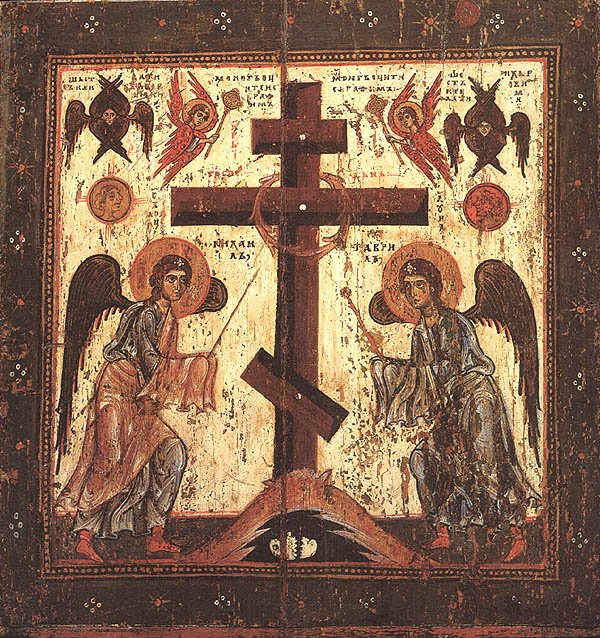
The Third Sunday of Lent is that of the Veneration of the Cross. The cross stands in the midst of the church in the middle of the lenten season not merely to remind men of Christ’s redemption and to keep before them the goal of their efforts, but also to be venerated as that reality by which man must live to be saved. “
The Third Sunday of Lent is that of the Veneration of the Cross. The cross stands in the midst of the church in the middle of the lenten season not merely to remind men of Christ’s redemption and to keep before them the goal of their efforts, but also to be venerated as that reality by which man must live to be saved. “He who does not take up his cross and follow me is not worthy of me” (Mt.10:38). For in the Cross of Christ Crucified lies both “the power of God and the wisdom of God” for those being saved (1 Cor.1:24).
Troparion - Tone 4
O Lord, save Your people, / and bless Your inheritance. / Grant victories to the Orthodox Christians, / over their adversaries. / And by virtue of Your Cross / preserve Your habitation!
Kontakion - Tone 7
Now the flaming sword no longer guards the gates of Eden; / it has mysteriously been quenched by the wood of the Cross! / The sting of death and the victory of hell have been vanquished; / for You, O my Savior, have come and cried to those in hell: / “Enter again into paradise.”
Martyrs Agapius, Publius, Timolaus, Romulus, two named Dionysius, and two named Alexander, at Caesarea in Palestine
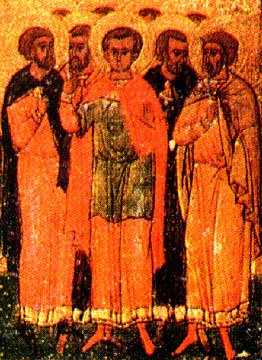
The Holy Martyrs Agapius, Publius (Pausis), Timolaus, Romulus, Alexander, Alexander, Dionysius and Dionysius suffered under the emperor Diocletian (284-305) in the city of Palestinian Caesarea. During one of the pagan festivals they began to torture and execute Christians who refused to offer sacrifice to idols.
The Holy Martyrs Agapius, Publius (Pausis), Timolaus, Romulus, Alexander, Alexander, Dionysius and Dionysius suffered under the emperor Diocletian (284-305) in the city of Palestinian Caesarea. During one of the pagan festivals they began to torture and execute Christians who refused to offer sacrifice to idols.
The Martyr Timolaus (August 19) was sentenced to burning, and the Martyrs Agapius and Thekla (August 19) were sentenced to be torn apart by wild beasts. A group of young Christians: Publius, Timolaus, Alexander, another Alexander, Dionysius, and Romulus, the subdeacon of the Diospolis church decided to confess their faith and suffer for Christ.
As a sign of their voluntary deed they tied their own hands behind their backs and appeared before the governor Urbanus. Seeing their youth, the governor tried to persuade them to reconsider their decision, but in vain. He then threw them in prison, where there were already two Christians, Agapius and his servant Dionysius. All these saints were subjected to terrible tortures and beheaded.
Troparion - Tone 4
Your soul aflame with love for Christ, / you gathered a company of illustrious athletes, O glorious Agapius. / With them you excelled in righteous contest, / and together you were beheaded by the sword. / Henceforth always pray for the forgiveness of our sins!
Kontakion - Tone 4
Out of love for Christ / the eight-fold choir of martyrs spurned all earthly things. / As they were beheaded / they cried out together: / O compassionate One, give joy to your servants!
Hieromartyr Alexander of Sίdē, in Pamphylia
The Hieromartyr Alexander was a priest from Sίdē in Pamphylia. He suffered for Christ during a time of persecution in the reign of Emperor Aurelian (270-275). When the ruler Antoninus arrived at Sίdē he ordered Father Alexander to be brought before him for interrogation. He began by asking him, "Who are you?"
The Saint replied, "I am a Christian, a priest, a shepherd of Christ's rational flock."
Antoninus continued, "Where is this flock of Christ?"
The Saint replied, "Christ God created all the people who live in the world; those who believe in Him are the sheep of His flock. Tho
The Hieromartyr Alexander was a priest from Sίdē in Pamphylia. He suffered for Christ during a time of persecution in the reign of Emperor Aurelian (270-275). When the ruler Antoninus arrived at Sίdē he ordered Father Alexander to be brought before him for interrogation. He began by asking him, "Who are you?"
The Saint replied, "I am a Christian, a priest, a shepherd of Christ's rational flock."
Antoninus continued, "Where is this flock of Christ?"
The Saint replied, "Christ God created all the people who live in the world; those who believe in Him are the sheep of His flock. Those who have fallen away from their Creator, those such as yourself, who worship idols, which are fashioned by human hands, may not belong to His holy flock. At the Last Judgment, they will be placed on His left side, along with the goats."
The ruler said to him, "Now I am going to torture you for two reasons; first, so that you will show me where to find those who believe in Christ and secondly, so that you can offer sacrifices to our gods."
Again, Antoninus asked Father Alexander, "Who was Christ?"
The Saint replied, "Christ is the Savior of the world, He is Life and Light for those who believe in Him."
Antoninus said: "How can this man who died on a cross be a Savior?"
Saint Alexander declared, "It is indeed marvelous and surprising that He took upon Himself the Cross and death in the flesh of His own will, His Divinity shattered the power of Hades, and released those who were held captive there. He put Death to death, and rose from the dead. Not only did He arise from the dead Himself, He also raised many of the dead with Himself: 'the tombs were opened, and many bodies of the saints who had fallen asleep were raised, and coming out of the tombs after His Resurrection, they went into the holy city and appeared to many' (Matthew 27:52-53). With Himself, Christ has resurrected the entire human race."
Antoninus exclaimed, "Are you mad? How could a tormented Jew, who was unable to help Himself, possibly help others?"
The Saint replied, "It is not I, but you yourself who are mad. You are spiritually blind, therefore you do not understand the mystery of our salvation, accomplished by Christ the Lord."
Then the ruler ordered that Saint Alexander be tortured. He was beaten, tormented on a wheel, and plunged into a vessel of boiling resin and oil, then he was placed in a fiery furnace. By the grace of God, the Saint was preserved unharmed. When he was thrown into the furnace, the wicked tormentors saw in the flames two young men with handsome faces, praising God along with the Holy Martyr. These were Angels, who cooled the flames of the furnace. The people marveled, for they knew that only one man had entered the furnace, and now there were three.
Antoninus, and those who were with him, regarded all these glorious miracles as magic, because they did not believe in the omnipotent power of Christ God. One of the ruler's servants believed in Christ and fell to the ground before the Saint, begging him to take him along with him to be with Christ. Immediately, the tyrant killed his servant with his sword.
When Saint Alexander emerged from the furnace unscathed, Antoninus ordered that he be hanged, and stabbed with sharp iron needles. The Saint was tortured until his body became one large wound. Those who tortured the Saint marveled at his steadfastness, saying, "How can this man endure such torment? His bones have already been exposed."
Afterward, the Saint was tormented in the fire for a second time, but did not suffer any harm from it. Then his body was stabbed with iron needles and his intestines fell out. Then Saint Alexander was thrown to the wild animals to be devoured, but the beasts did not touch him. This sufferer for Christ endured many other bitter torments, but he remained firm and courageous through all of them. Those who witnessed his suffering were astonished by the power of his patience, which surpassed all human understanding. Finally, the Hieromartyr Alexander was beheaded with a sword.
Just as Antoninus left his judgment seat, he was attacked by the demons he had served. His servants carried him to his home, weeping and sobbing all the way. They did not have time to bring him into the house, however, for he had breathed forth his vile soul.
Saint Alexander was taken to the heavenly abodes to dwell with Christ, His Saints, and His Holy Angels. As for Antoninus, he was cast "into the eternal fire prepared for the devil and his angels" (Matthew 25:41).
After the beheading of Saint Alexander, Eustáthios, an honest man, and a Christian, took the much-suffering body of the Holy Martyr and buried him with honor, glorifyng and praising Christ God.
Troparion - Tone 4
By sharing in the ways of the Apostles, / you became a successor to their throne. / Through the practice of virtue, you found the way to divine contemplation, O inspired one of God; / by teaching the word of truth without error, you defended the Faith, / even to the shedding of your blood. / Hieromartyr Alexander, entreat Christ God to save our souls.
Martyr Nicander of Egypt
The Holy Martyr Nicander suffered in Egypt under the emperor Diocletian (284-305). He was a physician and during a time of persecution he visited Christians in prison. He assisted them, brought them food, and buried the dead.
Once, he came to the place where the bodies of the martyrs were thrown to be eaten by wild beasts.
The Holy Martyr Nicander suffered in Egypt under the emperor Diocletian (284-305). He was a physician and during a time of persecution he visited Christians in prison. He assisted them, brought them food, and buried the dead.
Once, he came to the place where the bodies of the martyrs were thrown to be eaten by wild beasts. Fearing to bury them by day, he waited for night and buried the bodies under cover of darkness. They discovered Saint Nicander and subjected him to terrible tortures: they skinned him alive and then beheaded him in 302.
Troparion - Tone 4
Your holy martyr Nicander, O Lord, / through his sufferings has received an incorruptible crown from You, our God. / For having Your strength, he laid low his adversaries, / and shattered the powerless boldness of demons. / Through his intercessions, save our souls!
Scripture Readings
☩Epistle
Hebrews 4:14-5:6
14
Seeing then that we have a great high priest, that is passed into the heavens, Jesus the Son of God, let us hold fast our profession.
15
For we have not an high priest which cannot be touched with the feeling of our infirmities; but was in all points tempted like as we are, yet without sin.
16
Let us therefore come boldly unto the throne of grace, that we may obtain mercy, and find grace to help in time of need.
1
For every high priest taken from among men is ordained for men in things pertaining to God, that he may offer both gifts and sacrifices for sins:
2
Who can have compassion on the ignorant, and on them that are out of the way; for that he himself also is compassed with infirmity.
3
And by reason hereof he ought, as for the people, so also for himself, to offer for sins.
4
And no man taketh this honour unto himself, but he that is called of God, as was Aaron.
5
So also Christ glorified not himself to be made an high priest; but he that said unto him, Thou art my Son, to day have I begotten thee.
6
As he saith also in another place, Thou art a priest for ever after the order of Melchisedec.
☩Gospel
Mark 8:34-9:1
34
And when he had called the people unto him with his disciples also, he said unto them, Whosoever will come after me, let him deny himself, and take up his cross, and follow me.
35
For whosoever will save his life shall lose it; but whosoever shall lose his life for my sake and the gospel’s, the same shall save it.
36
For what shall it profit a man, if he shall gain the whole world, and lose his own soul?
37
Or what shall a man give in exchange for his soul?
38
Whosoever therefore shall be ashamed of me and of my words in this adulterous and sinful generation; of him also shall the Son of man be ashamed, when he cometh in the glory of his Father with the holy angels.
1
And he said unto them, Verily I say unto you, That there be some of them that stand here, which shall not taste of death, till they have seen the kingdom of God come with power.
Liturgical data sourced from OCA.org and orthocal.info