Fasting Rules
 Meat
Abstain
Meat
Abstain
 Fish
Abstain
Fish
Abstain
 Dairy
Abstain
Dairy
Abstain
 Oil
Abstain
Oil
Abstain
 Wine
Abstain
Wine
Abstain
Saints & Commemorations
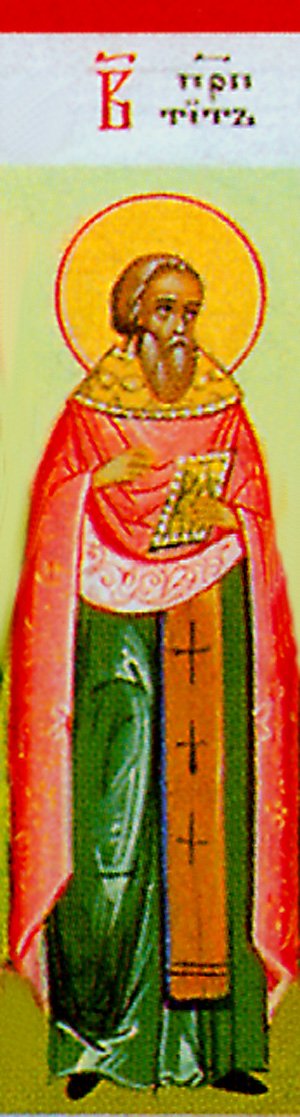
Venerable Titus the Wonderworker
From his youth Saint Titus the Wonderworker displayed zeal for the monastic life. He labored in asceticism in the IX century at the Studion Monastery near Constantinople. By his fasting, and meek disposition, Saint Titus gained the love of the brethren, and at their request he was ordained as a Hieromonk.
From his youth Saint Titus the Wonderworker displayed zeal for the monastic life. He labored in asceticism in the IX century at the Studion Monastery near Constantinople. By his fasting, and meek disposition, Saint Titus gained the love of the brethren, and at their request he was ordained as a Hieromonk.
His soul was filled with fervent love for God and for his neighbor. As the Lord had said to His disciples, "My food is to do the will of him who sent me, and to accomplish his work" (John 4:34). So it was with Saint Titus. His food was to do the will of the heavenly Father in every way, and to utilize his life for the moral and spiritual building of his brethren (I Corinthians 3:9). Because of the purity of his soul and his virtuous life, God rewarded him with the gift of working miracles. Thus, he became the Spiritual Father of many laymen and monks who received benefit from his advice.
Saint Titus defended the Orthodox veneration of the Holy Icons during the Iconoclastic persecution, remaining steadfast in the Faith until the end of his life, then he departed to the Lord.
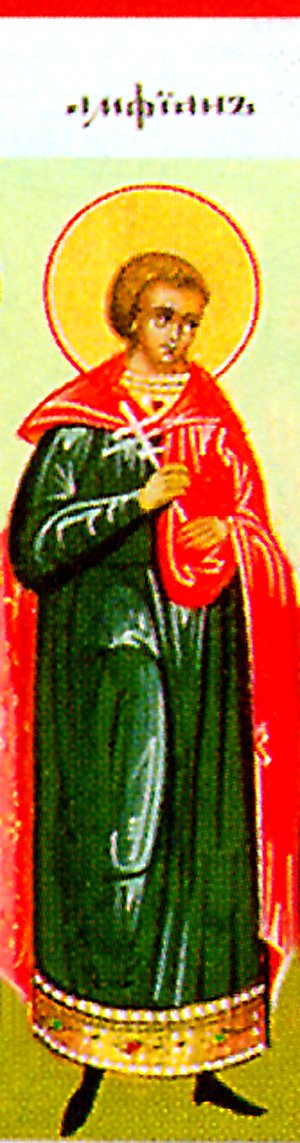
Martyrs Amphianus and Edesius of Lycia
The Holy Martyrs Amphianus (Apphianus) and Edesius (Aidesius) were brothers. They lived in the city of Patara (province of Lycia) in the family of the pagan governor. They went to the city of Beirut to study the pagan sciences. There they became ardent followers of Christ.
The holy brothers left their pagan parents and went to Alexandrian Caesarea, where they found an instructor, Saint Pamphilius (February 16), and under his guidance they became accomplished in the spiritual life, spending their time in prayer and the study of sacred books.
The Holy Martyrs Amphianus (Apphianus) and Edesius (Aidesius) were brothers. They lived in the city of Patara (province of Lycia) in the family of the pagan governor. They went to the city of Beirut to study the pagan sciences. There they became ardent followers of Christ.
The holy brothers left their pagan parents and went to Alexandrian Caesarea, where they found an instructor, Saint Pamphilius (February 16), and under his guidance they became accomplished in the spiritual life, spending their time in prayer and the study of sacred books.
By decree of the emperor Maximian (305-313), a zealous pagan and cruel persecutor of Christians, all the inhabitants of Caesarea were required to offer public sacrifice. Many Christians, including Saints Amphianus and Edesius, had to hide in order to avoid sacrificing to idols.
When the city prefect of Caesarea was about to offer sacrifice to idols, Saint Amphianus boldly went into the temple, took the prefect’s hand, and urged him to abandon his error and believe in Christ.
By order of the governor, soldiers seized Saint Amphianus, fiercely beat him and then threw him in prison. Two days later they led him to trial, where they beat him with iron rods and burned his body with bundles of flax soaked in oil.
The brave youth, steadfastly confessing his faith in Christ, was then thrown into the sea with a stone about his neck. Suddenly a storm arose, and the waves carried the martyr’s body to shore, where it was buried by Christians.
After a while they freed Saint Edesius and sent him to Alexandria. There he boldly denounced the governor Hierokles for his extreme cruelty towards Christians. Saint Edesius was tortured and then drowned.
Troparion - Tone 4
Your holy martyrs Amphianus and Edesius, O Lord, / through their sufferings have received incorruptible crowns from You, our God. / For having Your strength, they laid low their adversaries, / and shattered the powerless boldness of demons. / Through their intercessions, save our souls!
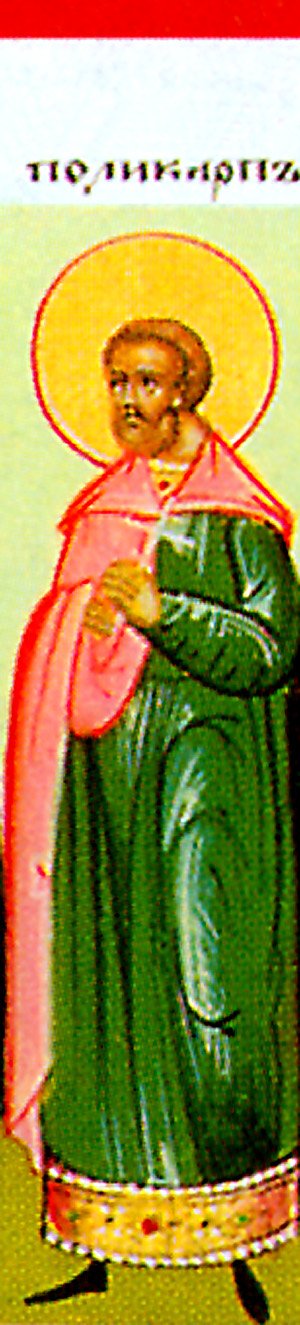
Martyr Polycarp of Alexandria
The Holy Martyr Polycarp was killed after he denounced the impious Emperor Maximian (305-313) for shedding the blood of innocent Christians in the city of Alexandria. As a devout Christian who was filled with zeal for God, he could not simply stand by when every day he saw many of the faithful being tortured because they refused to deny Christ.
The Holy Martyr Polycarp was killed after he denounced the impious Emperor Maximian (305-313) for shedding the blood of innocent Christians in the city of Alexandria. As a devout Christian who was filled with zeal for God, he could not simply stand by when every day he saw many of the faithful being tortured because they refused to deny Christ.
One day Saint Polycarp saw the ruler sitting in his chair and watching as the blood of Christians flowed like water. The Saint stood before him and questioned him saying, "Why have you so forgotten human nature, you insatiable dog, that you cut down your relatives and fellow countrymen with swords like wood, because they proclaim the one true God and refute the error of idolatry; just as I do, who am a servant of Christ?"
Because he angered the ruler by saying such things, Saint Polycarp was arrested and tortured. Finally, he was beheaded, dying with the name of Christ on his lips. By being cut down like a vine-branch, he offered much fruit to Christ, and received the crown of martyrdom.
Troparion - Tone 3
Your holy martyr Polycarp, O Lord, / through his suffering has received an incorruptible crown from You, our God. / For having Your strength, he laid low his adversaries, / and shattered the powerless boldness of demons. / Through his intercessions, save our souls!
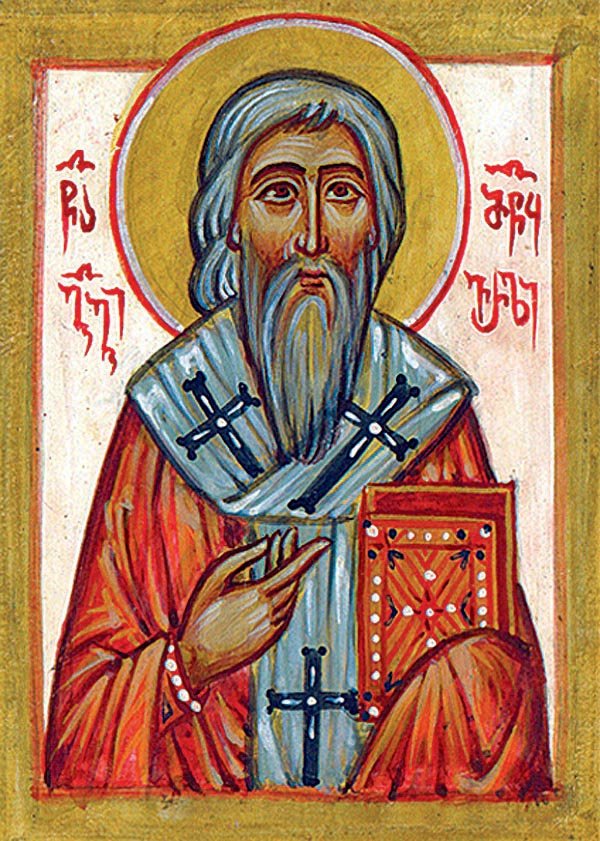
Saint George Matskevereli of Georgia
A few biographical details about Saint George of Atsquri have been preserved in the writings of the famous 10th-century Georgian hagiographers George Merchule and Basil of Zarzma.
Saint George of Atsquri lived at the end of the 9th and the beginning of the 10th centuries. A member of the aristocratic and pious Shuartqeli family, Saint George was raised and educated in the environs of Georgia’s renowned Opiza Monastery in Klarjeti.
A few biographical details about Saint George of Atsquri have been preserved in the writings of the famous 10th-century Georgian hagiographers George Merchule and Basil of Zarzma.
Saint George of Atsquri lived at the end of the 9th and the beginning of the 10th centuries. A member of the aristocratic and pious Shuartqeli family, Saint George was raised and educated in the environs of Georgia’s renowned Opiza Monastery in Klarjeti.
Four years after the death of the great feudal lord George Chorchaneli, Saint George succeeded him as ruler of the Samtskhe region. At that time a bitter conflict arose over who was the rightful heir to Chorchaneli’s inheritance.
While serving as the chief political leader of Samtskhe, Saint George also directed the region’s spiritual life, wisely administering the ancient Atsquri diocese for many years. According to tradition, the diocese of Atsquri was founded by the holy Apostle Andrew the First-called, who left there the “Not-Made-By-Hands” icon of the Most Holy Theotokos (known as the Atsquri Icon of the Mother of God) as an offering to the Georgian Church.
Though his literary works have not been preserved, Saint George is also commemorated as a great writer of the Church.
In his book The Life of Saint Grigol of Khandzta , Saint George Merchule notes that Saint George of Atsquri made some of the most significant contributions to the biographical writings on Saint Grigol of Khandzta. Saint George of Atsquri was a close companion of Saint Serapion of Zarzma. He was present at his burial and contributed much to the hagiographical writings on his life and works.
Troparion - Tone 4
In truth you were revealed to your flock as a rule of faith, / an image of humility and a teacher of abstinence; / your humility exalted you; / your poverty enriched you. / Hierarch Father George, / entreat Christ our God / that our souls may be saved.
Virgin Martyr Theodora of Tyre
Saint Theodora came from Tyre in Phoenicia. When she was seventeen years of age, she was brought before Urban, the ruler of Palestine, who asked her if she really believed in Christ. With remarkable courage, the holy virgin confessed that she truly believed. Then they flayed her sides and her breasts.
Saint Theodora came from Tyre in Phoenicia. When she was seventeen years of age, she was brought before Urban, the ruler of Palestine, who asked her if she really believed in Christ. With remarkable courage, the holy virgin confessed that she truly believed. Then they flayed her sides and her breasts. Afterward, they threw her into the sea, where she surrendered her soul to God, thereby receiving a martyr's crown.
Saint Νikόdēmos of the Holy Mountain thought it very likely that this Saint is the same as Saint Theodosia (May 29), because their Lives are almost identical.
Scripture Readings
View scripture readings for this date on OCA.org.
View readings on OCA.orgLiturgical data sourced from OCA.org and orthocal.info