Fasting Rules

Meat not allowed Meat Abstain
Fish not allowed Fish Abstain
Dairy not allowed Dairy Abstain
Oil not allowed Oil Abstain
Wine not allowed Wine Abstain

Saints & Commemorations

Great and Holy Wednesday

Great and Holy Wednesday

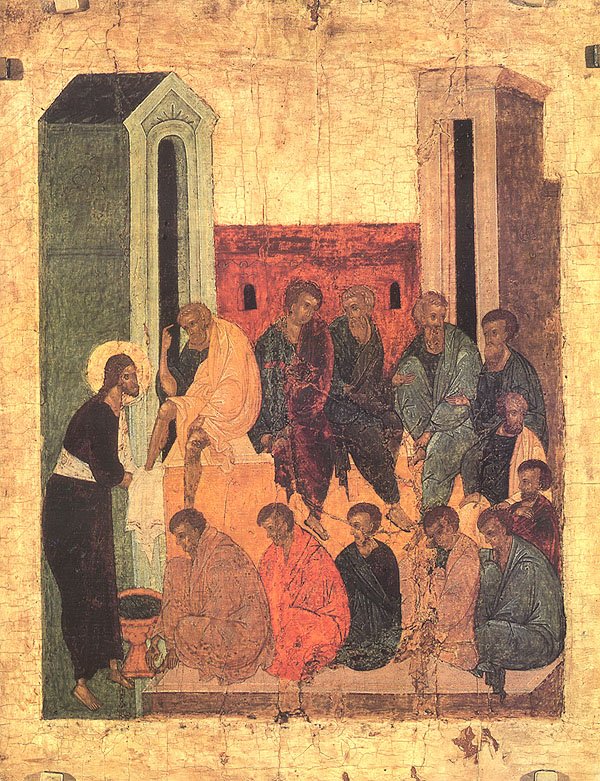
On Great and Holy Wednesday, the hymns of the Bridegroom Service remind us of the sinful woman who poured precious ointment on Christ’s head at Simon the leper’s house (Mt. 26:7). The disciples complained about the wasteful extravagance, for the myrrh could have been sold and the money given to the poor. On On Great and Holy Wednesday, the hymns of the Bridegroom Service remind us of the sinful woman who poured precious ointment on Christ’s head at Simon the leper’s house (Mt. 26:7). The disciples complained about the wasteful extravagance, for the myrrh could have been sold and the money given to the poor. On this same day Judas agreed to betray the Lord for thirty pieces of silver. Because the betrayal took place on Wednesday, Orthodox Christians fast on most Wednesdays during the year. On the other hand, the Savior declared that the woman’s actions would be remembered wherever the Gospel is preached (Mt. 26:13), for she had anointed Him in preparation for His burial (Mt. 26:12).

Troparion - Tone 8

Behold the Bridegroom comes at midnight, / and blessed is the servant whom He shall find watching, / and again unworthy is the servant whom He shall find heedless. / Beware, therefore, O my soul, do not be weighed down with sleep, / lest you be given up to death and lest you be shut out of the Kingdom. / But rouse yourself crying: Holy, Holy, Holy, are You, O our God! / Through the Theotokos have mercy on us!

Kontakion - Tone 4

Though I have transgressed more than the harlot, O Good One, / I have not offered You a flood of tears, but in silence I fall down before You. / With love I embrace Your most Pure feet. / As Master, grant me remission of sins, when I cry to You, O Savior: / “Deliver me from the filth of my evil deeds.”
Apostle Herodion of the Seventy, and those with Him

Apostle Herodion of the Seventy, and those with Him

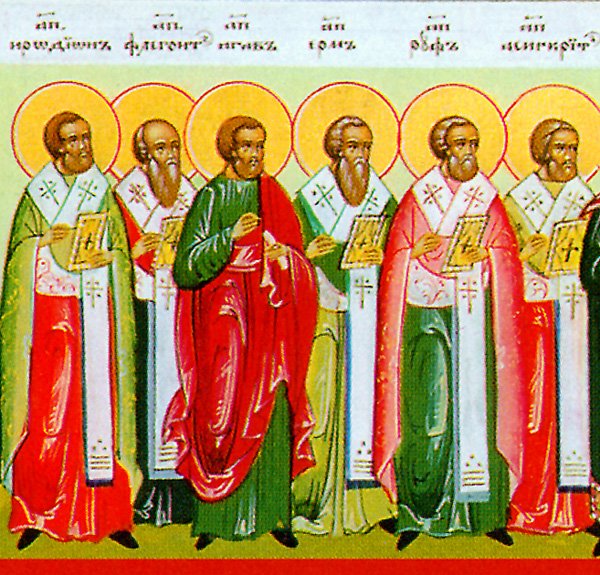
Saints Herodion (Rodion), Agabus, Asyncritus, Rufus, Phlegon and Hermes were among the Seventy Apostles, chosen by Christ and sent out by Him to preach (Synaxis of the Seventy Apostles: January 4). The holy Apostle Herodion was a relative of Saint Paul, and his companion on many journeys. When Christianity had spread to the Balkan Peninsula, the Apostles Peter and Paul established Saint Herodion as Bishop of Patara. Saints Herodion (Rodion), Agabus, Asyncritus, Rufus, Phlegon and Hermes were among the Seventy Apostles, chosen by Christ and sent out by Him to preach (Synaxis of the Seventy Apostles: January 4). The holy Apostle Herodion was a relative of Saint Paul, and his companion on many journeys. When Christianity had spread to the Balkan Peninsula, the Apostles Peter and Paul established Saint Herodion as Bishop of Patara. Saint Herodion zealously preached the Word of God and converted many of the Greek pagans and Jews to Christianity. Enraged by the preaching of the disciple, the idol-worshippers and Jews with one accord fell upon Saint Herodion, and they began to beat him with sticks and pelt him with stones. One of the mob struck him with a knife, and the saint fell down. But when the murderers were gone, the Lord restored him to health unharmed. Saint Herodion continued to accompany the Apostle Paul for many years. When the holy Apostle Peter was crucified (+ c. 67), Saint Herodion and Saint Olympos were beheaded by the sword at the same time. The holy Apostle Agabus was endowed with the gift of prophecy. He predicted (Acts 11:27-28) the famine during the reign of the emperor Claudius (41-52), and foretold the suffering of the Apostle Paul at Jerusalem (Acts 21:11). Saint Agabus preached in many lands, and converted many pagans to Christ. Saint Rufus, whom the holy Apostle Paul mentions in the Epistle to the Romans (Rom. 16:11-15), was bishop of the Greek city of Thebes. Saint Asyncritus (Rom. 16:14) was bishop in Hyrcania (Asia Minor). Saint Phlegon was bishop in the city of Marathon (Thrace). Saint Hermes was bishop in Dalmatia (there is another Apostle of the Seventy by the name of Hermas, who was bishop in the Thracian city of Philippopolis). All these disciples for their intrepid service to Christ underwent fierce sufferings and were found worthy of a martyr’s crown.

Troparion - Tone 1

Let us praise in hymns the six-fold choir of Apostles: / Herodion and Agabus, / Rufus, Asyncritus, Phlegon and holy Hermes. / They ever entreat the Trinity for our souls!

Kontakion - Tone 4

Holy Apostles / entreat the merciful God / to grant our souls forgiveness of transgressions.
Saint Niphon, Bishop of Novgorod

Saint Niphon, Bishop of Novgorod

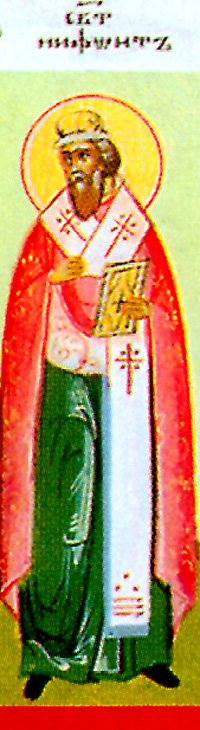
Saint Niphon was a monk of the Kiev Caves Monastery, where he struggled in asceticism. In imitation of the Holy Fathers, he uprooted the passions through fasting, vigil, and prayer, and adorned himself with every virtue. He was chosen as Bishop of Novgorod when Bishop John retired to a monastery after twenty-five years of episcopal service. Saint Niphon was a monk of the Kiev Caves Monastery, where he struggled in asceticism. In imitation of the Holy Fathers, he uprooted the passions through fasting, vigil, and prayer, and adorned himself with every virtue. He was chosen as Bishop of Novgorod when Bishop John retired to a monastery after twenty-five years of episcopal service. Saint Niphon was consecrated bishop in Kiev by Metropolitan Michael and other hierarchs. Saint Niphon embraced his archpastoral duties with great zeal, strengthening his flock in the Orthodox Faith, and striving to prevent them from becoming separated from the Church, which is the same as being separated from Christ Himself. The saint was also zealous in building and repairing churches. He built a new stone church in the center of Novgorod, dedicating it to the Most Holy Theotokos. He repaired the roof of the church of Holy Wisdom (Christ, the Wisdom of God), and adorned the interior with icons. When war broke out between Novgorod and Kiev, Saint Niphon showed himself to be a peacemaker. Meeting with the leaders of both sides, he was able to pacify them and avert the war. In the same way, he always tried to settle arguments and to reconcile those who were at enmity. He instructed his flock in the law of God, preaching to them, reproving, rebuking, and exhorting them patiently and with sound doctrine (2 Timothy 4:2) so that they might obtain the salvation which is in Christ Jesus with eternal glory (2 Timothy 2:10). When the people of Novgorod drove away their prince, Vsevolod, they invited Prince Svyatslav to govern them. The new prince wanted to enter into a marriage which was against the Church canons. Not only did Saint Niphon refuse to perform the ceremony, he also told his clergy to regard this betrothal as unlawful. Prince Svyatoslav brought priests in from elsewhere to perform the wedding, and the holy hierarch was not afraid to denounce his behavior. After the death of Metropolitan Michael of Kiev, the Great Prince Isaiaslav wished to have the schemamonk Clement succeed him. However, he wanted to have Clement consecrated without the blessing of the Patriarch of Constantinople. At a council of bishops, Saint Niphon declared that he would not approve the consecration without the permission of the Patriarch of Constantinople. He reminded the other bishops that this was contrary to the tradition of the Russian Church, for Russia had received the Orthodox Faith from Constantinople. Starting in 1448, however, the Russian Church began to elect its own primate without seeking confirmation from Constantinople. The uncanonical consecration took place despite the objections of Saint Niphon. Metropolitan Clement tried to force the saint to serve the Divine Liturgy with him, but he refused. He called Clement a wolf rather than a shepherd, for he had unjustly assumed an office which he did not deserve. Saint Niphon refused to serve with Clement, or to commemorate him during the services. In his fury, Clement would not permit Saint Niphon to return to Novgorod. Instead, he had the saint held under house arrest at the Kiev Caves Monastery. When Isaiaslav was defeated by Prince George, Saint Niphon returned to Novgorod, where the people welcomed him with great joy. The Patriarch of Constantinople sent a letter praising Saint Niphon for his steadfast defense of church teachings. He also sent Metropolitan Constantine to Rus in order to depose Metropolitan Clement, and to assume the see of Kiev himself. Saint Niphon again took up residence in the Kiev Caves Monastery, where he became ill. Thirteen days before his death, he revealed to the brethren that he had had a wondrous dream. Saint Theodosius (May 3) appeared to him and announced his imminent departure from this world. Saint Niphon reposed in peace on April 8, 1156. Now he stands before the throne of God, interceding for us before the All-Holy Trinity, to Whom be all glory, honor, and worship forever.

Troparion - Tone 4

In truth you were revealed to your flock as a rule of faith, / an image of humility and a teacher of abstinence; / your humility exalted you; / your poverty enriched you. / Hierarch Father Niphon, / entreat Christ our God / that our souls may be saved.
Venerable Rufus the Obedient of the Kiev Far Caves

Venerable Rufus the Obedient of the Kiev Far Caves

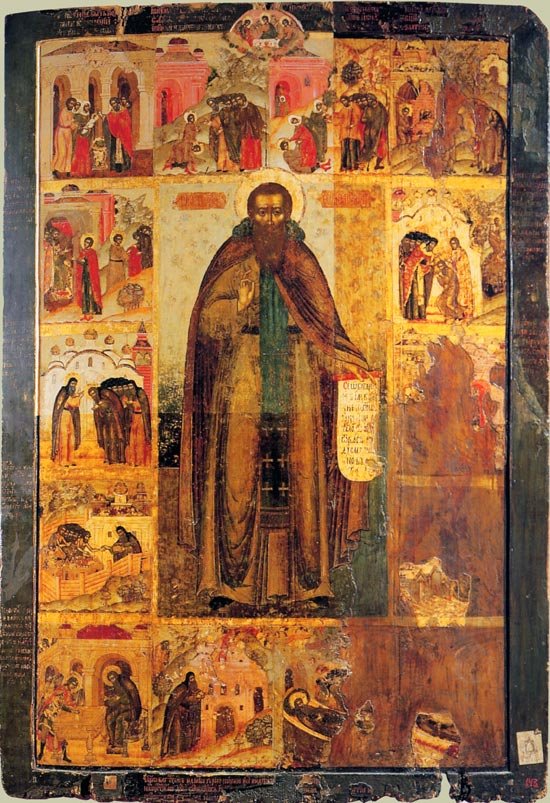
Saint Rufus the Obedient, Hermit of the Caves, lived at the Kiev Caves monastery during the fourteenth century. He was distinguished for his obedience and glorified as a lover of labor and fasting. He was buried in the Far Caves. He is celebrated a second time on August 28, the Synaxis of the Fathers of the Far Caves.

Troparion - Tone 8

By a flood of tears you made the desert fertile, / and your longing for God brought forth fruits in abundance. / By the radiance of miracles you illumined the whole universe! / O our holy father Rufus, pray to Christ our God to save our souls!
Martyr Pausilippus of Heraclea in Thrace

Martyr Pausilippus of Heraclea in Thrace

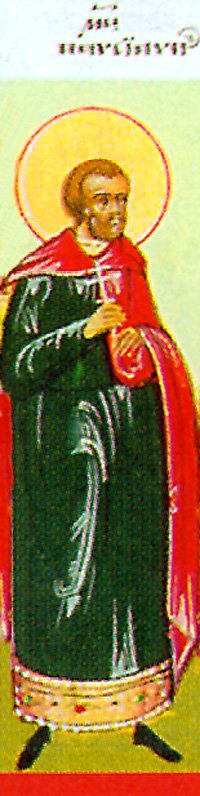
The Holy Martyr Pausilippus suffered under the emperor Hadrian (117-138). Denunced by the pagans, he was brought to trial before the emperor and staunchly declared himself a Christian. They beat him with iron rods and handed over to the governor named Precius, who for a long time attempted to make the martyr offer sacrifice to idols. The Holy Martyr Pausilippus suffered under the emperor Hadrian (117-138). Denunced by the pagans, he was brought to trial before the emperor and staunchly declared himself a Christian. They beat him with iron rods and handed over to the governor named Precius, who for a long time attempted to make the martyr offer sacrifice to idols. The martyr remained steadfast, and finally the governor gave orders to fetter him and execute him. Along the way, Saint Pausilippus prayed fervently that the Lord would spare him from the hand of the executioner and grant him a quick death. The Lord heard him. The martyr, beaten up and weak, was suddenly filled with such strength that he shattered the iron fetters and freed himself. Tossing them aside, Saint Pausilippus thought to escape, but he died as he fled. Christians buried the body of the martyr with reverence.

Troparion - Tone 3

Your holy martyr Pausilippus, O Lord, / through his suffering has received an incorruptible crown from You, our God. / For having Your strength, he laid low his adversaries, / and shattered the powerless boldness of demons. / Through his intercessions, save our souls!
Saint Celestine, Pope of Rome

Saint Celestine, Pope of Rome

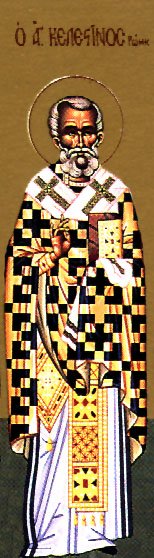
Saint Celestine, Pope of Rome (422-432), a zealous champion of Orthodoxy, lived during the reign of the holy Emperor Theodosius the Younger (408-450). He received an excellent education, and he knew philosophy well, but most of all he studied the Holy Scripture and pondered over theological questions. Saint Celestine, Pope of Rome (422-432), a zealous champion of Orthodoxy, lived during the reign of the holy Emperor Theodosius the Younger (408-450). He received an excellent education, and he knew philosophy well, but most of all he studied the Holy Scripture and pondered over theological questions. The virtuous life of the saint and his authority as a theologian won him the general esteem and love of the clergy and people. After the death of Saint Boniface (418-422), Saint Celestine was chosen to be the Bishop of Rome. During this time, the heresy of Nestorius emerged. At a local Council in Rome in 430, Saint Celestine denounced this heresy and condemned Nestorius as a heretic. After the Council, Saint Celestine wrote a letter to Saint Cyril, Archbishop of Alexandria (January 18), stating that if Nestorius did not renounce his false teachings after ten days, then he should be deposed and excommunicated. Saint Celestine also sent a series of letters to the churches in Constantinople and Antioch, in which he unmasked and denounced the Nestorian heresy. For two years after the Council, Saint Celestine proclaimed the true teaching about Christ the God-Man, and he died in peace on April 6, 432.

Troparion - Tone 4

In truth you were revealed to your flock as a rule of faith, / an image of humility and a teacher of abstinence; / your humility exalted you; / your poverty enriched you. / Hierarch Father Celestine, / entreat Christ our God / that our souls may be saved.

“Spanish” Icon of the Mother of God

The appearance of this Icon dates back to the VIII century. With the help of the Mother of God, King Pelagius of Spain, won a brilliant victory over the Saracens in 718. In the same year, in the east, the Saracens were defeated by Emperor Leo the Isaurian. In remembrance of these events, a Feast Day for the Spanish Icon of the Mother of God was established. The appearance of this Icon dates back to the VIII century. With the help of the Mother of God, King Pelagius of Spain, won a brilliant victory over the Saracens in 718. In the same year, in the east, the Saracens were defeated by Emperor Leo the Isaurian. In remembrance of these events, a Feast Day for the Spanish Icon of the Mother of God was established. In this Icon, which is one of the "Most Pure" (Άχρáντου) type, the Mother of God is depicted seated on a throne with the Pre-eternal Child in her arms. Information concerning another Spanish Icon, called the Abul Icon, is found under June 11 .

Troparion - Tone 4

Your Icon, O Virgin Lady, was given to us as an inexhaustible source of miracles, / bestowed upon those who are overwhelmed and afraid, / pouring forth the healing of the afflictions for the sick, / which is a sign of your intercession. / By the Cross of your Son, we conquer our enemies; / and to you, our Queen and Sovereign Lady, / we offer a song of praise.

Scripture Readings

Gospel

John 12:17-50

17 The people therefore that was with him when he called Lazarus out of his grave, and raised him from the dead, bare record.
18 For this cause the people also met him, for that they heard that he had done this miracle.
19 The Pharisees therefore said among themselves, Perceive ye how ye prevail nothing? behold, the world is gone after him.
20 And there were certain Greeks among them that came up to worship at the feast:
21 The same came therefore to Philip, which was of Bethsaida of Galilee, and desired him, saying, Sir, we would see Jesus.
22 Philip cometh and telleth Andrew: and again Andrew and Philip tell Jesus.
23 And Jesus answered them, saying, The hour is come, that the Son of man should be glorified.
24 Verily, verily, I say unto you, Except a corn of wheat fall into the ground and die, it abideth alone: but if it die, it bringeth forth much fruit.
25 He that loveth his life shall lose it; and he that hateth his life in this world shall keep it unto life eternal.
26 If any man serve me, let him follow me; and where I am, there shall also my servant be: if any man serve me, him will my Father honour.
27 Now is my soul troubled; and what shall I say? Father, save me from this hour: but for this cause came I unto this hour.
28 Father, glorify thy name. Then came there a voice from heaven, saying, I have both glorified it, and will glorify it again.
29 The people therefore, that stood by, and heard it, said that it thundered: others said, An angel spake to him.
30 Jesus answered and said, This voice came not because of me, but for your sakes.
31 Now is the judgment of this world: now shall the prince of this world be cast out.
32 And I, if I be lifted up from the earth, will draw all men unto me.
33 This he said, signifying what death he should die.
34 The people answered him, We have heard out of the law that Christ abideth for ever: and how sayest thou, The Son of man must be lifted up? who is this Son of man?
35 Then Jesus said unto them, Yet a little while is the light with you. Walk while ye have the light, lest darkness come upon you: for he that walketh in darkness knoweth not whither he goeth.
36 While ye have light, believe in the light, that ye may be the children of light. These things spake Jesus, and departed, and did hide himself from them.
37 But though he had done so many miracles before them, yet they believed not on him:
38 That the saying of Esaias the prophet might be fulfilled, which he spake, Lord, who hath believed our report? and to whom hath the arm of the Lord been revealed?
39 Therefore they could not believe, because that Esaias said again,
40 He hath blinded their eyes, and hardened their heart; that they should not see with their eyes, nor understand with their heart, and be converted, and I should heal them.
41 These things said Esaias, when he saw his glory, and spake of him.
42 Nevertheless among the chief rulers also many believed on him; but because of the Pharisees they did not confess him, lest they should be put out of the synagogue:
43 For they loved the praise of men more than the praise of God.
44 Jesus cried and said, He that believeth on me, believeth not on me, but on him that sent me.
45 And he that seeth me seeth him that sent me.
46 I am come a light into the world, that whosoever believeth on me should not abide in darkness.
47 And if any man hear my words, and believe not, I judge him not: for I came not to judge the world, but to save the world.
48 He that rejecteth me, and receiveth not my words, hath one that judgeth him: the word that I have spoken, the same shall judge him in the last day.
49 For I have not spoken of myself; but the Father which sent me, he gave me a commandment, what I should say, and what I should speak.
50 And I know that his commandment is life everlasting: whatsoever I speak therefore, even as the Father said unto me, so I speak.

Liturgical data sourced from OCA.org and orthocal.info