Fasting Rules
 Meat
Abstain
Meat
Abstain
 Fish
Abstain
Fish
Abstain
 Dairy
Abstain
Dairy
Abstain
 Oil
Abstain
Oil
Abstain
 Wine
Abstain
Wine
Abstain
Saints & Commemorations
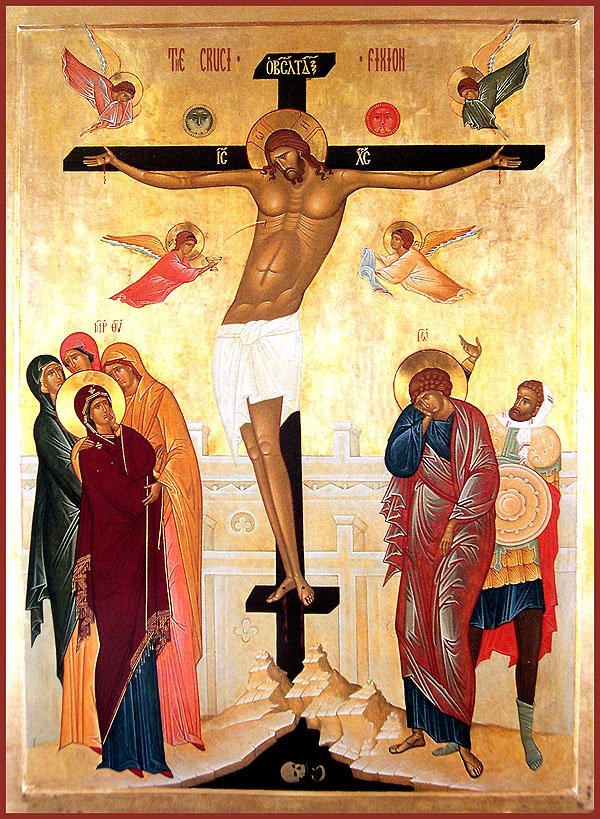
Great and Holy Friday
On Great and Holy Friday, Christ died on the Cross. He gave up His spirit with the words: “It is finished” (John 19:30). These words are better understood when rendered: “It is consummated.” He had accomplished the work for which His heavenly Father had sent Him into the world. He became a man in the fullest sense of the word. He acce
On Great and Holy Friday, Christ died on the Cross. He gave up His spirit with the words: “It is finished” (John 19:30). These words are better understood when rendered: “It is consummated.” He had accomplished the work for which His heavenly Father had sent Him into the world. He became a man in the fullest sense of the word. He accepted the baptism of repentance from John in the Jordan River. He assumed the whole human condition, experiencing all its alienation, agony, and suffering, concluding with the lowly death on the Cross. He perfectly fulfilled the prophecy of Isaiah:
“Therefore I will divide him a portion with the great, and he shall divide the spoil with the strong; because he has poured out his soul to death, and was numbered with the transgressors; yet he bore the sins of many, and made intercession for the transgressors.”
On the Cross Jesus thus became “the man of sorrows; acquainted with grief” whom the prophet Isaiah had foretold. He was “despised and forsaken by men” and “smitten by God, and afflicted” (Isaiah 53:3-4). He became the one with “no form or comeliness that we should look at him, and no beauty that we should desire him” (Isaiah 53:2). His appearance was “marred beyond human semblance, and his form beyond that of the sons of men” (Isaiah 52:14). All these Messianic prophecies were fulfilled in Jesus as he hung from the Cross.
As the end approached, He cried: “My God, my God, why hast Thou forsaken me?” (Matthew 27:46). This cry indicated His complete identification with the human condition. He had totally embraced the despised, forsaken and smitten condition of suffering and death—alienation from God. He was truly the man of sorrows.
Yet, it is important to note that Jesus’ cry of anguish from the Cross was not a sign of His loss of faith in His Father. The words which He exclaimed are the first verse of Psalm 22, a messianic Psalm. The first part of the Psalm foretells the anguish, suffering and death of the Messiah. The second part is a song of praise to God. It predicts the final victory of the Messiah.
The death of Christ had been sought by the religious leaders in Jerusalem from the earliest days of His public ministry. The formal charges made against Him usually fell into the following two categories:
1) violation of the Law of the Old Testament, e.g., breaking the Sabbath rest;
2) blasphemy: making Himself equal with God.
Matters were hastened (consummated) by the moment of truth which followed His entrance into Jerusalem on Palm Sunday. He had the people behind Him. He spoke plainly. He said that the Sabbath was made for man, and not man for the Sabbath. He chastised the scribes and Pharisees for reducing religion to a purely external affair;
“You are like whitewashed tombs, which outwardly appear beautiful, but within are full of dead men’s bones and all uncleanness. So you also outwardly appear righteous to men, but within you are full of hypocrisy and iniquity” (Matthew 23:27-28).
It was the second formal charge; however, that became the basis for His conviction.
Christ’s conviction and death sentence required two trials: religious and political. The religious trial was first and took place during the night immediately after His arrest. After considerable difficulty in finding witnesses for the prosecution who actually agreed in their testimony, Caiaphas, the high priest, asked Jesus the essential question: “Are you Christ, the Son of the Blessed?” Jesus, who had remained silent to this point, now responded directly:
“I am; and you will see the Son of man sitting at the right hand of power, and coming with the clouds of heaven” (Mark 14:61-62).
Jesus’ reply recalled the many other statements He had made beginning with the words, “I am.” “I am the bread of life . . . I am the light of the world. . . I am the way, the truth, and the life. . . before Abraham was, I am.” (John 6 through 15). The use of these words themselves was considered blasphemous by the religious leaders. The words were the Name of God. By using them as His own Name, Jesus positively identified Himself with God. From the burning bush the voice of God had disclosed these words to Moses as the Divine Name:
“Say this to the people of Israel, ‘I AM has sent me to you’” (Exodus 3:13-14).
Now Jesus, as He had done on many other occasions, used them as His own Name. The high priest immediately tore his mantle and “they all condemned Him as deserving death” (Mark 14:64). In their view He had violated the Law of the Old Testament:
“He who blasphemes the name of the Lord shall be put to death” (Leviticus 24:16).
The Jewish religious leaders lacked the actual authority to carry out the above law: to put a man to death. Such authority belonged to the Roman civil administration. Jesus had carefully kept His activity free of political implications. He refused the temptation of Satan to rule the kingdoms of the world by the sword (Luke 4: 1-12). He often charged His disciples and others to tell no one that He was , the Christ, because of the political overtones that this title carried for many (Matthew 16: 13-20). He rebuked Peter, calling him Satan, when the disciple hinted at His swerving from the true nature of His mission (Matthew 16:23). To Pilate, the spineless and indifferent Roman Governor, He said plainly: “My kingdom is not of this world” (John 18:36). Jesus was not a political revolutionary who came to free the people from Roman control and establish a new kingdom based on worldly power.
Nevertheless, the religious leaders, acting in agreement with the masses, devised political charges against Him in order to get their way. They presented Christ to the Romans as a political , leader, the “King of the Jews” in a worldly sense, a threat to Roman rule and a challenge to Caesar. Pilate became fearful of his own position as he heard the charges and saw the seething mobs. Therefore, despite his avowed testimony to Jesus’ innocence, he passed formal sentence, “washed his hands” of the matter, and turned Jesus over to be crucified (John 19:16).
Crucifixion—The Triumph of Evil
Before succumbing to this cruel Roman method of executing political criminals, Jesus suffered still other injustices. He was stripped, mocked and beaten. He wore a “kingly” crown of thorns on His head. He carried His own cross. He was finally nailed to the cross between two thieves at a place called Golgotha (the place of the skull) outside Jerusalem. An inscription was placed above His head on the Cross to indicate the nature of His crime: “Jesus of Nazareth, the King of the Jews.” He yielded up His spirit at about the ninth hour (3 p.m.), after hanging on the Cross for about six hours.
On Holy Friday evil triumphed. “It was night” (John 13:30) when Judas departed from the Last Supper to complete his act of betrayal, and “there was darkness over all the land” (Matthew 27:45) when Jesus was hanging on the Cross. The evil forces of this world had been massed against Christ. Unjust trials convicted Him. A criminal was released to the people instead of Him. Nails and a spear pierced His body. Bitter vinegar was given to Him to quench His thirst. Only one disciple remained faithful to Him. Finally, the tomb of another man became His place of repose after death.
The innocent Jesus was put to death on the basis of both religious and political charges. Both Jews and Gentile Romans participated in His death sentence.
“The rulers of the people have assembled against the Lord and His Christ.” (Psalm 2—the Prokeimenon of the Holy Thursday Vesperal Liturgy)
We, also, in many ways continue to participate in the death sentence given to Christ. The formal charges outlined above do not exhaust the reasons for the crucifixion. Behind the formal charges lay a host of injustices brought, on by hidden and personal motivations. Jesus openly spoke the truth about God and man. He thereby exposed the false character of the righteousness and smug security, both religious and material, claimed by many especially those in high places. The constantly occurring expositions of such smugness in our own day teach us the truly illusory nature of much so-called righteousness and security. In the deepest sense, the death of Christ was brought about by hardened, personal sin—the refusal of people to change themselves in the light of reality, which is Christ.
“He came to His very own, and His own received Him not” (John 1:11).
Especially we, the Christian people, are Christ’s very own. He continues to come to us in His Church. Each time we attempt to make the Church into something other than the eternal coming of Christ into our midst, each time we refuse to repent for our wrongs; we, too, reject Christ and participate in His death sentence.
The Vespers, celebrated in the Church on Holy Friday afternoon, brings to mind all of the final events of the life of Christ as mentioned above: the trial, the sentence, the scourging and mocking, the crucifixion, the death, the taking down of His body from the Cross, and the burial. As the hymnography indicates, these events remain ever-present in the Church; they constitute the today of its life.
The service is replete with readings from Scripture: three from the Old Testament and two from the New. The first of the Old Testament readings, from Exodus, speaks of Moses beholding the “back” of the glory of God—for no man can see the glory of God face to face and live. The Church uses this reading to emphasize that now, in the crucifixion and death of Christ, God is making the ultimate condescension to reveal His glory to man—from within man himself.
The death of Christ was of a wholly voluntary character. He dies not because of some necessity in His being: as the Son of God He has life in Himself! Yet, He voluntarily gave up His life as the greatest sign of God’s love for man, as the ultimate revelation of the Divine glory:
“Greater love has no man than this, that a man lay down his life for his friends” (John 15:13).
The vesperal hymnography further develops the fact that God reveals His glory to us in this condescending love. The Crucifixion is the heart of such love, for the One being crucified is none other than He through whom all things have been created:
Today the Master of creation stands before Pilate. Today the Creator of all is condemned to die on the cross. . . The Redeemer of the world is slapped on the face. The Maker of all is mocked by His own servants. Glory to Thy condescension, 0 Lover of man! (Verse on “Lord I call”, and the Apostikha)
The verses also underscore the cosmic dimensions of the event taking place on the Cross. Just as God who revealed Himself to Moses is not a god, but the God of “heaven and earth, and of all things visible and invisible,” so the death of Jesus is not the culmination of a petty struggle in the domestic life of Palestine. Rather, it is the very center of the epic struggle between God and the Evil One, involving the whole universe:
All creation was changed by fear
when it saw Thee hanging on the cross, 0 Christ! The sun was darkened,
and the foundations of the earth were shaken.
All things suffered with the Creator of all.
0 Lord, who didst willingly endure this for us, glory to Thee!
(Verse I on “Lord, I Call”)
The second Reading from the Old Testament (Job 42:12 to the end) manifests Job as a prophetic figure of the Messiah Himself. The plight of Job is followed in the services throughout Holy Week, and is concluded with this reading. Job is the righteous servant who remains faithful to God despite trial, humiliation, and the loss of all his possessions and family. Because of his faithfulness, however, “The Lord blessed the latter days of Job more than his beginning” (Job 42: 12)
The third of the Old Testamental readings is by far the most substantial (Isaiah 52:13 to 54:1). It is a prototype of the Gospel itself. Read at this moment, it positively identifies Jesus of Nazareth as the Suffering Servant, the Man of Sorrows; the Messiah of Israel.
The Epistle Reading (I Corinthians 1:18 to 2:2) speaks of Jesus crucified, a folly for the world, as the real center of our Faith. The Gospel reading, a lengthy composite taken from Matthew, Luke and John, simply narrates all the events associated with the crucifixion and burial of Christ.
All the readings obviously focus on the theme of hope. As the Lord of Glory, the fulfillment of the righteous Job, and the Messiah Himself, humiliation and death will have no final hold over Jesus. Even the parental mourning of Mary is transformed in the light of this hope:
When she who bore Thee without seed
saw Thee suspended upon the Tree,
0 Christ, the Creator and God of all,
she cried bitterly: “Where is the beauty of Thy countenance, my Son?
I cannot bear to see Thee unjustly crucified. Hasten and arise,
that I too may see Thy resurrection from the dead on the third day!
(Verse IV on “Lord I call.”)
Near the end of the Vespers, the priest vests fully in dark vestments. At the appointed time he lifts the Holy Shroud, a large icon depicting Christ lying in the tomb, from the altar table. Together with selected laymen and servers, a procession is formed and the Holy Shroud is carried to a specially prepared tomb in the center of the church. As the procession moves, the troparion is sung:
The Noble Joseph, when he had taken down Thy most pure body from the tree, wrapped it in fine linen and anointed it with spices, and placed it in a new tomb.
At this ultimate solemn moment of Vespers, the theme of hope once again occurs—this time more strongly and clearly than ever. As knees are bent and heads are bowed, and often tears are shed, another troparion is sung which penetrates through this triumph of evil, to the new day which is contained in its very midst:
The Angel came to the myrrh-bearing women at the tomb and said: “Myrrh is fitting for the dead, but Christ has shown Himself a stranger to corruption.
A new Age is dawning. Our salvation is taking place. The One who died is the same One who will rise on the third day, to “trample down death by death,” and to free us from corruption.
Therefore, at the conclusion of Holy Friday Vespers, at the end of this long day of darkness, when all things are apparently ended, our eternal hope for salvation springs forth. For Christ is indeed a stranger to corruption:
“As by a man came death, by a man has come also the resurrection of the dead. For as in Adam all die, so also in Christ shall all be made alive. But each in his own order: Christ the first fruits, then at his coming those who belong to Christ.” (I Cor. 15:21-32)
“If any man would come after me, let him deny himself and take up his cross and follow me. For whoever would save his life will lose it, and whoever loses his life for my sake and the gospel’s will save it.” (Mark 8:35)
Troparion - Tone 4
By Your precious blood, / You have redeemed us from the curse of the law. / By being nailed to the cross and pierced by a spear, / You have poured forth immortality upon men. / O our Savior, glory to You!
Kontakion - Tone 8
Come, let us all sing the praises of Him who was crucified for us, / for Mary said when she beheld Him upon the tree: / Though You endure the cross, You are my Son and my God!
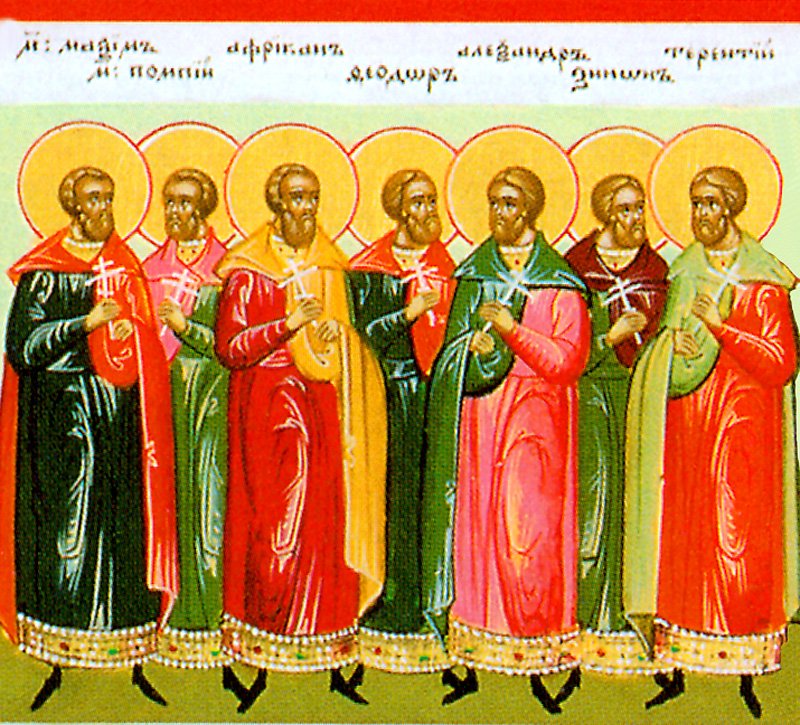
Martyr Terence and 40 others beheaded at Carthage
The Holy Martyr Terence and his companions suffered under the emperor Decius (249-251). The emperor issued an edict commanding all subjects to offer sacrifice to the pagan idols.
When the governor of Africa Fortunianus received this edict, he gathered the people into the city square, set out cruel instruments of torture and declared that everyone without exception had to offer the sacrifice to the idols.
The Holy Martyr Terence and his companions suffered under the emperor Decius (249-251). The emperor issued an edict commanding all subjects to offer sacrifice to the pagan idols.
When the governor of Africa Fortunianus received this edict, he gathered the people into the city square, set out cruel instruments of torture and declared that everyone without exception had to offer the sacrifice to the idols.
Many, afraid of torture, complied. However, Saint Terence and forty other Christians bravely affirmed their faith in the Savior and ridiculed the idols. Fortunianus was amazed at their boldness and he asked how they as rational people, could confess as God, One Whom the Jews crucified as a malefactor.
Saint Terence answered that their belief was in the Savior, Who voluntarily endured death on the Cross and rose on the third day. Fortunianus saw that Terence inspired the others by his example, and so he ordered him to be isolated in prison with his three closest companions: Africanus, Maximus, and Pompeius. Fortunianus was determined to force the rest of the martyrs, including Zeno, Alexander and Theodore, to renounce Christ.
Neither threats nor terrible tortures could sway the holy martyrs. They burned them with red-hot iron, they poured vinegar on the wounds, they sprinkled on salt, and they raked them with iron claws. In spite of their sufferings, the saints did not weaken in their confession of Christ, and the Lord gave them strength.
Fortunianus gave orders to lead the martyrs into the pagan temple, and once again he urged them to offer sacrifice to the idols. The valiant warriors of Christ cried out, “O Almighty God, Who once sent down fire on Sodom for its iniquity, destroy this impious temple of idolatry.” The idols fell down with a crash, and then the temple lay in ruins. The enraged governor gave orders to execute them, and the martyrs, glorifying God, bowed their necks beneath the executioner’s sword.
After the execution of the thirty-six martyrs, Fortunianus summoned Terence, Maximus, Africanus and Pompeius before him. He showed them the martyrs’ bodies and again urged them to offer sacrifice to the idols. The martyrs refused. The governor put heavy chains on them, and gave orders to starve them to death. By night, an angel of the Lord removed the martyrs’ chains and fed them.
In the morning, the guards found the saints cheerful and strong. Then Fortunianus ordered sorcerers and conjurers to carry snakes and all kinds of poisonous creatures into the prison. The guards looked into the cell through an opening in the ceiling and saw the martyrs unharmed, praying, and the snakes crawling at their feet. When the sorcerers opened the door of the prison cell, the snakes bit them. The furious Fortunianus gave orders to behead the holy martyrs. Christians took up their holy bodies and buried them with reverence outside the city.
Troparion - Tone 4
A chosen army of athletes from Africa contested nobly for the faith. / They were of one mind and heart / and of one accord in their struggles. / Now they intercede that we all may be saved.
Kontakion - Tone 1
Let us celebrate the memory of Terence and his companions / and draw near to receive healing. / For with grace and power of the Spirit / they heal the sicknesses of our souls.
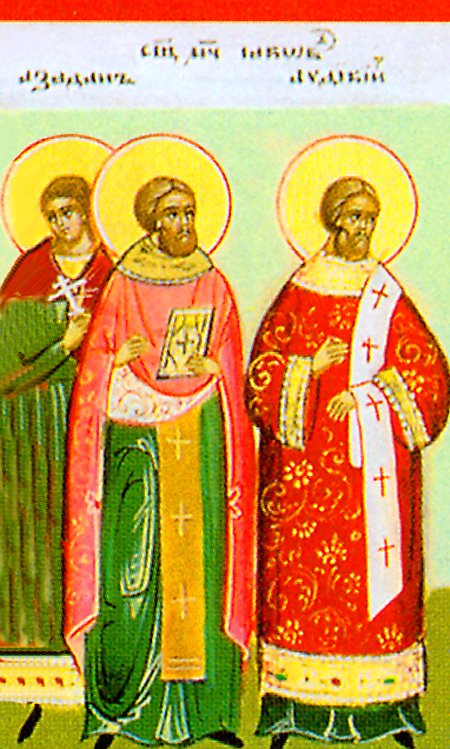
Martyrs James (Jacob) the Presbyter, and Azadanes and Abdicius, Deacons, of Persia
The Holy Martyrs James the Presbyter and the deacons Azadanes and Abdikius died in Persia under the emperor Sapor in about the year 380. They were arrested together with Bishop Akepsimas (November 3). Weak from hunger, the sufferers had mustard and vinegar inserted into their nostrils. Then they were stripped and led out to stand all night in the cold.
The Holy Martyrs James the Presbyter and the deacons Azadanes and Abdikius died in Persia under the emperor Sapor in about the year 380. They were arrested together with Bishop Akepsimas (November 3). Weak from hunger, the sufferers had mustard and vinegar inserted into their nostrils. Then they were stripped and led out to stand all night in the cold.
In the morning, after new torments, the martyrs were returned to prison and beheaded.
Troparion - Tone 4
O God of our Fathers, / always act with kindness towards us; / take not Your mercy from us, / but guide our lives in peace / through the prayers of Saints James, Azadanes, and Abdikius.
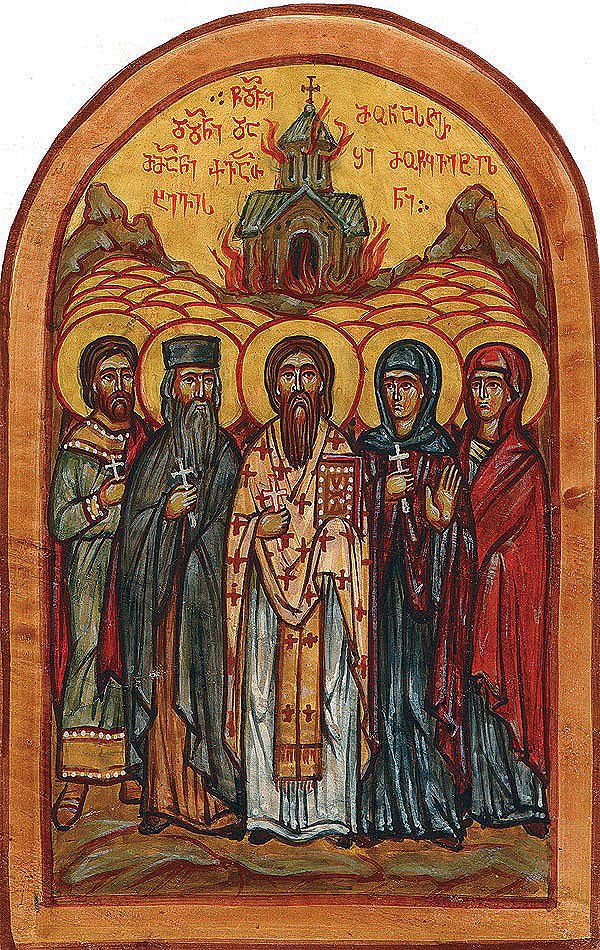
Martyrs of the Kvabtakhevi Monastery in Georgia
In the 14th century, during the reign of King Bagrat V (1360-1394), Timur (Tamerlane) invaded Georgia seven times. His troops inflicted irreparable damage on the country, seizing centuries-old treasures and razing ancient churches and monasteries.
Timur’s armies ravaged Kartli, then took the king, queen, and the entire royal court captive and sent them to Karabakh (in present-day Azerbaijan). L
In the 14th century, during the reign of King Bagrat V (1360-1394), Timur (Tamerlane) invaded Georgia seven times. His troops inflicted irreparable damage on the country, seizing centuries-old treasures and razing ancient churches and monasteries.
Timur’s armies ravaged Kartli, then took the king, queen, and the entire royal court captive and sent them to Karabakh (in present-day Azerbaijan). Later Timur attempted to entice King Bagrat to renounce the Christian Faith in exchange for permission to return to the throne and for the release of the other Georgian prisoners.
For some time Timur was unable to subjugate King Bagrat, but in the end, being powerless and isolated from his kinsmen, the king began to falter. He devised a sly scheme: to confess Islam before the enemy, but to remain a Christian at heart. Satisfied with King Bagrat’s decision to “convert to Islam,” Timur permitted the king to return to the throne of Kartli. At the request of King Bagrat, Timur sent twelve thousand troops with him to complete Georgia’s forcible conversion to Islam.
When they were approaching the village of Khunani in southeastern Georgia, Bagrat secretly informed his son Giorgi of everything that had happened and called upon him and his army to massacre the invaders.
The news of Bagrat’s betrayal and the ruin of his army infuriated Timur, and he called for immediate revenge. At their leader’s command, his followers destroyed everything in their path, set fire to cities and villages, devastated churches, and thus forced their way through to Kvabtakhevi Monastery.
Monastics and laymen alike were gathered in Kvabtakhevi when the enemy came thundering in. Having forced open the gate, the attackers burst into the monastery, then plundered and seized all its treasures. They captured the young and strong, carrying them away.
The old and infirm were put to the sword. As the greatest humiliation, they mocked the clergy and monastics by strapping them with sleigh bells and jumping and dancing around them.
Already drunk on the blood they had shed, the barbarians posed an ultimatum to those who remained: to renounce Christ and live or to be driven into the church and burned alive.
Faced with these terms, the faithful cried out: “Go ahead and burn our flesh—in the Heavenly Kingdom our souls will burn with a divine flame more radiant than the sun!” And in their exceeding humility, the martyrs requested that their martyrdom not be put on display: “We ask only that you not commit this sin before the eyes of men and angels. The Lord alone knows the sincerity of our will and comforts us in our righteous afflictions!”
Having been driven like beasts into the church, the martyrs raised up a final prayer to God: “ In the multitude of Thy mercy shall I go into Thy house; I shall worship toward Thy holy temple in fear of Thee. O Lord, guide me in the way of Thy righteousness; because of mine enemies, make straight my way before Thee (Ps. 5:6-7) that with a pure mind I may glorify Thee forever....”
The executioners hauled in more and more wood, until the flames enveloping the church blazed as high as the heavens and the echo of crackling timber resounded through the mountains. Ensnared in a ring of fire, the blissful martyrs chanted psalms as they gave up their spirits to the Lord.
The massacre at Kvabtakhevi took place in 1386. The imprints of the martyrs’ charred bodies remain on the floor of the church to this day.
Troparion - Tone 4
Your holy martyrs O Lord, / through their sufferings have received incorruptible crowns from You, our God. / For having Your strength, they laid low their adversaries, / and shattered the powerless boldness of demons. / Through their intercessions, save our souls!
Hieromartyr Patriarch Gregory V of Constantinople
The Holy Patriarch Gregory (George Angelopoulos in the world) was born in 1745 at Dēmētsána in the Pelopónnēsos. He began his education in the village schools, since his father could not afford to send him to better schools. In 1765, he went to Athens to study under the renowned teacher Dēmḗtrios Vodas, and in 1767, he went to Smyrna to attend an ecclesiastical school. Later,
The Holy Patriarch Gregory (George Angelopoulos in the world) was born in 1745 at Dēmētsána in the Pelopónnēsos. He began his education in the village schools, since his father could not afford to send him to better schools. In 1765, he went to Athens to study under the renowned teacher Dēmḗtrios Vodas, and in 1767, he went to Smyrna to attend an ecclesiastical school. Later, he went to Patmos for further study, and was ordained as a Deacon in 1775 at Smyrna. Soon after, he was ordained as a Hieromonk.
In 1785 he was consecrated as a Bishop, and was chosen as the Metropolitan of Smyrna. His ministry produced much spiritual fruit, and he edified his flock by his eloquent sermons, by building schools, and by writing books. On May 1,1797 he was elected as Patriarch of Constantinople. From that day forward, he concerned himself with the internal and external order of the Patriarchate. He established rules for his household and staff, called regular meetings, and set agendas for the Synod of Bishops.
In the early XIX century, Greece was suffering under the heavy Turkish yoke, though many Greek patriots hoped to regain their independence. They found support from the Holy Patriarch, whose connections with Greek patriots were revealed only after Alexander Ypsilantis crossed the Prut River with his army against Sultan Mahmud.
The Patriarch was an ascetic who kept the fasts and devoted himself to the unceasing Prayer of the Heart. Such traits did not endear him to everyone, and he had many enemies. The Saint's austerity annoyed some bishops, who slandered him, resulting in his removal and exile to Mount Athos from 1798-1806, where he lived in the Greatest Lavra.
His second tenure as Patriarch began amid political turmoil. Once more he began a program of building churches and schools. Turkey declared war in 1807 as the result of Russian activity in the Balkans. The Sultan ordered Saint Gregory to issue an encyclical against Russia in order to prevent the Greeks from cooperating with them. He bore no malice toward Russia, but he was trying to avoid massacres and insurrections. Three times during his second Patriarchate, Saint Gregory was forced to quell Greek attempts to revolt. Nevertheless, he was deposed and exiled to the Holy Mountain in 1808.
In January 1819, the Holy Hierarch ascended the Patriarchal throne for the final time. He established a fund to help the poor of Constantinople and reorganized the Patriarchal printing press, which published many spiritual books. In March, several bishops were imprisoned or executed because of the failed insurrection of Alexander Ypsilantis in Moldavia. When the Greek Revolution began on March 25, 1821, the Turks ordered the Patriarch and his Synod to issue an anathema against Ypsilantis and those who had cooperated with him. The anathema was ignored, because the Greeks knew that it had been issued under duress.
During that Lent, jailings and executions were common. One of the Patriarch's friends advised him to flee from Constantinople to the Morea. Saint Gregory replied: "I have a premonition that the fish of the Bosphorus will eat my body, but I will die calmly, for the sake of of saving my nation."
On Holy Pascha, April 10, 1821, the Patriarch was seized at 10:00 A.M. and hanged at the gate of the Patriarchate, and then his body was thrown into the sea. That gate has remained shut ever since.
Greek sailors noticed the place where the Hieromartyr's body was abandoned, and placed it on a ship from Kephalonia under the command of Captain Macri Sklavos, and then it was taken to Odessa under the Russian flag. The Hierarch's relics were buried in the Greek church of the Holy Trinity on June 19, 1821. Patriarchal vestments were sent from Moscow for the Saint's relics, as well as a mitre and a cross, which had belonged to His Holiness Patriarch Nikon (1652-1658). The Hieromartyr Gregory V of Constantinople, held the See of Constantinople three times (1797-1799, 1806-1808, 1819-1821).
In 1871, at the request of the Greek government, permission was granted to transfer Patriarch Gregory's relics from Odessa to Athens for the celebration of the fiftieth anniversary of Greek independence. A special Service was composed in Athens in honor of the Hierarch, whose martyrdom heralded the triumph of Christianity in Greece.
The Hieromartyr Gregory was glorified as a Saint in 1921. The scroll on his Icon reads: "For freedom Christ has set us free; stand fast therefore, and do not be entangled again with the yoke of slavery" (Galatians 5:1).
Scripture Readings
☩Epistle
1 Corinthians 1:18-2:2
18
For the preaching of the cross is to them that perish foolishness; but unto us which are saved it is the power of God.
19
For it is written, I will destroy the wisdom of the wise, and will bring to nothing the understanding of the prudent.
20
Where is the wise? where is the scribe? where is the disputer of this world? hath not God made foolish the wisdom of this world?
21
For after that in the wisdom of God the world by wisdom knew not God, it pleased God by the foolishness of preaching to save them that believe.
22
For the Jews require a sign, and the Greeks seek after wisdom:
23
But we preach Christ crucified, unto the Jews a stumblingblock, and unto the Greeks foolishness;
24
But unto them which are called, both Jews and Greeks, Christ the power of God, and the wisdom of God.
25
Because the foolishness of God is wiser than men; and the weakness of God is stronger than men.
26
For ye see your calling, brethren, how that not many wise men after the flesh, not many mighty, not many noble, are called:
27
But God hath chosen the foolish things of the world to confound the wise; and God hath chosen the weak things of the world to confound the things which are mighty;
28
And base things of the world, and things which are despised, hath God chosen, yea, and things which are not, to bring to nought things that are:
29
That no flesh should glory in his presence.
30
But of him are ye in Christ Jesus, who of God is made unto us wisdom, and righteousness, and sanctification, and redemption:
31
That, according as it is written, He that glorieth, let him glory in the Lord.
1
And I, brethren, when I came to you, came not with excellency of speech or of wisdom, declaring unto you the testimony of God.
2
For I determined not to know any thing among you, save Jesus Christ, and him crucified.
☩Gospel
John 13:31-18:1
31
Therefore, when he was gone out, Jesus said, Now is the Son of man glorified, and God is glorified in him.
32
If God be glorified in him, God shall also glorify him in himself, and shall straightway glorify him.
33
Little children, yet a little while I am with you. Ye shall seek me: and as I said unto the Jews, Whither I go, ye cannot come; so now I say to you.
34
A new commandment I give unto you, That ye love one another; as I have loved you, that ye also love one another.
35
By this shall all men know that ye are my disciples, if ye have love one to another.
36
Simon Peter said unto him, Lord, whither goest thou? Jesus answered him, Whither I go, thou canst not follow me now; but thou shalt follow me afterwards.
37
Peter said unto him, Lord, why cannot I follow thee now? I will lay down my life for thy sake.
38
Jesus answered him, Wilt thou lay down thy life for my sake? Verily, verily, I say unto thee, The cock shall not crow, till thou hast denied me thrice.
1
Let not your heart be troubled: ye believe in God, believe also in me.
2
In my Father’s house are many mansions: if it were not so, I would have told you. I go to prepare a place for you.
3
And if I go and prepare a place for you, I will come again, and receive you unto myself; that where I am, there ye may be also.
4
And whither I go ye know, and the way ye know.
5
Thomas saith unto him, Lord, we know not whither thou goest; and how can we know the way?
6
Jesus saith unto him, I am the way, the truth, and the life: no man cometh unto the Father, but by me.
7
If ye had known me, ye should have known my Father also: and from henceforth ye know him, and have seen him.
8
Philip saith unto him, Lord, shew us the Father, and it sufficeth us.
9
Jesus saith unto him, Have I been so long time with you, and yet hast thou not known me, Philip? he that hath seen me hath seen the Father; and how sayest thou then, Shew us the Father?
10
Believest thou not that I am in the Father, and the Father in me? the words that I speak unto you I speak not of myself: but the Father that dwelleth in me, he doeth the works.
11
Believe me that I am in the Father, and the Father in me: or else believe me for the very works’ sake.
12
Verily, verily, I say unto you, He that believeth on me, the works that I do shall he do also; and greater works than these shall he do; because I go unto my Father.
13
And whatsoever ye shall ask in my name, that will I do, that the Father may be glorified in the Son.
14
If ye shall ask any thing in my name, I will do it.
15
If ye love me, keep my commandments.
16
And I will pray the Father, and he shall give you another Comforter, that he may abide with you for ever;
17
Even the Spirit of truth; whom the world cannot receive, because it seeth him not, neither knoweth him: but ye know him; for he dwelleth with you, and shall be in you.
18
I will not leave you comfortless: I will come to you.
19
Yet a little while, and the world seeth me no more; but ye see me: because I live, ye shall live also.
20
At that day ye shall know that I am in my Father, and ye in me, and I in you.
21
He that hath my commandments, and keepeth them, he it is that loveth me: and he that loveth me shall be loved of my Father, and I will love him, and will manifest myself to him.
22
Judas saith unto him, not Iscariot, Lord, how is it that thou wilt manifest thyself unto us, and not unto the world?
23
Jesus answered and said unto him, If a man love me, he will keep my words: and my Father will love him, and we will come unto him, and make our abode with him.
24
He that loveth me not keepeth not my sayings: and the word which ye hear is not mine, but the Father’s which sent me.
25
These things have I spoken unto you, being yet present with you.
26
But the Comforter, which is the Holy Ghost, whom the Father will send in my name, he shall teach you all things, and bring all things to your remembrance, whatsoever I have said unto you.
27
Peace I leave with you, my peace I give unto you: not as the world giveth, give I unto you. Let not your heart be troubled, neither let it be afraid.
28
Ye have heard how I said unto you, I go away, and come again unto you. If ye loved me, ye would rejoice, because I said, I go unto the Father: for my Father is greater than I.
29
And now I have told you before it come to pass, that, when it is come to pass, ye might believe.
30
Hereafter I will not talk much with you: for the prince of this world cometh, and hath nothing in me.
31
But that the world may know that I love the Father; and as the Father gave me commandment, even so I do. Arise, let us go hence.
1
I am the true vine, and my Father is the husbandman.
2
Every branch in me that beareth not fruit he taketh away: and every branch that beareth fruit, he purgeth it, that it may bring forth more fruit.
3
Now ye are clean through the word which I have spoken unto you.
4
Abide in me, and I in you. As the branch cannot bear fruit of itself, except it abide in the vine; no more can ye, except ye abide in me.
5
I am the vine, ye are the branches: He that abideth in me, and I in him, the same bringeth forth much fruit: for without me ye can do nothing.
6
If a man abide not in me, he is cast forth as a branch, and is withered; and men gather them, and cast them into the fire, and they are burned.
7
If ye abide in me, and my words abide in you, ye shall ask what ye will, and it shall be done unto you.
8
Herein is my Father glorified, that ye bear much fruit; so shall ye be my disciples.
9
As the Father hath loved me, so have I loved you: continue ye in my love.
10
If ye keep my commandments, ye shall abide in my love; even as I have kept my Father’s commandments, and abide in his love.
11
These things have I spoken unto you, that my joy might remain in you, and that your joy might be full.
12
This is my commandment, That ye love one another, as I have loved you.
13
Greater love hath no man than this, that a man lay down his life for his friends.
14
Ye are my friends, if ye do whatsoever I command you.
15
Henceforth I call you not servants; for the servant knoweth not what his lord doeth: but I have called you friends; for all things that I have heard of my Father I have made known unto you.
16
Ye have not chosen me, but I have chosen you, and ordained you, that ye should go and bring forth fruit, and that your fruit should remain: that whatsoever ye shall ask of the Father in my name, he may give it you.
17
These things I command you, that ye love one another.
18
If the world hate you, ye know that it hated me before it hated you.
19
If ye were of the world, the world would love his own: but because ye are not of the world, but I have chosen you out of the world, therefore the world hateth you.
20
Remember the word that I said unto you, The servant is not greater than his lord. If they have persecuted me, they will also persecute you; if they have kept my saying, they will keep yours also.
21
But all these things will they do unto you for my name’s sake, because they know not him that sent me.
22
If I had not come and spoken unto them, they had not had sin: but now they have no cloke for their sin.
23
He that hateth me hateth my Father also.
24
If I had not done among them the works which none other man did, they had not had sin: but now have they both seen and hated both me and my Father.
25
But this cometh to pass, that the word might be fulfilled that is written in their law, They hated me without a cause.
26
But when the Comforter is come, whom I will send unto you from the Father, even the Spirit of truth, which proceedeth from the Father, he shall testify of me:
27
And ye also shall bear witness, because ye have been with me from the beginning.
1
These things have I spoken unto you, that ye should not be offended.
2
They shall put you out of the synagogues: yea, the time cometh, that whosoever killeth you will think that he doeth God service.
3
And these things will they do unto you, because they have not known the Father, nor me.
4
But these things have I told you, that when the time shall come, ye may remember that I told you of them. And these things I said not unto you at the beginning, because I was with you.
5
But now I go my way to him that sent me; and none of you asketh me, Whither goest thou?
6
But because I have said these things unto you, sorrow hath filled your heart.
7
Nevertheless I tell you the truth; It is expedient for you that I go away: for if I go not away, the Comforter will not come unto you; but if I depart, I will send him unto you.
8
And when he is come, he will reprove the world of sin, and of righteousness, and of judgment:
9
Of sin, because they believe not on me;
10
Of righteousness, because I go to my Father, and ye see me no more;
11
Of judgment, because the prince of this world is judged.
12
I have yet many things to say unto you, but ye cannot bear them now.
13
Howbeit when he, the Spirit of truth, is come, he will guide you into all truth: for he shall not speak of himself; but whatsoever he shall hear, that shall he speak: and he will shew you things to come.
14
He shall glorify me: for he shall receive of mine, and shall shew it unto you.
15
All things that the Father hath are mine: therefore said I, that he shall take of mine, and shall shew it unto you.
16
A little while, and ye shall not see me: and again, a little while, and ye shall see me, because I go to the Father.
17
Then said some of his disciples among themselves, What is this that he saith unto us, A little while, and ye shall not see me: and again, a little while, and ye shall see me: and, Because I go to the Father?
18
They said therefore, What is this that he saith, A little while? we cannot tell what he saith.
19
Now Jesus knew that they were desirous to ask him, and said unto them, Do ye enquire among yourselves of that I said, A little while, and ye shall not see me: and again, a little while, and ye shall see me?
20
Verily, verily, I say unto you, That ye shall weep and lament, but the world shall rejoice: and ye shall be sorrowful, but your sorrow shall be turned into joy.
21
A woman when she is in travail hath sorrow, because her hour is come: but as soon as she is delivered of the child, she remembereth no more the anguish, for joy that a man is born into the world.
22
And ye now therefore have sorrow: but I will see you again, and your heart shall rejoice, and your joy no man taketh from you.
23
And in that day ye shall ask me nothing. Verily, verily, I say unto you, Whatsoever ye shall ask the Father in my name, he will give it you.
24
Hitherto have ye asked nothing in my name: ask, and ye shall receive, that your joy may be full.
25
These things have I spoken unto you in proverbs: but the time cometh, when I shall no more speak unto you in proverbs, but I shall shew you plainly of the Father.
26
At that day ye shall ask in my name: and I say not unto you, that I will pray the Father for you:
27
For the Father himself loveth you, because ye have loved me, and have believed that I came out from God.
28
I came forth from the Father, and am come into the world: again, I leave the world, and go to the Father.
29
His disciples said unto him, Lo, now speakest thou plainly, and speakest no proverb.
30
Now are we sure that thou knowest all things, and needest not that any man should ask thee: by this we believe that thou camest forth from God.
31
Jesus answered them, Do ye now believe?
32
Behold, the hour cometh, yea, is now come, that ye shall be scattered, every man to his own, and shall leave me alone: and yet I am not alone, because the Father is with me.
33
These things I have spoken unto you, that in me ye might have peace. In the world ye shall have tribulation: but be of good cheer; I have overcome the world.
1
These words spake Jesus, and lifted up his eyes to heaven, and said, Father, the hour is come; glorify thy Son, that thy Son also may glorify thee:
2
As thou hast given him power over all flesh, that he should give eternal life to as many as thou hast given him.
3
And this is life eternal, that they might know thee the only true God, and Jesus Christ, whom thou hast sent.
4
I have glorified thee on the earth: I have finished the work which thou gavest me to do.
5
And now, O Father, glorify thou me with thine own self with the glory which I had with thee before the world was.
6
I have manifested thy name unto the men which thou gavest me out of the world: thine they were, and thou gavest them me; and they have kept thy word.
7
Now they have known that all things whatsoever thou hast given me are of thee.
8
For I have given unto them the words which thou gavest me; and they have received them, and have known surely that I came out from thee, and they have believed that thou didst send me.
9
I pray for them: I pray not for the world, but for them which thou hast given me; for they are thine.
10
And all mine are thine, and thine are mine; and I am glorified in them.
11
And now I am no more in the world, but these are in the world, and I come to thee. Holy Father, keep through thine own name those whom thou hast given me, that they may be one, as we are.
12
While I was with them in the world, I kept them in thy name: those that thou gavest me I have kept, and none of them is lost, but the son of perdition; that the scripture might be fulfilled.
13
And now come I to thee; and these things I speak in the world, that they might have my joy fulfilled in themselves.
14
I have given them thy word; and the world hath hated them, because they are not of the world, even as I am not of the world.
15
I pray not that thou shouldest take them out of the world, but that thou shouldest keep them from the evil.
16
They are not of the world, even as I am not of the world.
17
Sanctify them through thy truth: thy word is truth.
18
As thou hast sent me into the world, even so have I also sent them into the world.
19
And for their sakes I sanctify myself, that they also might be sanctified through the truth.
20
Neither pray I for these alone, but for them also which shall believe on me through their word;
21
That they all may be one; as thou, Father, art in me, and I in thee, that they also may be one in us: that the world may believe that thou hast sent me.
22
And the glory which thou gavest me I have given them; that they may be one, even as we are one:
23
I in them, and thou in me, that they may be made perfect in one; and that the world may know that thou hast sent me, and hast loved them, as thou hast loved me.
24
Father, I will that they also, whom thou hast given me, be with me where I am; that they may behold my glory, which thou hast given me: for thou lovedst me before the foundation of the world.
25
O righteous Father, the world hath not known thee: but I have known thee, and these have known that thou hast sent me.
26
And I have declared unto them thy name, and will declare it: that the love wherewith thou hast loved me may be in them, and I in them.
1
When Jesus had spoken these words, he went forth with his disciples over the brook Cedron, where was a garden, into the which he entered, and his disciples.
Liturgical data sourced from OCA.org and orthocal.info