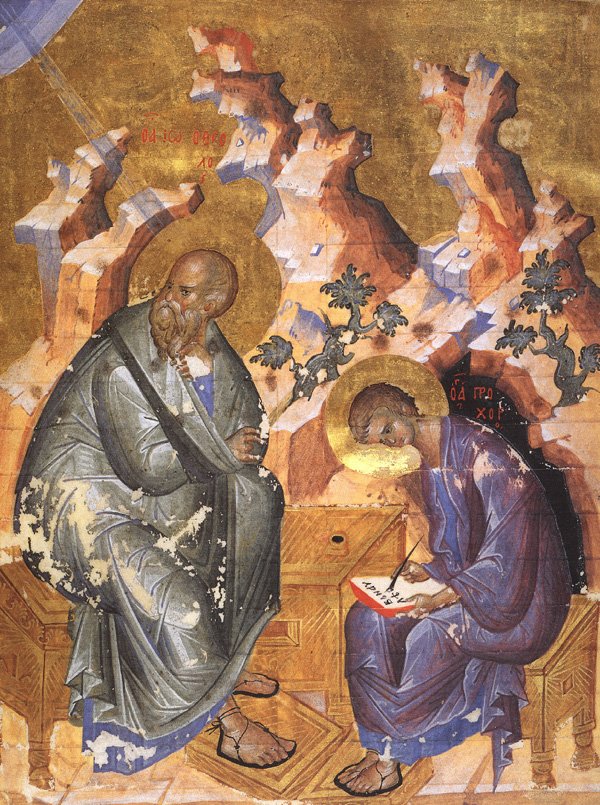
When Saint John was more than one hundred years old, he told seven of his disciples to take spades and follow him to a certain place outside the city of Ephesus, and then he told everyone to sit down while he went off to pray by himself for a while. When he returned, he told his disciples to dig a grave as long as he was tall, in the form of a cross.
When Saint John was more than one hundred years old, he told seven of his disciples to take spades and follow him to a certain place outside the city of Ephesus, and then he told everyone to sit down while he went off to pray by himself for a while. When he returned, he told his disciples to dig a grave as long as he was tall, in the form of a cross. After giving them instructions and kissing them, he climbed into the grave and said: "Take some earth, my mother earth, and cover me."
They covered him with earth up to his knees, and he said: "Now take some more earth and cover me up to my neck."
As soon as he they had done this, Saint John spoke again: "Bring a linen cloth and place it on my face, then kiss me again for the last time, because you shall not see me anymore in this life."
After the Apostle dismissed them, they buried him and wept bitterly. Later, they returned and opened the grave, but the Saint's body was not there. They wept and returned to the city.
Every year, on May 8, a red dust appears on his grave, which heals the sick, through the prayers of the Holy Apostle John. People call this dust "manna from the earth."
Saint Augustine knew about this dust, and Saint Gregory of Tours also wrote about it. Some sources call this Feast "rodismos" (ροδισμός) i.e. Day of the Roses. Some think that this manna is called ροδής (a pink ointment, or a rose-colored dust). Others say that by this name they celebrate the roses of spring, just as we decorate the church with greenery and flowers on Pentecost.
Saint John’s principal Feast Day is September 26, but today the Church commemorates Saint John because of the annual pilgrimage to his grave.
There is a special title to be used when commemorating Saint John at the Dismissal: “The holy, glorious Apostle and Evangelist, Virgin, Beloved friend of Christ, John the Theologian.” 1
1 John M. Fountoulis, Apanteseis Eis Leitourgikas Aporias (Thessalonike, 1973) pages 12 - 17.
Troparion - Tone 2
O beloved Apostle of Christ our God, / come quickly to deliver your helpless people. / He on whose breast you leaned, will accept you as intercessor. / Entreat Him, O Theologian, to disperse the clouds of darkness, / granting us peace and great mercy!
Kontakion - Tone 2
Who shall declare your greatness, / O virgin disciple, / for you pour forth wonders and are a source of healings, / and pray for our souls as theologian and friend of Christ.
Venerable Arsenius the Great
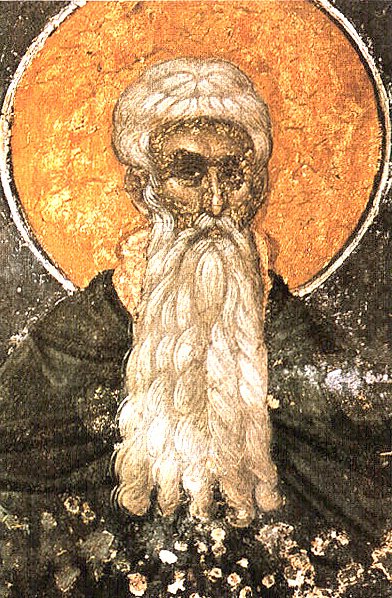
Saint Arsenius the Great was born in the year 354 at Rome into a pious Christian family, which provided him a fine education and upbringing. He studied rhetoric and philosophy, and mastered the Latin and Greek languages. Saint Arsenius gave up philosophy and the vanity of worldly life, seeking instead the true wisdom praised by Saint James “pure, peaceable, gentle, and easy to be entreated, full of mercy and good fruits” (Jas. 3:1
Saint Arsenius the Great was born in the year 354 at Rome into a pious Christian family, which provided him a fine education and upbringing. He studied rhetoric and philosophy, and mastered the Latin and Greek languages. Saint Arsenius gave up philosophy and the vanity of worldly life, seeking instead the true wisdom praised by Saint James “pure, peaceable, gentle, and easy to be entreated, full of mercy and good fruits” (Jas. 3:17). He entered the ranks of the clergy as a deacon in one of the Roman churches, dedicating himself to the service of God.
The emperor Theodosius (379-395), who ruled the eastern half of the Roman Empire, heard about his erudition and piety, and he wished to entrust Arsenius with the education of his sons Arcadius and Honorius. Arsenius, however, protested that he had given up secular studies in order to serve God. Against his will, but in obedience to the will of Pope Damasus (December 11), Saint Arsenius agreed to teach the imperial children, hoping to teach them Christian piety as well.
When he arrived at Constantinople, Arsenius was received with great honor by the emperor Theodosius, who charged him to educate his sons not only in wisdom, but also in piety, guarding them from the temptations of youth. “Forget that they are the emperor’s sons,” said Theodosius, “for I want them to submit to you in all things, as to their father and teacher.”
With fervor the saint devoted himself to the education of the youths, but the high esteem in which he was held troubled his spirit, which yearned for the quietude of monastic life. Saint Arsenius entreated the Lord to show him the way to salvation. The Lord heard his prayer and one time he heard a voice telling him, “Arsenius, flee from men, and you shall be saved.” And then, removing his rich clothing and replacing it with old and tattered garments, he secretly left the palace, boarded a ship for Alexandria, and he made his way to Sketis, a monastery in the midst of the desert.
Arriving at the church, he asked the priests to accept him into the monastic brotherhood, calling himself a wretched wanderer, though his very manner betrayed him as a cultivated man. The brethren led him to Abba John the Dwarf (November 9), famed for his holiness of life. He, wishing to test the newcomer’s humility, did not seat Arsenius with the monks for the trapeza meal. He threw him a piece of dry bread saying, “Eat if you wish.” Saint Arsenius got down on his hands and knees, and picked up the bread with his mouth. Then he crawled off into a corner and ate it. Seeing this, Elder John said, “He will be a great ascetic!” Then accepting Arsenius with love, he tonsured him into monasticism.
Saint Arsenius zealously passed through his obediences and soon he surpassed many of the desert Fathers in asceticism. The saint again heard the Voice while he was praying, “Arsenius, hide from people and dwell in silence, this is the root of virtue.” From that moment Saint Arsenius settled in a solitary cell deep in the desert.
Having taken on the struggle of silence he seldom left his seclusion. He came to church only on Sundays and Feast days, observing complete silence and conversing with no one. When Abba Moses asked him why he hid himself from people, Saint Arsenius replied, “God knows that I love you, but I cannot remain with God and with men at the same time. The Heavenly Powers all have one will and praise God together. On earth, however, there are many human wills, and each man has his own thoughts. I cannot leave God in order to live with people.”
Though absorbed in constant prayer, the saint did not refuse visiting monks with his counsel and guidance, giving short, but perceptive answers to their questions. Once, a monk from Sketis saw the great Elder through a window standing at prayer, surrounded by a flame.
The handicraft of Saint Arsenius was to weave baskets, for which he used the fronds of date palms soaked in water. For a whole year Saint Arsenius did not change the water in the container, but merely added a little water to it from time to time. This caused his cell to be permeated with a foul stench. When asked why he did this, the saint replied that it was fitting for him to humble himself in this way, because in the world he had used incense and fragrant oils. He prayed that after death he would not experience the stench of hell.
The fame of the great ascetic spread far, and many wanted to see him, and they disturbed his tranquility. As a result, the saint was forced to move around from place to place. But those thirsting to receive his guidance and blessing still found him.
Saint Arsenius taught that many take upon themselves great deeds of repentance, fasting, and vigil, but it is rare for someone to guard his soul from pride, greed, jealousy, hatred of one’s brother, remembrance of wrongs, and judgment. In this they resemble graves which are decorated outwardly, but filled with stinking bones.
A certain monk once asked Saint Arsenius what he should do when he read the Holy Scriptures and did not comprehend their meaning. The Elder answered, “My child, you must study and learn the Holy Scriptures constantly, even if you do not understand their power... For when we have the words of the Holy Scriptures on our lips, the demons hear them and are terrified. Then they flee from us, unable to bear the words of the Holy Spirit Who speaks through His apostles and prophets.”
The monks heard how the saint often urged himself on in his efforts with the words, “Rouse yourself, Arsenius, work! Do not remain idle! You have not come here to rest, but to labor.” He also said, “I have often regretted the words I have spoken, but I have never regretted my silence.”
The great ascetic and keeper of silence was given the gift of tears with which his eyes were constantly filled. He spent fifty-five years at monastic labors and struggles. He spent forty years at Sketis, and ten years on the mountain of Troe near Memphis. Then he spent three years at Canopus, and two more years at Troe, where he fell asleep in the Lord.
Our holy, God-bearing Father Arsenius reposed when he was nearly one hundred years old, in the year 449 or 450.
His only disciples seem to have been Alexander, Zoilos, and Daniel (June 7).
Troparion - Tone 8
By a flood of tears you made the desert fertile, / and your longing for God brought forth fruits in abundance. / By the radiance of miracles you illumined the whole universe! / O our holy father Arsenius, pray to Christ our God to save our souls!
Kontakion - Tone 2
You shone from Rome as a great sun and reached the royal city,1 most blessed one, / enlightening it by your words and deeds, and dispersing the darkness of foolishness. / Therefore, we honor you, O Venerable Arsenios, glory of the Fathers.1 Constantinople
Venerable Arsenius the Lover-of-Labor of the Kiev Far Caves
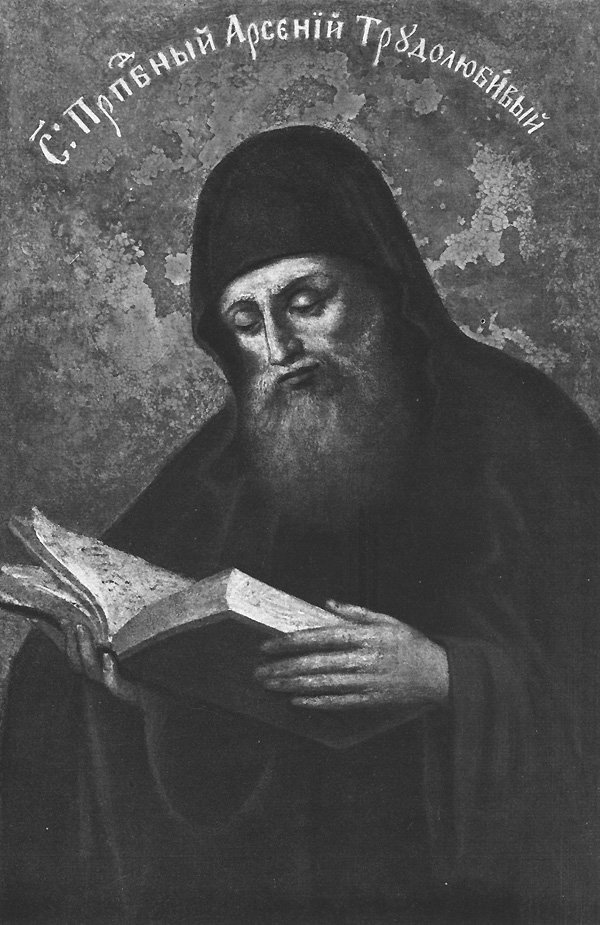
Saint Arsenius the Lover of Labor lived during the fourteenth century. This ascetic was distinguished by his love for toil, and living in asceticism in the Kiev Caves monastery of the Dormition of the Most Holy Theotokos, he knew no rest. He prayed constantly and partook of food only at the setting of the sun.
Saint Arsenius the Lover of Labor lived during the fourteenth century. This ascetic was distinguished by his love for toil, and living in asceticism in the Kiev Caves monastery of the Dormition of the Most Holy Theotokos, he knew no rest. He prayed constantly and partook of food only at the setting of the sun. For his humility and love of labor the Lord gave him the gift of wonderworking. His memory is also celebrated together with the Saints of the Far Caves on August 28.
Troparion - Tone 8
By a flood of tears you made the desert fertile, / and your longing for God brought forth fruits in abundance. / By the radiance of miracles you illumined the whole universe! / O our holy father Arsenius, pray to Christ our God to save our souls!
Venerable Pimen the Ascetic of the Kiev Far Caves
Saint Pimen, Faster of the Caves, won fame by his exploit of fasting. The relics of the saint rest in the Far Caves. He is also commemorated on August 28.
Troparion - Tone 8
By a flood of tears you made the desert fertile, / and your longing for God brought forth fruits in abundance. / By the radiance of miracles you illumined the whole universe! / O our holy father Pimen, pray to Christ our God to save our souls!
Scripture Readings
☩Epistle
Acts 10:44-11:10
44
While Peter yet spake these words, the Holy Ghost fell on all them which heard the word.
45
And they of the circumcision which believed were astonished, as many as came with Peter, because that on the Gentiles also was poured out the gift of the Holy Ghost.
46
For they heard them speak with tongues, and magnify God. Then answered Peter,
47
Can any man forbid water, that these should not be baptized, which have received the Holy Ghost as well as we?
48
And he commanded them to be baptized in the name of the Lord. Then prayed they him to tarry certain days.
1
And the apostles and brethren that were in Judea heard that the Gentiles had also received the word of God.
2
And when Peter was come up to Jerusalem, they that were of the circumcision contended with him,
3
Saying, Thou wentest in to men uncircumcised, and didst eat with them.
4
But Peter rehearsed the matter from the beginning, and expounded it by order unto them, saying,
5
I was in the city of Joppa praying: and in a trance I saw a vision, A certain vessel descend, as it had been a great sheet, let down from heaven by four corners; and it came even to me:
6
Upon the which when I had fastened mine eyes, I considered, and saw fourfooted beasts of the earth, and wild beasts, and creeping things, and fowls of the air.
7
And I heard a voice saying unto me, Arise, Peter; slay and eat.
8
But I said, Not so, Lord: for nothing common or unclean hath at any time entered into my mouth.
9
But the voice answered me again from heaven, What God hath cleansed, that call not thou common.
10
And this was done three times: and all were drawn up again into heaven.
☩Gospel
John 8:21-30
21
Then said Jesus again unto them, I go my way, and ye shall seek me, and shall die in your sins: whither I go, ye cannot come.
22
Then said the Jews, Will he kill himself? because he saith, Whither I go, ye cannot come.
23
And he said unto them, Ye are from beneath; I am from above: ye are of this world; I am not of this world.
24
I said therefore unto you, that ye shall die in your sins: for if ye believe not that I am he, ye shall die in your sins.
25
Then said they unto him, Who art thou? And Jesus saith unto them, Even the same that I said unto you from the beginning.
26
I have many things to say and to judge of you: but he that sent me is true; and I speak to the world those things which I have heard of him.
27
They understood not that he spake to them of the Father.
28
Then said Jesus unto them, When ye have lifted up the Son of man, then shall ye know that I am he, and that I do nothing of myself; but as my Father hath taught me, I speak these things.
29
And he that sent me is with me: the Father hath not left me alone; for I do always those things that please him.
 Meat
Abstain
Meat
Abstain
 Fish
Abstain
Fish
Abstain
 Dairy
Abstain
Dairy
Abstain
 Oil
Abstain
Oil
Abstain
 Wine
Abstain
Wine
Abstain