Fasting Rules

Meat allowed Meat Allowed
Fish allowed Fish Allowed
Dairy allowed Dairy Allowed
Oil allowed Oil Allowed
Wine allowed Wine Allowed

Saints & Commemorations
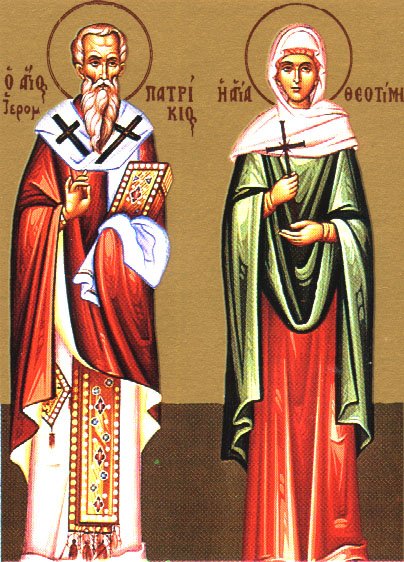
Hieromartyr Patrick, Bishop of Prusa, and his companions

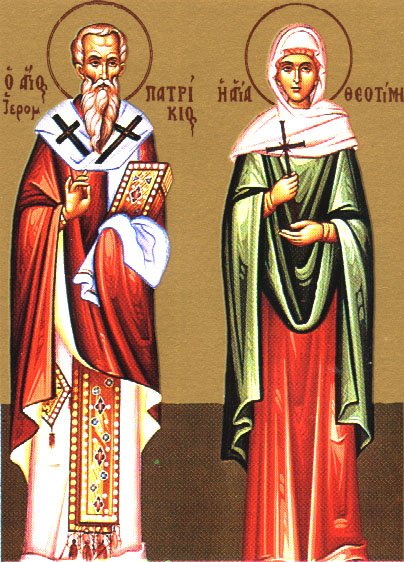
Hieromartyr Patrick, Bishop of Prusa, and his companions

Saint Patrick lived during the first century and was bishop of the city of Prusa in Bythnia (Asia Minor). He openly and boldly preached Christ the Savior, and denounced the error of the pagans. Therefore, he and the priests, Acacius, Menander and Polyainus were arrested, and brought to Julius, the prefect of the city for interrogation. Saint Patrick lived during the first century and was bishop of the city of Prusa in Bythnia (Asia Minor). He openly and boldly preached Christ the Savior, and denounced the error of the pagans. Therefore, he and the priests, Acacius, Menander and Polyainus were arrested, and brought to Julius, the prefect of the city for interrogation. Julius was going to the hot springs for treatment, and he ordered that the Christian bishop and the priests be brought along after him, bound in iron chains. After he washed in the hot springs, Julius offered sacrifice to his gods. He had Saint Patrick and the other prisoners brought before him, ordering them to offer sacrifice to the pagan gods, threatening punishment if they refused. Saint Patrick replied, “I am a Christian and I worship the one true God, Jesus Christ, Who has created the heavens and the earth, and these warm springs for the benefit of all mankind.” Julius had the saint thrown into the hot spring, and with firm faith the martyr prayed, “Lord, Jesus Christ, help Your servant,” and he remained unharmed. In an impotent rage, Julius ordered Saint Patrick and his three presbyters beheaded. They received their crowns of unfading glory from Christ around the year 100.

Troparion - Tone 4

Your holy martyr Patrick and his companions, O Lord, / through their sufferings have received incorruptible crowns from You, our God. / For having Your strength, they laid low their adversaries, / and shattered the powerless boldness of demons. / Through their intercessions, save our souls!
Venerable Cornelius, Abbot of Komel, Vologda

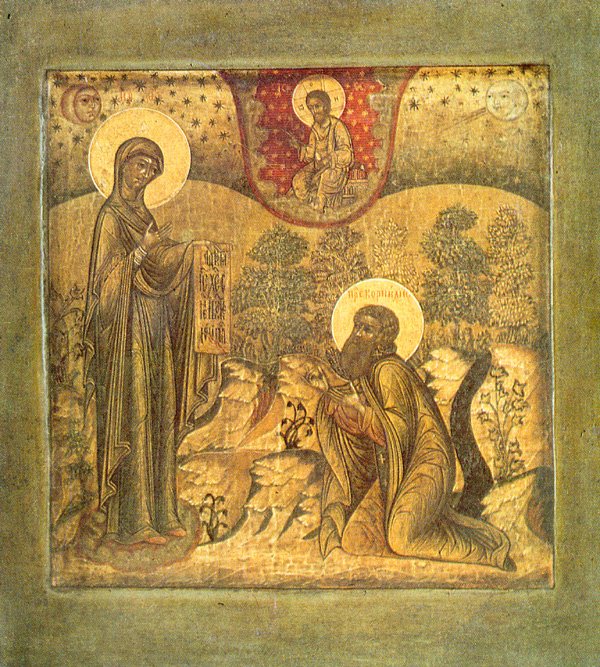
Venerable Cornelius, Abbot of Komel, Vologda

Saint Cornelius of Komel was descended from the boyar (noble) family Kriukov. His brother Lukian served at the court of the Great Prince of Moscow. When Lukian, who was getting old, decided to go to the monastery of Saint Cyril of White Lake, he was followed by Cornelius, who longed for the solitary life from a young age. Saint Cornelius of Komel was descended from the boyar (noble) family Kriukov. His brother Lukian served at the court of the Great Prince of Moscow. When Lukian, who was getting old, decided to go to the monastery of Saint Cyril of White Lake, he was followed by Cornelius, who longed for the solitary life from a young age. After he was tonsured, the young Cornelius began his monastic endeavors with a difficult obedience: he wore heavy chains in the bakery. In his spare time he occupied himself with copying church books. Because of his love for solitude, Saint Cornelius later left the White Lake monastery, and he visited Rostov. At Novgorod, Saint Gennadius (December 4) attempted to hold on to him, but the ascetic settled in a desolate spot near Novgorod. When people began to visit here also, he moved to the Tver Sabbatiev wilderness monastery. Later, in 1497, he settled in the Komel forest, not far from Vologda, where he built a cell. Monks began to gather around the cell of Saint Cornelius. In 1501 he built a wooden church in honor of the Entry into the Temple of the Most Holy Theotokos. In that year Metropolitan Simon ordained him as hieromonk. In 1512, when the number of brethren had grown, the saint built a stone church and he compiled a Rule for the brethren, based on the Rules of Saints Joseph of Volokolamsk and Nilus of Sora. This was the third monastic Rule written by Russian saints. Saint Cornelius of Komel was distinguished by his charity toward the unfortunate, and during a famine he built an orphanage in the monastery courtyard. Because of his love for the poor and orphaned, Saint Cornelius was often granted visions of Saint Anthony the Great (January 17), for whom he had a special reverence. He constructed a church at his monastery in honor of this great ascetic. The saint’s strictness of life provoked some of the brethren to grumbling, and Saint Cornelius was compelled to leave the monastery. He settled at Lake Sursk, 70 versts from his monastery. At times he also lived at the Trinity-Sergiev Lavra. Interceding for the monks of the Korniliev monastery, Great Prince Basil Ivanovich urged the saint to return to his own monastery. The ascetic gave in, and having returned to his own monastery, he transferred its guidance to his disciple Laurence and shut himself in his cell. During a Tatar incursion into the Vologda region Saint Cornelius went with the monks to the outskirts of White Lake. The saint died at the age of eighty-two on May 19, 1537. Many disciples of Saint Cornelius were also glorified for their holiness of life: Saints Gennadius of Liubimograd (January 23), Cyril of New Lake (February 4), Herodion of Iloezersk (September 28), Adrian of Poshekhonye (March 5), Laurence and Cassian of Komel (May 16). The commemoration of Saint Cornelius (May 19) was established on January 25, 1600 by Patriarch Job and a council of bishops. The Life of the saint was written by his disciple Nathaniel in the year 1589. There is a service and an encomium to the saint, and the Rule of Saint Cornelius has been preserved. Saint Cornelius is also commemorated at the Synaxis of the Saints of Vologda (Third Sunday after Pentecost); and at the Synaxis of the Saints of Tver (the Sunday after June 28).

Troparion - Tone 4

From your youth you were inflamed with the fire of divine love, / and you forsook the vanity of earthly life, O Venerable one. / As a disciple of Anthony the Great, / you served Christ in silence and in strictness, through vigil, prayer, and fasting. / Therefore, O blessed Cornelius, pray to the Lord that our souls may be saved.

Kontakion - Tone 8

From your youth, like an Angel, you served the Lord, / Who shone forth to the world from the Holy Virgin, O blessed one, / and by His power, you made the desert a city; / for there you gathered a multitude of disciples, enlightening them with your God-inspired teaching. / Therefore, we cry to you: “Hail, Father Cornelius, divine adornment of monks.”
Venerable Cornelius, Abbot of Paleostrov

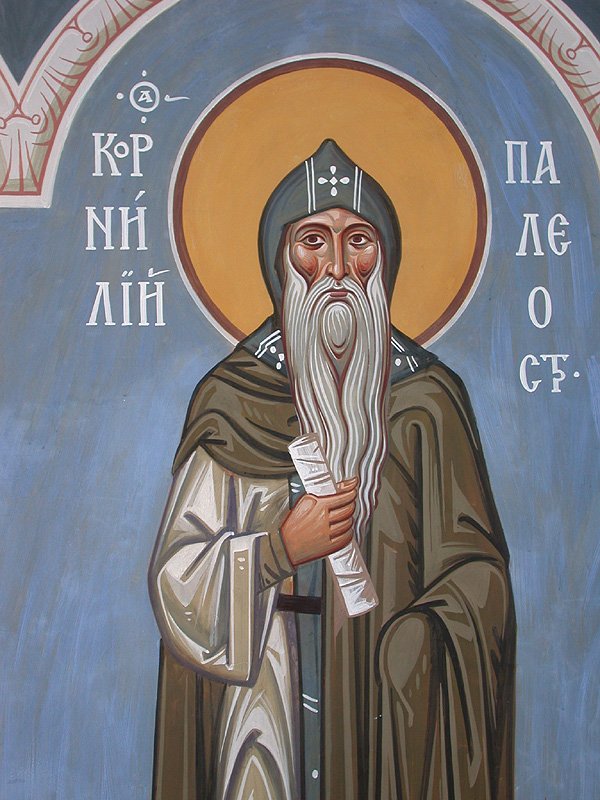
Venerable Cornelius, Abbot of Paleostrov

Saint Cornelius of Paleostrov and Olonets, born at Pskov, was the founder of monastic life on Pali island in Lake Onega at the end of the fourteenth century. Despite the desolation of the island, brethren soon gathered near him. He built for them a church in honor of the Nativity of the Most Holy Theotokos, and a trapeza church in honor of the holy Prophet Elias. Saint Cornelius of Paleostrov and Olonets, born at Pskov, was the founder of monastic life on Pali island in Lake Onega at the end of the fourteenth century. Despite the desolation of the island, brethren soon gathered near him. He built for them a church in honor of the Nativity of the Most Holy Theotokos, and a trapeza church in honor of the holy Prophet Elias. The saint spent the final years of his life in a cave half a verst from the monastery, in unceasing prayer. The ascetic added the wearing of heavy chains to his struggles. The saint’s blessed repose occurred around the year 1420. His relics were transferred to the monastery church by his disciple, Saint Abramius of Paleostrov (August 21), who was also glorified by his ascetical life, and was buried in the Paleostrov monastery beside his Elder.

Troparion - Tone 8

By a flood of tears you made the desert fertile, / and your longing for God brought forth fruits in abundance. / By the radiance of miracles you illumined the whole universe! / O our holy father Cornelius, pray to Christ our God to save our souls!

Right-believing John, Prince of Uglich, tonsured as Ignatius

The holy Prince John of Uglich was a devout and God-fearing Christian from his youth. He and his brother Demetrius were thrown into prison by their uncle John, and remained there for thirty-two years. Before his death, Prince John received monastic tonsure with the name Ignatius. He was known as a wonderworker.

Troparion - Tone 8

In you the image was preserved with exactness, O Father, / for taking up your cross, you followed after Christ. / By so doing, you taught us to disregard the flesh, for it passes away, / but to care instead for the soul, since it is immortal. / Therefore, most venerable Father Ignatius your spirit rejoices with the Angels.

Venerable Sergius of Shukhtom

Saint Sergius (Stephen, in the world) was a Schema-monk of Shukhtom (or Shukhtov) Monastery, located in the village of Shukhtom 50 km from the city of Cherepovets. His Holy Relics were buried under the floor of the monastery church, which later became the Protection parish church when the monastery was abolished. Saint Sergius (Stephen, in the world) was a Schema-monk of Shukhtom (or Shukhtov) Monastery, located in the village of Shukhtom 50 km from the city of Cherepovets. His Holy Relics were buried under the floor of the monastery church, which later became the Protection parish church when the monastery was abolished. Some information about the devout and ascetical life of Saint Sergius is given in a lengthy inscription on his tomb. It states that on May 19, 1609, the Feast of the Holy Martyr Patrick, the Bishop of Prussia, the servant of God, Schema-monk Sergius, reposed during the reign of Tsar Basil IV Shuisky, when His Holiness Ermogen (February 17 and May 12) was Patriarch of Moscow. The labor-loving body of Saint Sergius was buried in the chapel of the church of the Life-creating Trinity and the Protection of the Theotokos at Shukhtom, in the region of White Lake. The Saint was born and raised in Kazan, and from his youth he had a profound reverence for the monastic Life, but considered himself unworthy of it. He spent three years wandering through Palestine, Constantinople, and Greece, worshipping at the holy places, and learning about the monastic life in various countries. He visited Orthodox shrines from the Holy Land to Solovki Monastery, and his life was very austere. He fasted constantly, allowing himself to sleep only while sitting. Therefore, he received from God the great spiritual gifts of unceasing prayer, clairvoyance, and working miracles. In 1603, the man of God came to the Vologda region, where he was tonsured with the name Sergius by the Superior, Archimandrite Isaiah of the Cherepovets Monastery of the Resurrection. Later, Father Isaiah painted an icon depicting the Saint's tonsure. Saint Sergius reposed on May 19, 1609 at the age of seventy-nine, after fifty years of asceticism.

Troparion - Tone 8

With the streams of your tears you cultivated the barrenness of the desert; / and with your deep sighs, you bore fruit a hundredfold by your labors. / You became a luminary, shining upon the world with miracles. / O our righteous Father Sergius, intercede with Christ God that our souls be saved!

Saint John, Bishop of the Goths in the Crimea

Saint John, Bishop of the Goths, lived during the eighth century. The future saint was born in answer to the fervent prayer of his parents. From an early age, he lived a life of asceticism. The saint made a pilgrimage to Jerusalem, and spent three years visiting all the holy places. Then he returned to his native country. Saint John, Bishop of the Goths, lived during the eighth century. The future saint was born in answer to the fervent prayer of his parents. From an early age, he lived a life of asceticism. The saint made a pilgrimage to Jerusalem, and spent three years visiting all the holy places. Then he returned to his native country. At that time the emperor Constantine Copronymos the Iconoclast (741-775) banished the Gothic bishop, and the Goths fervently entreated Saint John to become their bishop. Saint John went to Georgia, which was isolated from the Iconoclast heresy. There he was ordained. Upon his return to the Goths he was soon compelled to depart from them. Hidden away from the pursuing Khazars, he settled at Amastridia, where he dwelt for four years. Hearing about the death of the Khazar kagan (ruler), the saint said, “After forty days I shall go to be judged with him before Christ the Savior.” Indeed, the saint died forty days later. This took place when he returned to his people, in the year 790. The saint’s body was conveyed to the Parthenit monastery in the Crimea, at the foot of Mount Ayu-Dag, where the saint once lived in the large church he built in honor of the holy Apostles Peter and Paul. Saint John, Bishop of the Goths, is also celebrated on June 26.

Troparion - Tone 4

In truth you were revealed to your flock as a rule of faith, / an image of humility and a teacher of abstinence; / your humility exalted you; / your poverty enriched you. / Hierarch Father John, / entreat Christ our God / that our souls may be saved.

Right-believing Demetrios Donskoy, Grand Prince of Moscow

The right-believing Great Prince Demetrios of Moscow was born in 1350. His father died when Demetrios was just a young child, and so he was entrusted to the guidance of Saint Alexis of Moscow (February 12). The holy Prince Demetrios combined Christian piety with his remarkable political talents, devoting himself to the unification of the land of Russia and to the emancipation of Russia from the Tatar-Mongol Yoke. The right-believing Great Prince Demetrios of Moscow was born in 1350. His father died when Demetrios was just a young child, and so he was entrusted to the guidance of Saint Alexis of Moscow (February 12). The holy Prince Demetrios combined Christian piety with his remarkable political talents, devoting himself to the unification of the land of Russia and to the emancipation of Russia from the Tatar-Mongol Yoke. On August 18, 1380, after gathering his forces for a decisive battle with Mamai of the Golden Horde, Saint Demetrios visited Saint Sergius of Radonezh (September 25) in order to receive his blessing. The Elder blessed two monks from his monastery, Schema-monk Andrew [Oslyaba] and Schema-monk Alexander [Peresvet], to go along and help the Prince. He also predicted that Saint Demetrios would be victorious. The Prince left Moscow with his army on August 20, and marched toward Kolomna. One day, as they made camp before the Battle of Kulikovo, an Icon of St. Nicholas appeared in the air, hovering over a pine tree, and it descended into the hands of Saint Demetrios. There is a later Icon depicting this event, with Saint Demetrios kneeling before the Icon of Saint Nicholas, and laying his gold crown at the roots of the tree. One of those who fought in the Battle of Kulikovo was a Lithuanian Prince by the name of Montvid Montvilo, who saved the life of Saint Demetrios by shielding him from a Tatar sword with his own body. That night he beheld Saint Nicholas in a dream. The holy wonderworker told him that he had cushioned the blow because Prince Montvilo wore on his chest an Icon of Saint Nicholas, which was a family heirloom. In return for saving the Prince's life, Saint Nicholas told Prince Montvilo that one of his descendants would render great service to Russia. Over the years, the Lithuanian name Montvilo became the Russian Motovilov. Alexander Motovilov, a descendant of Prince Montvilo, proposed and was rejected by his intended bride Maria, and so he entered a monastery. His obedience was to work in the prosphora bakery, but one day he felt so exhausted that he fell asleep at noon. Saint Nicholas appeared to him and said, "Alexander, your path does not lie in the monastery, but in family life. You will find your happiness with Maria, who turned you down. She will bear you a son, whom you shall name Nicholas. God requires him! I am Saint Nicholas, and I shall be the patron saint of the Motovilov family. I have been so since your ancestor, Prince Montvid Montvilo, served in the army of Prince Demetrios of the Don. During the Battle of Kulikovo, the Tatar warrior who struck down the monks Alexander and Andrew rushed at the Great Prince with his sword, but your ancestor took the blow, and the sword struck my Icon, which he wore on his chest. He would have been killed if I had not cushioned the blow, and then struck down the Tatar by Montvid's hand." The Icon of Saint Nicholas, which was damaged by the Tatar's sword, was treasured as a holy relic in the family of George Nikolaevich Motovilov. Nicholas Alexandrovich Motovilov was born on May 3, 1809, and reposed on January 14, 1879. His great service to Russia, of course, was to write down his conversation with Saint Seraphim of Sarov (January 2) about the aim of the Christian life, and how to acquire the grace of the Holy Spirit. After winning the battle, the Prince ordered a Moleben of Thanksgiving to God and to Saint Nicholas to be served. Later, he built a church and a monastery dedicated to St. Nicholas on that site. Following his victory at Kulikovo Field, between the Don and Nepryadva Rivers (on September 8, the Great Feast of the Nativity of the Most Holy Theotokos), Prince Demetrios received the honorific "of the Don." He established the Dormition Monastery at the Dubenka River, and the church of the Nativity of the Most Holy Theotokos near the graves of those who died for their country. The Memorial Saturday before the Feast of Saint Demetrios of Thessalonika (October 26) was established in memory of the Orthodox warriors who were killed at Kulikovo Field in the great battle against the Horde. Saint Demetrios fell asleep in the Lord on May 19, 1389. He was buried in the cathedral of the Archangels in the Moscow Kremlin.

Troparion - Tone 3

In you the Russian land has found a great defender in a time of tribulation, / O vanquisher of the pagans. / At the Don you defeated the vainglorious Mamai; / having received the blessing of Saint Sergius for this undertaking; / and so, Prince Demetrios, pray to Christ God to grant us great mercy.

Kontakion - Tone 2

By your deeds, Saint Demetrios, / God preserved our country by granting you invincible power. / And now, our powerful defender, / by your holy prayers, keep your city of Moscow safe from all hostile schemes.

Martyr Caluf of Egypt

The Holy Martyr Caluf the Egyptian lived during the third century, and was from the city of Thebes. For his confession of faith in Christ he was arrested and taken before the prefect of the city. He was suspended head downward, and received a cruel beating. The sufferer repeated, “I endure everything in expectation of the future life.” They then untied him and urged him to offer sacrifice to idols, but the saint did not consent. Fin The Holy Martyr Caluf the Egyptian lived during the third century, and was from the city of Thebes. For his confession of faith in Christ he was arrested and taken before the prefect of the city. He was suspended head downward, and received a cruel beating. The sufferer repeated, “I endure everything in expectation of the future life.” They then untied him and urged him to offer sacrifice to idols, but the saint did not consent. Finally, he was thrown into a fire and surrendered his soul to God. This occurred in the year 303. The holy martyr Caluf suffered during the persecution by the emperor Maximian Hercules, who ruled jointly with Diocletian (284-305).

Troparion - Tone 3

Your holy martyr Caluf, O Lord, / through his sufferings has received an incorruptible crown from You, our God. / For having Your strength, he laid low his adversaries, / and shattered the powerless boldness of demons. / Through his intercessions, save our souls!
Entrance of Saint Nino (Nina) the Enlightener into Georgia

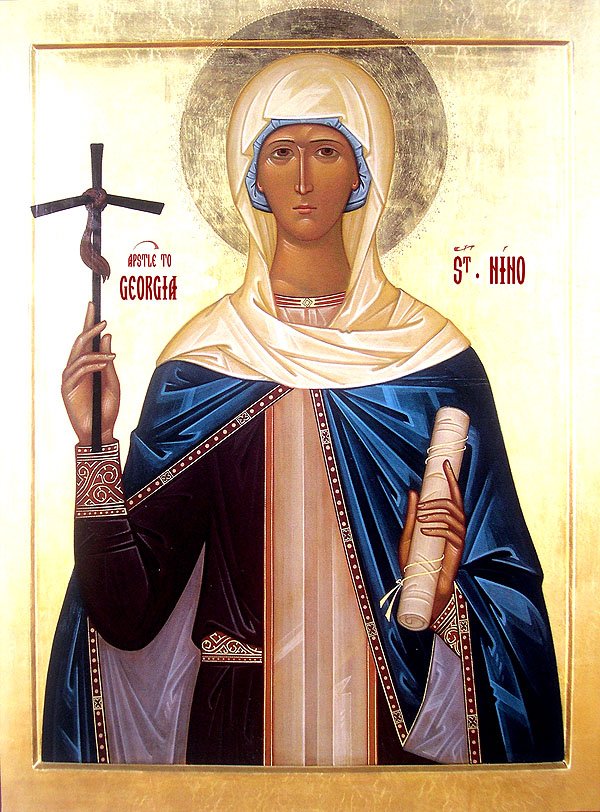
Entrance of Saint Nino (Nina) the Enlightener into Georgia

The holy Apostles Andrew the First-called and Simon the Canaanite first preached the Christian Faith in Georgia in the 1st century, but at the beginning of the 4th century most of the country was still pagan. After the Theotokos revealed God’s will for her future, the Equal-to-the-Apostles Nino set off for Georgia to enlighten the Iberian people. S The holy Apostles Andrew the First-called and Simon the Canaanite first preached the Christian Faith in Georgia in the 1st century, but at the beginning of the 4th century most of the country was still pagan. After the Theotokos revealed God’s will for her future, the Equal-to-the-Apostles Nino set off for Georgia to enlighten the Iberian people. She arrived in Armenia with the holy martyrs and virgins Rhipsimia, Gaiana and their fifty companions. The holy virgins were martyred in Armenia and, according to God’s will, Saint Nino journeyed on alone to Lake Paravani, entering Georgia from the Javakheti Mountains. She arrived in the spring, but the weather was unseasonably cold. The Apostolic Church of Georgia has honored the Entrance of the holy Equal-to-the-Apostles Nino as a major feast day. The Church also commemorates her on January 14, the day of her repose.

Troparion - Tone 4

O handmaiden of the Word of God, / who equaled the first-called Apostle Andrew in preaching, / and emulated the other Apostles; / enlightener of Iberia and lyre of the Holy Spirit, / Holy equal of the Apostles Nina, pray to Christ God for the salvation of our souls.

Kontakion - Tone 2

Come, all of you, let us sing praises today to the one chosen by Christ, / the equal of the Apostles, the preacher of God's Word, / the wise bearer of good tidings, who brought the people of Kartli to the path of life and truth; / she is the disciple of the Mother of God, / our zealous intercessor and unsleeping guardian, / the all-praised Nina.
Martyr Theotime

Martyr Theotime

There is very little information about Saint Theotime (Θεοτίμη) except that she was beheaded ca. 311, thereby receiving an incorruptible crown from Christ.

Troparion - Tone 4

Your lamb Theotime* calls out to You, O Jesus, in a loud voice: / “I love You, my Bridegroom, and in seeking You I endure suffering. / In Baptism I was crucified so that I might reign in You, / and I died so that I might live with You. / Accept me as a pure sacrifice, / for I have offered myself in love.” / Through her prayers, save our souls, since You are merciful.

Scripture Readings

Epistle

Acts 17:19-28

19 And they took him, and brought him unto Areopagus, saying, May we know what this new doctrine, whereof thou speakest, is?
20 For thou bringest certain strange things to our ears: we would know therefore what these things mean.
21 (For all the Athenians and strangers which were there spent their time in nothing else, but either to tell, or to hear some new thing.)
22 Then Paul stood in the midst of Mars’ hill, and said, Ye men of Athens, I perceive that in all things ye are too superstitious.
23 For as I passed by, and beheld your devotions, I found an altar with this inscription, TO THE UNKNOWN GOD. Whom therefore ye ignorantly worship, him declare I unto you.
24 God that made the world and all things therein, seeing that he is Lord of heaven and earth, dwelleth not in temples made with hands;
25 Neither is worshipped with men’s hands, as though he needed any thing, seeing he giveth to all life, and breath, and all things;
26 And hath made of one blood all nations of men for to dwell on all the face of the earth, and hath determined the times before appointed, and the bounds of their habitation;
27 That they should seek the Lord, if haply they might feel after him, and find him, though he be not far from every one of us:
28 For in him we live, and move, and have our being; as certain also of your own poets have said, For we are also his offspring.

Gospel

John 12:19-36

19 The Pharisees therefore said among themselves, Perceive ye how ye prevail nothing? behold, the world is gone after him.
20 And there were certain Greeks among them that came up to worship at the feast:
21 The same came therefore to Philip, which was of Bethsaida of Galilee, and desired him, saying, Sir, we would see Jesus.
22 Philip cometh and telleth Andrew: and again Andrew and Philip tell Jesus.
23 And Jesus answered them, saying, The hour is come, that the Son of man should be glorified.
24 Verily, verily, I say unto you, Except a corn of wheat fall into the ground and die, it abideth alone: but if it die, it bringeth forth much fruit.
25 He that loveth his life shall lose it; and he that hateth his life in this world shall keep it unto life eternal.
26 If any man serve me, let him follow me; and where I am, there shall also my servant be: if any man serve me, him will my Father honour.
27 Now is my soul troubled; and what shall I say? Father, save me from this hour: but for this cause came I unto this hour.
28 Father, glorify thy name. Then came there a voice from heaven, saying, I have both glorified it, and will glorify it again.
29 The people therefore, that stood by, and heard it, said that it thundered: others said, An angel spake to him.
30 Jesus answered and said, This voice came not because of me, but for your sakes.
31 Now is the judgment of this world: now shall the prince of this world be cast out.
32 And I, if I be lifted up from the earth, will draw all men unto me.
33 This he said, signifying what death he should die.
34 The people answered him, We have heard out of the law that Christ abideth for ever: and how sayest thou, The Son of man must be lifted up? who is this Son of man?
35 Then Jesus said unto them, Yet a little while is the light with you. Walk while ye have the light, lest darkness come upon you: for he that walketh in darkness knoweth not whither he goeth.
36 While ye have light, believe in the light, that ye may be the children of light. These things spake Jesus, and departed, and did hide himself from them.

Liturgical data sourced from OCA.org and orthocal.info