Fasting Rules

Meat allowed Meat Allowed
Fish allowed Fish Allowed
Dairy allowed Dairy Allowed
Oil allowed Oil Allowed
Wine allowed Wine Allowed

Saints & Commemorations
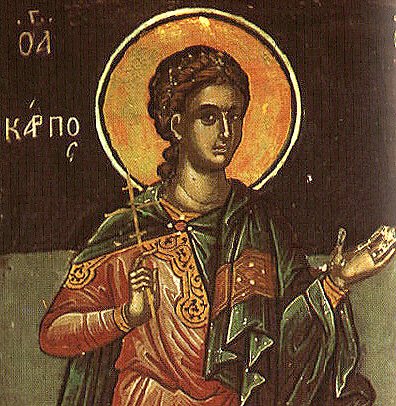
Apostle Carpus of the Seventy

Apostle Carpus of the Seventy

Saint Carpus was one of the Seventy Apostles chosen and sent forth to preach by Christ (Luke 10:1). He was bishop of Verria in Macedonia.

Troparion - Tone 3

Holy Apostles Carpus and Alphaeus, / entreat the merciful God / to grant our souls forgiveness of transgressions.
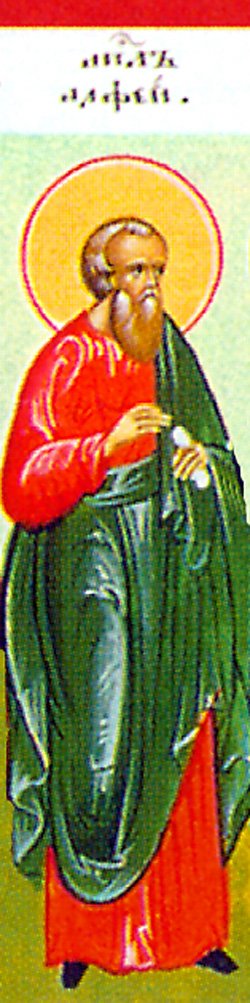
Apostle Alphaeus of the Seventy

Apostle Alphaeus of the Seventy

The Holy Apostle Alphaeus of the Seventy came from the Galilean city of Capernaum and was the father of the Apostles James and Matthew.

Troparion - Tone 3

Holy Apostle Alphaeus, / entreat the merciful God, / to grant our souls forgiveness of transgressions.
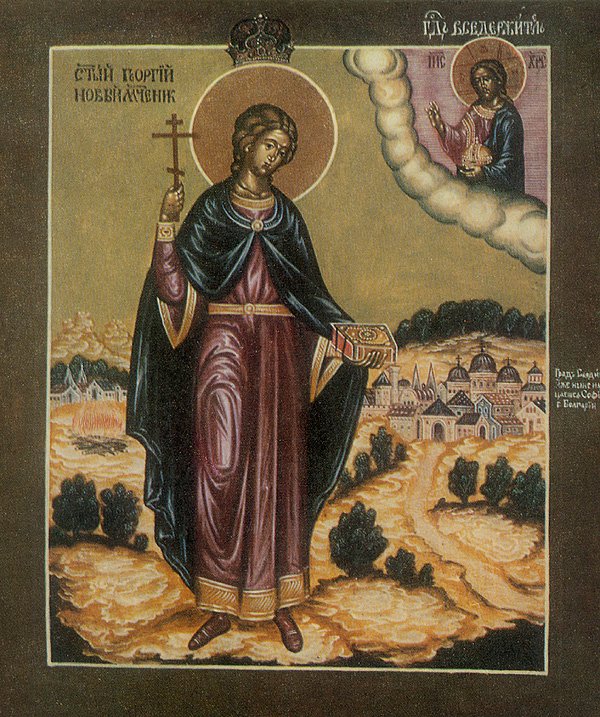
Greatmartyr George the New at Sofia, Bulgaria

Greatmartyr George the New at Sofia, Bulgaria

The Holy Martyr George the New was born into an illustrious Bulgarian family, living in the capital city of Bulgaria, Sredets (now the city of Sofia). Saint George’s childless parents, John and Mary, in their declining years entreated the Lord to send them a child. Their prayer was answered, and they baptized the infant with the name of the holy Great Martyr George (April 23). The Holy Martyr George the New was born into an illustrious Bulgarian family, living in the capital city of Bulgaria, Sredets (now the city of Sofia). Saint George’s childless parents, John and Mary, in their declining years entreated the Lord to send them a child. Their prayer was answered, and they baptized the infant with the name of the holy Great Martyr George (April 23). Young George received a fine upbringing, he attentively studied the Holy Scriptures, and he was pious and chaste. His parents died when George was twenty-five. At that time Bulgaria found itself under the rule of the Turks, who forcibly converted Christians to Islam. Once, several Moslems tried to convert George. They put a fez on the saint’s head. This is a red circular hat which Moslems wear to enter their house of prayer. But George threw the fez on the ground. The Turks brought the martyr to their governor with beatings and abuse. The governor was impressed with Saint George’s appearance and bearing, and he urged him to accept Islam, promising honors and wealth from Sultan Selim (1512-1520). The saint boldly and steadfastly confessed his faith in the Lord Jesus Christ, and reproached the errors of Islam. The governor in a rage gave orders to beat Saint George with rods, but the saint persevered in his confession of faith in Christ. The governor ordered the tortures to be increased. The passion-bearer bore all his sufferings, calling on the Lord Jesus Christ for help. Then they led the martyr through the city to the beat of a drum and shouts: “Do not insult Mohammed nor abase the Moslem faith”. Finally, a large fire was lit in the city, to burn Saint George. Weakened by his wounds, the saint fell to the ground. They threw him into the fire still alive, and they threw corpses of dogs on top of him so that Christians would not be able to find the relics of the martyr. Suddenly, a heavy rain fell and extinguished the fire. With the onset of darkness, the place where the body of the martyr was thrown was illumined with a bright light. They gave permission to a certain Christian priest to take the venerable relics of the martyr for burial. Informed about the occurrence, Metropolitan Jeremiah and his clergy went to the place of execution. In the ashes of the fire they located the body of the holy Martyr George and carried it to the church of Saint George the Great Martyr in the city of Sredets. On May 26, 1515 the holy relics of Saint George were removed from the grave, placed in a coffin, and then brought into the church, where they have remained ever since. The Church honors Saint George twice during the year: on February 11 , the day of his martyrdom, and on May 26, the uncovering of his holy relics.

Troparion - Tone 3

Your holy martyr George, O Lord, / through his sufferings has received an incorruptible crown from You, our God. / For having Your strength, he laid low his adversaries, / and shattered the powerless boldness of demons. / Through his intercessions, save our souls!
Uncovering of the relics of Venerable Macarius, Abbot of Kalyazin

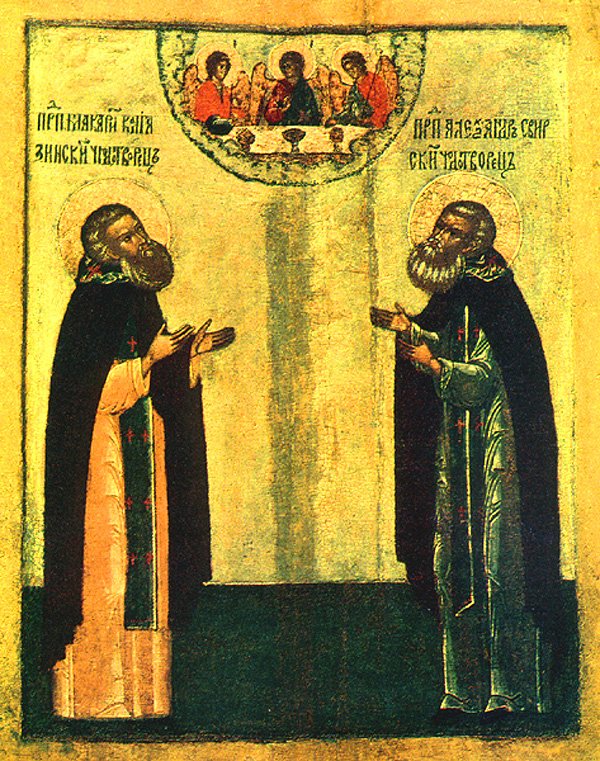
Uncovering of the relics of Venerable Macarius, Abbot of Kalyazin

The Uncovering of the Relics of Saint Macarius of Kalyazin occurred on May 26, 1521. A merchant from the city of Dmitrov, Michael Voronkov, offered the means for the construction of a stone church to replace the decaying wooden one at the Kalyazin monastery. The igumen of the monastery, Joasaph, set up a cross at the spot designated for the altar, and gave a blessing to dig the trench for the foundation. The Uncovering of the Relics of Saint Macarius of Kalyazin occurred on May 26, 1521. A merchant from the city of Dmitrov, Michael Voronkov, offered the means for the construction of a stone church to replace the decaying wooden one at the Kalyazin monastery. The igumen of the monastery, Joasaph, set up a cross at the spot designated for the altar, and gave a blessing to dig the trench for the foundation. During the work a grave was discovered, exuding an ineffable fragrance. Igumen Joasaph immediately recognized the grave of the monastery’s founder, Saint Macarius, who reposed in the year 1483. The brethren of the monastery and a crowd of people sang a Panikhida during the transfer of the coffin to the church. From that day the incorrupt relics of the saint began to work healings. A report about this was made to Metropolitan Daniel of Moscow (1522-1539), who convened a Council at Moscow. After examining testimony about the sanctity of Macarius, he established a Feast day for the newly-appeared saint. The relics were solemnly transferred to the church of the Holy Trinity. Theodosius of Tver composed the service for the Uncovering of the Relics. Until 1547, Saint Macarius was venerated only at this monastery. During the Moscow Council of 1547 under Metropolitan Macarius (1543-1564), Saint Macarius of Kalyazin was numbered among the saints, and his name added to the calendar of other Russian saints to be celebrated throughout all of Russia. The Life of Saint Macarius of Kalyazin is found under March 17, the day of his blessed repose.

Troparion - Tone 8

By a flood of tears you made the desert fertile, / and your longing for God brought forth fruits in abundance. / By the radiance of miracles you illumined the whole universe! / O our holy father Macarius, pray to Christ our God to save our souls!
Martyrs Abercius and Helen, children of the Apostle Alphæus

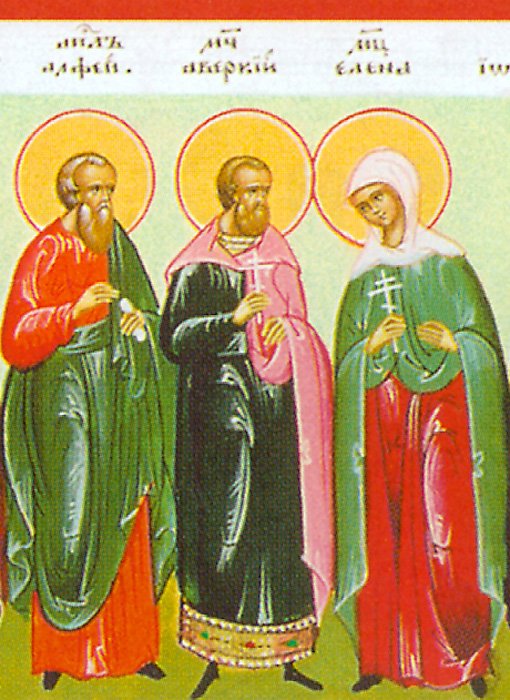
Martyrs Abercius and Helen, children of the Apostle Alphæus

According to Tradition, the Holy Martyrs Abercius and Helen were children of the holy Apostle Alphaeus. For confessing his faith in Christ, Saint Abercius was tied naked to a beehive and died from the bees’ sting. For confessing her faith in Christ, Saint Helen was pelted with stones.

Troparion - Tone 4

Your holy martyrs O Lord, / through their sufferings have received incorruptible crowns from You, our God. / For having Your strength, they laid low their adversaries, / and shattered the powerless boldness of demons. / Through their intercessions, save our souls!
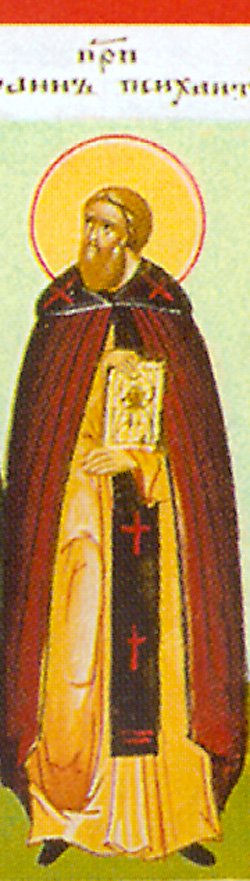
Venerable Confessor John Psykhaitis

Venerable Confessor John Psykhaitis

The Venerable Confessor John Psykhaitis (Psykhaϊtēs) lived at the end of the VIII or the beginning of the IX century. Nothing is known about his early life, but he lived during the reign of Emperor Leo V (813 – 820). As a young man, he forsook the world and became a monk at the Psykhaiti (Psykhaϊtē) Monastery (in the suburbs of Constantinople). The S The Venerable Confessor John Psykhaitis (Psykhaϊtēs) lived at the end of the VIII or the beginning of the IX century. Nothing is known about his early life, but he lived during the reign of Emperor Leo V (813 – 820). As a young man, he forsook the world and became a monk at the Psykhaiti (Psykhaϊtē) Monastery (in the suburbs of Constantinople). The Saint was an ascetic who subdued the desires of the flesh by fasting, prayer, and austerity. Because of his holy life and deeds, he received from God the gift of casting out demons and healing diseases. The iconoclast heresy was raging at that time, and those who venerated holy icons were subjected to persecution. Saint John was led away for interrogation, and they tried to force him to sign a document repudiating the veneration of the holy icons. Instead of repudiating the holy icons, the Saint denounced his persecutors, calling Emperor Leo the Isaurian (813 – 820) a heretic; therefore, he was sent into exile. He was a vigorous defender of the holy icons, and he fought against the impious iconoclasts. For this reason, he was arrested and exiled many times. After every persecution, he returned more energetic and more aggressive than before, defeating the audacity of the iconoclasts, who despised the revered image of Christ. Saint John had tremendous spiritual strength and great boldness. His very appearance shook his opponents and strengthened his friends. Therefore, he was highly respected and honored by all. This was enhanced by the miraculous grace with which he had been endowed by God. After living a godly life, and contesting mightily for the Orthodox Faith, Saint John reposed in peace Saint John is commemorated on May 7 in Greek usage.

Troparion - Tone 8

In you, O Father, was preserved with exactness what was according to the image; / for you took up the Cross and followed Christ. / By so doing, you taught us to disregard the flesh, for it passes away; / but to care for the soul, since it is immortal. / Therefore, O Venerable John, your spirit rejoices with the Angels.

Kontakion - Tone 2

Finding delight in abstinence, / you subdued the desires of the flesh / Revealed as one nurtured in the Faith, / you blossomed like the Tree of Life in Paradise, / O Holy Father John.
Saint Augustine of Canterbury, Evangelizer of England

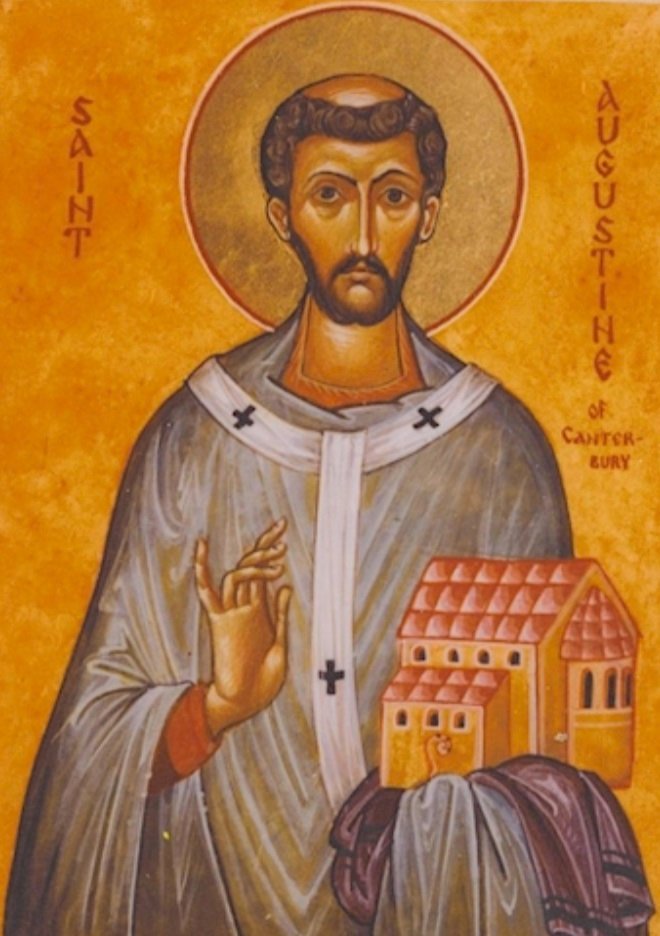
Saint Augustine of Canterbury, Evangelizer of England

Saint Augustine was from Italy, and a disciple of Saint Felix, Bishop of Messana. Saint Gregory Dialogus (March 12) chose him to lead a mission of forty monks to evangelize the people of Britain. They arrived at Ebbsfleet (on the isle of Thanet) in Kent in 597. King Ethelbert, whose Frankish wife Bertha was a Christian, welcomed them. Saint Augustine was from Italy, and a disciple of Saint Felix, Bishop of Messana. Saint Gregory Dialogus (March 12) chose him to lead a mission of forty monks to evangelize the people of Britain. They arrived at Ebbsfleet (on the isle of Thanet) in Kent in 597. King Ethelbert, whose Frankish wife Bertha was a Christian, welcomed them. They were allowed to base their mission at the ancient church of Saint Martin in Canterbury, which was restored for their use. This church had been built during the Roman occupation of Britain, and the queen often went there to pray. At first, the king was reluctant to give up his pagan beliefs, but he promised not to harm them, and to supply them with whatever they needed. He also promised that he would not prevent them from preaching Christianity. Saint Augustine later converted the king to Christianity, along with thousands of his subjects. The holy right-believing King Ethelbert is commemorated on February 25. Bede says that Saint Augustine was consecrated as Archbishop of Britain by Archbishop Etherius of Arles (others say that it was his successor Saint Virgilius of Arles [March 5] who consecrated Saint Augustine). Returning to Britain, he threw himself into the work of evangelizing the country with renewed zeal. Saint Augustine built Christ Church, predecessor of the present cathedral at Canterbury, and consecrated it on June 9, 603 (according to the Anglo-Saxon Chronicle). He also founded the monastery of Saints Peter and Paul east of the city. Here Saint Augustine, the Archbishops of Canterbury, and the Kings of Kent were buried. The monastery, now in ruins, was later known as Saint Augustine’s Monastery. The saint was instrumental in founding the dioceses of Rochester and London. In 604 he consecrated Saint Justus (November 10) and Saint Mellitus (April 24) as bishops for those Sees. Saint Augustine also helped the king draft the earliest Anglo-Saxon laws, and founded a school in Canterbury. Saint Augustine was not completely successful in all his efforts, however. He was not able to achieve unity with the already existing Christian communities who followed Celtic practices. He met with some of their bishops to urge them to abandon their Celtic traditions and to accept the Roman practices. He invited them to cooperate with him in evangelizing the country, but they refused to give up their ancient traditions. Before meeting with Saint Augustine in 603, the Celtic bishops asked a holy hermit whether or not to accept Augustine as their leader. The hermit replied, “If he rises to greet you, then accept him. If he remains seated, then he is arrogant and unfit to be your leader, and you should reject him.” Unfortunately, Saint Augustine did not rise to greet them. Perhaps Saint Augustine was, to some degree, a bit tactless and too insistent on conformity to Roman customs. On the other hand, Celtic resentment against Roman authority also contributed to the stormy relationship. Known in his lifetime as a wonderworker, Saint Augustine fell asleep in the Lord on May 26, 604. He was laid to rest at the entrance of the unfinished church of Saints Peter and Paul. When the church was dedicated in 613, his holy relics were placed inside. An epitaph was composed for his tomb. In part, it reads: “Here lies the Lord Augustine, first Archbishop of Canterbury, sent here by blessed Gregory, bishop of the city of Rome, who with the help of God, and aided by miracles, guided King Ethelbert and his people from the worship of idols to the Faith of Christ.” Saint Bede (May 27) gives detailed information about Saint Augustine’s mission to Britain in his History of the English Church and People (Book I, 23-33. Book II, 1-3).

Troparion - Tone 8

In you the image was preserved with exactness, O Father, / for taking up your cross, you followed after Christ. / By so doing, you taught us to disregard the flesh, for it passes away, / but to care instead for the soul, since it is immortal. / Therefore, most venerable Father Augustine your spirit rejoices with the Angels.

Scripture Readings

Epistle

Acts 21:26-32

26 Then Paul took the men, and the next day purifying himself with them entered into the temple, to signify the accomplishment of the days of purification, until that an offering should be offered for every one of them.
27 And when the seven days were almost ended, the Jews which were of Asia, when they saw him in the temple, stirred up all the people, and laid hands on him,
28 Crying out, Men of Israel, help: This is the man, that teacheth all men every where against the people, and the law, and this place: and further brought Greeks also into the temple, and hath polluted this holy place.
29 (For they had seen before with him in the city Trophimus an Ephesian, whom they supposed that Paul had brought into the temple.)
30 And all the city was moved, and the people ran together: and they took Paul, and drew him out of the temple: and forthwith the doors were shut.
31 And as they went about to kill him, tidings came unto the chief captain of the band, that all Jerusalem was in an uproar.
32 Who immediately took soldiers and centurions, and ran down unto them: and when they saw the chief captain and the soldiers, they left beating of Paul.

Gospel

John 16:2-13

2 They shall put you out of the synagogues: yea, the time cometh, that whosoever killeth you will think that he doeth God service.
3 And these things will they do unto you, because they have not known the Father, nor me.
4 But these things have I told you, that when the time shall come, ye may remember that I told you of them. And these things I said not unto you at the beginning, because I was with you.
5 But now I go my way to him that sent me; and none of you asketh me, Whither goest thou?
6 But because I have said these things unto you, sorrow hath filled your heart.
7 Nevertheless I tell you the truth; It is expedient for you that I go away: for if I go not away, the Comforter will not come unto you; but if I depart, I will send him unto you.
8 And when he is come, he will reprove the world of sin, and of righteousness, and of judgment:
9 Of sin, because they believe not on me;
10 Of righteousness, because I go to my Father, and ye see me no more;
11 Of judgment, because the prince of this world is judged.
12 I have yet many things to say unto you, but ye cannot bear them now.
13 Howbeit when he, the Spirit of truth, is come, he will guide you into all truth: for he shall not speak of himself; but whatsoever he shall hear, that shall he speak: and he will shew you things to come.

Liturgical data sourced from OCA.org and orthocal.info