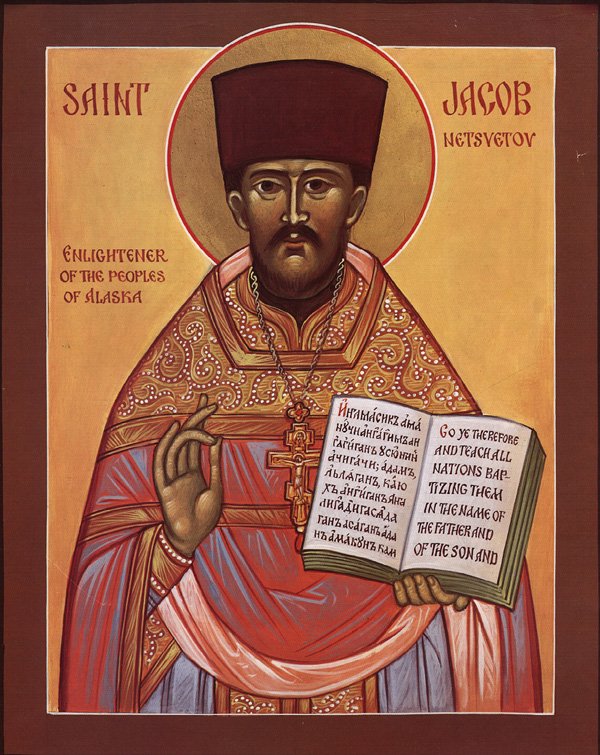
Repose of Saint Jacob Netsvetov, Enlightener of the Peoples of Alaska
Father Jacob (Netsvetov) of Alaska was born of pious parents in 1802 on Atka Island, Alaska. His father, Yegor Vasil’evich Netsvetov was a Russian from Tobolsk. His mother, Maria Alekseevna, was an Aleut from Atka island. Yegor and Maria had four children who survived infancy; Jacob was the first born, followed by Osip (Joseph), Elena, and Antony. Y
Father Jacob (Netsvetov) of Alaska was born of pious parents in 1802 on Atka Island, Alaska. His father, Yegor Vasil’evich Netsvetov was a Russian from Tobolsk. His mother, Maria Alekseevna, was an Aleut from Atka island. Yegor and Maria had four children who survived infancy; Jacob was the first born, followed by Osip (Joseph), Elena, and Antony. Yegor and Maria were devoted to their children and, though of meager means, did all they could to provide them with the education which would help them in this life as well as in the life to come. Osip and Antony were eventually able to study at the Saint Petersburg Naval Academy in Russia, becoming a naval officer and a shipbuilder, respectively. Their sister, Elena, married a successful and respected clerk for the Russian-American Company. But Jacob yearned for a different kind of success, a success that the world might consider failure for “the righteous live forever, their reward is with the Lord” (Wis. Sol. 5:15). And so, when the family moved to Irkutsk in 1823, Jacob enrolled in the Irkutsk Theological Seminary and placed all his hope in Christ by seeking first the Kingdom of God (Mt. 6:33).
Jacob was tonsured as a Subdeacon on October 1, 1825. He married a Russian woman (perhaps also a Creole) named Anna Simeonovna, and in 1826 graduated from the Seminary with certificates in history and theology. On October 31, 1826, he was ordained to the Holy Diaconate and assigned to serve the altar of the Holy Trinity-Saint Peter Church in Irkutsk. Two years later, on March 4, 1828, Archbishop Michael, who had earlier ordained Father John Veniaminov (Saint Innocent), elevated the godly deacon Jacob to the Holy Priesthood. This, however, was no ordinary ordination. As if he were a new Patrick, hearing the mystical call of his distant flock, Father Jacob yearned to return to his native Alaska. And the all-good God, who “satisfies the longing soul and fills the hungry soul with goodness” (Ps.107:9) heard the prayer of his servant.
Archbishop Michael provided Father Jacob with two antimensia: one for the new Church which would be dedicated to the glory of God in honor of Saint Nicholas the Wonderworker in Atka, and one to be used for missionary activity. On May 1, 1828 a molieben for travelers was served, and Father Jacob, his father, Yegor, (now tonsured as reader for the Atka Church), and his matushka, Anna, set out for Alaska.
Who can tell of the perils and trials associated with such a journey? Travel in those days was never easy, either overland or over the waves of the sea. Nevertheless, aided by prayer and confidence in God’s providence, the Netsvetov family arrived safely in Atka over a year later, on June 15, 1829. The new assignment for the newly-ordained Father Jacob would also prove to be quite a challenge. The Atka “parish” comprised a territory stretching for nearly 2,000 miles and included Amchitka, Attu, Copper, Bering and Kurile Islands. But this did not deter the godly young priest, for when he was clothed in the garments of the Priesthood, he was found to be “clad with zeal as a cloak’ (Is. 59:17), and so he threw himself wholly into his sacred ministry. His deep love for God and for his flock was evident in everything that he did. Both in Atka and in the distant villages and settlements which he visited, Father Jacob offered himself as a “living sacrifice” (Rom 12:1). Having “no worry about his life” (Mt. 6:25 ff), the holy one endured manifold tortures of cold, wet, wind, illness, hunger and exhaustion, for to him life was Christ (Phil 1:21). Showing himself as a “rule of faith,” his example brought his people to a deep commitment to their own salvation. Being fully bilingual and bicultural, Father Jacob was uniquely blessed by God to care for the souls of his fellow Alaskans.
When he arrived in Atka, the Church of Saint Nicholas had not yet been built. So, with his own hands Father Jacob constructed a large tent (Acts 18:3) in which he conducted the services. For Father Jacob the services of the Church were life: life for his people and life for himself. It was in the worship of God that he found both strength and joy. Later he would transport this tent with him on his missionary journeys, and like Moses in the wilderness, the grace of God was found wherever this tent was taken (Num 4:1 ff; 10:17 ff).
When his first six months had ended (end of 1829), Father Jacob recorded that he had baptized 16, chrismated 442, married 53 couples, and buried 8.
Once the church was constructed, Father Jacob turned his attention to the building of a school in which the children would learn to read and write both Russian and Unangan Aleut. The Russian American Company provided some of the support initially, with the students providing the remainder. This continued until 1841, when it was reorganized as a parish school and ties with the company ceased. Father Jacob proved to be a talented educator and translator whose students became distinguished Aleut leaders in the next generation.
Father Netsvetov led an active physical and intellectual life, hunting and gathering for his own subsistence needs, preparing specimens of fish and marine animals for the natural history museums of Moscow and Saint Petersburg, corresponding with Saint Innocent (Veniaminov) on matters of linguistics and translations. He labored over the creation of an adequate alphabet for the Unangan-Aleut language, and the translation of the Holy Scriptures and other appropriate literature into that language. Saint Innocent praised the young pastor for his holiness of life, his teaching, and for continuing this work of translating which he, himself, had begun earlier among the native peoples. After fifteen years of service, Father Jacob was awarded the Nabedrennik, Kamilavka, and Gold Cross. Later, he would be made Archpriest and receive the Order of Saint Anna.
These ecclesiastical awards do not tell of the personal sufferings of this warrior for Christ. In March of 1836, his precious wife, Anna, died of cancer; his home burned to the ground in July of 1836; and his dear father, Yegor, died of an undetermined illness in 1837. Who can utter the depth of sorrow felt by this God-pleaser? Yet he lifted up his voice with that ancient sufferer and cried, “shall we indeed accept good from God and shall we not accept adversity? In all this he did not sin with his lips” (Job 2:10). In his journal Father Jacob attributed all to “the Will of Him whose Providence and Will are inscrutable and whose actions toward men are incomprehensible.” He patiently endured hardships and sufferings like the Holy Apostle Paul. He saw in these misfortunes not a Victory by the hater of men’s souls (i.e. the devil) but a call from God to even greater spiritual struggles. With this in mind, Father Jacob petitioned his ruling bishop to return to Irkutsk in order to enter the monastic life. A year later, word reached him that permission was granted contingent upon the arrival of a replacement. None ever came.
Instead, Bishop Innocent soon came to Atka and asked Father Jacob to accompany him on a voyage by ship to Kamchatka. Who can know the heavenly discourse enjoyed by these two lovers of Christ as they traveled over the waves? This, however, is clear, the holy archpastor was able to accomplish three things in Father Netsvetov. Firstly, he applied the healing salve of the Spirit with words of comfort; secondly, he dissuaded Father Jacob from entering the monastery; and thirdly, he revealed to the godly priest the true plan of the Savior for his life, that he ‘might preach (Christ) among the Gentiles” (Gal. 1: 16) deep in the Alaskan interior. Father Jacob continued to serve his far-flung flock of the Atka parish until December 30, 1844. A new zeal had taken hold of him, and it was then that Saint Innocent appointed him to head the new Kvikhpak Mission in order to bring the light of Christ to the people of the Yukon. Here, aided by two young Creole assistants, Innokentii Shayashnikov and Konstantin Lukin, together with his young nephew, Vasilii Netsvetov, Father Jacob “settled’ in the wilderness of Alaska.
He learned new languages, embraced new peoples and cultures, devised another alphabet, built another church and Orthodox community, and for the next twenty years, until his health and eyesight failed, continued to be an evangelical beacon of the grace of God in southwestern Alaska.
Establishing his headquarters in the Yup’ik Eskimo village of Ikogmiute (today’s ‘Russian Mission’) he traveled to native settlements hundreds of miles up and down Alaska’s longest river (the Yukon) as well as the Kuskokwim River region. At the insistence of Indian leaders, he traveled as far as the middle of the Innoko River baptizing hundreds of Indians from various, and often formerly hostile, tribes. “Behold how good and how pleasant it is for brethren to dwell together in unity” (Ps 133:1). He built the first Christian temple in this region, and dedicated it to the feast of the Elevation of the Holy Cross. Here Father Jacob, in spite of failing health, joyfully celebrated the Church’s cycle of services, including all of the services prescribed for Holy Week and Pascha.
Finally, in 1863, the evil One, who “walks about like a roaring lion, seeking whom he may devour” (I Pet 5:8), sought one last time to get the better of the righteous one. So the devil, the father of lies, (John 8:44), inspired an assistant of Father Jacob to level spurious and slanderous charges against his master. This resulted in a summons to Sitka, issued by Bishop Peter. The godly pastor was quickly cleared of all charges, but due to his ever-worsening health, he remained in Sitka for his final year serving a Tlingit chapel. He died on July 26, 1864 at the age of 60 and was buried on the third day at the entry of the chapel. During his final missionary travels in the Kuskokwim/Yukon delta region, he had baptized 1,320 people—distinguishing himself as the evangelizer of the Yup’ik Eskimo and Athabascan Indian peoples.
This brief history has recounted the basic chronology of the saint’s life and labors, but we must not neglect to relate his other deeds, that the light be not “hidden under a bushel” (Mt.5:15). In 1841, Father Jacob encountered a group of women from his flock in Amlia who had fallen victim to certain demonic influences and teachings. Blaming himself for the seduction and fall of his spiritual children by the evil one, he informed the leader among them that he was going to pay them a visit.
Upon arriving, he found one of the women paralyzed, semi-conscious and unable to speak. He ordered that she be removed to another house apart, and on the next day when this was accomplished, he lit the lampada before the icons of the beautiful corner, vested himself in his priestly epitrachilion (stole), sprinkled holy water throughout the room, and began the first prayers of exorcism. He then left.
During the night he was notified that the woman had begun to speak but incoherently. He came immediately to her and performed a second exorcism. This time, she sprang out of her bed and stood next to the saint, joined her prayer to his, and accompanied them with prostrations. When the prayers were finished, Father Jacob again sprinkled her with holy water and gave her the precious cross to kiss. She regained full consciousness, a state of health and true reason—that is, even the false teachings of the evil spirits had no more part in her.
Once in November of 1845, Father Jacob was preaching in the village of Kalskag, where the local chief was also the head shaman. He spoke for all of the villagers and resisted the Word of God forcefully. But the saint, calm and full of the Holy Spirit, continued to sow the seeds of right belief and piety. After many hours, the chief fell silent and finally came to believe. The villagers, in solidarity with their leader, also joyously expressed their belief in the Triune God and sought Holy Baptism.
Father Jacob was a physician of bodies as well as souls. He often cared for the sick among his flock even to his own detriment. During the winter of 1850-1851 the saint was himself ravaged with illness. Yet he cared for the sick and dispensed medicine to them every day. Father Jacob’s preaching often brought together in the Holy Faith tribes who were traditional enemies. One example from his journal reads:
“Beginning in the morning, upon my invitation, all the Kol’chane and Ingalit from the Yukon and the local ones gathered at my place and I preached the word of God, concluding at noon. Everyone listened to the preaching with attention and without discussion or dissent, and in the end they all expressed faith and their wish to accept Holy Baptism, both the Kol’chane and the Ingatit (formerly traditional enemies). I made a count by families and in groups, and then in the afternoon began the baptismal service. First I baptized 50 Kol’chane and Ingalit men, the latter from the Yukon and Innoko. It was already evening when I completed the service. March 21, 1853.”
So it was that this apostolic man, this new Job, conducted himself during his earthly course. There are many other deeds and wonders which he performed, many known and many more known only to God. Few missionaries in history have had to endure the hardships which Father Jacob faced, yet he did so with patience and humility. His life of faith and piety are the legacy which he leaves to us, his spiritual children in America, and indeed to all Christians throughout the world.
Troparion - Tone 4
Righteous Father Jacob, / adornment of Atka and the Yukon delta, / offspring of Russian America, / flower of brotherly unity, / healer of sickness, / and terror of demons, / you offered yourself as a living sacrifice / to bring light to a searching people. / Pray to Christ God that our souls may be saved!
Kontakion - Tone 3
Holy Father Jacob, / teacher of the knowledge of God, / you revealed your love for your people, / taking up your cross and following Christ, / enduring hardships like the apostle Paul. / Pray on our behalf to Christ our God / to grant us great mercy!
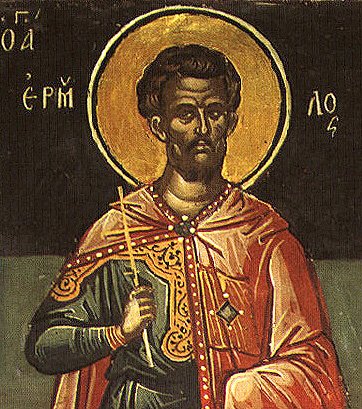
Hieromartyr Hermolaus and Martyrs Hermippus and Hermocrates at Nicomedia
Hieromartyrs Hermolaus, Hermippus and Hermocrates of Nicomedia, were among the small number of those remaining alive after 20,000 Christians were burned alive in a church at Nicomedia in the year 303 (December 28), on the orders of the emperor Maximian (284-305). They lived in remote places and did not cease to preach Christianity to the pagans.
Hieromartyrs Hermolaus, Hermippus and Hermocrates of Nicomedia, were among the small number of those remaining alive after 20,000 Christians were burned alive in a church at Nicomedia in the year 303 (December 28), on the orders of the emperor Maximian (284-305). They lived in remote places and did not cease to preach Christianity to the pagans.
The young pagan named Pantoleon (Holy Great Martyr Panteleimon, July 27) often passed by the house in which Saint Hermolaus had concealed himself. Once Saint Hermolaus chanced to meet the youth and asked him to stop by his house. In their conversation Saint Hermolaus began to explain to his guest the falseness, impiety and vanity of worshipping the pagan gods. From that day on, Pantoleon began to visit Saint Hermolaus daily and received holy Baptism from him.
When the trial of the holy Great Martyr Panteleimon was being held, Saints Hermolaus, Hermippus and Hermocrates, were also arrested. The Lord Jesus Christ appeared to Saint Hermolaus one evening and revealed to him that on the following day he would suffer for Him and receive a martyr’s crown.
Saints Hermippus and Hermocrates were arrested and brought to trial after Saint Hermolaus. All three were given the chance to deny Christ and offer sacrifice to idols. But they resolutely refused, confessed their faith in the Lord Jesus Christ and were prepared gladly to die for Him.
The pagans began to threaten the holy priests with torture and death. Suddenly, a strong earthquake occurred, and the idols and pagan temple collapsed and shattered. This was reported to the emperor. The enraged Maximian gave the holy martyrs over to torture and pronounced upon them a sentence of death. Bravely enduring all the torments, the holy Hieromartyrs Hermolaus, Hermippus and Hermocrates were beheaded in about the year 305.
Troparion - Tone 4
O God of our Fathers, / always act with kindness towards us; / take not Your mercy from us, / but guide our lives in peace / through the prayers of the hierarchs Hermolaus, Hermippus, and Hermocrates.
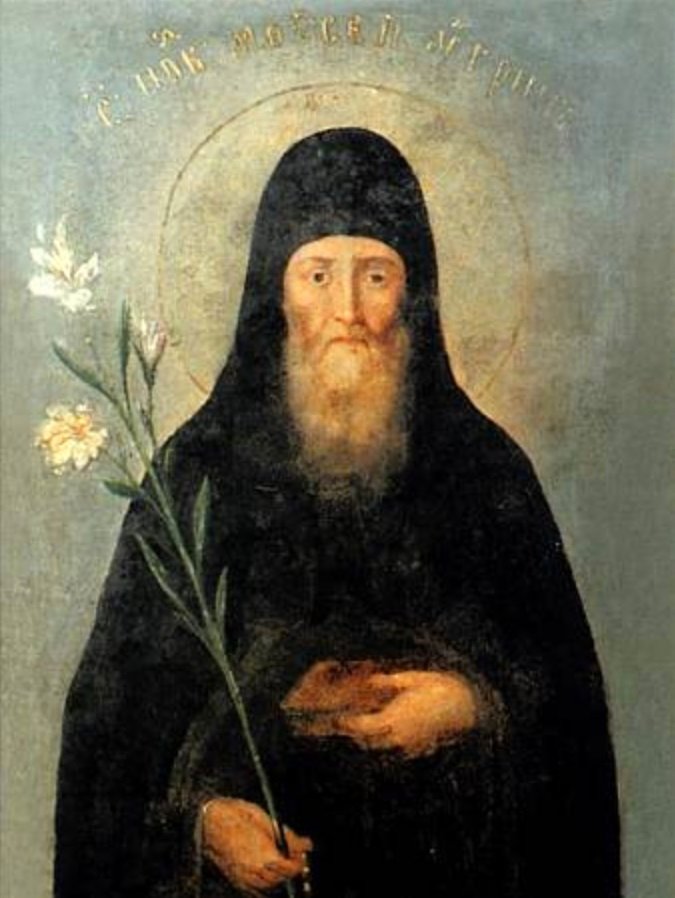
Venerable Moses the Hungarian of the Kiev Near Caves
Venerable Moses of the Kiev Caves, a Hungarian by birth, was the brother of Venerable Ephraim of Novy Torg (+ January 28, 1053) and George. Together with them he entered the service of the holy Prince Boris (+ July 24, 1015). After the murder of Saint Boris in 1015 on the Alta River, with whom George died, Saint Moses fled and hid himself in Kiev with Predislava, the sister of Prince Yaroslav.
Venerable Moses of the Kiev Caves, a Hungarian by birth, was the brother of Venerable Ephraim of Novy Torg (+ January 28, 1053) and George. Together with them he entered the service of the holy Prince Boris (+ July 24, 1015). After the murder of Saint Boris in 1015 on the Alta River, with whom George died, Saint Moses fled and hid himself in Kiev with Predislava, the sister of Prince Yaroslav. In 1018, the Polish king Bolesław captured Kiev, and Saint Moses, along with others, went to Poland as a prisoner.
A tall and slender handsome man, Saint Moses attracted the attention of a wealthy Polish widow who was aflame with passion for him, and wanted to make him her husband, after she ransomed him from captivity. Saint Moses firmly refused to exchange captivity for slavery to a woman. His long cherished dream was to receive the angelic Schema. The Polish woman, however, ransomed the prisoner despite his refusal.
She tried in every possible way to seduce the young man, but he preferred pangs of hunger to magnificent feasts. Then the Polish woman rode with Saint Moses through her lands, thinking that he would be impressed by her power and wealth. Saint Moses told her that he would not exchange spiritual riches for the perishable things of this world, and that he would become a monk.
An Athonite Hieromonk who was passing through the area tonsured Saint Moses in secret. He spoke to him and taught him many things about spiritual and physical purity. When the woman found out about this she had Moses tortured. Father Moses was stretched on the ground, and he was beaten with iron rods until the earth was saturated with his blood. She obtained permission from Bolesław to do whatever she wished with her prisoner. The shameless woman ordered that the Saint be placed in bed with her by force. Then she kissed and embraced him, but she achieved nothing by this. Saint Moses said, "Out of the fear of God I despise you as unclean." Hearing this, the Polish woman commanded that the Saint be given a hundred blows every day, and then to be emasculated. Soon Bolesław began a persecution against all the monks in the country, but unexpectedly he died. A rebellion broke out in Poland, during which the widow was also killed.
After recovering from his ordeal Venerable Moses came to the Monastery of the Caves, bearing the wounds of a Martyr and the crown of a Confessor, as a brave and victorious soldier of Christ. The Lord also gave him strength against the passions. A certain brother was possessed by an unclean passion and came to Saint Moses, begging for his help saying: "I promise to keep until death everything you tell me to do.” Saint Moses said: “As long as you live, do not speak a word to any woman.” The brother promised to obey the Saint's counsel. Father Moses had a staff in his hand, without which he was unable to walk, because of the wounds which he had received. With this staff Saint Moses struck the chest of the brother who had come to him, and immediately he was delivered from temptation.
Saint Moses engaged in ascetical contests (podvigs) in the Monastery of the Caves for ten years. He reposed around 1043 and was buried in the Near Caves. By venerating the holy relics of Saint Moses and praying fervently to him, the monks of the Kiev Caves were delivered from their carnal temptations.
Troparion - Tone 3
O great lover of purity and chastity, we sinners praise you with sacred hymns as another Joseph, / O Moses, / revered by all, and equal of the Angels. We pray diligently to you: / “Entreat Christ God that He may heal all our passions and grant us great mercy.”
Kontakion - Tone 3
Seeking God alone in Heaven, you despised all earthly things. / You did not care for your body, but valiantly gave yourself up to torments, hunger, thirst, and bonds; / in prison you endured beatings, shedding your blood, / and having parts of your body cut off, for the sake of purity. / You preserved your virginity courageously, / and now with the assembly of virgins you stand before the Most Holy Trinity. / Entreat Him to deliver from all their temptations those who cry out to you: / “Rejoice, Most Blessed Father Moses.”
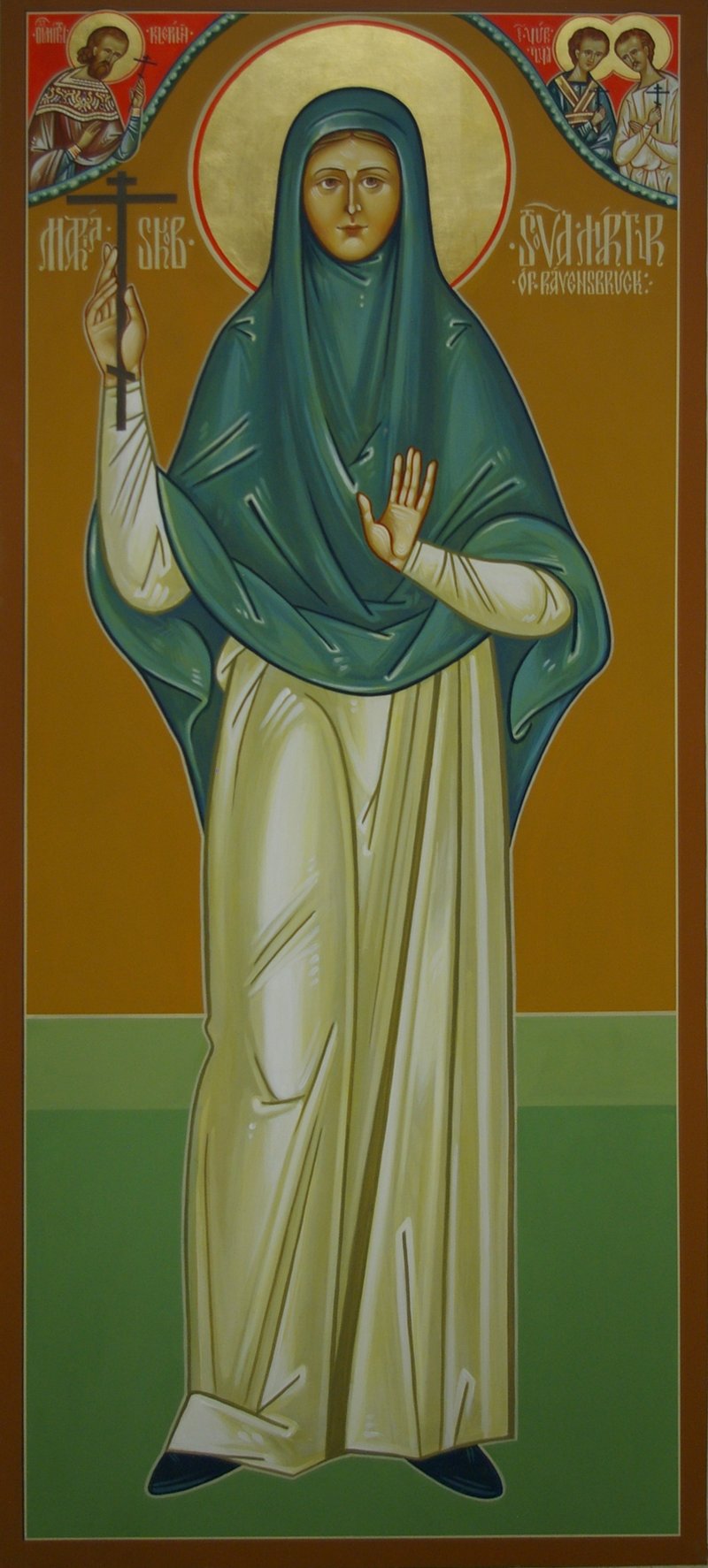
Holy Righteous Martyr Paraskeve (140)
Elizaveta Pilenko, the future Mother Maria, was born in 1891 in Riga, Latvia, then part of the Russian Empire, and grew up in the south of Russia on the shore of the Black Sea. Her father was mayor of the town of Anapa, while on her mother's side, she was descended from the last governor of the Bastille, the Parisian prison destroyed during the French Revolution.
Elizaveta Pilenko, the future Mother Maria, was born in 1891 in Riga, Latvia, then part of the Russian Empire, and grew up in the south of Russia on the shore of the Black Sea. Her father was mayor of the town of Anapa, while on her mother's side, she was descended from the last governor of the Bastille, the Parisian prison destroyed during the French Revolution.
Her parents were devout Orthodox Christians whose faith helped shape their daughter's values, sensitivities and goals. As a child she once emptied her piggy bank in order to contribute to the painting of an icon that would be part of a new church in Anapa. At seven she asked her mother if she was old enough to become a nun, while a year later she sought permission to become a pilgrim who spends her life walking from shrine to shrine.
At the age of 14, her father died, an event that seemed to her meaningless and unjust and led her to embrace atheism. "If there is no justice," she said, "there is no God." She decided God's nonexistence was well known to adults but kept secret from children. For her, childhood was over. When her widowed mother moved the family to Saint Petersburg in 1906, she found herself in the country's political and cultural center — also a hotbed of radical ideas and groups — and became part of radical literary circles that gathered around such symbolist poets as Alexander Blok, whom she first met at age 15. Like many of her contemporaries, she was drawn to the left, but was often disappointed at the radicals she encountered. Though regarding themselves as revolutionaries, they seemed to do nothing but talk. "My spirit longed to engage in heroic feats, even to perish, to combat the injustice of the world," she recalled. Yet no one she knew was actually laying down his or her life for others. Should her friends hear of someone dying for the Revolution, she noted, "they will value it, approve or not approve, show understanding on a very high level, and discuss the night away till the sun rises and it's time for fried eggs. But they will not understand at all that to die for the Revolution means to feel a rope around one's neck."
In 1910, she married Dimitri Kuzmin-Karaviev, a Bolshevik and part of a community of poets, artists and writers, but she later commented that it was a marriage born "more of pity than of love." In addition to politics and poetry, she and her friends also talked theology, but just as their political ideas had no connection at all to the lives of ordinary people, their theology floated far above the actual Church. There was much they might have learned, she reflected later in life, from "any old beggar woman hard at her Sunday prostrations in church." For many intellectuals, the Church was an idea or a set of abstract values, not a community in which one actually lives.
Though still regarding herself an atheist, gradually her earlier attraction to Christ revived and deepened, not yet Christ as God incarnate but Christ as heroic man. In time, she found herself drawn toward the religious faith she had abandoned after her father's death. She prayed and read the Gospel and the lives of saints and concluded that the real need of the people was not for revolutionary theories but for Christ. She wanted "to proclaim the simple word of God," she told Blok in a letter written in 1916. Desiring to study theology, she applied for admission to Saint Petersburg's Theological Academy of the Alexander Nevsky Monastery, in those days an entirely male school whose students were preparing for ordination. As surprising as her wanting to study there was the rector's decision that she could be admitted.
By 1913, her marriage collapsed. Later that year, her first child, Gaiana, was born. Just as World War I was beginning, she returned with her daughter to southern Russia, where her religious life grew more intense. For a time she secretly wore lead weights sewn into a hidden belt as a way of reminding herself both "that Christ exists" and also to be more aware that minute-by-minute many people were suffering and dying in the war. She realized, however, that the primary Christian asceticism was not self-mortification, but caring response to the needs of other people.
In October 1917, she was present in Saint Petersburg when Russia's Provisional Government was overthrown by the Bolsheviks. Taking part in the All-Russian Soviet Congress, she heard Lenin's lieutenant, Leon Trotsky, dismiss people from her party with the words, "Your role is played out. Go where you belong, into history's garbage can!" She grew to see how hideously different actual revolution was from the dreams of revolution that had once filled the imagination of so many Russians! In February 1918, she was elected deputy mayor of Anapa. Eventually, she was arrested, jailed, and put on trial for collaboration with the enemy. In court, she rose and spoke in her own defense: "My loyalty was not to any imagined government as such, but to those whose need of justice was greatest, the people. Red or White, my position is the same — I will act for justice and for the relief of suffering. I will try to love my neighbor." It was thanks to Daniel Skobtsov, a former schoolmaster who was now her judge, that she avoided execution. After the trial, she sought him out to thank him. Eventually they married.
As the course of the civil war was turning in favor of the Bolsheviks, the Skobtsovs fled to Georgia, where she gave birth to a son, Yura, in 1920. A year later, having relocated to Yugoslavia, she gave birth to Anastasia, Their long journey ended with their arrival in Paris in 1923, where to supplement their income she made dolls and painted silk scarves, often working ten or twelve hours a day.
A friend introduced her to the Russian Student Christian Movement, an Orthodox association founded in 1923. She began attending lectures and other activities and felt herself coming back to life spiritually and intellectually. In 1926, she grieved the death of her daughter Anastasia. She emerged from her mourning determined to seek a "new road before me and a new meaning in life, to be a mother for all, for all who need maternal care, assistance, or protection." She devoted herself to social work and theological writing. In 1927 two volumes, Harvest of the Spirit , were published, in which she retold the lives of many saints.
In 1930, she was appointed traveling secretary of the Russian Student Christian Movement, work which put her into daily contact with impoverished Russian refugees throughout France and neighboring countries. She often lectured, but she was quick to listen to others as they related some terrible grief that had burdened them for years. She took literally Christ's words, that He was always present in the least person. "Man ought to treat the body of his fellow human being with more care than he treats his own," she wrote. "Christian love teaches us to give our fellows material as well as spiritual gifts. We should give them our last shirt and our last piece of bread. Personal alms-giving and the most wide-ranging social work are both equally justified and needed."
In time, she began to envision a new type on community, "half monastic and half fraternal," that would connect spiritual life with service to those in need, in the process showing "that a free Church can perform miracles." Father Sergei Bulgakov, her confessor, was a source of support and encouragement, as was her bishop, Metropolitan Evlogy [Georgievsky], who was responsible from 1921 to 1946 for the many thousands of Russian expatriates scattered across Europe. Recognizing her devotion to social work, and knowing of her waning marriage, he suggested to her the possibility of becoming a nun. In time, Daniel came to accept the idea after meeting with Metropolitan Evlogy. In the spring of 1932, in the chapel at Paris' Saint Sergius Theological Institute, she was professed as a nun with the name Maria. She made her monastic profession, Metropolitan Evlogy recognized, "in order to give herself unreservedly to social service." Mother Maria called it simply "monasticism in the world." Intent "to share the life of paupers and tramps," she began to look for a house of hospitality and found it at 9 villa de Saxe in Paris, which she leased with financial assistance from Metropolitan Evlogy. She began receiving guests, mainly young Russian women without jobs, giving up her own room to house them while herself sleeping on a narrow iron bedstead in the basement. A room upstairs became a chapel — she painted the iconostasis icons — while the dining room doubled as a hall for lectures and dialogues.
In need of larger facilities, a new location was found two years later in an area of Paris where many impoverished Russian refugees had settled. While at the former address she could feed only 25, here she could feed a hundred. Here her guests could regain their breath "until the time comes to stand on their two feet again." Her credo was: "Each person is the very icon of God incarnate in the world." With this recognition came the need "to accept this awesome revelation of God unconditionally, to venerate the image of God" in her brothers and sisters. As her ministry evolved, she rented other buildings, one for families in need, and another for single men. A rural property became a sanatorium. By 1937, she housed several dozen women, serving up to 120 dinners every day. Every morning, she would beg for food or buy cheaply whatever was not donated.
Despite a seemingly endless array of challenges, Mother Maria was sustained chiefly by those she served — themselves beaten down, people in despair, cripples, alcoholics, the sick, survivors of many tragedies. But not all responded to trust with trust. Theft was not uncommon. On one occasion a guest stole 25 francs. Everyone guessed who the culprit was, a drug addict, but Mother Maria refused to accuse her. Instead she announced at the dinner table that the money had not been stolen, only misplaced, and she had found it. "You see how dangerous it is to make accusations," she commented. At once the girl who stole the money burst into tears.
Mother Maria and her collaborators would not simply open the door when those in need knocked, but would actively seek out the homeless. One place to find them was an all-night café at Les Halles where those with nowhere else to go could sit for the price of a glass of wine. Children also were cared for, and a part-time school was opened at several locations. Turning her attention toward Russian refugees who had been classified insane, Mother Maria began a series of visits to mental hospitals. In each hospital five to ten percent of the Russian patients turned out to be sane and, thanks to her intervention, were released. Language barriers and cultural misunderstandings had kept them in the asylum. In time, she and her associates helped establish clinics for TB sufferers and a variety of other ministries. Another landmark was the foundation in September 1935 of a group named "Orthodox Action" — a name proposed by her friend, philosopher Nicholas Berdyaev. Cofounders included Father Sergei Bulgakov, historian George Fedotov, the scholar Constantine Mochulsky, the publisher Ilya Fondaminsky, and her long-time coworker Fedor Pianov, with Metropolitan Evgoly serving as honorary president. With financial support from supporters across Europe and the United States, a wider range of projects and centers were made possible: hostels, rest homes, schools, camps, hospital work, help to the unemployed, assistance to the elderly, publication of books and pamphlets, etc. In all of these growing ministries, Mother Maria's driving concern was that it should never lose its personal or communal character.
In October 1939, Father Dimitri Klepinin, then 35 years old, began to assist Mother Maria as she began the last phase of her life — a series of responses to World War II and Germany's occupation of France. While Mother Maria could have fled Paris when the Germans were advancing, or even sought refuge in America, she would not budge. "If the Germans take Paris, I shall stay here with my old women. Where else could I send them?" She had no illusions about the Nazi threat, which to her represented a "new paganism" bringing in its wake disasters, upheavals, persecutions and wars. With defeat came greater poverty and hunger, and the local authorities in Paris declared her house an official food distribution point, where volunteers sold at cost price whatever food Mother Maria had bought in that morning.
Russian refugees were among the particular targets of the occupiers. In June 1941, a thousand were arrested, including several close friends and collaborators of Mother Maria and Father Dimitri, who launched an aid project for prisoners and their dependents. Early in 1942, their registration now underway, Jews began to knock at Mother Maria's door, asking Father Dimitri if he would issue baptismal certificates to them. The answer was always yes. The names of those "baptized" were also duly recorded in his parish register in case there was any cross-checking by the police or Gestapo, as indeed did happen. Father Dimitri was convinced that in such a situation Christ would do the same. When the Nazis issued special identity cards for those of Russian origin living in France, with Jews being specially identified, Mother Maria and Father Dimitri refused to comply, though they were warned that those who failed to register would be regarded as citizens of the USSR — enemy aliens — and be punished accordingly.
With the subsequent mass arrest of Jews — 12,884, of whom 6,900 (two-thirds of them children) were brought to the Velodrome d'Hiver sports stadium and held for five days before being sent to Auschwitz — Mother Maria entered the stadium and for three days offered comfort to the children and their parents, distributing what food she could bring in. She even managed to rescue a number of children by enlisting the aid of garbage collectors and smuggling them out in trash bins. Meanwhile, her house house was bursting with people, many of them Jews. "It is amazing," Mother Maria remarked, "that the Germans haven't pounced on us yet." Father Dimitri, Mother Maria and their coworkers set up routes of escape to the unoccupied south. It was complex and dangerous work. Forged documents had to be obtained. A local resistance group helped secure provisions for those Mother Maria's community was struggling to feed.
On February 8, 1943, while Mother Maria was traveling, Nazi security police entered the house and found a letter in her son Yura's pocket in which Father Dimitri was asked to provide a Jew with a false baptismal document. Yura, now actively a part of his mother's work, was taken to the office of Orthodox Action, soon after followed by his distraught grandmother, Sophia Pilenko. The interrogator ordered her to bring Father Dimitri. Once the priest was there, said the interrogator, they would let Yura go. His grandmother Sophia was allowed to embrace Yura and give him a blessing. It was last time she saw him in this world.
The following morning, after celebrating the Divine Liturgy, Father Dimitri set off for the Gestapo office, where he was interrogated for four hours, making no attempt to hide his beliefs. The next day, February 10, Mother Maria was arrested and her quarters were searched. Several others were called for questioning and then held by the Gestapo. She was confined with 34 other woman at the Gestapo headquarters in Paris. Her son Yura, Father Dimitri and their coworker of many years, Feodor Pianov, were held in the same building. Pianov later recalled witnessing Father Dimitri being prod and beaten by an SS officer while Yura stood by, weeping. Father Dimitri "began to console him, saying the Christ withstood greater mockery than this."
In April, the prisoners were transferred to Compiegne, where Mother Maria was blessed with a final meeting with Yura, who said his mother "was in a remarkable state of mind and told me ... that I must trust in her ability to bear things and in general not to worry about her. Every day [Father Dimitri and I] remember her at the proskomidia ... We celebrate the Eucharist and receive Communion each day." Hours after their meeting,Mother Maria was transported to Germany.
On December 16, Yura and Father Dimitri were deported to Buchenwald concentration camp in Germany, followed several weeks later by Pianov. In January 1944, Father Dimitri and Yura were sent to another camp, Dora. Within ten days of arrival, Yura contracted furunculosis. On February 6, "dispatched for treatment" — a euphemism for "sentenced to death." Four days later Father Dimitri, lying on a dirt floor, died of pneumonia. His body was disposed of in the Buchenwald crematorium.
Meanwhile, Mother Maria — now "Prisoner 19,263" — was sent in a sealed cattle truck to the Ravensbruck camp in Germany, where she endured for two years, an achievement in part explained by her long experience of ascetic life. She was assigned to Block 27 and befriended the many Russian prisoners who were with her. Unable to correspond with friends, little testimony in her own words has come down to us, but prisoners who survived the war remembered her. One of them, Solange Perichon, recalls: "She was never downcast, never. She never complained.... She was full of good cheer, really good cheer. We had roll calls which lasted a great deal of time. We were woken at three in the morning and we had to stand out in the open in the middle of winter until the barracks [population] was counted. She took all this calmly and she would say, 'Well that's that. Yet another day completed. And tomorrow it will be the same all over again.' ... She allowed nothing of secondary importance to impede her contact with people."
Anticipating that her own exit point from the camp might be via the crematoria, Mother Maria asked a fellow prisoner whom she hoped would survive to memorize a message to be given at last to Father Sergei Bulgakov, Metropolitan Evlogy and her mother: "My state at present is such that I completely accept suffering in the knowledge that this is how things ought to be for me, and if I am to die, I see this as a blessing from on high." Her work in the camp varied. There was a period when she was part of a team of women dragging a heavy iron roller about the camp's pathways for 12 hours a day. In another period she worked in a knitwear workshop. Her legs began to give way. As her health declined, friends no longer allowed her to give away portions of her own food, as she had done in the past to help keep others alive.
With the Red Army approaching from the East, the concentration camp administrators further reduced food rations while greatly increasing the population of each block from 800 to 2,500. In serious decline, Mother Maria accepted a pink card freely issued to any prisoner who wished to be excused from labor because of age or ill health. In January 1945, those who had received such cards were transferred to what was called the Jugendlager — the "youth camp" — where the authorities said each person would have her own bed and abundant food. Mother Maria's transfer was on January 31. Here the food ration was further reduced and the hours spent standing for roll calls increased. Though it was mid-winter, blankets, coats and jackets were confiscated, and then even shoes and stockings. The death rate was at least fifty per day. Next all medical supplies were withdrawn. Those who still persisted in surviving now faced death by shootings and gas, the latter made possible by the construction of a gas chamber in March 1945, in which 150 were executed every day. Amazingly, Mother Maria survived five weeks in the "youth camp" before she was returned to the main camp on March 3. Though emaciated and infested with lice, with her eyes festering, she began to think she might actually live to return to Paris, or even go back to Russia.
Such was not to be the case. On March 30, 1945 — Great, Holy and Good Friday that year — Mother Maria was selected for the gas chambers, in which she perished the following day, on Great and Holy Saturday. Accounts are at odds about what happened. According to one, she was one of the many selected for death that day. According to another, she took the place of another prisoner, a Jew, who had been chosen. Although perishing in the gas chamber, she did not perish in the Church's memory. Survivors of the war who had known her would again and again draw attention to the ideas, insights and activities of the unusual nun who had spent so many years coming to the aid of people in desperate straits. Soon after the end of World War II, essays and books about her began to appear in France and Russia. A Russian film, "Mother Maria," was made in 1982. There have been two biographies in English and, little by little, the translation and publication in English of her most notable essays.
On January 18, 2004, the Holy Synod of the Ecumenical Patriarchate of Constantinople recognized Mother Maria Skobtsova as a saint, along with her son Yuri; the priest who worked closely with her, Fr. Dimitri Klépinin; and her close friend and collaborator Ilya Fondaminsky. Their glorification took place in Paris' Cathedral of Saint Alexander Nevsky.
Troparion - Tone 4
Your lamb Maria calls out to You, O Jesus, in a loud voice: / “I love You, my Bridegroom, and in seeking You I endure suffering. / In Baptism I was crucified so that I might reign in You, / and I died so that I might live with You. / Accept me as a pure sacrifice, / for I have offered myself in love.” / Through her prayers, save our souls, since You are merciful.
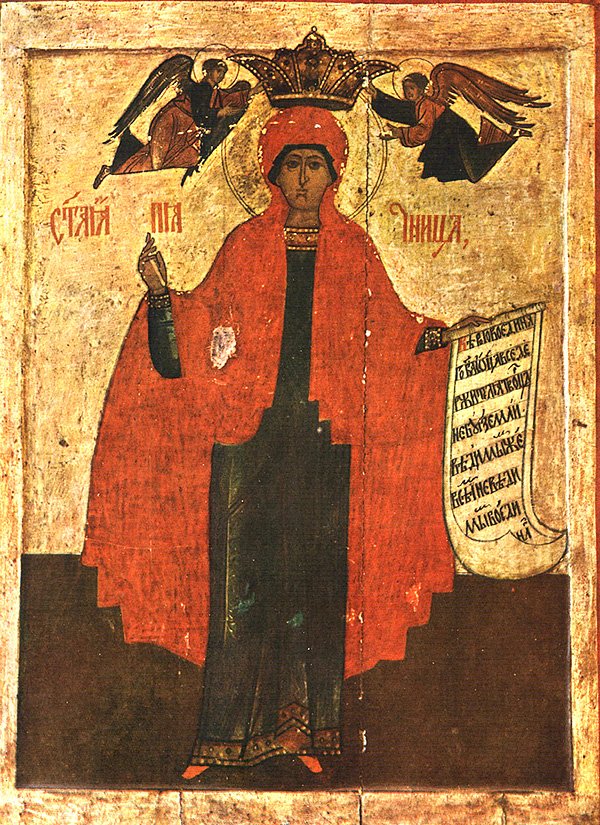
Martyr Paraskevi of Rome
Holy Virgin Martyr Paraskevi (Paraskevḗ) of Rome was the only daughter of Christian parents, Agathon and Politia, and from her early years she dedicated herself to God. She spent much of her time in prayer and the study of the Holy Scriptures. After the death of her parents Saint Paraskevi distributed all of her inheritance to the poor, and consecrated her virginity to Christ. E
Holy Virgin Martyr Paraskevi (Paraskevḗ) of Rome was the only daughter of Christian parents, Agathon and Politia, and from her early years she dedicated herself to God. She spent much of her time in prayer and the study of the Holy Scriptures. After the death of her parents Saint Paraskevi distributed all of her inheritance to the poor, and consecrated her virginity to Christ. Emulating the holy Apostles, she began to preach to the pagans about Christ, converting many to Christianity.
She was arrested during the reign of Antoninus Pius (138-161) because she refused to worship the idols. She was brought to trial and fearlessly confessed herself a Christian. Neither enticements of honors and material possessions, nor threats of torture and death shook the firmness of the saint nor turned her from Christ. She was given over to beastly tortures. They put a red-hot helmet on her head and threw her in a cauldron filled with boiling oil and pitch. By the power of God the holy martyr remained unharmed. When the emperor peered into the cauldron, Saint Paraskevi threw a drop of the hot liquid in his face, and he was burned. The emperor began to ask her for help, and the holy martyr healed him. After this the emperor set her free.
Traveling from one place to another to preach the Gospel, Saint Paraskevi arrived in a city where the governor was named Asclepius. Here again they tried the saint and sentenced her to death. They took her to an immense serpent living in a cave, so that it would devour her. But Saint Paraskevi made the Sign of the Cross over the snake and it died. Asclepius and the citizens witnessed this miracle and believed in Christ. She was set free, and continued her preaching. In a city where the governor was a certain Tarasius, Saint Paraskevi endured fierce tortures and was beheaded in the year 140.
Many miracles took place at the saint’s tomb: the blind received sight, the lame walked, and barren women gave birth to children. It is not only in the past that the saint performed her miracles, but even today she helps those who call on her in faith.
Troparion - Tone 1
Showing a diligence befitting your calling, O namesake of preparedness,1 / you have inherited as your dwelling, a faith worthy of your name, O prize-winner Paraskevḗ. / Therefore, you pour forth healings, / and you intercede for our souls.1 Paraskevḗ means Friday, in Greek. In the Scriptures, Friday is called the day of preparation (Matthew 27:62; Mark 15:42; Luke 23:54; John 19:31).
Kontakion - Tone 8
Showing a diligence befitting your calling, O namesake of preparedness,1 / you have inherited as your dwelling, a faith worthy of your name, O prize-winner Paraskevḗ. / Therefore, you pour forth healings, / and you intercede for our souls.
Venerable Geróntios, the Founder of the Skḗtē of Saint Anna on Mount Athos
Saint Geróntios was the Igoumen of the old Bouleuterίon Monastery on Mount Athos. But since this Monastery was near the seashore and was subject to many barbarian raids, it was abandoned by the monks, who moved to other inaccessible places on Mount Athos. So Saint Geróntios and his disciple settled in the upper part of the Skḗtē of Saint Anna, where he built a hesychastḗrion and a church dedicated to Saint Panteleimon. Thus, S
Saint Geróntios was the Igoumen of the old Bouleuterίon Monastery on Mount Athos. But since this Monastery was near the seashore and was subject to many barbarian raids, it was abandoned by the monks, who moved to other inaccessible places on Mount Athos. So Saint Geróntios and his disciple settled in the upper part of the Skḗtē of Saint Anna, where he built a hesychastḗrion and a church dedicated to Saint Panteleimon. Thus, Saint Geróntios is the first founder of the Skḗtē of Saint Anna. Nearby, through a revelation of the Panagίa, he found water in a completely arid place, which continues to flow today and the monks use it as holy water (agiasmós).
Saint Geróntios lived a most wondrous life and reposed at an advanced age. He was associated in spiritual friendship with Saint Maximus Kavsokalybίtēs (January 13), as seen in his Life. The Skḗtē founded by Saint Geróntios produced about fifteen Saints and many great and virtuous Fathers.
The Church Service in honor of Saint Geróntios was composed by the monk Gerásimos of the Skḗtē of Little Saint Anna.
Troparion - Tone 8
By a flood of tears you made the desert fertile, / and your longing for God brought forth fruits in abundance. / By the radiance of miracles you illumined the whole universe! / O our holy father Gerontius, pray to Christ our God to save our souls!
Icon of the Mother of God in Constantinople of “Emvolon”
No information available at this time.
Saint Savva III of Serbia
Saint Savva III was Archbishop of Serbia from 1305 -1316. He is also commemorated on August 30.
Troparion - Tone 4
In truth you were revealed to your flock as a rule of faith, / an image of humility and a teacher of abstinence; / your humility exalted you; / your poverty enriched you. / Hierarch Father Savva, / entreat Christ our God / that our souls may be saved.
Holy Virgin Martyr Oraiozele, disciple of the Holy Apostle Andrew
Saint Oraiozele (Oraiozélē) lived in Byzantium during the first century. At first she was an idol-worshipper, but then she became a Christian when she heard the preaching of Saint Andrew, who baptized her.
Oraiozele was an educated woman and was able to learn all the truths of the Gospel correctly, therefore Saint Andrew permitted her to instruct other women. S
Saint Oraiozele (Oraiozélē) lived in Byzantium during the first century. At first she was an idol-worshipper, but then she became a Christian when she heard the preaching of Saint Andrew, who baptized her.
Oraiozele was an educated woman and was able to learn all the truths of the Gospel correctly, therefore Saint Andrew permitted her to instruct other women. She was very successful in bringing many of them to Christ. Later, she attached herself to a church dedicated to the Archangel Michael at Revma on the Bosporos. There she converted many pagans.
Afterward, Saint Oraiozele accepted two women who had been idolaters, but came to believe in Christ. They were most eager to emulate the Saint, regarding her as a model of virtue. The two disciples wished to follow her example in ascetical struggles, each trying to surpass the other in fasting, vigils, and prayer. This continued for several years, until the reign of Emperor Domitian. 1
When the Emperor started to persecute Christians, Saint Oraiozele was arrested as well. She appeared before him and was charged with the "crime" of refusing to sacrifice to the idols. Domitian was unable to persuade her to return to idolatry, and since she remained steadfast in her love for Christ, he ordered her to be tortured. First she was disrobed, and then she was beaten for many hours. Those who watched were amazed because she did not seem to feel the blows. it was as if someone else was enduring her punishment.
Finally, Saint Oraiozele was beheaded and her dead body was thrown into the fire. Now she stands before her Bridegroom Christ as one of the choir of the Martyrs.
Women who are unable to conceive will pray to Saint Oraiozele and many of them give birth. Other women whose breasts do not produce enough milk have been able to nurse their babies after praying to the Holy Virgin Martyr Oraiozele.
1 Titus Flavius Domitianus (reigned 81 - 96 A.D.)
Scripture Readings
☩Epistle
1 Corinthians 1:10-18
10
Now I beseech you, brethren, by the name of our Lord Jesus Christ, that ye all speak the same thing, and that there be no divisions among you; but that ye be perfectly joined together in the same mind and in the same judgment.
11
For it hath been declared unto me of you, my brethren, by them which are of the house of Chloe, that there are contentions among you.
12
Now this I say, that every one of you saith, I am of Paul; and I of Apollos; and I of Cephas; and I of Christ.
13
Is Christ divided? was Paul crucified for you? or were ye baptized in the name of Paul?
14
I thank God that I baptized none of you, but Crispus and Gaius;
15
Lest any should say that I had baptized in mine own name.
16
And I baptized also the household of Stephanas: besides, I know not whether I baptized any other.
17
For Christ sent me not to baptize, but to preach the gospel: not with wisdom of words, lest the cross of Christ should be made of none effect.
18
For the preaching of the cross is to them that perish foolishness; but unto us which are saved it is the power of God.
☩Gospel
Matthew 14:14-22
14
And Jesus went forth, and saw a great multitude, and was moved with compassion toward them, and he healed their sick.
15
And when it was evening, his disciples came to him, saying, This is a desert place, and the time is now past; send the multitude away, that they may go into the villages, and buy themselves victuals.
16
But Jesus said unto them, They need not depart; give ye them to eat.
17
And they say unto him, We have here but five loaves, and two fishes.
18
He said, Bring them hither to me.
19
And he commanded the multitude to sit down on the grass, and took the five loaves, and the two fishes, and looking up to heaven, he blessed, and brake, and gave the loaves to his disciples, and the disciples to the multitude.
20
And they did all eat, and were filled: and they took up of the fragments that remained twelve baskets full.
21
And they that had eaten were about five thousand men, beside women and children.
22
And straightway Jesus constrained his disciples to get into a ship, and to go before him unto the other side, while he sent the multitudes away.
 Meat
Allowed
Meat
Allowed
 Fish
Allowed
Fish
Allowed
 Dairy
Allowed
Dairy
Allowed
 Oil
Allowed
Oil
Allowed
 Wine
Allowed
Wine
Allowed