Fasting Rules
 Meat
Abstain
Meat
Abstain
 Fish
Allowed
Fish
Allowed
 Dairy
Abstain
Dairy
Abstain
 Oil
Allowed
Oil
Allowed
 Wine
Allowed
Wine
Allowed
Saints & Commemorations
Begin Dormition Fast
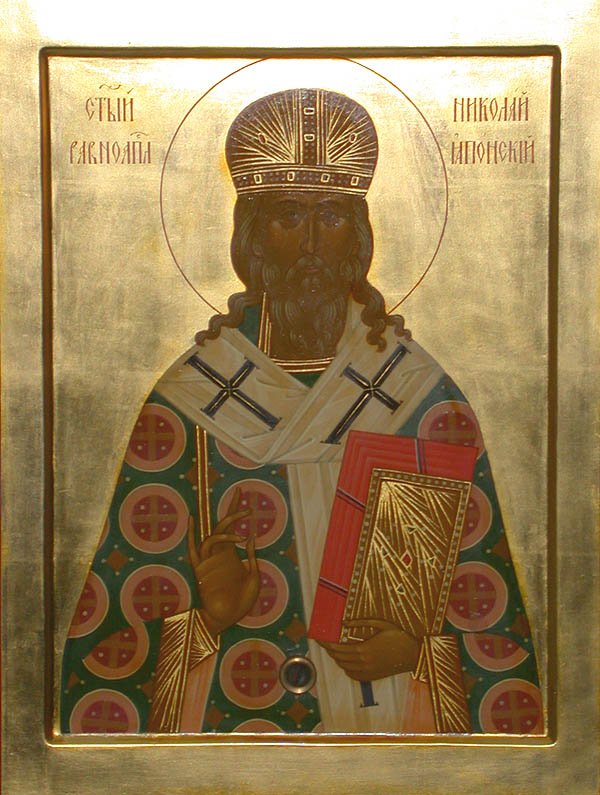
St Nicholas, enlightener of Japan (1912)
Saint Nicholas (Kasatkin) Equal of the Apostles, Bishop of the Russian Orthodox Church. Missionary, Founder of the Orthodox Church in Japan, honorary member of the Imperial Orthodox Palestine Society. (Name Day: May 9).
Saint Nicholas (in the world John Kasatkin) was born on August 1,1836 in the village of Berezovsky Pogost, Belsky District, Smolensk Province into the family of a deacon.
Saint Nicholas (Kasatkin) Equal of the Apostles, Bishop of the Russian Orthodox Church. Missionary, Founder of the Orthodox Church in Japan, honorary member of the Imperial Orthodox Palestine Society. (Name Day: May 9).
Saint Nicholas (in the world John Kasatkin) was born on August 1,1836 in the village of Berezovsky Pogost, Belsky District, Smolensk Province into the family of a deacon. He graduated from the Belsk Theological School and the Smolensk Theological Seminary (1857). Among the best students he was recommended for the St. Petersburg Theological Academy, where he studied until 1860, when, at the personal request of Metropolitan Gregory (Postnikov) of St. Petersburg, he was given the post of rector of the church at the Russian consulate in the city of Hakodate (Japan), and was also awarded a Ph.D in Theology without having to submit an appropriate qualifying essay.
On June 23, 1860, he was tonsured by the rector of the Academy, Bishop Nektarios (Nadezhdin), and named for Saint Nicholas of Myra. On June 30 he was ordained a Hieromonk.
He arrived at Hakodate on July 2, 1861. During the first years of his stay in Japan, on his own he studied the Japanese language, culture and way of life.
The first Japanese person to convert to Orthodoxy, despite the fact that conversion to Christianity was forbidden by law, was the adopted son of a Shinto cleric, Takuma Sawabe, a former samurai who was baptized with two other Japanese in the spring of 1868.
During his half-century of service in Japan, Father Nicholas left only twice: in 1869-1870 and in 1879-1880. In 1870, through his intercession, a Russian ecclesiastical mission was opened in Japan with its center in Tokyo. On March 17, 1880, by the decision of the Holy Synod, he was assigned as vicar of Reval, then vicar of the Diocese of Riga. He was consecrated as a Bishop on March 30, 1880, in Holy Trinity Cathedral at Alexander Nevsky Lavra.
In the course of his missionary work, Father Nicholas translated the Holy Scriptures and other liturgical books into Japanese; he established a theological seminary, six theological schools for girls and boys, a library, a shelter and other institutions. He published the Orthodox journal Church Herald in Japanese. According to his report to the Holy Synod, by the end of 1890 the Orthodox Church in Japan numbered 216 communities with 18,625 Christians in them.
On March 8, 1891, the Cathedral of the Resurrection in Tokyo, called Nikorai-do (ニコライ堂) by the Japanese, was consecrated. During the Russo-Japanese War, he remained with his flock in Japan, but did not take part in any public services. because according to the rite of worship (and the blessing of Japanese Christians to pray for their country's victory over Russia. Bishop Nicholas said: "Today, according to custom, I serve in the cathedral, but from now on I will no longer take part in the public services of our church... Hitherto I have prayed for the prosperity and peace of the Empire of Japan. Now, since war has been declared between Japan and my country, I, as a Russian subject, cannot pray for Japan's victory over my own homeland. I also have obligations to my country, and that is why I will be happy to see that you fulfill your duty in relation to your country."
When Russian prisoners of war began to arrive in Japan (their total number reached 73,000 people), Bishop Nicholas, with the consent of the Japanese government, formed the Society for the Spiritual Consolation of Prisoners of War. For their spiritual guidance, he selected five priests who spoke Russian. The prisoners were provided with icons and books. Vladyka repeatedly addressed them in writing (he himself was not allowed to see the prisoners).
On March 24, 1906, he was elevated to the rank of Archbishop of Tokyo and All Japan. In the same year, the Kyoto Vicariate was founded. In 1911, when half a century of Saint Nicholas' s missionary work was completed, there were already 266 communities of the Japanese Orthodox Church, which included 33,017 Orthodox laymen.
Archbishop Nicholas, the Enlightener of Japan, fell asleep in the Lord on February 3, 1912 at the age of 76, After the Hierarch's repose, the Japanese Emperor Meiji personally gave permission for him to be buried within the city, at the Yanaka cemetery. In Japan, Saint Nicholas is revered as a great righteous man and a special intercessor before the Lord.
He was canonized on April 10, 1970, by the decision of the Holy Synod of the Moscow Patriarchate. A Service was composed for him by Metropolitan Nikodim (Rotov) of Leningrad and Novgorod, and published in 1978.
Saint Nicholas is also commemorated on the Sunday before July 28 (Synaxis of the Smolensk Saints).
Troparion - Tone 4
You shared in the ways of the Apostles and sat upon their throne, / O faithful and divinely-wise servant of Christ, / chosen harp of the divine Spirit, vessel overflowing with the love of Christ, / and Enlightener of Japan, O Holy Hierarch Nicholas, Equal of the Apostles, / entreat the Life-Giving Trinity on behalf of all your flock, and for the entire world.
Kontakion - Tone 4
As a colleague of the Apostles in their labors and rewards, / the Church honors you with love, O Holy Hierarch Nicholas Equal of the Apostles. / For having laid the foundation of the beginning of Orthodoxy in pagan Japan by your many deeds, / you increased the number of those who are saved; / and as is meet, after your death God received you into the abode of His Apostles. / Therefore we beseech you: / “Pray to the Lord that your work may continue to abide unshakably for eternity, / and that all those doomed to perdition may enter the bosom of the Orthodox Church, / for the peace of the world and for the salvation of our souls.”
Procession of the Lifegiving Cross; 7 Maccabean Martyrs
Scripture Readings
☩Epistle
Romans 14:6-9
6
He that regardeth the day, regardeth it unto the Lord; and he that regardeth not the day, to the Lord he doth not regard it. He that eateth, eateth to the Lord, for he giveth God thanks; and he that eateth not, to the Lord he eateth not, and giveth God thanks.
7
For none of us liveth to himself, and no man dieth to himself.
8
For whether we live, we live unto the Lord; and whether we die, we die unto the Lord: whether we live therefore, or die, we are the Lord’s.
9
For to this end Christ both died, and rose, and revived, that he might be Lord both of the dead and living.
☩Gospel
Matthew 15:32-39
32
Then Jesus called his disciples unto him, and said, I have compassion on the multitude, because they continue with me now three days, and have nothing to eat: and I will not send them away fasting, lest they faint in the way.
33
And his disciples say unto him, Whence should we have so much bread in the wilderness, as to fill so great a multitude?
34
And Jesus saith unto them, How many loaves have ye? And they said, Seven, and a few little fishes.
35
And he commanded the multitude to sit down on the ground.
36
And he took the seven loaves and the fishes, and gave thanks, and brake them, and gave to his disciples, and the disciples to the multitude.
37
And they did all eat, and were filled: and they took up of the broken meat that was left seven baskets full.
38
And they that did eat were four thousand men, beside women and children.
39
And he sent away the multitude, and took ship, and came into the coasts of Magdala.
Liturgical data sourced from OCA.org and orthocal.info