Fasting Rules
 Meat
Abstain
Meat
Abstain
 Fish
Allowed
Fish
Allowed
 Dairy
Abstain
Dairy
Abstain
 Oil
Allowed
Oil
Allowed
 Wine
Allowed
Wine
Allowed
Saints & Commemorations
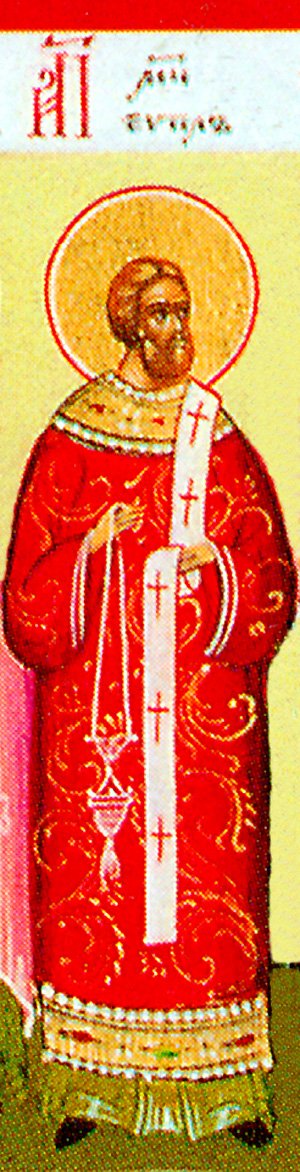
Holy Martyr and Archdeacon Euplus of Catania
The Martyr Archdeacon Euplus suffered in the year 304 under the emperors Diocletian (284-305) and Maximian (305-311). He served in the Sicilian city of Catania. Always carrying the Gospel with him, Saint Euplus preached constantly to the pagans about Christ.
Once, while he read and explained the Gospel to the gathered crowd, they arrested him and took him to the governor of the city, Calvisianus.
The Martyr Archdeacon Euplus suffered in the year 304 under the emperors Diocletian (284-305) and Maximian (305-311). He served in the Sicilian city of Catania. Always carrying the Gospel with him, Saint Euplus preached constantly to the pagans about Christ.
Once, while he read and explained the Gospel to the gathered crowd, they arrested him and took him to the governor of the city, Calvisianus. Saint Euplus confessed himself a Christian and denounced the impiety of idol-worship. For this they sentenced him to torture.
They threw the injured saint into prison, where he remained in prayer for seven days. The Lord made a spring of water flow into the prison for the martyr to quench his thirst. Brought to trial a second time, strengthened and rejoicing, he again confessed his faith in Christ and denounced the torturer for spilling the blood of innocent Christians.
The judge commanded that the saint’s ears be torn off, and that he be beheaded. When they led the saint to execution, they hung the Gospel around his neck. Having asked time for prayer, the archdeacon began to read and explain the Gospel to the people, and many of the pagans believed in Christ. The soldiers beheaded the saint with a sword.
His holy relics are in the village of Vico della Batonia, near Naples.
Troparion - Tone 4
As a holy deacon and righteous minister of the Church of Christ, / you contended superbly. / You sailed over the sea of many torments and afflictions, / O all-blessed Euplus. / Guide us into the haven of heaven.
Kontakion - Tone 1
When the love of Christ was your only defense, / you stood in the midst of your fight and said: / I endure this struggle willingly and with confidence! / You rejoiced, O Euplus, to offer your head to the sword and so complete your course!
The Holy Martyr Susanna the Virgin, and those with her (295-296)
She was the daughter of Gavinius, a Christian priest in Rome, and the niece of Pope Gaius. The Emperor Diocletian’s adopted son Maximian wished to marry Susanna, but she had no desire to marry any one, least of all a pagan. The patricians Claudia and Maxima were sent to Susanna by the Emperor to present Maximian’s suit; but instead she turned both of them, and all their households, to the Faith. The
She was the daughter of Gavinius, a Christian priest in Rome, and the niece of Pope Gaius. The Emperor Diocletian’s adopted son Maximian wished to marry Susanna, but she had no desire to marry any one, least of all a pagan. The patricians Claudia and Maxima were sent to Susanna by the Emperor to present Maximian’s suit; but instead she turned both of them, and all their households, to the Faith. The enraged Emperor had Claudia, Maxima and their families executed, then had Susanna herself beheaded. The Emperor’s wife, Serena, was a secret Christian, and took Susanna’s body secretly and buried it. Soon after this Susanna’s father Gavinius and her uncle Pope Gaius also met martyrdom.
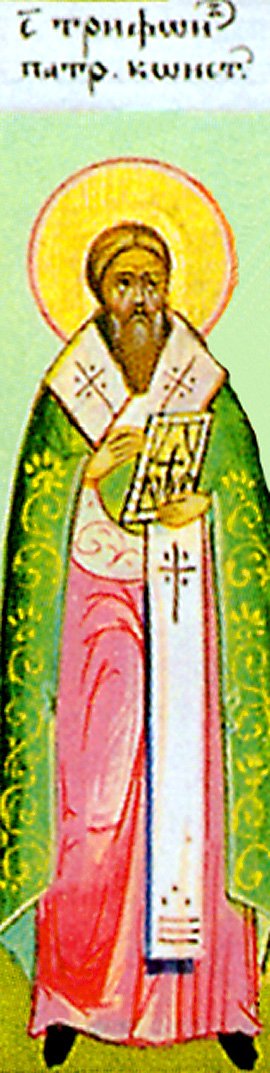
Saint Niphon, Patriarch of Constantinople (1508)
Saint Tryphon, Patriarch of Constantinople, was a monk from the time of his youth, distinguished by his meekness, lack of malice, full submission to the will of God, and his firm faith and love for the Church. At this time the emperor Romanus (919-944) ruled in Constantinople. He wanted to elevate his younger son Theophylactus to the patriarchal throne.
Saint Tryphon, Patriarch of Constantinople, was a monk from the time of his youth, distinguished by his meekness, lack of malice, full submission to the will of God, and his firm faith and love for the Church. At this time the emperor Romanus (919-944) ruled in Constantinople. He wanted to elevate his younger son Theophylactus to the patriarchal throne. When Patriarch Stephanos (925-928) died, Theophylactus was only sixteen years old. The emperor then suggested that Saint Tryphon be “locum tenens” of the patriarchal throne until Theophylactus came of age.
Saint Tryphon meekly accepted the burden of patriarchal service and for three years he wisely governed the Church. When Theophylactus turned twenty (931), the emperor told Saint Tryphon to resign the patriarchal throne. Saint Tryphon did not consider it proper to hand over the throne to an inexperienced youth, and he refused to do so. The emperor could not intimidate Saint Tryphon, since his life was blameless. Then Romanus employed the cunning counsels of Bishop Theophilus of Caesarea.
The deceitful bishop went to Saint Tryphon and urged him not to obey the emperor, and not to resign the patriarchal throne. Then Bishop Theophilus craftily obtained Saint Tryphon’s signature on a blank sheet of paper. Not suspecting any treachery, the guileless saint took a clean sheet of paper and wrote: “Tryphon, by the Mercy of God, Archbishop of Constantinople, the New Rome, and Ecumenical Patriarch.”
When they presented this paper to the emperor, he ordered them to write over the saint’s signature: “I hereby resign the position of Patriarch, because I consider myself unworthy of this office.” When this false document was read before the imperial dignitaries, servants removed Saint Tryphon from the patriarchal chambers.
Saint Tryphon patiently endured the injustice done to him, and returned to his own monastery. He lived there as a simple monk for a year before his death (+ 933). His body was taken to Constantinople and buried with the Patriarchs.
Troparion - Tone 4
In truth you were revealed to your flock as a rule of faith, / an image of humility and a teacher of abstinence; / your humility exalted you; / your poverty enriched you. / Hierarch Father Tryphon, / entreat Christ our God / that our souls may be saved.
Repose of Fr Georges Florovsky (1979) (July 29 OC)
Scripture Readings
☩Epistle
2 Corinthians 2:14-3:3
14
Now thanks be unto God, which always causeth us to triumph in Christ, and maketh manifest the savour of his knowledge by us in every place.
15
For we are unto God a sweet savour of Christ, in them that are saved, and in them that perish:
16
To the one we are the savour of death unto death; and to the other the savour of life unto life. And who is sufficient for these things?
17
For we are not as many, which corrupt the word of God: but as of sincerity, but as of God, in the sight of God speak we in Christ.
1
Do we begin again to commend ourselves? or need we, as some others, epistles of commendation to you, or letters of commendation from you?
2
Ye are our epistle written in our hearts, known and read of all men:
3
Forasmuch as ye are manifestly declared to be the epistle of Christ ministered by us, written not with ink, but with the Spirit of the living God; not in tables of stone, but in fleshy tables of the heart.
☩Gospel
Matthew 23:23-28
23
Woe unto you, scribes and Pharisees, hypocrites! for ye pay tithe of mint and anise and cummin, and have omitted the weightier matters of the law, judgment, mercy, and faith: these ought ye to have done, and not to leave the other undone.
24
Ye blind guides, which strain at a gnat, and swallow a camel.
25
Woe unto you, scribes and Pharisees, hypocrites! for ye make clean the outside of the cup and of the platter, but within they are full of extortion and excess.
26
Thou blind Pharisee, cleanse first that which is within the cup and platter, that the outside of them may be clean also.
27
Woe unto you, scribes and Pharisees, hypocrites! for ye are like unto whited sepulchres, which indeed appear beautiful outward, but are within full of dead men’s bones, and of all uncleanness.
28
Even so ye also outwardly appear righteous unto men, but within ye are full of hypocrisy and iniquity.
Liturgical data sourced from OCA.org and orthocal.info