Fasting Rules
 Meat
Abstain
Meat
Abstain
 Fish
Allowed
Fish
Allowed
 Dairy
Abstain
Dairy
Abstain
 Oil
Allowed
Oil
Allowed
 Wine
Allowed
Wine
Allowed
Saints & Commemorations
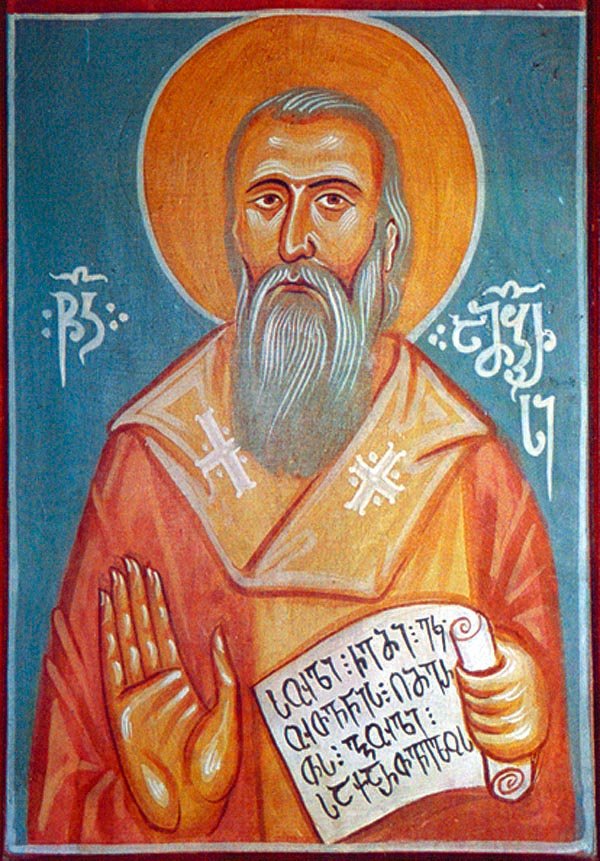
St Maximos the Confessor (662)
Saint Ambrose the Confessor (in the world Besarion Khelaia) was born in 1861. He received his primary education at the theological school in Samegrelo and graduated from Tbilisi Seminary in 1885. He graduated and was ordained to the priesthood in the same year. Fr. Ambrose served as a priest in Sokhumi (in northwestern Georgia) for eight years, at the same time teaching the Georgian language in schools and directing the activity of various philanthropic societies.
Saint Ambrose the Confessor (in the world Besarion Khelaia) was born in 1861. He received his primary education at the theological school in Samegrelo and graduated from Tbilisi Seminary in 1885. He graduated and was ordained to the priesthood in the same year. Fr. Ambrose served as a priest in Sokhumi (in northwestern Georgia) for eight years, at the same time teaching the Georgian language in schools and directing the activity of various philanthropic societies. In 1896 he was widowed, and in 1897 he enrolled at the Kazan Theological Academy.
While in Kazan, Fr. Ambrose followed both the literary-cultural life of the city and the Georgian national independence movement with great interest. He researched the history of Georgia from primary sources and composed several essays based on his findings. His essay, entitled “The Struggle Between Christianity and Islam in Georgia,” was so compelling to one professor that he recommended that Fr. Ambrose continue exploring this theme and present his research for a master’s degree.
In 1901 Fr. Ambrose completed his studies at the Kazan Theological Academy, and in the same year he was tonsured a monk and returned to Georgia. Together with the greatest sons of his nation, he fought tirelessly for the autocephaly of the Georgian Orthodox Church. As a punishment for his uncompromising commitment to this goal, Fr. Ambrose was exiled to Russia in 1905.
Upon his return to Georgia, he was elevated to the rank of archimandrite and appointed abbot of Chelishi Monastery. Chelishi Monastery had at one time been a center for theological education in Georgia, but many years had passed since then and the monastery’s student body was rapidly shrinking. Before long it would be completely deserted. But with the blessing of Bishop Leonid of Imereti (later Catholicos-Patriarch of All Georgia), Saint Ambrose gathered a number of gifted young people to study at the seminary and began to instruct them in chanting and the reading of the Holy Gospel.
Saint Ambrose devoted much of his time and energy to finding and restoring the old manuscripts of Chelishi Monastery. Once, while passing through the monastery yard, he heard a muted sound coming from beneath the earth. He began to dig at that place and discovered an ancient copy of the Holy Gospels. It was the “Chelishi Gospel,” a famous Georgian relic from the 9th or 10th century.
Soon Saint Ambrose joined the Tbilisi Synodal Council and was enthroned as abbot of Holy Transfiguration Monastery in Tbilisi. But in 1908 he was accused of conspiring in the murder of the exarch Nikon and deprived of the right to serve in the Church. The prosecutors exiled him to the Holy Trinity Monastery in Ryazan, where he spent over a year under strict guard. In 1910 Saint Ambrose was acquitted and again permitted to serve in the Church.
In 1917 Archimandrite Ambrose returned to Georgia and rejoined the struggle for an autocephalous Georgian Church. Within a few months the Church’s autocephaly was proclaimed. He was consecrated Metropolitan of Chqondidi, later to be transferred to the Tskum-Abkhazeti region. In 1921 Saint Ambrose was enthroned Catholicos-Patriarch of All Georgia.
The Soviet government began to persecute the Church not long after Saint Ambrose’s enthronement. Some 1,200 churches were plundered, converted for other purposes, or destroyed. A great number of clergy were arrested, exiled, and later shot to death.
On February 7, 1922, Catholicos-Patriarch Ambrose, the spiritual father and chief shepherd of his nation, sent a memorandum to participants in the Conference of Genoa 1 in which he defended the rights of the Georgian Church and nation. Every word of his appeal was permeated with distress for the fate not only of his motherland but of the entire human race. Saint Ambrose assured his audience that a nation and government deprived of Christian virtue would have no future and pleaded for help in this time of misfortune.
The receipt of such a memorandum was unprecedented for the Bolshevik regime, and in response the officials had Saint Ambrose arrested. Nevertheless, he fearlessly criticized the government’s complaisance with acts of crime, injustice, and sacrilege.
In response to one of the Bolshevik interrogations, the patriarch asserted, “Confession of Faith is a spiritual necessity for every nation— persecution increases its necessity. Faith deepens, being contracted and accumulated, and it bursts out with new energy. So it was in the past, and so it will be in our country. Georgia is no exception to this universal law.”
Saint Ambrose spoke these remarkable last words to his persecutors: “My soul belongs to God, my heart to my motherland, and with my flesh you may do whatever you wish.” The court sentenced the Catholicos-Patriarch of All Georgia to seven years, nine months and twenty-eight days in prison.
At the end of 1924 Saint Ambrose and the other members of the Synodal Council were granted amnesty, but their grave experience had already taken its toll. The Georgian flock lost its faithful shepherd in 1927.
In 1995 the life of Catholicos-Patriarch of All Georgia Ambrose (Khelaia) was discussed at an expanded council of the Holy Synod of the Georgian Church. In recognition of his great achievements on behalf of the Church and nation, Ambrose was canonized as “Saint Ambrose the Confessor.”
1 In 1922 representatives of thirty-four nations met in Genoa, Italy to discuss the economic reconstruction of Central and Eastern Europe and to improve relations between the Soviet Union and Western Europe.
Troparion - Tone 8
Champion of Orthodoxy, teacher of purity and of true worship, / the enlightener of the universe and the adornment of hierarchs: / all-wise father Ambrose, your teachings have gleamed with light upon all things. / Intercede before Christ God to save our souls.
St Tikhon of Zadonsk (1783)
He is one of the best-loved Saints of the Russian people. He was born into a very poor family in Novgorod province and received the baptismal name of Timothy. He went to seminary in Novgorod, where he excelled, later teaching Greek and other subjects. He was tonsured a monk at the age of thirty-four, receiving the monastic name of Tikhon.
He is one of the best-loved Saints of the Russian people. He was born into a very poor family in Novgorod province and received the baptismal name of Timothy. He went to seminary in Novgorod, where he excelled, later teaching Greek and other subjects. He was tonsured a monk at the age of thirty-four, receiving the monastic name of Tikhon. As his ascesis and wisdom became known, he quickly became eminent in the Church and in 1761 was made a bishop. In 1763 he was consecrated Bishop of Voronezh. After serving as bishop for about seven years, he retired to the monastery of Zadonsk, where he spent the remainder of his life. He devoted his “retirement” to prayer and the writing of books, producing a huge collection of writings that have earned him the name “the Russian Chrysostom.” He reposed in peace in 1783 at the age of fifty-nine. Many miracles were wrought by him after his death, and he was soon proclaimed a Saint by the people. When his body was exhumed in 1845 (over sixty years later) to make way for a new church in Zadonsk, his relics were found to be whole and incorrupt; even his vestments were free from decay. He was officially glorified in 1863; some three hundred thousand pilgrims attended his glorification.
Holy Martyr Hippolytus of Rome and 18 Martyrs with him (258)
He was the pagan jailkeeper who guarded St Laurence (see August 10); seeing his prisoner’s holiness and the wonders wrought by him, Hippolytus was convinced of the truth of the Faith and became a Christian. When St Laurence baptized him, he was granted a vision of heaven and said ‘I see innocent souls in great joy.’ He took Laurence into his own home, and his entire household were baptized, nineteen in all.
When
He was the pagan jailkeeper who guarded St Laurence (see August 10); seeing his prisoner’s holiness and the wonders wrought by him, Hippolytus was convinced of the truth of the Faith and became a Christian. When St Laurence baptized him, he was granted a vision of heaven and said ‘I see innocent souls in great joy.’ He took Laurence into his own home, and his entire household were baptized, nineteen in all.
When St Laurence was martyred, Hippolytus retrieved his body by night and buried it. He was detected and brought before the Emperor Valerian on the third day after Laurence’s death. Despite severe beatings he would not renounce his faith. The Emperor ordered that he be stripped and flayed but, standing naked before the emperor, Hippolytus said ‘You have not stripped me, but have begun to clothe me.’ Despite all torments, neither Hippolytus nor any of his household would deny Christ. All of his household were slain, one by one, before Hippolytus. Finally Hippolytus himself was bound behind a wild horse and dragged to death.
Our Holy Mother the Empress Irene (Xenia in Monasticism) (12th c.)
She was the pious wife of the Emperor John II Comnenus (reigned 1118-1143), but retired into monastic life. She founded the Monastery of the Pantokrator in Constantinople.
St Tikhon of Zadonsk
He is one of the best-loved Saints of the Russian people. He was born into a very poor family in Novgorod province and received the baptismal name of Timothy. He went to seminary in Novgorod, where he excelled, later teaching Greek and other subjects. He was tonsured a monk at the age of thirty-four, receiving the monastic name of Tikhon.
He is one of the best-loved Saints of the Russian people. He was born into a very poor family in Novgorod province and received the baptismal name of Timothy. He went to seminary in Novgorod, where he excelled, later teaching Greek and other subjects. He was tonsured a monk at the age of thirty-four, receiving the monastic name of Tikhon. As his ascesis and wisdom became known, he quickly became eminent in the Church and in 1761 was made a bishop. In 1763 he was consecrated Bishop of Voronezh. After serving as bishop for about seven years, he retired to the monastery of Zadonsk, where he spent the remainder of his life. He devoted his “retirement” to prayer and the writing of books, producing a huge collection of writings that have earned him the name “the Russian Chrysostom.” He reposed in peace in 1783 at the age of fifty-nine. Many miracles were wrought by him after his death, and he was soon proclaimed a Saint by the people. When his body was exhumed in 1845 (over sixty years later) to make way for a new church in Zadonsk, his relics were found to be whole and incorrupt; even his vestments were free from decay. He was officially glorified in 1863; some three hundred thousand pilgrims attended his glorification.
Scripture Readings
☩Epistle
2 Corinthians 4:1-6
1
Therefore seeing we have this ministry, as we have received mercy, we faint not;
2
But have renounced the hidden things of dishonesty, not walking in craftiness, nor handling the word of God deceitfully; but by manifestation of the truth commending ourselves to every man’s conscience in the sight of God.
3
But if our gospel be hid, it is hid to them that are lost:
4
In whom the god of this world hath blinded the minds of them which believe not, lest the light of the glorious gospel of Christ, who is the image of God, should shine unto them.
5
For we preach not ourselves, but Christ Jesus the Lord; and ourselves your servants for Jesus’ sake.
6
For God, who commanded the light to shine out of darkness, hath shined in our hearts, to give the light of the knowledge of the glory of God in the face of Jesus Christ.
☩Gospel
Matthew 24:13-28
13
But he that shall endure unto the end, the same shall be saved.
14
And this gospel of the kingdom shall be preached in all the world for a witness unto all nations; and then shall the end come.
15
When ye therefore shall see the abomination of desolation, spoken of by Daniel the prophet, stand in the holy place, (whoso readeth, let him understand:)
16
Then let them which be in Judea flee into the mountains:
17
Let him which is on the housetop not come down to take any thing out of his house:
18
Neither let him which is in the field return back to take his clothes.
19
And woe unto them that are with child, and to them that give suck in those days!
20
But pray ye that your flight be not in the winter, neither on the sabbath day:
21
For then shall be great tribulation, such as was not since the beginning of the world to this time, no, nor ever shall be.
22
And except those days should be shortened, there should no flesh be saved: but for the elect’s sake those days shall be shortened.
23
Then if any man shall say unto you, Lo, here is Christ, or there; believe it not.
24
For there shall arise false Christs, and false prophets, and shall shew great signs and wonders; insomuch that, if it were possible, they shall deceive the very elect.
25
Behold, I have told you before.
26
Wherefore if they shall say unto you, Behold, he is in the desert; go not forth: behold, he is in the secret chambers; believe it not.
27
For as the lightning cometh out of the east, and shineth even unto the west; so shall also the coming of the Son of man be.
28
For wheresoever the carcase is, there will the eagles be gathered together.
Liturgical data sourced from OCA.org and orthocal.info