Fasting Rules
 Meat
Allowed
Meat
Allowed
 Fish
Allowed
Fish
Allowed
 Dairy
Allowed
Dairy
Allowed
 Oil
Allowed
Oil
Allowed
 Wine
Allowed
Wine
Allowed
Saints & Commemorations
Sash of the Theotokos
At the Dormition of the Most Holy Theotokos, her sash came into the possession of the Apostle Thomas and after various transfers came to Cappadocia. It was later taken from there to Constantinople, where it was kept in a sealed casket in the Church of the Theotokos at Blachernae, at the time of the Emperor Arcadius (395-408).
At the Dormition of the Most Holy Theotokos, her sash came into the possession of the Apostle Thomas and after various transfers came to Cappadocia. It was later taken from there to Constantinople, where it was kept in a sealed casket in the Church of the Theotokos at Blachernae, at the time of the Emperor Arcadius (395-408). The casket was not opened until the reign of the Emperor Leo the Wise (886-912), when the Empress Zoe, who was ill, had a vision in which she was told to have the sash placed upon her. The Emperor obtained the blessing of the Patriarch, the sash was placed upon the Empress, and she was immediately healed. Some accounts say that today’s feast celebrates the bringing of the sash to Constantinople; others that it commemorates the miraculous healing of the Empress.
The Placing of the Sash of the Most Holy Theotokos (395-408? 886- 912?)
At the Dormition of the Most Holy Theotokos, her sash came into the possession of the Apostle Thomas and after various transfers came to Cappadocia. It was later taken from there to Constantinople, where it was kept in a sealed casket in the Church of the Theotokos at Blachernae, at the time of the Emperor Arcadius (395-408).
At the Dormition of the Most Holy Theotokos, her sash came into the possession of the Apostle Thomas and after various transfers came to Cappadocia. It was later taken from there to Constantinople, where it was kept in a sealed casket in the Church of the Theotokos at Blachernae, at the time of the Emperor Arcadius (395-408). The casket was not opened until the reign of the Emperor Leo the Wise (886-912), when the Empress Zoe, who was ill, had a vision in which she was told to have the sash placed upon her. The Emperor obtained the blessing of the Patriarch, the sash was placed upon the Empress, and she was immediately healed. Some accounts say that today’s feast celebrates the bringing of the sash to Constantinople; others that it commemorates the miraculous healing of the Empress.
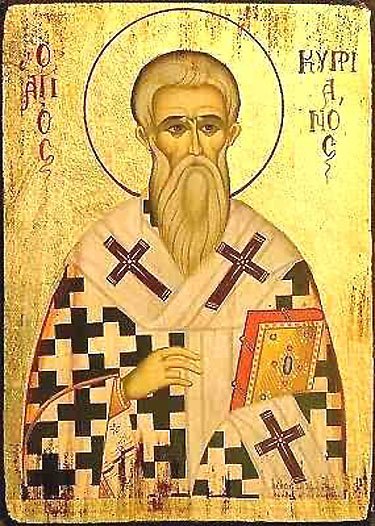
Hieromartyr Cyprian, bishop of Carthage (258)
He was born around 190 to pagan parents in North Africa. Before baptism he was distinguished in Carthage as a teacher of philosophy and rhetoric. He came to faith in Christ and was baptized at a young age; as soon as he became a Christian he abandoned his prestigious teacher’s position, sold his many possessions and gave all his wealth to the poor. H
He was born around 190 to pagan parents in North Africa. Before baptism he was distinguished in Carthage as a teacher of philosophy and rhetoric. He came to faith in Christ and was baptized at a young age; as soon as he became a Christian he abandoned his prestigious teacher’s position, sold his many possessions and gave all his wealth to the poor. He was ordained presbyter in 247, Bishop of Carthage in 248. He was known for his gentleness and paternal care for his flock, combined with firm opposition to heretics. His extensive writings still guide the Church today.
For his confession of Christ, he was beheaded under the Emperor Valerian on September 14; since that is the date of the Exaltation of the Cross, his feast is kept today. At the time of his execution he left twenty-five gold pieces (a huge sum) for the executioner who beheaded him.
Troparion - Tone 4
By sharing in the ways of the Apostles, / you became a successor to their throne. / Through the practice of virtue, you found the way to divine contemplation, O divinely-inspired one; by rightly dividing the word of truth without error, you defended the Faith, / even to the shedding of your blood. / O Hieromartyr Cyprian, entreat Christ God to save our souls.
Kontakion - Tone 4
Guide of Orthodoxy, teacher of piety and holiness, / luminary of Carthage, and divinely-inspired adornment of Confessors. / O wise Cyprian, by your teachings you have enlightened all, O harp of the Spirit. / Pray to Christ God that our souls may be saved.
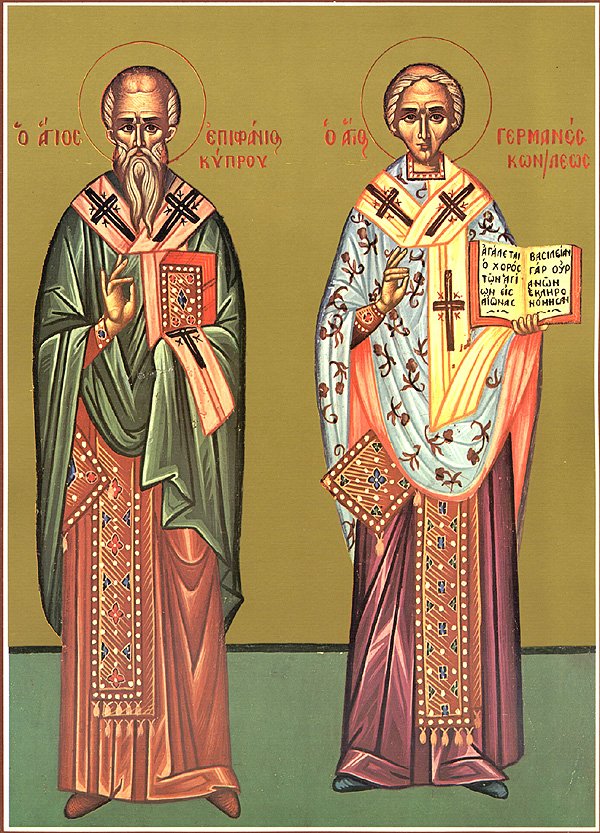
St Gennadius, Patriarch of Constantinople (471)
Saint Germanus, Patriarch of Constantinople, was born at Constantinople in the seventh century. His father, a prominent senator, was killed by order of the emperor Constantine Pogonatos (668-685). The young Germanus was emasculated and sent to a monastery, where he studied Holy Scripture.
Because of the sanctity of his life, Germanus was made bishop in the city of Cyzicus.
Saint Germanus, Patriarch of Constantinople, was born at Constantinople in the seventh century. His father, a prominent senator, was killed by order of the emperor Constantine Pogonatos (668-685). The young Germanus was emasculated and sent to a monastery, where he studied Holy Scripture.
Because of the sanctity of his life, Germanus was made bishop in the city of Cyzicus. Saint Germanus rose up in defense of the Orthodox Faith against the iconoclast heretics. He was later made Patriarch of Constantinople. Saint Germanus continued to stand up against the iconoclasts and to their spokesman, the heretical emperor Leo III the Isaurian (717-741), but the contest was unequal. He was forced to put his omophorion upon the altar table in the sanctuary, and to resign the archpastoral throne. Then the enraged emperor, who accused the Patriarch of heresy the day before, sent soldiers, who beat the saint and threw him out of the patriarchal residence. Saint Germanus was Patriarch for fourteen years and five months.
He went to a monastery, where he spent the remaining days of his life. The holy Patriarch Germanus died in the year 740, at age ninety-five, and was buried in the Chora monastery in Constantinople. Afterwards, his relics were transferred to France.
At the Seventh Ecumenical Council (787), the name of Patriarch Germanus was included in the diptychs of the saints. He wrote a “Meditation on Church Matters or Commentary on the Liturgy;” also an explanation of the difficult passages of Holy Scripture, and another work on the rewards of the righteous after death.
His important work on the various heresies that had arisen since apostolic times, and on the church councils that took place during the reign of the emperor Leo the Iconoclast, provides a wealth of historical information. There are also three letters from the Patriarch about the veneration of icons, which were read at the Seventh Ecumenical Council.
His other works include hymns in praise of the saints, discourses on the Feasts of the Entry into the Temple, the Annunciation and the Dormition of the Most Holy Theotokos, and on the restoration of the church in honor of the Placing of the Venerable Zone of the Most Holy Theotokos.
Troparion - Tone 4
O God of our Fathers, / take not away Your mercy from us, / but ever act towards us according to Your kindness, / and by the prayers of Your saints, / guide our lives in peace.
Kontakion - Tone 4
Come, O faithful, let us sing a worthy hymn of praise / to honor the glorious Bishops, Epiphanius and Germanus. / They enlightened the minds of those living without faith, / while presenting the great mysteries of God to the faithful, / explaining True Belief with great wisdom!
Saint Aidan of Lindisfarne (651)
Around AD 635, Saint Oswald (5 August), King of Northumbria, appealed to the monks of the Monastery of Iona to send missionaries to his mostly-pagan kingdom. (An earlier mission had ended with the death of St Edwin in 633.) The fathers of the monastery chose St Aidan and consecrated him bishop. He founded a monastery (and his episcopal seat) on the island of Lindisfarne, and undertook missionary journeys, always on foot, throughout the kingdom, with King Oswald often accompanying him and serving as his interpreter.
Around AD 635, Saint Oswald (5 August), King of Northumbria, appealed to the monks of the Monastery of Iona to send missionaries to his mostly-pagan kingdom. (An earlier mission had ended with the death of St Edwin in 633.) The fathers of the monastery chose St Aidan and consecrated him bishop. He founded a monastery (and his episcopal seat) on the island of Lindisfarne, and undertook missionary journeys, always on foot, throughout the kingdom, with King Oswald often accompanying him and serving as his interpreter. He lived in great poverty, using all the gifts he received as alms for the poor or to buy back captives and slaves. He was the spiritual father of St Hilda (17 Nov.), and founded the first women’s monasteries in Northumbria. He reposed in peace in 651, and was buried at Lindisfarne.
Note: Northumbria was an Anglo-Saxon kingdom in what is now northeastern England and southern Scotland.
Scripture Readings
☩Epistle
2 Corinthians 12:10-19
10
Therefore I take pleasure in infirmities, in reproaches, in necessities, in persecutions, in distresses for Christ’s sake: for when I am weak, then am I strong.
11
I am become a fool in glorying; ye have compelled me: for I ought to have been commended of you: for in nothing am I behind the very chiefest apostles, though I be nothing.
12
Truly the signs of an apostle were wrought among you in all patience, in signs, and wonders, and mighty deeds.
13
For what is it wherein ye were inferior to other churches, except it be that I myself was not burdensome to you? forgive me this wrong.
14
Behold, the third time I am ready to come to you; and I will not be burdensome to you: for I seek not yours, but you: for the children ought not to lay up for the parents, but the parents for the children.
15
And I will very gladly spend and be spent for you; though the more abundantly I love you, the less I be loved.
16
But be it so, I did not burden you: nevertheless, being crafty, I caught you with guile.
17
Did I make a gain of you by any of them whom I sent unto you?
18
I desired Titus, and with him I sent a brother. Did Titus make a gain of you? walked we not in the same spirit? walked we not in the same steps?
19
Again, think ye that we excuse ourselves unto you? we speak before God in Christ: but we do all things, dearly beloved, for your edifying.
☩Gospel
Mark 4:10-23
10
And when he was alone, they that were about him with the twelve asked of him the parable.
11
And he said unto them, Unto you it is given to know the mystery of the kingdom of God: but unto them that are without, all these things are done in parables:
12
That seeing they may see, and not perceive; and hearing they may hear, and not understand; lest at any time they should be converted, and their sins should be forgiven them.
13
And he said unto them, Know ye not this parable? and how then will ye know all parables?
14
The sower soweth the word.
15
And these are they by the way side, where the word is sown; but when they have heard, Satan cometh immediately, and taketh away the word that was sown in their hearts.
16
And these are they likewise which are sown on stony ground; who, when they have heard the word, immediately receive it with gladness;
17
And have no root in themselves, and so endure but for a time: afterward, when affliction or persecution ariseth for the word’s sake, immediately they are offended.
18
And these are they which are sown among thorns; such as hear the word,
19
And the cares of this world, and the deceitfulness of riches, and the lusts of other things entering in, choke the word, and it becometh unfruitful.
20
And these are they which are sown on good ground; such as hear the word, and receive it, and bring forth fruit, some thirtyfold, some sixty, and some an hundred.
21
And he said unto them, Is a candle brought to be put under a bushel, or under a bed? and not to be set on a candlestick?
22
For there is nothing hid, which shall not be manifested; neither was any thing kept secret, but that it should come abroad.
23
If any man have ears to hear, let him hear.
Liturgical data sourced from OCA.org and orthocal.info