Fasting Rules
 Meat
Abstain
Meat
Abstain
 Fish
Abstain
Fish
Abstain
 Dairy
Abstain
Dairy
Abstain
 Oil
Abstain
Oil
Abstain
 Wine
Abstain
Wine
Abstain
Saints & Commemorations
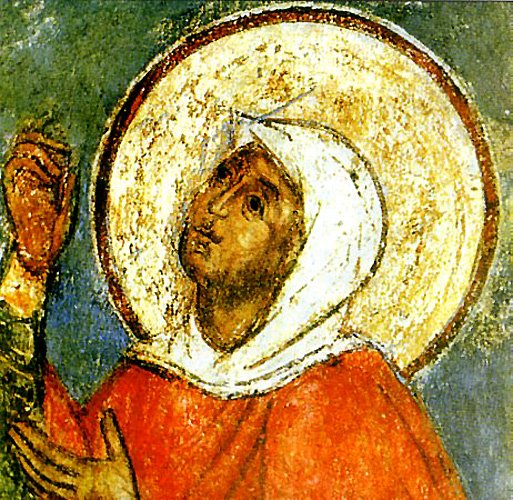
Greatmartyr Euphemia the All-Praised
The Miracle of Saint Euphemia the All-Praised: The holy Great Martyr Euphemia (September 16) suffered martyrdom in the city of Chalcedon in the year 304, during the time of the persecution against Christians by the emperor Diocletian (284-305). One and a half centuries later, at a time when the Christian Church had become victorious within the Roman Empire, God deigned that Euphemia the All-Praised should again be a witness and confessor of the purity of the Orthodox teaching.
The Miracle of Saint Euphemia the All-Praised: The holy Great Martyr Euphemia (September 16) suffered martyrdom in the city of Chalcedon in the year 304, during the time of the persecution against Christians by the emperor Diocletian (284-305). One and a half centuries later, at a time when the Christian Church had become victorious within the Roman Empire, God deigned that Euphemia the All-Praised should again be a witness and confessor of the purity of the Orthodox teaching.
In the year 451 in the city of Chalcedon, in the very church where the glorified relics of the holy Great Martyr Euphemia rested, the sessions of the Fourth Ecumenical Council (July 16) took place. The Council was convened for determining the precise dogmatic formulae of the Orthodox Church concerning the nature of the God-Man Jesus Christ. This was necessary because of the widespread heresy of the Monophysites [“mono-physis” meaning “one nature”], who opposed the Orthodox teaching of the two natures in Jesus Christ, the Divine and the Human natures (in one Divine Person). The Monophysites falsely affirmed that in Christ was only one nature, the Divine [i.e. that Jesus is God but not man, by nature], causing discord and unrest within the Church. At the Council were present 630 representatives from all the local Christian Churches. On the Orthodox side Anatolius, Patriarch of Constantinople (July 3), Juvenal, Patriarch of Jerusalem (July 2), and representatives of Saint Leo, Pope of Rome (February 18) participated in the conciliar deliberations. The Monophysites were present in large numbers, headed by Dioscorus, the Patriarch of Alexandria, and the Constantinople archimandrite Eutychius.
After prolonged discussions the two sides could not come to a decisive agreement.
The holy Patriarch Anatolius of Constantinople proposed that the Council submit the decision of the Church dispute to the Holy Spirit, through His undoubted bearer Saint Euphemia the All-Praised, whose wonderworking relics had been discovered during the Council’s discussions. The Orthodox hierarchs and their opponents wrote down their confessions of faith on separate scrolls and sealed them with their seals. They opened the tomb of the holy Great Martyr Euphemia and placed both scrolls upon her bosom. Then, in the presence of the emperor Marcian (450-457), the participants of the Council sealed the tomb, putting on it the imperial seal and setting a guard to watch over it for three days. During these days both sides imposed upon themselves strict fast and made intense prayer. After three days the patriarch and the emperor in the presence of the Council opened the tomb with its relics: the scroll with the Orthodox confession was held by Saint Euphemia in her right hand, and the scroll of the heretics lay at her feet. Saint Euphemia, as though alive, raised her hand and gave the scroll to the patriarch. After this miracle many of the hesitant accepted the Orthodox confession, while those remaining obstinant in the heresy were consigned to the Council’s condemnation and excommunication.
After an invasion by the Persians during the seventh century, the relics of Saint Euphemia were transferred from Chalcedon to Constantinople, into a newly built church dedicated to her. Many years later, during the period of the Iconoclast heresy, the reliquary with the relics of the saint was cast into the sea by order of the Iconoclast emperor Leo the Isaurian (716-741). The reliquary was rescued from the sea by the ship-owning brothers Sergius and Sergonos, who gave it over to the local bishop. The holy bishop ordered that the relics be preserved in secret, beneath a crypt, since the Iconoclast heresy was continuing to rage. A small church was built over the relics, and over the reliquary was put a board with an inscription stating whose relics rested within. When the Iconoclast heresy was finally condemned at the holy Seventh Ecumenical Council (in the year 787), during the time of Saint Tarasius, Patriarch of Constantinople (784-806) and the emperor Constantine VI (780-797) and his mother Saint Irene (797-802), the relics of the holy Great Martyr Euphemia were once again solemnly transferred to Constantinople.
Troparion - Tone 3
You brought joy to the Orthodox / and shame to the defenders of heresy, / for you confirmed what the Fathers of the Fourth Council had correctly taught. / Glorious martyr Euphemia, fair virgin of Christ, / entreat Christ God to grant us His great mercy.
Kontakion - Tone 2
For the sake of Christ your Bridegroom / you underwent struggles in both martyrdom and faith. / Now intercede with the Mother of God / that heresies and the insolent enemies of the Orthodox be placed underfoot. / You received and guarded that which was defined by the six hundred and thirty God-bearing Fathers, / all-praised Euphemia.
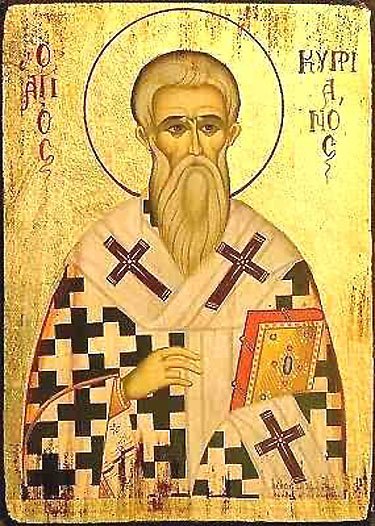
Holy Hieromartyr Cyprian of Carthage (258)
The Hieromartyr Cyprian, Bishop of Carthage, was born in about the year 200 in the city of Carthage (Northern Africa), where all his life and work took place. Thascius Cyprianus was the son of a rich pagan senator, and received a fine secular education becoming a splendid orator, and a teacher of rhetoric and philosophy in the school of Carthage.
The Hieromartyr Cyprian, Bishop of Carthage, was born in about the year 200 in the city of Carthage (Northern Africa), where all his life and work took place. Thascius Cyprianus was the son of a rich pagan senator, and received a fine secular education becoming a splendid orator, and a teacher of rhetoric and philosophy in the school of Carthage. He often appeared in the courts to defend his fellow citizens.
Cyprian afterwards recalled that for a long time “he remained in a deep dark mist.., far from the light of Truth.” His fortune, received from his parents and from his work, was spent on sumptuous banquets, but they were not able to quench in him the thirst for truth. He became acquainted with the writings of the Apologist Tertullian, and became convinced of the truth of Christianity. The holy bishop later wrote that he thought it was impossible for him to attain to the regeneration promised by the Savior, because of his habits.
He was helped by his friend and guide, the presbyter Cecilius, who assured him of the power of God’s grace. At 46 years of age the studious pagan was received into the Christian community as a catechumen. Before accepting Baptism, he distributed his property to the poor and moved into the house of the presbyter Cecilius.
When Saint Cyprian was finally baptized, he wrote in the Treatise To Donatus: “When the water of regeneration cleansed the impurity of my former life, a light from on high shone into my heart... and the Spirit transformed me into a new man by a second birth. Then at once, in a miraculous manner, certainty replaced doubt, mysteries were revealed, and darkness became light.... Then it was possible to acknowledge that what was born of the flesh and lived for sin was earthly, but what the Holy Spirit had vivified began to be of God.... In God and from God is all our strength.... Through Him we, while living upon the earth, have a hint of future bliss.”
Two years after his Baptism, the saint was ordained to the priesthood. When Bishop Donatus of Carthage died, Saint Cyprian was unanimously chosen as bishop. He gave his consent, having complied with his guide’s request, and was consecrated Bishop of Carthage in the year 248.
The saint first of all concerned himself about the welfare of the Church and the eradication of vices among the clergy and flock. The saintly life of the archpastor evoked in everyone a desire to imitate his piety, humility and wisdom. The fruitful activity of Saint Cyprian became known beyond the bounds of his diocese. Bishops from other sees often turned to him for advice on how to deal with various matters.
A persecution by the emperor Decius (249-251), revealed to the saint in a vision, forced him to go into hiding. His life was necessary to his flock for the strengthening of faith and courage among the persecuted. Before his departure from his diocese, the saint distributed the church funds among all the clergy for the aid of the needy, and in addition he sent further funds.
He kept in constant touch with the Carthaginian Christians through his epistles, and he wrote letters to presbyters, confessors and martyrs. Some Christians, broken by torture, offered sacrifice to the pagan gods. These lapsed Christians appealed to the confessors, asking to give them what is called a letter of reconciliation, i.e. a certificate for accepting them back into the Church. Saint Cyprian wrote a general letter to all the Carthaginian Christians, stating that those who lapsed during a time of persecution might be admitted into the Church, but this must be preceded by an investigation of the circumstances under which the falling away came about. It was necessary to determine the sincerity of contrition of the lapsed. To admit them was possible only after penance, and with the permission of the bishop. Some of the lapsed insistently demanded their immediate re-admittance into the Church and caused unrest in the whole community. Saint Cyprian wrote the bishops of other dioceses asking their opinion, and from all he received full approval of his directives.
During his absence the saint authorized four priests to examine the lives of persons preparing for ordination to the priesthood and the deaconate. This met with resistance from the layman Felicissimus and the presbyter Novatus, roused to indignation against their bishop. Saint Cyprian excommunicated Felicissimus and six of his followers. In his letter to the flock, the saint touchingly admonished all not to separate themselves from the unity of the Church, to be subject to the lawful commands of the bishop and to await his return. This letter kept the majority of Carthaginian Christians faithful to the Church.
In a short while, Saint Cyprian returned to his flock. The insubordination of Felicissimus was put to an end at a local Council in the year 251. This Council decreed that it was possible to receive the lapsed back into the Church after a penance, and it affirmed the excommunication of Felicissimus.
During this time there occurred a new schism, led by the Roman presbyter Novatian, and joined by the Carthaginian presbyter Novatus, a former adherent of Felicissimus. Novatian asserted that those who lapsed during a time of persecution could not be readmitted, even if they repented of their sin. Besides this, Novatian with the help of Novatus convinced three Italian bishops during the lifetime of the lawful Roman bishop Celerinus to place another bishop on the Roman cathedra. Against such iniquity, Saint Cyprian wrote a series of encyclicals to the African bishops, and later a whole book, On the Unity of the Church .
When the discord in the Carthage church began to quiet down, a new calamity began: a pestilential plague flared up. Hundreds of people fled from the city, leaving the sick without help, and the dead without burial. Saint Cyprian, providing an example by his firmness and his courage, tended the sick and buried the dead himself, not only Christians but also pagans. The plague was accompanied by drought and famine. A horde of barbarian Numidians, taking advantage of the misfortune, fell upon the inhabitants, taking many into captivity. Saint Cyprian moved many rich Carthaginians to offer up means for feeding the starving and ransoming captives.
When a new persecution against Christians spread under the emperor Valerian (253-259), the Carthaginian proconsul Paternus ordered the saint to offer sacrifice to idols. He steadfastly refused to do this. He also refused to give the names and addresses of the presbyters of the church of Carthage. They sent the saint to the city of Curubis, and Deacon Pontus voluntarily followed his bishop into exile.
On the day the saint arrived at the place of exile he had a vision, predicting for him a quick martyr’s end. While in exile, Saint Cyprian wrote many letters and books. Desiring to suffer at Carthage, he returned there. Taken before the court, he was set at liberty until the following year. Nearly all the Christians of Carthage came to take leave of their bishop and receive his blessing.
At the trial, Saint Cyprian calmly and firmly refused to offer sacrifice to idols and was sentenced to beheading with a sword. Hearing the sentence, Saint Cyprian said, “Thanks be to God!” All the people cried out with one voice, “Let us also be beheaded with him!”
Coming to the place of execution, the saint again gave his blessing to all and arranged to give twenty-five gold coins to the executioner. He then tied a handkerchief over his eyes, and gave his hands to be bound to the presbyter and archdeacon standing near him and lowered his head. Christians put their cloths and napkins in front of him so as to collect the martyr’s blood. Saint Cyprian was executed in the year 258. The body of the saint was taken by night and given burial in a private crypt of the procurator Macrobius Candidianus.
Some say that his holy relics were transferred to France in the time of King Charles the Great (i.e. Charlemagne, 771-814).
Saint Cyprian of Carthage left the Church a precious legacy: his writings and 80 letters. The works of Saint Cyprian were accepted by the Church as a model of Orthodox confession and read at two Ecumenical Councils (Ephesus and Chalcedon).
In the writings of Saint Cyprian the Orthodox teaching about the Church is stated: It has its foundation upon the Lord Jesus Christ, and was proclaimed and built up by the Apostles. The inner unity is expressed in an unity of faith and love, and the outer unity is actualized by the hierarchy and sacraments of the Church.
In the Church Christ comprises all the fulness of life and salvation. Those having separated themselves from the unity of the Church do not have true life in themselves. Christian love is shown as the bond that holds the Church together. “Love is the foundation of all the virtues, and it continues with us eternally in the Heavenly Kingdom.”
Troparion - Tone 4
By sharing in the ways of the Apostles, / you became a successor to their throne. / Through the practice of virtue, you found the way to divine contemplation, O divinely-inspired one; by rightly dividing the word of truth without error, you defended the Faith, / even to the shedding of your blood. / O Hieromartyr Cyprian, entreat Christ God to save our souls.
Kontakion - Tone 4
Guide of Orthodoxy, teacher of piety and holiness, / luminary of Carthage, and divinely-inspired adornment of Confessors. / O wise Cyprian, by your teachings you have enlightened all, O harp of the Spirit. / Pray to Christ God that our souls may be saved.
St Ninian, Enlightener of Scotland (432)
One of the great missionaries and early Saints of the British Isles, he was born in Britain around the year 360. Though Britain was still mostly pagan, Ninian was born of Christian parents. He traveled to Rome as a young man, and spent several years there engaged in study and ascetic struggle. He was ordained in Rome and sent back as a missionary to Britain around the year 400.
One of the great missionaries and early Saints of the British Isles, he was born in Britain around the year 360. Though Britain was still mostly pagan, Ninian was born of Christian parents. He traveled to Rome as a young man, and spent several years there engaged in study and ascetic struggle. He was ordained in Rome and sent back as a missionary to Britain around the year 400. On the way he probably met St Martin of Tours: many of the churches he founded, including his cathedral in Whithorn, were named in honor of St Martin. He established several monasteries, ministered to his Christian Briton countrymen and converted many more Britons to the Faith. He also converted many of the fierce Picts, inhabitants of today’s Scotland, to faith in Christ. He reposed in peace in Whithorn in 432.
Our Holy Father Dorotheos the Solitary of Egypt (4th c.)
He was one of the great company of Egyptian desert fathers of the fourth century. He lived alone in a cell in the Thebaid for sixty years, devoting himself to prayer, asceticism and renowned love of labor. He spent his days building cells for new monks, his nights making plaited mats, all the while immersed in prayer and psalmody.
Scripture Readings
☩Epistle
Galatians 6:2-10
2
Bear ye one another’s burdens, and so fulfil the law of Christ.
3
For if a man think himself to be something, when he is nothing, he deceiveth himself.
4
But let every man prove his own work, and then shall he have rejoicing in himself alone, and not in another.
5
For every man shall bear his own burden.
6
Let him that is taught in the word communicate unto him that teacheth in all good things.
7
Be not deceived; God is not mocked: for whatsoever a man soweth, that shall he also reap.
8
For he that soweth to his flesh shall of the flesh reap corruption; but he that soweth to the Spirit shall of the Spirit reap life everlasting.
9
And let us not be weary in well doing: for in due season we shall reap, if we faint not.
10
As we have therefore opportunity, let us do good unto all men, especially unto them who are of the household of faith.
☩Gospel
Mark 7:14-24
14
And when he had called all the people unto him, he said unto them, Hearken unto me every one of you, and understand:
15
There is nothing from without a man, that entering into him can defile him: but the things which come out of him, those are they that defile the man.
16
If any man have ears to hear, let him hear.
17
And when he was entered into the house from the people, his disciples asked him concerning the parable.
18
And he saith unto them, Are ye so without understanding also? Do ye not perceive, that whatsoever thing from without entereth into the man, it cannot defile him;
19
Because it entereth not into his heart, but into the belly, and goeth out into the draught, purging all meats?
20
And he said, That which cometh out of the man, that defileth the man.
21
For from within, out of the heart of men, proceed evil thoughts, adulteries, fornications, murders,
22
Thefts, covetousness, wickedness, deceit, lasciviousness, an evil eye, blasphemy, pride, foolishness:
23
All these evil things come from within, and defile the man.
24
And from thence he arose, and went into the borders of Tyre and Sidon, and entered into an house, and would have no man know it: but he could not be hid.
Liturgical data sourced from OCA.org and orthocal.info