Fasting Rules
 Meat
Abstain
Meat
Abstain
 Fish
Abstain
Fish
Abstain
 Dairy
Abstain
Dairy
Abstain
 Oil
Abstain
Oil
Abstain
 Wine
Abstain
Wine
Abstain
Saints & Commemorations
Saint Macarius the Roman of Mesopotamia (?)
“Three holy men who lived in ascesis in the Monastery of St Asclepius in Mesopotamia decided to walk up and down the world in search of a sign from God for their salvation. As they approached a cave, deep in the wilderness, they became aware all at once of a marvellous scent and saw an old man coming towards them covered only by his hair and the beard that fell to his knees. H
“Three holy men who lived in ascesis in the Monastery of St Asclepius in Mesopotamia decided to walk up and down the world in search of a sign from God for their salvation. As they approached a cave, deep in the wilderness, they became aware all at once of a marvellous scent and saw an old man coming towards them covered only by his hair and the beard that fell to his knees. He cast himself to the earth and remained there for a while, until he was sure the three strangers were not demons. Then he brought them into his cave, where he lived with two lions. They asked him to tell them his story, which he did.
“His name was Macarius, the son of a rich senator of Rome. When he reached marriageable age, his parents betrothed him against his will. On his wedding night, at the moment of entering the bridal chamber in the midst of the festivities, he fled to a pious widow’s, where he spent seven days in hiding, weeping and entreating the help of God. As he left her house, an old man of kindly and noble demeanour came by, and told him to follow. And, indeed, Macarius followed him for three years, until the moment of arrival near the cave, when the old man vanished. He appeared to Macarius in a dream soon after, and revealed that he was the Archangel Raphael, who had once been the guide of Tobias in his travels. Before departing, the Archangel entrusted him to the care of God and of two lion cubs that had just lost their mother.
“Some while after, Macarius saw, standing before him, a most beautiful maiden, who told him that she too had fled marriage in Rome. Macarius did not have discernment enough to escape the Devil’s trap, and welcomed her to spend the night in his cave. During the night, he was violently attacked, for the first time in his life, by the fiery darts of carnal desire. The pretended maiden suddenly disappeared, as the Devil triumphed in his success at introducing the thought of sin into the mind of the ascetic. Macarius then realized the gravity of his fall in the sight of God. Weeping bitterly, he made up his mind to leave the cave and find somewhere else to do penance. But, on his way, the Archangel Raphael appeared to him anew and urged him to return, for it was in his cave that God would hear his prayer. So he went back and sorely afflicted his flesh with fasting, vigils and utter abnegation for many years, in order to regain a heart of unsullied purity in which to contemplate the image of God.
“When he had edified the three brethren with the story of his struggles, Macarius sent them away in peace and fell asleep in the Lord, unknown to all, in the presence only of the angels and the saints.” (Synaxarion)
Not even the century of the Saint’s life is given in our sources.
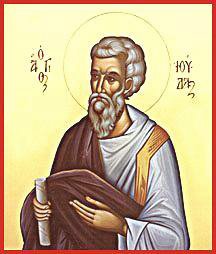
Holy Apostle James, Brother of the Lord
The Holy Apostle Jude, one of the twelve apostles of Christ, is descended from King David and Solomon, and was the son of Righteous Joseph the Betrothed (Sunday after the Nativity of the Lord) by his first wife.
The Holy Apostle John the Theologian writes in his Gospel, “... neither did his brethren believe in Him” (John. 7:5
The Holy Apostle Jude, one of the twelve apostles of Christ, is descended from King David and Solomon, and was the son of Righteous Joseph the Betrothed (Sunday after the Nativity of the Lord) by his first wife.
The Holy Apostle John the Theologian writes in his Gospel, “... neither did his brethren believe in Him” (John. 7:5). Saint Theophylact, Archbishop of Bulgaria, explains this passage. He says that at the beginning of the Lord Jesus Christ’s earthly ministry, Joseph’s sons, Jude among them, did not believe in His divine nature. Tradition says that when Saint Joseph returned from Egypt, he began to divide his possessions among his sons. He wanted to allot a share to Christ the Savior, born miraculously and incorruptibly from the All-Pure Virgin Mary. The brothers were opposed to this because Jesus was born of another mother. Only James, later called “The Brother of God,” offered to share his portion with Him.
Jude came to believe in Christ the Savior as the awaited Messiah, and he followed Him and was chosen as one of the twelve Apostles. Mindful of his sin, the Apostle Jude considered himself unworthy to be called the Lord’s brother, and in his Epistle he calls himself merely the brother of James.
The Holy Apostle Jude also had other names: the Evangelist Matthew terms him “Lebbaeus, whose surname was Thaddeus” (Mt. 10:3). The Holy Evangelist Mark also calls him Thaddeus (Mark 3:18), and in the Acts of the Holy Apostles he is called Barsabas (Acts 15: 22). This was customary at that time.
After the Ascension of the Lord Jesus Christ, Saint Jude traveled about preaching the Gospel. He propagated the faith in Christ at first in Judea, Galilee, Samaria and Idumaia, and later in the lands of Arabia, Syria and Mesopotamia. Finally, he went to the city of Edessa. Here he finished the work that was not completed by his predecessor, Saint Thaddeus, Apostle of the Seventy (August 21). There is a tradition that Saint Jude went to Persia, where he wrote his catholic Epistle in Greek. In the Epistle much profound truth was expressed in a few words.
Saint Jude’s Epistle speaks about the Holy Trinity, about the Incarnation of the Lord Jesus Christ, about the good and bad angels, and about the dread Last Judgment. The Apostle urges believers to guard themselves against fleshly impurity, to be diligent in prayer, faith and love, to convert the lost to the path of salvation, and to guard themselves from the teachings of heretics. He also says that it is not enough just to be converted to Christianity, but faith must be demonstrated by good works. He cites the rebellious angels and men punished by God (verse 6) to support this.
The Holy Apostle Jude died as a martyr around the year 80 near Mt. Ararat in Armenia, where he was crucified and pierced by arrows.
Troparion - Tone 1
Divinely we praise you, O Jude, as a faithful witness, / knowing you to be the brother of Christ. / You trampled on delusion, / and so preserved the faith. / Today as we celebrate your holy memory, / by your intercessions we receive remission of sins.
Kontakion - Tone 2
You were chosen as a disciple for your firmness of mind: / An unshakable pillar of the Church of Christ, / you proclaimed His word to the Gentiles, / telling them to believe in one Godhead. / You were glorified by Him, receiving the grace of healing, / healing the ills of all who came to you, / O most praised Apostle Jude!
Scripture Readings
☩Epistle
Colossians 2:1-7
1
For I would that ye knew what great conflict I have for you, and for them at Laodicea, and for as many as have not seen my face in the flesh;
2
That their hearts might be comforted, being knit together in love, and unto all riches of the full assurance of understanding, to the acknowledgement of the mystery of God, and of the Father, and of Christ;
3
In whom are hid all the treasures of wisdom and knowledge.
4
And this I say, lest any man should beguile you with enticing words.
5
For though I be absent in the flesh, yet am I with you in the spirit, joying and beholding your order, and the stedfastness of your faith in Christ.
6
As ye have therefore received Christ Jesus the Lord, so walk ye in him:
7
Rooted and built up in him, and stablished in the faith, as ye have been taught, abounding therein with thanksgiving.
☩Gospel
Luke 10:1-15
1
After these things the Lord appointed other seventy also, and sent them two and two before his face into every city and place, whither he himself would come.
2
Therefore said he unto them, The harvest truly is great, but the labourers are few: pray ye therefore the Lord of the harvest, that he would send forth labourers into his harvest.
3
Go your ways: behold, I send you forth as lambs among wolves.
4
Carry neither purse, nor scrip, nor shoes: and salute no man by the way.
5
And into whatsoever house ye enter, first say, Peace be to this house.
6
And if the son of peace be there, your peace shall rest upon it: if not, it shall turn to you again.
7
And in the same house remain, eating and drinking such things as they give: for the labourer is worthy of his hire. Go not from house to house.
8
And into whatsoever city ye enter, and they receive you, eat such things as are set before you:
9
And heal the sick that are therein, and say unto them, The kingdom of God is come nigh unto you.
10
But into whatsoever city ye enter, and they receive you not, go your ways out into the streets of the same, and say,
11
Even the very dust of your city, which cleaveth on us, we do wipe off against you: notwithstanding be ye sure of this, that the kingdom of God is come nigh unto you.
12
But I say unto you, that it shall be more tolerable in that day for Sodom, than for that city.
13
Woe unto thee, Chorazin! woe unto thee, Bethsaida! for if the mighty works had been done in Tyre and Sidon, which have been done in you, they had a great while ago repented, sitting in sackcloth and ashes.
14
But it shall be more tolerable for Tyre and Sidon at the judgment, than for you.
15
And thou, Capernaum, which art exalted to heaven, shalt be thrust down to hell.
Liturgical data sourced from OCA.org and orthocal.info