Fasting Rules
 Meat
Allowed
Meat
Allowed
 Fish
Allowed
Fish
Allowed
 Dairy
Allowed
Dairy
Allowed
 Oil
Allowed
Oil
Allowed
 Wine
Allowed
Wine
Allowed
Saints & Commemorations
Prophet Habakkuk
Prophet Habbakuk
He prophesied in the time of Joachim, just before the Jewish people were taken into captivity in Babylon. He himself escaped captivity, and after Jerusalem was destroyed, returned to his homeland. Once he was taking some food to his harvesters when an Angel transported him to Babylon to feed the Prophet Daniel in the lions’ den, then bore him back to Judea (this is told in the full version of the book of Daniel, ch. 6
He prophesied in the time of Joachim, just before the Jewish people were taken into captivity in Babylon. He himself escaped captivity, and after Jerusalem was destroyed, returned to his homeland. Once he was taking some food to his harvesters when an Angel transported him to Babylon to feed the Prophet Daniel in the lions’ den, then bore him back to Judea (this is told in the full version of the book of Daniel, ch. 6 LXX). The third chapter of his prophecy is used as the Fourth Ode of the Matins Canon(the Ode is usually sung in full only in monasteries during Lent, but the eirmos of the Fourth Ode, sung in many parishes, usually refers to the Prophet). His holy relics were found through a revelation in Palestine during the reign of Theodosius the Great, and a chapel built there. His name means “Father of the Resurrection.”
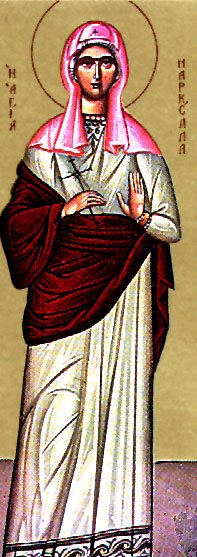
Holy Martyr Myrope (Myropea) of Chios (251)
Saint Markella lived in the village of Volissos, Chios sometime after the middle of the fourteenth century. Her parents were Christians, and among the wealthiest citizens of Volissos. The saint’s mother died when she was young, and so her father, the mayor of the village, saw to her education.
She had been trained by her mother to be respectful and devout, and to guard her purity. S
Saint Markella lived in the village of Volissos, Chios sometime after the middle of the fourteenth century. Her parents were Christians, and among the wealthiest citizens of Volissos. The saint’s mother died when she was young, and so her father, the mayor of the village, saw to her education.
She had been trained by her mother to be respectful and devout, and to guard her purity. She avoided associations with other girls who were more outgoing than she was so that she would not come to spiritual harm through such company. Her goal was to attain the Kingdom of Heaven, and to become a bride of Christ.
Saint Markella increased in virtue as she grew older, fasting, praying, and attending church services. She tried to keep the commandments and to lead others to God. She loved and respected her father, and comforted him in his sorrow. She told him she would take care of him in his old age, and would not abandon him.
As an adult, Saint Markella was loved by everyone for her beauty and for her spiritual gifts. The Enemy of our salvation tried to lure her into sin by placing evil thoughts in her mind. She resisted these temptations, and so the devil turned away from a direct confrontation with the young woman. Instead, he incited her father with an unnatural desire for his daughter.
Markella’s father changed in his behavior toward her. He became moody and depressed, forbidding her to go into the garden or to speak with the neighbors. Unable to understand the reason for this change, the saint went to her room and wept. She prayed before an icon of the Mother of God, asking Her to help her father. Soon she fell asleep, only to be awakened by her father’s shouting.
The unfortunate man had spent a long time struggling against his lust, but finally he gave in to it. At times he would speak to his daughter roughly, then later he would appear to be gentle. He wanted to be near her, and to stroke her hair. Unaware of her father’s intentions, Saint Markella was happy to see him emerge from his melancholy state, thinking that her prayer had been answered.
One day, her father openly declared the nature of his feelings for her. Horrified, the saint tried to avoid him as much as she could. Even the neighbors realized that there was something wrong with the man, so they stopped speaking to him.
A shepherd was tending his sheep near the beach one morning, and was leading them into the shade of a plane tree to avoid the hot July sun. Just as he was about to lie down, he heard a noise and looked up. He saw a young woman with a torn dress running down the hill. She hid in a nearby bush, ignoring its thorns.
The shepherd wondered who was chasing her, and how she had come to this spot. Then he heard the sound of a horse approaching, and recognized the mayor of the village. He asked the shepherd if he had seen his daughter. He said that he had not seen her, but pointed to her hiding place with his finger.
The mayor ordered Markella to come out of the bush, but she refused. Therefore, he set fire to the bush in order to force her out. She emerged on the side opposite her father, and ran toward the rocky shore, calling out to the Mother of God for help.
Markella continued to run, even though blood was flowing from her face and hands. Feeling a sharp pain in her leg, she saw that she had been shot with an arrow. She paused to pull it out, then took to flight once more. She scrambled over the rocks, staining them with her blood. Hearing her father getting closer, she prayed that the earth would open up and swallow her.
The saint sank to her knees, her strength all gone, and then a miracle took place. The rock split open and received her body up to the waist. Her father drew near with wild-eyed joy shouting, “I have caught you. Now where will you go?
Drawing his sword, he began to butcher his helpless daughter, cutting off pieces of her body. Finally, he seized her by the hair and cut off her head, throwing it into the sea. At once the calm sea became stormy, and large waves crashed to the shore near the murderer’s feet. Thinking that the sea was going to drown him because of his crime, he turned and fled. His ultimate fate has not been recorded.
In later years, pious Christians built a church on the spot where Saint Markella hid in the bush. The spot where she was killed became known as “The Martyrdom of Saint Markella,” and the rock that opened to receive her is still there. The rock appears to be a large stone that broke off from a mountain and rolled into the sea. Soil from the mountain covers the spot on the side facing the land. On the side facing the ocean is a small hole, about the size of a finger. A healing water flows from the opening, which cures every illness.
The flow of water is not due to the movements of the tide, because when the tide is out, there would be no water. This, however, is not the case. The water is clear, but some of the nearby rocks have been stained with a reddish-yellow color. According to tradition, the lower extremities of Saint Markella’s body are concealed in the rock.
The most astonishing thing about the rock is not the warmth of the water, nor the discoloration of the other rocks, but what happens when a priest performs the Blessing of Water. A sort of steam rises up from the water near the rock, and the entire area is covered with a mist. The sea returns to normal as soon as the service is over. Many miracles have occurred at the spot, and pilgrims flock there from all over the world.
Troparion - Tone 4
Your lamb Markella calls out to You, O Jesus, in a loud voice: / “I love You, my Bridegroom, and in seeking You I endure suffering. / In Baptism I was crucified so that I might reign in You, / and I died so that I might live with You. / Accept me as a pure sacrifice, / for I have offered myself in love.” / Through her prayers, save our souls, since You are merciful.
Our Holy Father Athanasius "the Resurrected," Recluse of the Kiev Caves (1176)
After many years of ascetic struggle, Athanasius died and was prepared for burial. After lying dead for two full days, he inexplicably came back to life: the monks who came to bury him were astonished to find him sitting up and weeping. The brethren gathered around him and asked him many questions about what he had seen of the next world, but he
After many years of ascetic struggle, Athanasius died and was prepared for burial. After lying dead for two full days, he inexplicably came back to life: the monks who came to bury him were astonished to find him sitting up and weeping. The brethren gathered around him and asked him many questions about what he had seen of the next world, but he would only answer ‘Save yourselves!’ When they pressed him further, he said ‘If I told you, you would not believe me or want to listen to me.’ His final reply was ‘Repent every moment, and pray to the Lord Jesus Christ and to His most pure Mother.’ He then shut himself in his cell and lived another twelve years, taking only bread and water and never speaking again to anyone.
Saint (Stephen) Uroš, King of Serbia (1367)
“The son of King Dušan, he ruled during the difficult time of the fall of the Kindom of Serbia. Humble, pious and gentle, he refused to attempt to restrain the power of the powerful nobles by force. Amongst these was Vukašin, who brought about his death. Good King Uroš suffered a martyr’s death on December 2nd, 1367, at the age of thirty-one. Killed
“The son of King Dušan, he ruled during the difficult time of the fall of the Kindom of Serbia. Humble, pious and gentle, he refused to attempt to restrain the power of the powerful nobles by force. Amongst these was Vukašin, who brought about his death. Good King Uroš suffered a martyr’s death on December 2nd, 1367, at the age of thirty-one. Killed by men, he was glorified by God. His wonderworking relics were preserved in the monastery of Jazak in the Fruška Gora, whence they were taken to Belgrade in 1942, during the Second World War, and placed in the Cathedral beside the bodies of Prince Lazar and Despot Stephen Štiljanovic. During the reign of this benevolent king, the monastery of St Nahum was built beside Lake Ochrid by one of Uroš’s nobles, Grgur.” (Prologue)
Saint Porphyrios of Kavsokalyvia (1991) (Nov. 19 OC)
One of the true God-bearing Elders of our own time, he was glorified by the Church in 2013.
Scripture Readings
☩Epistle
1 Timothy 5:22-6:11
22
Lay hands suddenly on no man, neither be partaker of other men’s sins: keep thyself pure.
23
Drink no longer water, but use a little wine for thy stomach’s sake and thine often infirmities.
24
Some men’s sins are open beforehand, going before to judgment; and some men they follow after.
25
Likewise also the good works of some are manifest beforehand; and they that are otherwise cannot be hid.
1
Let as many servants as are under the yoke count their own masters worthy of all honour, that the name of God and his doctrine be not blasphemed.
2
And they that have believing masters, let them not despise them, because they are brethren; but rather do them service, because they are faithful and beloved, partakers of the benefit. These things teach and exhort.
3
If any man teach otherwise, and consent not to wholesome words, even the words of our Lord Jesus Christ, and to the doctrine which is according to godliness;
4
He is proud, knowing nothing, but doting about questions and strifes of words, whereof cometh envy, strife, railings, evil surmisings,
5
Perverse disputings of men of corrupt minds, and destitute of the truth, supposing that gain is godliness: from such withdraw thyself.
6
But godliness with contentment is great gain.
7
For we brought nothing into this world, and it is certain we can carry nothing out.
8
And having food and raiment let us be therewith content.
9
But they that will be rich fall into temptation and a snare, and into many foolish and hurtful lusts, which drown men in destruction and perdition.
10
For the love of money is the root of all evil: which while some coveted after, they have erred from the faith, and pierced themselves through with many sorrows.
11
But thou, O man of God, flee these things; and follow after righteousness, godliness, faith, love, patience, meekness.
☩Gospel
Luke 20:1-8
1
And it came to pass, that on one of those days, as he taught the people in the temple, and preached the gospel, the chief priests and the scribes came upon him with the elders,
2
And spake unto him, saying, Tell us, by what authority doest thou these things? or who is he that gave thee this authority?
3
And he answered and said unto them, I will also ask you one thing; and answer me:
4
The baptism of John, was it from heaven, or of men?
5
And they reasoned with themselves, saying, If we shall say, From heaven; he will say, Why then believed ye him not?
6
But and if we say, Of men; all the people will stone us: for they be persuaded that John was a prophet.
7
And they answered, that they could not tell whence it was.
8
And Jesus said unto them, Neither tell I you by what authority I do these things.
Liturgical data sourced from OCA.org and orthocal.info