Fasting Rules
 Meat
Allowed
Meat
Allowed
 Fish
Allowed
Fish
Allowed
 Dairy
Allowed
Dairy
Allowed
 Oil
Allowed
Oil
Allowed
 Wine
Allowed
Wine
Allowed
Saints & Commemorations
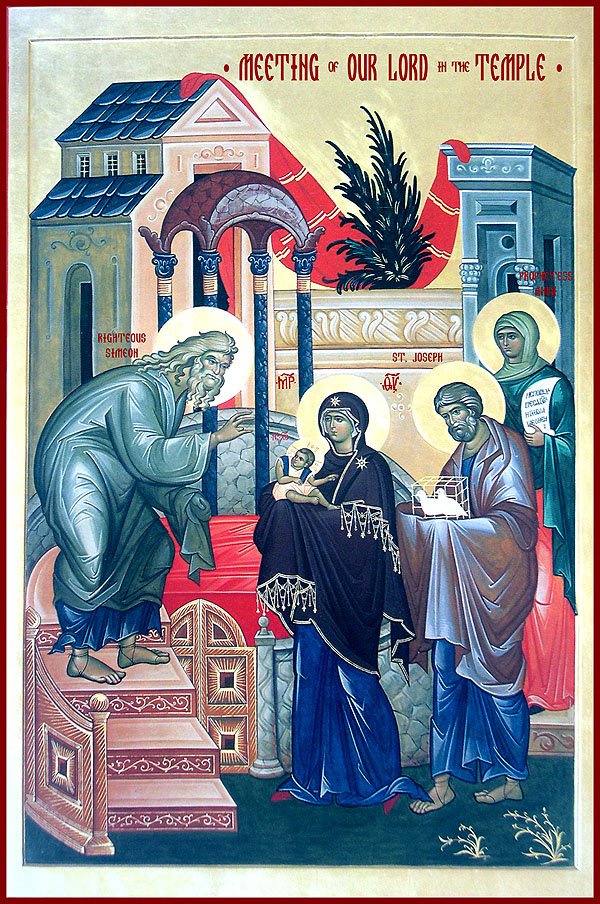
The Meeting of our Lord and Savior Jesus Christ in the Temple
The Meeting of our Lord God and Savior Jesus Christ is described in the third Gospel (Luke 2:22-40). Forty days after His birth the Divine Child was brought to the Temple at Jerusalem to be presented to the Lord. According to the Law of Moses (Lev. 12:2-8), a woman who gave birth to a male child was forbidden to enter the Temple for forty days.
The Meeting of our Lord God and Savior Jesus Christ is described in the third Gospel (Luke 2:22-40). Forty days after His birth the Divine Child was brought to the Temple at Jerusalem to be presented to the Lord. According to the Law of Moses (Lev. 12:2-8), a woman who gave birth to a male child was forbidden to enter the Temple for forty days. At the end of the time of her purification, the mother went to the Temple with the child, to offer a young lamb, two turtledoves, or pigeons to the Lord as a sacrifice. The Most Holy Virgin had no need of purification, since she had given birth to the Source of purity and sanctity. Out of humility, however, she fulfilled the requirements of the Law.
At this time the righteous Elder Simeon (February 3) was living in Jerusalem. It had been revealed to him that he would not die until he beheld the promised Messiah. By divine inspiration, Saint Simeon went to the Temple at the very moment when the Most Holy Theotokos and Saint Joseph had brought the Child Jesus to fulfill the Law.
Saint Simeon received the divine Child in his arms, 1 and giving thanks to God, he spoke the words repeated by the Church each evening at Vespers: “Lord, now lettest Thou Thy servant depart in peace, according to Thy word, for mine eyes have seen Thy salvation, which Thou hast prepared before the face of all people, a light to enlighten the Gentiles, and the glory of Thy people Israel” (Luke 2:29-32). Saint Simeon said to the Most Holy Virgin: “Behold, this child is set for the fall and rising again of many in Israel, and for a sign which shall be spoken against. Yea, a sword shall pierce through your own soul also, that the thoughts of many hearts may be revealed” (Luke 2:34-35).
At the Temple was an 84-year-old widow, Saint Anna the Prophetess, the daughter of Phanuel (February 3), “who did not leave the temple, but served God with fasting and prayers night and day." She arrived just when Saint Simeon met the Divine Child. She also gave thanks to the Lord and spoke of Him to all those who were looking for redemption of Jerusalem” (Luke 2:38). In the icon of the Feast she holds a scroll which reads: “This Child has established Heaven and earth.”
Before Christ was born, the righteous men and women lived by faith in the promised Messiah, and awaited His coming. The Righteous Simeon and the Prophetess Anna, the last righteous persons of the Old Testament, were deemed worthy to meet Him in the Temple.
The Feast of the Meeting of the Lord is among the most ancient feasts of the Christian Church. We have sermons by the holy bishops Methodios of Patara (+ 312), Cyril of Jerusalem (+ 360), Gregory the Theologian (+ 389), Amphilokhios of Iconium (+ 394), Gregory of Nyssa (+ 400), and John Chrysostom (+ 407). Despite its early origin, this Feast was not celebrated so splendidly until the VI century.
In 528, during the reign of Justinian, an earthquake killed many people in Antioch. Other misfortunes followed this one. In 541 a terrible plague broke out in Constantinople, carrying off several thousand people each day. During this time of widespread suffering, a solemn prayer service (Litia) for deliverence from evils was celebrated on the Feast of the Meeting of the Lord, and the plague ceased. Giving thanks to God, the Church established a more solemn celebration of this Feast.
Church hymnographers have adorned this Feast with their hymns: Saint Andrew of Crete in the VII century; Saint Cosmas Bishop of Maium, Saint John of Damascus, and Saint Germanus Patriarch of Constantinople in the VIII century; and Saint Joseph, Archbishop of Thessaloniki in the IX century.
Today we also commemorate the Icon of the Most Holy Theotokos known as “the Softening of Evil Hearts” or “Simeon’s Prophecy.” The Mother of God is depicted without her Child, and seven swords piercing her breast: three from the left side, three from the right, and one from below.
A similar Icon, “Of the Seven Swords” (August 13) shows three swords on the left side and four from the right. The "Softening of Evil Hearts” Is also commemorated on August 13.
The Icon “Simeon’s Prophecy” symbolizes the fulfillment of the prophecy of the righteous Elder Simeon: “a sword shall pierce through your own soul” (Luke 2:35).
In Constantinople, the Emperors would celebrate the Feast Day at the Blakhernae church during the All-Night Vigil. This custom continued until the Fall of the Byzantine Empire.
1 For this reason, he is known as the God-Receiver (Θεοδόχος).
Troparion - Tone 1
Hail, Virgin Theotokos, full of grace; / for from you has shone forth the Sun of Righteousness, Christ our God, / giving light to those in darkness. / Be glad, O righteous Elder; / for you received in your arms the Redeemer of our souls, / Who bestows upon us the resurrection.
Kontakion - Tone 1
By Your birth, You sanctified a virginal womb, / and fittingly You blessed Simeon’s hands, O Christ God; / even now You have saved us by anticipation. / Grant peace to Your faithful people whom You have loved, O only Lover of mankind.
Scripture Readings
☩Epistle
Hebrews 7:7-17
7
And without all contradiction the less is blessed of the better.
8
And here men that die receive tithes; but there he receiveth them, of whom it is witnessed that he liveth.
9
And as I may so say, Levi also, who receiveth tithes, payed tithes in Abraham.
10
For he was yet in the loins of his father, when Melchisedec met him.
11
If therefore perfection were by the Levitical priesthood, (for under it the people received the law,) what further need was there that another priest should rise after the order of Melchisedec, and not be called after the order of Aaron?
12
For the priesthood being changed, there is made of necessity a change also of the law.
13
For he of whom these things are spoken pertaineth to another tribe, of which no man gave attendance at the altar.
14
For it is evident that our Lord sprang out of Juda; of which tribe Moses spake nothing concerning priesthood.
15
And it is yet far more evident: for that after the similitude of Melchisedec there ariseth another priest,
16
Who is made, not after the law of a carnal commandment, but after the power of an endless life.
17
For he testifieth, Thou art a priest for ever after the order of Melchisedec.
☩Gospel
Mark 13:9-13
9
But take heed to yourselves: for they shall deliver you up to councils; and in the synagogues ye shall be beaten: and ye shall be brought before rulers and kings for my sake, for a testimony against them.
10
And the gospel must first be published among all nations.
11
But when they shall lead you, and deliver you up, take no thought beforehand what ye shall speak, neither do ye premeditate: but whatsoever shall be given you in that hour, that speak ye: for it is not ye that speak, but the Holy Ghost.
12
Now the brother shall betray the brother to death, and the father the son; and children shall rise up against their parents, and shall cause them to be put to death.
13
And ye shall be hated of all men for my name’s sake: but he that shall endure unto the end, the same shall be saved.
Liturgical data sourced from OCA.org and orthocal.info