Fasting Rules
 Meat
Allowed
Meat
Allowed
 Fish
Allowed
Fish
Allowed
 Dairy
Allowed
Dairy
Allowed
 Oil
Allowed
Oil
Allowed
 Wine
Allowed
Wine
Allowed
Saints & Commemorations
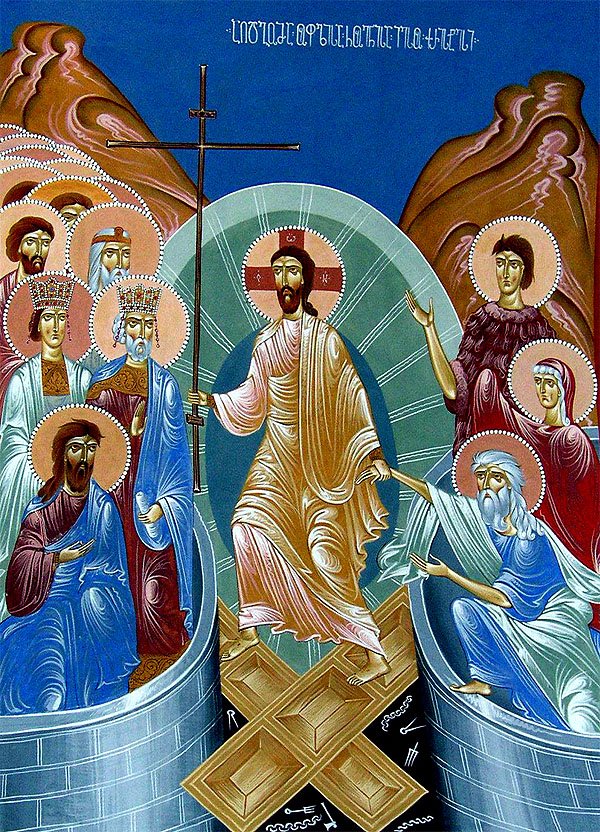
Bright Saturday
The Artos, which was blessed after the Liturgy of Pascha, is cut and distributed after Liturgy on Bright Saturday.
The cutting and distribution of the Artos takes place after the Liturgy on Bright Saturday. In monasteries the cutting and distribution of the Artos is done in the trapeza.
The cutting of the Artos is done in this way: After the Divine Liturgy, the Artos is brought into the trapeza, as is customary, and "Christ is risen" is sung three times, with bows.
The Artos, which was blessed after the Liturgy of Pascha, is cut and distributed after Liturgy on Bright Saturday.
The cutting and distribution of the Artos takes place after the Liturgy on Bright Saturday. In monasteries the cutting and distribution of the Artos is done in the trapeza.
The cutting of the Artos is done in this way: After the Divine Liturgy, the Artos is brought into the trapeza, as is customary, and "Christ is risen" is sung three times, with bows. After the "Our Father" has been said, and after the food has been blessed as usual, the Deacon says: "Let us pray to the Lord," and the brethren reply: "Lord, have mercy."
Then the Priest says the following prayer over the Artos:
O Lord Jesus Christ our God, the Angelic Bread, the Bread of eternal life Who came down from Heaven and nourished us on these most radiant days with the spiritual food of Your divine benefits for the sake of Your saving Resurrection on the third day, so now we humbly entreat You: "Look down upon our prayers and thanksgivings, and as You blessed the five loaves in the wilderness, so now bless this bread, that all who partake of it may be granted bodily and spiritual blessings and health, through the grace and compassion of Your love for mankind. For You are our sanctification, and to You we send up glory, together with Your Unoriginate Father, Your All-holy, Good and Life-creating Spirit, now and ever, and unto ages of ages.
After cutting the Artos, as is customary, the Priest distributes it to everyone before the meal. He may also cut the Artos at the Liturgy after the Prayer before the Ambo, and distribute it to the faithful instead of the Antidoron. They should consume it right away. They may, however, bring some home for those who were not able to be in church.
Troparion - Tone 4
Christ is risen from the dead, / trampling down death by death, / and upon those in the tombs bestowing life!
Kontakion - Tone 8
(Hypakoe)
Before the dawn Mary and the women came / and found the stone rolled away from the tomb. / They heard the angelic voice: “Why do you seek among the dead as a Man / the One Who is everlasting Light? / Behold the clothes in the grave; go and proclaim to the world: / ‘The Lord is risen; He has slain death, / as He is the Son of God, saving the race of man.’”
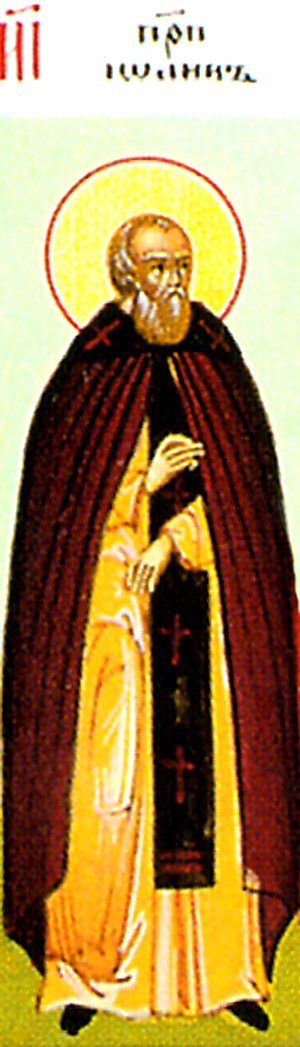
Venerable John, disciple of Venerable Gregory of Decapolis
Saint John was born at the end of the eighth century. At a young age he became a disciple of Saint Gregory of Decapolis (November 20) and accepted monastic tonsure from him at a monastery in Thessalonica. Under the guidance of this experienced teacher, Saint John attained great spiritual perfection.
When the emperor Leo the Armenian (813-820) renewed the persecution against Orthodox Christians because they venerated the holy icons, Saint Gregory of Decapolis and Saint Joseph the Hymnographer (April 4) and his disciple Saint John went from Thessalonica to Constantinople, to raise opposition to the Iconoclast heresy.
Saint John was born at the end of the eighth century. At a young age he became a disciple of Saint Gregory of Decapolis (November 20) and accepted monastic tonsure from him at a monastery in Thessalonica. Under the guidance of this experienced teacher, Saint John attained great spiritual perfection.
When the emperor Leo the Armenian (813-820) renewed the persecution against Orthodox Christians because they venerated the holy icons, Saint Gregory of Decapolis and Saint Joseph the Hymnographer (April 4) and his disciple Saint John went from Thessalonica to Constantinople, to raise opposition to the Iconoclast heresy.
In spite of persecution, Saints Gregory and John fearlessly defended Orthodoxy for several years, and preached the veneration of icons. After many hardships Saint Gregory died (around 820), and soon after, his faithful disciple John also departed to the Lord. Saint Joseph the Hymnographer transferred the relics of Saints Gregory and John and placed them in the church of Saint Nicholas the Wonderworker.
Troparion - Tone 8
The image of God was truly preserved in you, O Father, / for you took up the Cross and followed Christ. / By so doing you taught us to disregard the flesh for it passes away / but to care instead for the soul, since it is immortal. / Therefore your spirit, venerable John, rejoices with the angels.
Kontakion - Tone 1
Blessed John, with the Lord’s Cross upon your shoulder, / you climbed to the summit of virtues. / In place of passing pleasures / you attained the glory of the Kingdom of Heaven.
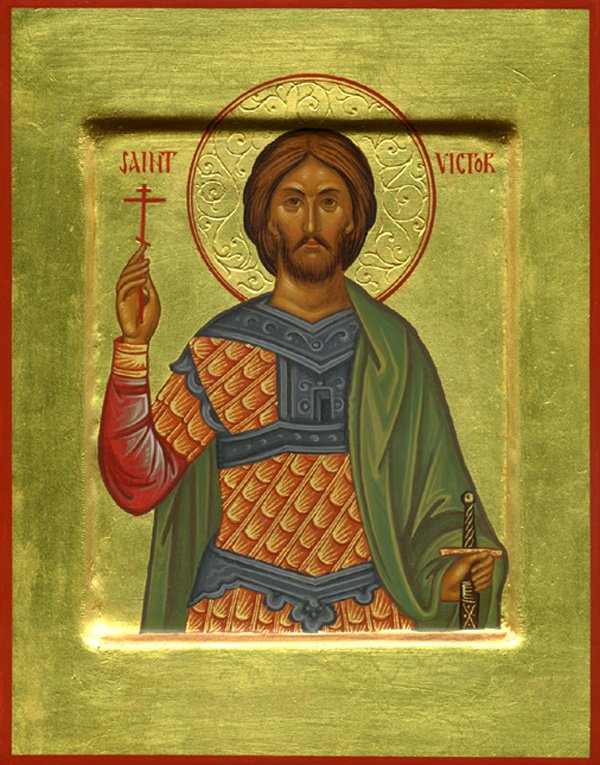
Martyr Victor, and his companions, of Nicomedia
The Holy Martyrs Victor, Zoticus, Acindynus, Zeno, Severian and Caesarius suffered under the emperor Diocletian (284-305) when he began a fierce persecution against Christians. One of the first to suffer was the holy Great Martyr and Victory-Bearer George (April 23). Saint George’s unshakable faith and bravery during his suffering led many pagans to Christ.
The Holy Martyrs Victor, Zoticus, Acindynus, Zeno, Severian and Caesarius suffered under the emperor Diocletian (284-305) when he began a fierce persecution against Christians. One of the first to suffer was the holy Great Martyr and Victory-Bearer George (April 23). Saint George’s unshakable faith and bravery during his suffering led many pagans to Christ.
The saints were struck with astonishment that Saint George suffered no harm from the wheel of torture, and they declared in the hearing of all that they also believed in Christ. At the judge’s order, the holy martyrs were beheaded at Nicomedia in 303.
Troparion - Tone 4
Your holy martyr Victor and his companions, O Lord, / through their sufferings have received incorruptible crowns from You, our God. / For having Your strength, they laid low their adversaries, / and shattered the powerless boldness of demons. / Through their intercessions, save our souls
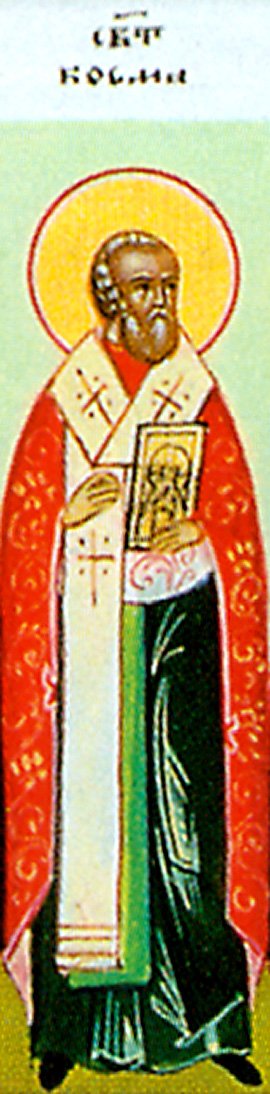
Saint Cosmas, Bishop of Chalcedon, and his fellow ascetic, Saint Auxentius
Saint Cosmas, Bishop of Chalcedon, and his companion Saint Auxentius, lived during the ninth century, at a time when the Iconoclasts oppressed the Orthodox. Saint Cosmas while still in his youth had entered a monastery and received monastic tonsure. Later, he was consecrated as Bishop of Chalcedon, and zealously defended the Orthodox Faith against the Iconoclast heretics.
Saint Cosmas, Bishop of Chalcedon, and his companion Saint Auxentius, lived during the ninth century, at a time when the Iconoclasts oppressed the Orthodox. Saint Cosmas while still in his youth had entered a monastery and received monastic tonsure. Later, he was consecrated as Bishop of Chalcedon, and zealously defended the Orthodox Faith against the Iconoclast heretics. Saint Auxentius helped the saint in this struggle.
The Iconoclasts tried in many ways to win the saint over to their side, but he remained faithful to Orthodoxy until the very end. Saint Cosmas did not obey the decree of Emperor Leo the Armenian (813-820) ordering the removal of the holy icons from the churches. For this he was expelled from his See and exiled to prison.
When the saint returned from exile, he and Saint Auxentius continued to defend the veneration of holy icons. At the end of the persecution, Saint Cosmas was weak in body, but remained strong in spirit. Saint Cosmas and Saint Auxentius steadfastly preserved the Orthodox Faith until the end of their lives.
Troparion - Tone 4
In truth you were revealed to your flock as a rule of faith, / an image of humility and a teacher of abstinence; / your humility exalted you; / your poverty enriched you. / Hierarch Father Cosmas, / entreat Christ our God / that our souls may be saved.
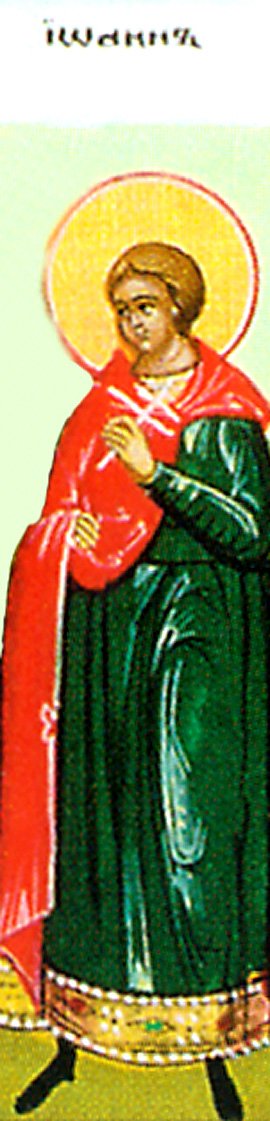
New Martyr John the New of Epirus
The holy martyr John Kulikos was born in the Greek district of Epirus, in the city of Ioannina. His parents were pious, but he was orphaned at an early age, and he went to Constantinople. With the means left him by his parents, he built a small stall in the city bazaar and was occupied with trade.
He loved to work, he honorably filled all his orders, and his business was successful.
The holy martyr John Kulikos was born in the Greek district of Epirus, in the city of Ioannina. His parents were pious, but he was orphaned at an early age, and he went to Constantinople. With the means left him by his parents, he built a small stall in the city bazaar and was occupied with trade.
He loved to work, he honorably filled all his orders, and his business was successful. However, his soul did not yearn for earthly blessings, but for the Kingdom of Heaven.
Saint John lived during difficult times. Constantinople was under the dominion of the Turks, and Christians were subjected to oppressions. Many Christian tradesmen and merchants went over to the Moslem religion. Saint John reproached them for their betrayal of Christ, and he also sustained the unwavering in their faith. The apostates were filled with hatred for Saint John, and they desired his ruin. The saint knew this, but was not afraid. He was willing to suffer for Christ.
On Great and Holy Friday he went to his spiritual Father and asked his blessing to seek martyrdom. The priest counselled the youth to examine himself and to prepare himself by fasting and prayer, so that at the time of torture he would not deny Christ. Saint John prayed ardently to the Lord to strengthen him. At night on Great and Holy Saturday he saw himself in a dream, standing in a fiery furnace and singing praises to the Lord. Interpreting this vision as an indication to go to martyrdom, Saint John received the Holy Mysteries and asked the priest’s blessing.
When Saint John arrived at the market, the vexed tradesmen began to reproach him that he had promised to renounce Christ, but that he was not fulfilling his word. In reply, the martyr declared that he was a Christian and had never renounced, nor would he ever renounce Christ.
Then the envious merchants had him arrested. The judge tried to persuade Saint John to accept Islam, for he respected him as a skilled master craftsman. But the martyr steadfastly confessed himself a Christian. For several days, they wearied him with hunger and thirst, and beat him without mercy. They sentenced the martyr to be burned alive.
Saint John met his sentence with joy. When they led him to the blazing fire, he went boldly into the midst of the flames. The torturers, seeing that Saint John was prepared to die in the fire, pulled him out and beheaded him with the sword (+ 1526). They then threw the martyr’s head and body into the fire.
Christians gathered up the bones of the martyr which remained from the fire, and reverently brought them to the cathedral church.
Troparion - Tone 3
Your holy martyr John, O Lord, / through his sufferings has received an incorruptible crown from You, our God. / For having Your strength, he laid low his adversaries, / and shattered the powerless boldness of demons. / Through his intercessions, save our souls!
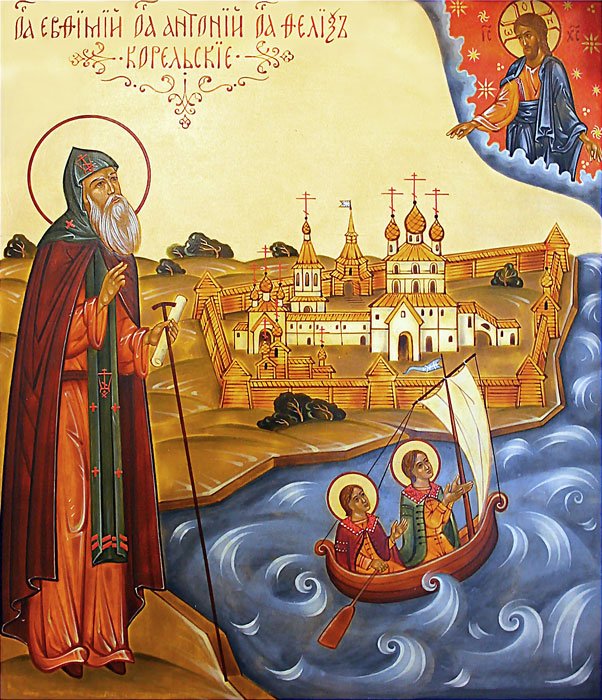
Venerable Euthymius, Enlightener of Karelia, Finland and the Righteous Anthony and Felix
According to an ancient manuscript Hemerologion (Ημερολογιον), Saint Euthymios was born in the
second half of the XIV century. From his youth, he felt drawn to the monastic life, so when he reached adulthood, he travelled north around the year 1400, in order to live as an Anchorite. Later, about 1410, several disciples came to him, begging him to guide them in the monastic life. On the shor
According to an ancient manuscript Hemerologion (Ημερολογιον), Saint Euthymios was born in the
second half of the XIV century. From his youth, he felt drawn to the monastic life, so when he reached adulthood, he travelled north around the year 1400, in order to live as an Anchorite. Later, about 1410, several disciples came to him, begging him to guide them in the monastic life. On the shores of the White Sea in Karelia, 34 versts from Archangelsk, they built a monastery dedicated to the Holy Wonderworker Saint Nicholas of Myra in Lycia (December 6), with cells for the monks.
At first, nothing seemed to go well for the monks, who had settled in an area inhabited by pagans. Saint Euthymius knew, however, that in the place where they labored, one day the monastic life would be firmly established, and the Faith would flourish.
In 1418, the Venerable Anthony and Felix, the two devout sons of Martha Boretska, the wife of a government official (посадница) from Novgorod, were drowned at the mouth of the North Dvina River while exploring the land. These young brothers were buried at Saint Nicholas monastery. In life, they were distinguished for their works of charity, and their grief-stricken mother asked Saint Euthymius to pray for the sons who had been taken from her. Subsequently, their names were included in the manuscript Lives of the Saints of Saint Nicholas Monastery.
In 1419, the monastery was destroyed by Norwegian invaders, who descended upon the monastery, burned the church, and killed several of the monks. Saint Euthymius decided that he would rebuild the monastery, and Martha Boretska gave a large sum of money for the monastery to be rebuilt over the graves of her sons.
Saint Euthymius reposed peacefully in 1435, and was buried at the monastery in Karelia, as were his disciples Stephen the Ascetic, Isaiah, and Nikanor.
In 1641, Saint Euthymios of Karelia was glorified for his apostolic labors in Karelia, and his holy relics were uncovered in 1647. Now they rest in a hidden place within the monastery.
A Church Service has been composed for Saints Euthymius, Anthony and Felix. They are commemorated on April 18, and again on May 21, the Synaxis of All Saints of Karelia.
Troparion - Tone 8
By a flood of tears you made the desert fertile, / and your longing for God brought forth fruits in abundance. / By the radiance of miracles you illumined the whole universe! / O our holy fathers Euthymius, Anthony, and Felix, pray to Christ our God to save our souls!
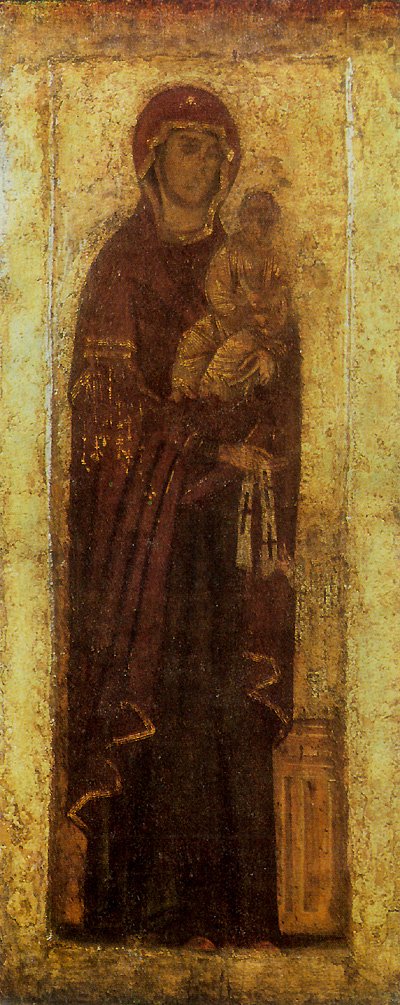
“Maximov” Icon of the Mother of God
The Saint Maximus Icon is in the cathedral church of the city of Vladimir. Metropolitan Maximus (December 6), a Greek by birth, painted the Icon in 1299, as he was told to do in a vision while he slept in his cell. When St. Maximus arrived in Vladimir from Kiev, the Mother of God appeared to him in a dream and gave him an omophorion saying, "My servant Maximus, it is good that you have come to visit my city.
The Saint Maximus Icon is in the cathedral church of the city of Vladimir. Metropolitan Maximus (December 6), a Greek by birth, painted the Icon in 1299, as he was told to do in a vision while he slept in his cell. When St. Maximus arrived in Vladimir from Kiev, the Mother of God appeared to him in a dream and gave him an omophorion saying, "My servant Maximus, it is good that you have come to visit my city. Take this omophorion and shepherd the rational flock of my city."
When he awoke, he found he was holding an omophorion. The appearance of the Mother of God was regarded as a sign of approval for the transfer of the metropolitan See from Kiev to Vladimir.
A description of this vision was inscribed on the left side of his crypt. The Mother of God is shown in full stature, holding the Divine Child on her left arm. With her right hand, she offers the omophorion to Saint Maximus, who is standing on a pillar. The contrast in the size of their figures is meant to show the difference in their spiritual states. A variant Icon depicts Saint Maximus kneeling at the feet of the Theotokos.
Later, a golden coffer was made, and the omophorion was placed inside. This omophorion was kept in the Vladimir cathedral as a relic for 112 years. It was hidden by the cathedral’s doorkeeper Patrick in 1412 during an invasion by the Tartars, Patrick was killed when he refused to show them where the cathedral's treasures were hidden. The coffer has not yet been found.
This Icon, which measures five feet by two and a half feet, has been glorified by many miracles.
Troparion - Tone 4
O Sovereign Lady, / today the most glorious city of Vladimir rejoices exceedingly, / joyously celebrating the Feast of your apparition to Saint Maximus; / as we remember him now and beseeching you we cry out: / “O Most Holy Sovereign Lady Theotokos, / entreat your Son, that He strengthen the Orthodox Church, / and that He preserve our souls in peace in the Orthodox Faith.”
Kontakion - Tone 6
Turn your gaze toward us, O Theotokos praised by all, shine light into our darkened hearts, illumine your flock, O Most Pure one, for as the Mother of the Creator, whatever you wish, you are able to do, and you cry to those who entreat you, “I am with you, and no one can prevail against you.”1
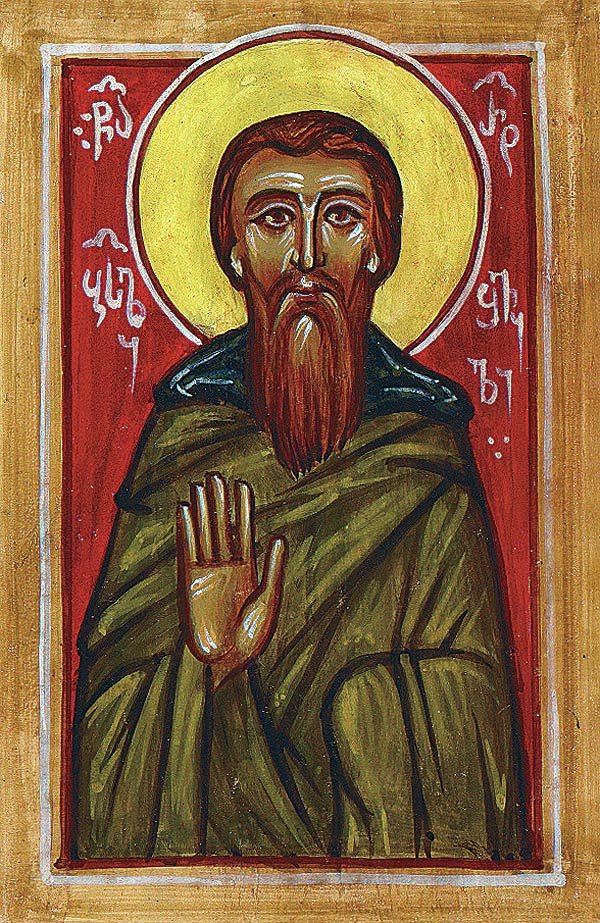
Saint Basil Ratishvili of Georgia
Saint Basil Ratishvili, one of the most prominent figures of the 13th-century Church, was the uncle of Catholicos Ekvtime III. He labored with the other Georgian fathers at the Ivḗron Monastery on Mt. Athos. Endowed with the gift of prophecy, Saint Basil beheld a vision in which the Most Holy Theotokos called upon him to censure King Demetre’s impious rule. (Th
Saint Basil Ratishvili, one of the most prominent figures of the 13th-century Church, was the uncle of Catholicos Ekvtime III. He labored with the other Georgian fathers at the Ivḗron Monastery on Mt. Athos. Endowed with the gift of prophecy, Saint Basil beheld a vision in which the Most Holy Theotokos called upon him to censure King Demetre’s impious rule. (This is actually Saint Demetre the Devoted, who in his youth lived profligately but later laid down his life for his nation.)
Having arrived in Georgia and been brought before the king, the God-fearing father denounced the sovereign’s uncrowned marriage [i.e., a conjugal union without the blessing of the Church]. He promised the king that if he abandoned his present way of life, he would find great happiness and success. Saint Basil also condemned the ungodly ways of Georgia’s apostate feudal lords.
But the king and his court disregarded the virtuous elder’s admonitions, and in response Saint Basil prophesied: “A vicious enemy will kill you, and your kingdom will remain without refuge. Your children will be scattered, your kingdom conquered, and all your wealth seized. Know that, according to the will of the Most Holy Theotokos, everything I have told you will come to pass unless you repent and turn from this way of life. Now I will depart from you in peace.”
Saint Basil returned to Mt. Athos and peacefully reposed at the Ivḗron Monastery.
Troparion - Tone 8
In you the image was preserved with exactness, O Father, / for taking up your cross, you followed after Christ. / By so doing, you taught us to disregard the flesh, for it passes away, / but to care instead for the soul, since it is immortal. / Therefore, most venerable Father Basil your spirit rejoices with the Angels.
Scripture Readings
☩Epistle
Acts 3:11-16
11
And as the lame man which was healed held Peter and John, all the people ran together unto them in the porch that is called Solomon’s, greatly wondering.
12
And when Peter saw it, he answered unto the people, Ye men of Israel, why marvel ye at this? or why look ye so earnestly on us, as though by our own power or holiness we had made this man to walk?
13
The God of Abraham, and of Isaac, and of Jacob, the God of our fathers, hath glorified his Son Jesus; whom ye delivered up, and denied him in the presence of Pilate, when he was determined to let him go.
14
But ye denied the Holy One and the Just, and desired a murderer to be granted unto you;
15
And killed the Prince of life, whom God hath raised from the dead; whereof we are witnesses.
16
And his name through faith in his name hath made this man strong, whom ye see and know: yea, the faith which is by him hath given him this perfect soundness in the presence of you all.
☩Gospel
John 3:22-33
22
After these things came Jesus and his disciples into the land of Judea; and there he tarried with them, and baptized.
23
And John also was baptizing in Ænon near to Salim, because there was much water there: and they came, and were baptized.
24
For John was not yet cast into prison.
25
Then there arose a question between some of John’s disciples and the Jews about purifying.
26
And they came unto John, and said unto him, Rabbi, he that was with thee beyond Jordan, to whom thou barest witness, behold, the same baptizeth, and all men come to him.
27
John answered and said, A man can receive nothing, except it be given him from heaven.
28
Ye yourselves bear me witness, that I said, I am not the Christ, but that I am sent before him.
29
He that hath the bride is the bridegroom: but the friend of the bridegroom, which standeth and heareth him, rejoiceth greatly because of the bridegroom’s voice: this my joy therefore is fulfilled.
30
He must increase, but I must decrease.
31
He that cometh from above is above all: he that is of the earth is earthly, and speaketh of the earth: he that cometh from heaven is above all.
32
And what he hath seen and heard, that he testifieth; and no man receiveth his testimony.
33
He that hath received his testimony hath set to his seal that God is true.
Liturgical data sourced from OCA.org and orthocal.info