Fasting Rules
 Meat
Allowed
Meat
Allowed
 Fish
Allowed
Fish
Allowed
 Dairy
Allowed
Dairy
Allowed
 Oil
Allowed
Oil
Allowed
 Wine
Allowed
Wine
Allowed
Saints & Commemorations
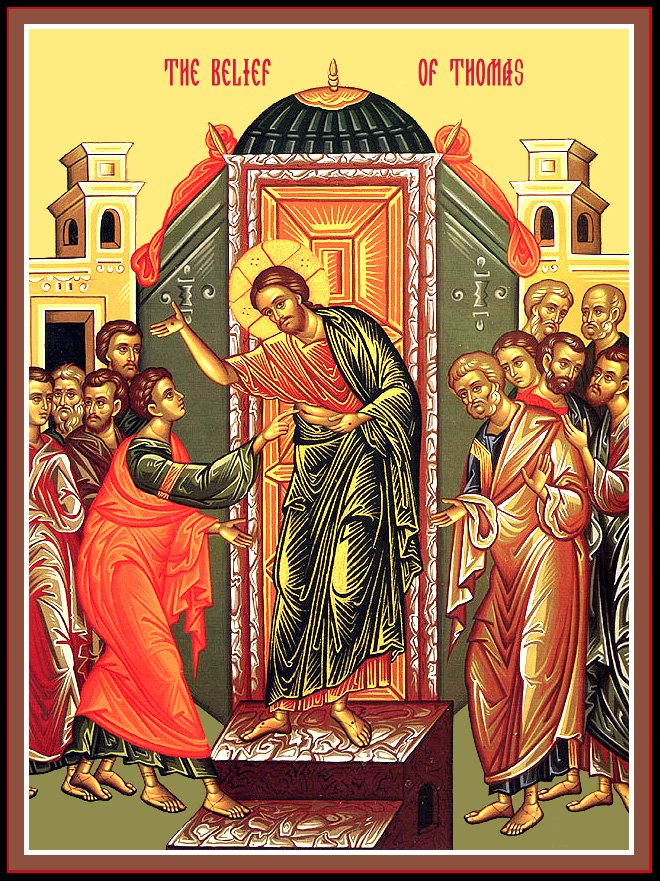
Antipascha: Saint Thomas Sunday
Some icons depicting this event are inscribed “The Doubting Thomas.” This is incorrect. In Greek, the inscription reads, “The Touching of Thomas.” The Slavonic inscription is, “The Belief of Thomas.” When Saint Thomas touched the Life-giving side of the Lord, he no longer had any doubts.
This day is also known as “Antipascha.” This does not mean “opposed to Pascha,” but “in place of Pascha.” Beginning with this first Sunday after Pascha, the Church dedicates every Sunday of the year to the Lord’s Resurrection. Sunday is called “Resurre
Some icons depicting this event are inscribed “The Doubting Thomas.” This is incorrect. In Greek, the inscription reads, “The Touching of Thomas.” The Slavonic inscription is, “The Belief of Thomas.” When Saint Thomas touched the Life-giving side of the Lord, he no longer had any doubts.
This day is also known as “Antipascha.” This does not mean “opposed to Pascha,” but “in place of Pascha.” Beginning with this first Sunday after Pascha, the Church dedicates every Sunday of the year to the Lord’s Resurrection. Sunday is called “Resurrection” in Russian, and “the Lord’s Day” in Greek.
Troparion - Tone 7
From the sealed tomb, You did shine forth O Life! / Through closed doors You did come to Your disciples, O Christ God! / Renew in us, through them, an upright spirit, / by the greatness of Your mercy, O Resurrection of all!
Kontakion - Tone 8
Thomas touched Your life-giving side with an eager hand, O Christ God, / when You did come to Your apostles through closed doors. / He cried out with all: You are my Lord and my God!
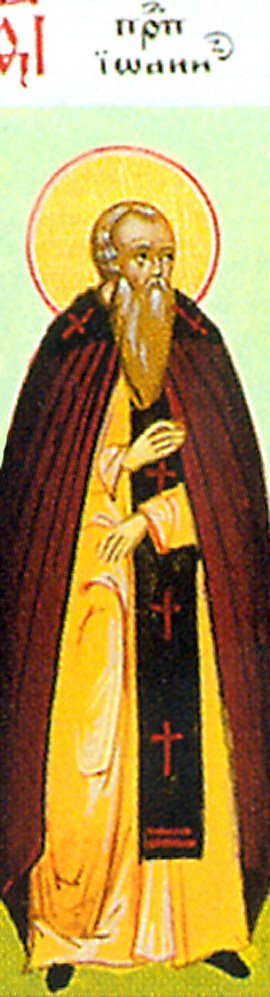
Venerable John of the Ancient Caves in Palestine
Saint John of the Ancient Caves is so called because he lived during the eighth century in the Lavra of Saint Chariton (September 28). This was called the “Old,” or ancient cave, since it was one the oldest of the Palestinian monasteries. The Lavra was situated not far from Bethlehem, near the Dead Sea.
Sa
Saint John of the Ancient Caves is so called because he lived during the eighth century in the Lavra of Saint Chariton (September 28). This was called the “Old,” or ancient cave, since it was one the oldest of the Palestinian monasteries. The Lavra was situated not far from Bethlehem, near the Dead Sea.
Saint John in his early years left the world, went to venerate the holy places of Jerusalem, and settled at the Lavra, where he labored in fasting, vigil, and prayer. He was ordained to the holy priesthood, and glorified by his ascetic life.
Troparion - Tone 8
The image of God was truly preserved in you, O Father, / for you took up the Cross and followed Christ. / By so doing, you taught us to disregard the flesh, for it passes away, / but to care instead for the soul, since it is immortal. / Therefore your spirit, O holy Father John, rejoices with the angels.
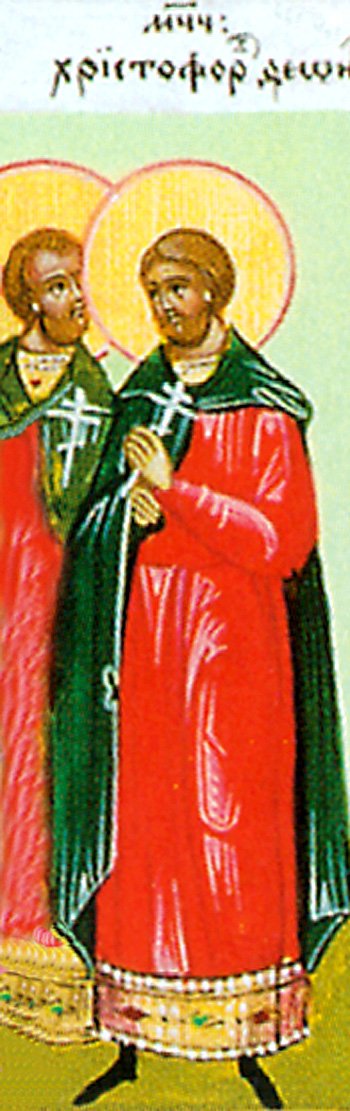
Martyrs Christopher, Theonas, and Anthony, at Rome
The Holy Martyrs Christopher, Theonas, and Anthony were officers in the army of the emperor Diocletian (284-305). They were present at the sufferings of the Holy Great Martyr George (April 23), they saw the miracles accomplished by the power of God, and they witnessed Saint George’s faith and unshakable courage.
The Holy Martyrs Christopher, Theonas, and Anthony were officers in the army of the emperor Diocletian (284-305). They were present at the sufferings of the Holy Great Martyr George (April 23), they saw the miracles accomplished by the power of God, and they witnessed Saint George’s faith and unshakable courage.
The soldiers came to believe in the Savior, threw down their golden military belts, and declared themselves Christians in front of the emperor. They were immediately thrown into prison. The next day the emperor urged the former soldiers to renounce Christ, but they firmly confessed their faith and glorified the Savior as the true God.
The emperor ordered that the martyrs be beaten with iron rods, and their bodies to be raked with hooks. The holy martyrs endured all the torments and remained unyielding. Then Diocletian gave orders to burn them. The martyric death of Saints Christopher, Theonas, and Anthony occurred in the year 303.
Troparion - Tone 4
Your holy martyrs Christopher, Theonas, and Anthony, O Lord, / through their sufferings have received incorruptible crowns from You, our God. / For having Your strength, they laid low their adversaries, / and shattered the powerless boldness of demons. / Through their intercessions, save our souls!
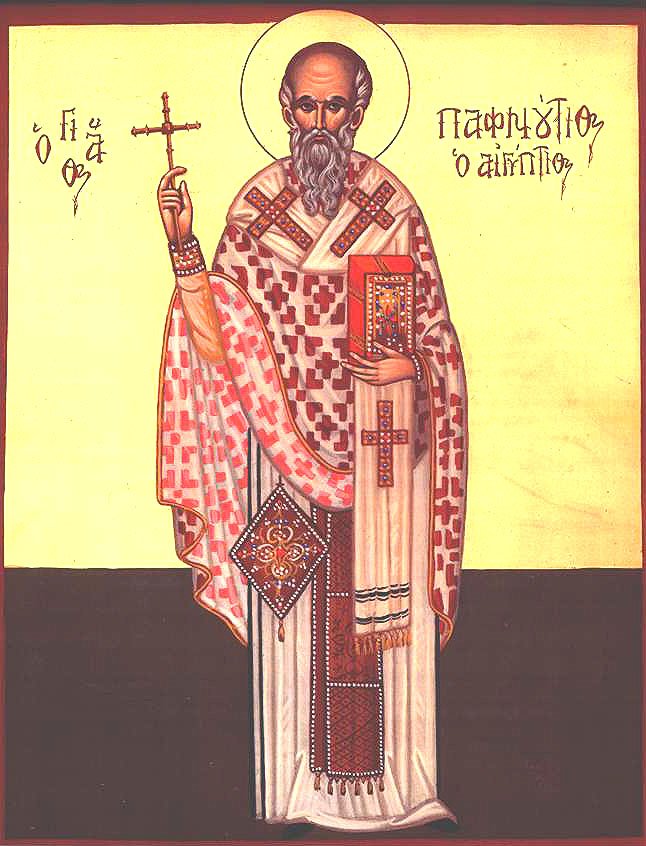
Hieromartyr Paphnutius of Jerusalem
Hieromartyr Paphnutius of Jerusalem was a bishop. He underwent many sufferings from the pagans and was tortured by fire, wild beasts, and finally was beheaded by the sword.
Some suggest that the hieromartyr Paphnutius was an Egyptian bishop and suffered together with many other Egyptians, exiled to the Palestinian mines during the persecution by Diocletian (284-305).
Hieromartyr Paphnutius of Jerusalem was a bishop. He underwent many sufferings from the pagans and was tortured by fire, wild beasts, and finally was beheaded by the sword.
Some suggest that the hieromartyr Paphnutius was an Egyptian bishop and suffered together with many other Egyptians, exiled to the Palestinian mines during the persecution by Diocletian (284-305).
The myrrh-streaming relics of the hieromartyr were glorified by miracles. The Canon in his honor was composed during the Iconoclast period (before 842). In the final Ode is a petition for the hieromartyr to put an end to the heresy disrupting the Church.
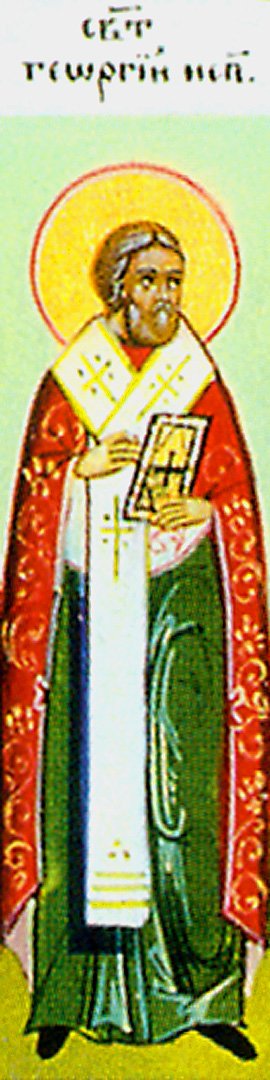
Saint George the Confessor and Bishop of Antioch, in Pisidia
Saint George the Confessor, Bishop of Antioch in Pisidia, lived during the Iconoclast period. In his youth he became a monk, was known for his holiness of life and was made bishop of Antioch in Pisidia.
Saint George was at Constantinople during the iconoclastic persecution under Emperor Leo the Armenian (813-820).
Saint George the Confessor, Bishop of Antioch in Pisidia, lived during the Iconoclast period. In his youth he became a monk, was known for his holiness of life and was made bishop of Antioch in Pisidia.
Saint George was at Constantinople during the iconoclastic persecution under Emperor Leo the Armenian (813-820). He denounced the Iconoclast heresy at a Council of bishops, calling on the emperor to abandon it. When Saint George refused to remove the icons from the church, as ordered by the emperor’s decree, he was exiled to imprisonment (813-820).
Troparion - Tone 8
Champion of Orthodoxy, teacher of purity and of true worship, / the enlightener of the universe and the adornment of hierarchs: / all-wise father George, your teachings have gleamed with light upon all things. / Intercede before Christ God to save our souls.
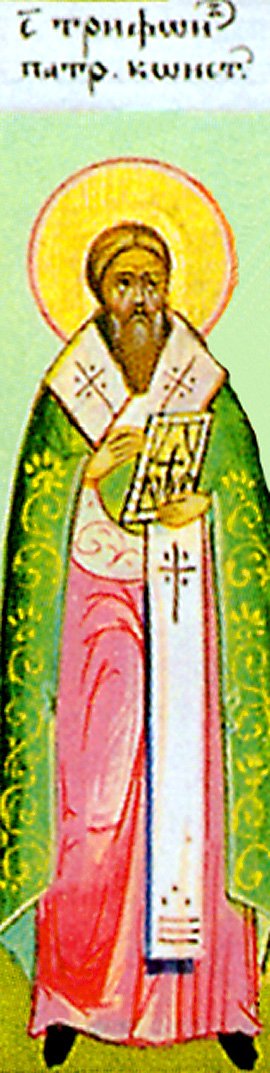
Saint Tryphon, Patriarch of Constantinople
Saint Tryphon, Patriarch of Constantinople, was a monk from the time of his youth, distinguished by his meekness, lack of malice, full submission to the will of God, and his firm faith and love for the Church. At this time the emperor Romanus (919-944) ruled in Constantinople. He wanted to elevate his younger son Theophylactus to the patriarchal throne.
Saint Tryphon, Patriarch of Constantinople, was a monk from the time of his youth, distinguished by his meekness, lack of malice, full submission to the will of God, and his firm faith and love for the Church. At this time the emperor Romanus (919-944) ruled in Constantinople. He wanted to elevate his younger son Theophylactus to the patriarchal throne. When Patriarch Stephanos (925-928) died, Theophylactus was only sixteen years old. The emperor then suggested that Saint Tryphon be “locum tenens” of the patriarchal throne until Theophylactus came of age.
Saint Tryphon meekly accepted the burden of patriarchal service and for three years he wisely governed the Church. When Theophylactus turned twenty (931), the emperor told Saint Tryphon to resign the patriarchal throne. Saint Tryphon did not consider it proper to hand over the throne to an inexperienced youth, and he refused to do so. The emperor could not intimidate Saint Tryphon, since his life was blameless. Then Romanus employed the cunning counsels of Bishop Theophilus of Caesarea.
The deceitful bishop went to Saint Tryphon and urged him not to obey the emperor, and not to resign the patriarchal throne. Then Bishop Theophilus craftily obtained Saint Tryphon’s signature on a blank sheet of paper. Not suspecting any treachery, the guileless saint took a clean sheet of paper and wrote: “Tryphon, by the Mercy of God, Archbishop of Constantinople, the New Rome, and Ecumenical Patriarch.”
When they presented this paper to the emperor, he ordered them to write over the saint’s signature: “I hereby resign the position of Patriarch, because I consider myself unworthy of this office.” When this false document was read before the imperial dignitaries, servants removed Saint Tryphon from the patriarchal chambers.
Saint Tryphon patiently endured the injustice done to him, and returned to his own monastery. He lived there as a simple monk for a year before his death (+ 933). His body was taken to Constantinople and buried with the Patriarchs.
Troparion - Tone 4
In truth you were revealed to your flock as a rule of faith, / an image of humility and a teacher of abstinence; / your humility exalted you; / your poverty enriched you. / Hierarch Father Tryphon, / entreat Christ our God / that our souls may be saved.
Venerable Nikēphóros, Abbot of Catabad
Saint Nikēphóros was born at Constantinople into a rich and illustrious family. His parents, Andrew and Theodora, raised their son in the Christian Faith. After their death, young Nikēphóros distributed all his wealth to the poor and went to Chalcedon. The strict monastic life at the Monastery of Saint Andrew appealed to Nikēphóros, and he remained there with the brethren.
From
Saint Nikēphóros was born at Constantinople into a rich and illustrious family. His parents, Andrew and Theodora, raised their son in the Christian Faith. After their death, young Nikēphóros distributed all his wealth to the poor and went to Chalcedon. The strict monastic life at the Monastery of Saint Andrew appealed to Nikēphóros, and he remained there with the brethren.
From the very start, the saint displayed unusual fervor in prayer and at work. He had such endurance in asceticism, that soon the igumen sent the saint to a Phoenician island to preach Christ, and he was made igumen of a monastery dedicated to the Most Holy Theotokos.
Saint Nikēphóros lived on the island for thirty-three years, and he brought many pagans to Christ. A church was built on the island on the site of a pagan temple.
Sensing the approach of death, the saint was carried aboard a ship and said to the captain, “I am going to the Lord, but take my body to Chalcedon to the monastery of Saint Andrew.” As soon as he said these words, he died.
The ship sailed to Chalcedon, and the brethren of the monastery of Saint Andrew reverently buried the body of the holy ascetic.
Troparion - Tone 8
By a flood of tears you made the desert fertile, / and your longing for God brought forth fruits in abundance. / By the radiance of miracles you illumined the whole universe! / O our holy father Nicephorus, pray to Christ our God to save our souls!
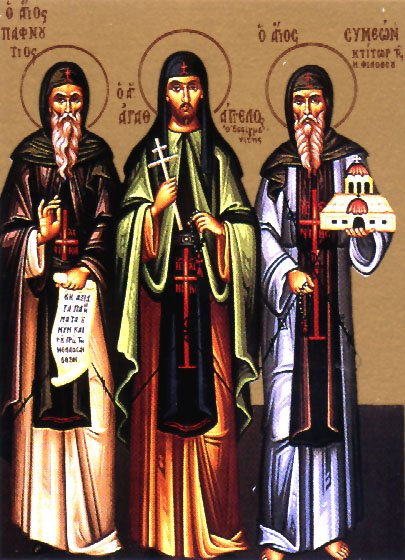
Monastic Martyr Agathangelus of Esphigmenou, Mount Athos
The Monkmartyr Agathangelus, in the world Athanasius, was born in the city of Enos, Thrace, and was raised in a strict Orthodox family. After the death of his parents Constantine and Krystalia, he became a sailor. The Turks wanted to convert the skilled and intelligent youth to Islam, but knew that he would not do so of his own free will.
The Monkmartyr Agathangelus, in the world Athanasius, was born in the city of Enos, Thrace, and was raised in a strict Orthodox family. After the death of his parents Constantine and Krystalia, he became a sailor. The Turks wanted to convert the skilled and intelligent youth to Islam, but knew that he would not do so of his own free will. So they arrested him in the city of Smyrna, wounded him and threatened him with death, then demanded that he become a Moslem.
The youth was terrified and promised to do as they asked, hoping to escape from the bullies and then go back on his promise. However, he was unable to do this for a long time. Tormented by pangs of conscience, he was able to quit the city and seek refuge on Mount Athos. Igumen Euthymius of Esphigmenou monastery confessed him and blessed him to become a novice.
Saint Athanasius considered even his most intense efforts insufficient to atone for his sin of apostasy. He believed that he had to suffer martyrdom for Christ, and he began to pray about this.
On the fourth Sunday of Great Lent the nineteen-year-old youth was tonsured as a monk with the name Agathangelus.
Saint Nicholas the Wonderworker appeared to the new monk in a dream and promised to help him. The igumen of the monastery saw this as a special sign, and blessed Saint Agathangelus to bear witness to Christ at Smyrna before those who forced him to become a Moslem.
In the Ottoman courtroom the confessor told how they had compelled him to accept an alien faith. Then he publicly renounced Islam and confessed himself a Christian. They began to cajole and admonish Saint Agathangelus to reconsider his statement. He replied, “I will not give in to you, nor to your threats, nor to your promises. I love only Christ, I follow only Christ, only in my Christ do I hope to know happiness.”
The judge threatened him with death by torture. “I am prepared to endure all for my Christ! I accept every manner of torment with the greatest joy! I ask only that you do not tarry in carrying out your word,” the saint replied.
They bound Saint Agathangelus with heavy chains, hammered his feet into wooden boots, and threw him into prison. With him were two other wrongly condemned Christians. One of them, Nicholas, gave an account of the saint’s martyrdom.
On the following day, Saint Agathangelus was again brought before the judge in fetters. Bravely enduring all the torments which the Turks had readied for him, he again was sent to prison. Nicholas told him that a certain influential man would intervene before the judge for his release, but Saint Agathangelus wrote a note to this man asking that he not attempt to free him, but to pray to God that he be strengthened for martyrdom.
The saint readied himself for the final trial. At midnight, it was revealed to him in a vision that they would execute him no later than five o’clock, and he waited for the appointed hour. At about the fourth hour, a watch was placed over him. Seeing no possibility of converting the confessor from his faith in Christ, the judges decided to execute him. Absorbed in prayer, the martyr did not take notice the preparations for execution, nor the large throng of people.
He was beheaded at the fifth hour of the morning, on April 19, 1818. Christians gathered up the holy relics of the martyr and buried them in the city of Smyrna, in the church of the Great Martyr George.
A portion of the relics of Saint Agathangelus was sent to the Esphigmenou monastery on Mount Athos in 1844.
Troparion - Tone 1
The image of God was truly preserved in you, O Father, / for you took up the Cross and followed Christ. / By so doing you taught us to disregard the flesh for it passes away / but to care instead for the soul, since it is immortal. / Therefore your spirit, venerable Agathangelus, rejoices with the angels.
Kontakion - Tone 2
As a venerable and proven ascetic, as an honorable and renowned martyr, / and as a model of the desert life, O most exalted Agathangelus, / we sing hymns of praise to you, / for you have trampled upon serpents.
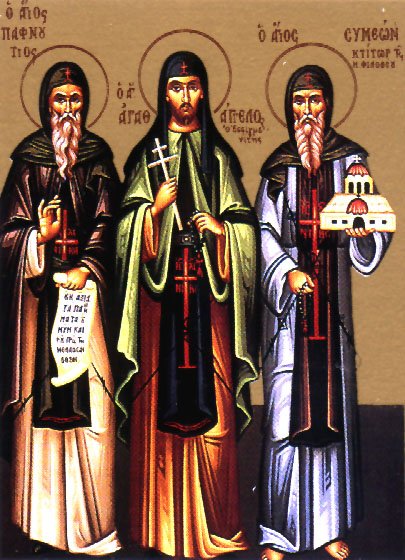
Venerable Simeon of Philotheou
Saint Simeon the Bare-Foot [Bosoi] was the son of a priest. When he was fifteen years old, he came under the spiritual guidance of Pachomius, the Bishop of Demetriada (Larissa diocese), who tonsured him and ordained him as hierodeacon. Desiring to follow a strict monastic life, Saint Simeon soon went to a monastery near Mount Olympus, and then to Mount Athos, to the Lavra of Saint Athanasius.
Saint Simeon the Bare-Foot [Bosoi] was the son of a priest. When he was fifteen years old, he came under the spiritual guidance of Pachomius, the Bishop of Demetriada (Larissa diocese), who tonsured him and ordained him as hierodeacon. Desiring to follow a strict monastic life, Saint Simeon soon went to a monastery near Mount Olympus, and then to Mount Athos, to the Lavra of Saint Athanasius.
By his humility and obedience he gained the respect of the brethren and was ordained hieromonk. After he transferred to the Philotheou monastery, he intensified his God-pleasing labors, he became an example for the brethren, and was unanimously chosen as head of this monastery. Later, through the cunning of the Enemy of mankind, Saint Simeon had to endure the complaints of monks who thought he was too strict.
Leaving it to God to judge the culprits, Saint Simeon left the monastery and went to Mt. Phlamourion on Mt. Pelion. There, in solitude and quiet, with neither roof nor fire, the holy hermit engaged in spiritual struggles dressed in old clothing, with almost no food, in constant prayer either standing or on bended knees. After three years, he was found by certain God-loving people. Inspired with reverence for his way of life, they begged him to allow them to live with him.
After seven years, through the efforts and zeal of Saint Simeon, a monastery was formed. A church was built in honor of the Most Holy Trinity, where he served the Divine Liturgy every day. When the life of the brethren in the wilderness monastery had been put in order, the wise servant left the monastery and began to preach the Word of God in Epirus, Thessaly and Athens.
By his instructions and teaching the saint strengthened the wavering in their faith, and he set those in error on the path to salvation. He made those who were strong in their faith even stronger, and he taught everyone to love one another, and to attend church on Sundays and feastdays.
The boldness of the holy confessor aroused the malice of the opponents of Christianity. In the city of Euripa they slandered Saint Simeon before the city ruler, Ayan, accusing him of converting a Turk to Christianity. The saint was arrested and sentenced to public burning. However, God did not permit the unjust sentence to be carried out.
The condemned one was led to his interrogation in shackles, barefoot [bosoi] and in an old rassa. Saint Simeon, inspired by the Holy Spirit, answered the governor so wisely that Ayan could not impose the death sentence. The saint received his freedom and continued his efforts, sealing his preaching with healings and miracles.
Many followed Saint Simeon and submitted themselves to him. He accepted everyone, blessed them for the monastic life, and sent them to his monastery.
Saint Simeon ended his life at Constantinople. He fell asleep in the Lord and was buried by the Patriarch at Chalke, in a church dedicated to the Most Holy Theotokos. After two years, when the monks of the Phlamourion monastery decided to transfer his holy relics to their monastery, and his grave was opened, an ineffable fragrance came forth, and healings began.
The Life and the Service to Saint Simeon were published at Smyrna in 1646.
Troparion - Tone 8
By a flood of tears you made the desert fertile, / and your longing for God brought forth fruits in abundance. / By the radiance of miracles you illumined the whole universe! / O our holy father Simeon, pray to Christ our God to save our souls!
Martyr Theodore and those with him
The Holy Martyr Theodore was from Pérgē of Pamphylia and was executed by Emperor Antoninus Pius (138 – 161). Out of pious zeal, Saint Theodore destroyed the idols and temples of the pagans.
He was arrested for this, however, and was later subjected to horrible tortures. They placed him on red hot iron grates, and then his feet were tied to horses which dragged him along the ground. The
The Holy Martyr Theodore was from Pérgē of Pamphylia and was executed by Emperor Antoninus Pius (138 – 161). Out of pious zeal, Saint Theodore destroyed the idols and temples of the pagans.
He was arrested for this, however, and was later subjected to horrible tortures. They placed him on red hot iron grates, and then his feet were tied to horses which dragged him along the ground. Then they threw him into a fiery furnace with the soldiers Sokrátēs and Dionysios. The pagan priest Dióskoros, after witnessing the Saint's martyrdom, also believed in Christ.
First, Saint Theodore was imprisoned, then they crucified him, and wounded him with arrows for three consecutive days. Thus, Saint Theodore was put to death and received a crown of martyrdom and glory.
After her son's death on the cross, Saint Theodore's mother, Philippa, confessed Christ as the True God, and was killed with a sword.
The Holy Martyr Dióskoros was burnt in the fire, and the Martyrs Sokrátēs and Dionysios were executed by being stabbed with a lance in the furnace.
Troparion - Tone 4
Your holy martyrs Theodore and his companions O Lord, / through their sufferings have received incorruptible crowns from You, our God. / For having Your strength, they laid low their adversaries, / and shattered the powerless boldness of demons. / Through their intercessions, save our souls!
Scripture Readings
☩Epistle
Acts 5:12-20
12
And by the hands of the apostles were many signs and wonders wrought among the people; (and they were all with one accord in Solomon’s porch.
13
And of the rest durst no man join himself to them: but the people magnified them.
14
And believers were the more added to the Lord, multitudes both of men and women.)
15
Insomuch that they brought forth the sick into the streets, and laid them on beds and couches, that at the least the shadow of Peter passing by might overshadow some of them.
16
There came also a multitude out of the cities round about unto Jerusalem, bringing sick folks, and them which were vexed with unclean spirits: and they were healed every one.
17
Then the high priest rose up, and all they that were with him, (which is the sect of the Sadducees,) and were filled with indignation,
18
And laid their hands on the apostles, and put them in the common prison.
19
But the angel of the Lord by night opened the prison doors, and brought them forth, and said,
20
Go, stand and speak in the temple to the people all the words of this life.
☩Gospel
John 20:19-31
19
Then the same day at evening, being the first day of the week, when the doors were shut where the disciples were assembled for fear of the Jews, came Jesus and stood in the midst, and saith unto them, Peace be unto you.
20
And when he had so said, he shewed unto them his hands and his side. Then were the disciples glad, when they saw the Lord.
21
Then said Jesus to them again, Peace be unto you: as my Father hath sent me, even so send I you.
22
And when he had said this, he breathed on them, and saith unto them, Receive ye the Holy Ghost:
23
Whose soever sins ye remit, they are remitted unto them; and whose soever sins ye retain, they are retained.
24
But Thomas, one of the twelve, called Didymus, was not with them when Jesus came.
25
The other disciples therefore said unto him, We have seen the Lord. But he said unto them, Except I shall see in his hands the print of the nails, and put my finger into the print of the nails, and thrust my hand into his side, I will not believe.
26
And after eight days again his disciples were within, and Thomas with them: then came Jesus, the doors being shut, and stood in the midst, and said, Peace be unto you.
27
Then saith he to Thomas, Reach hither thy finger, and behold my hands; and reach hither thy hand, and thrust it into my side: and be not faithless, but believing.
28
And Thomas answered and said unto him, My Lord and my God.
29
Jesus saith unto him, Thomas, because thou hast seen me, thou hast believed: blessed are they that have not seen, and yet have believed.
30
And many other signs truly did Jesus in the presence of his disciples, which are not written in this book:
31
But these are written, that ye might believe that Jesus is the Christ, the Son of God; and that believing ye might have life through his name.
Liturgical data sourced from OCA.org and orthocal.info