Fasting Rules
 Meat
Allowed
Meat
Allowed
 Fish
Allowed
Fish
Allowed
 Dairy
Allowed
Dairy
Allowed
 Oil
Allowed
Oil
Allowed
 Wine
Allowed
Wine
Allowed
Saints & Commemorations
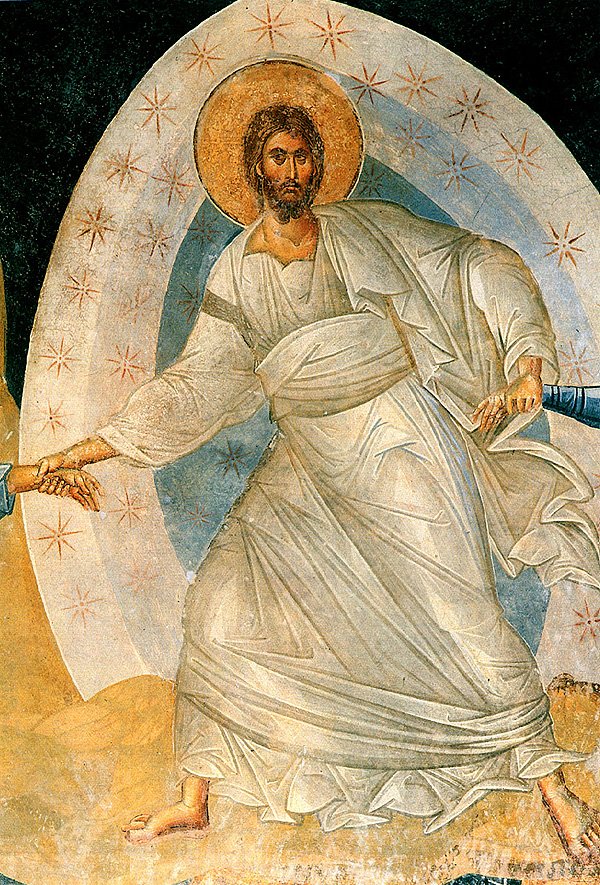
Day of Rejoicing
On Tuesday of Saint Thomas week we remember those Orthodox Christians from all ages who have died in faith, and in the hope of resurrection.
There are indications of this commemoration in the sermons of the Fathers of the Church. Saint John Chrysostom, for example, mentions it in his homily “On the Cemetery and the Cross.”
In pre-Revolutionary Russia bars remained closed and alcoholic beverages were not sold until this Day of Rejoicing so that the joy people felt would be because of the Resurrection, and not an artificial joy brought on by alcohol.
To
On Tuesday of Saint Thomas week we remember those Orthodox Christians from all ages who have died in faith, and in the hope of resurrection.
There are indications of this commemoration in the sermons of the Fathers of the Church. Saint John Chrysostom, for example, mentions it in his homily “On the Cemetery and the Cross.”
In pre-Revolutionary Russia bars remained closed and alcoholic beverages were not sold until this Day of Rejoicing so that the joy people felt would be because of the Resurrection, and not an artificial joy brought on by alcohol.
Today the Church remembers its faithful members at Liturgy, and koliva is offered in remembrance of those who have fallen asleep. Priests visit cemeteries to bless the graves of Orthodox Christians, and to share the paschal joy with the departed. It is also customary to give alms to the poor on this day.
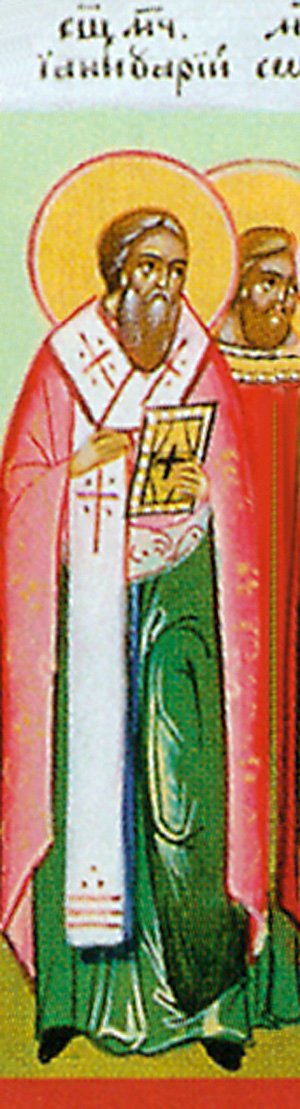
Hieromartyr Januarius, Bishop of Benevento, and his companions, at Pozzuoli
Hieromartyr Januarius Bishop of Benevento, and the deacons Proculus, Sossius and Faustus, Desiderius the Reader, Eutychius and Acution suffered martyrdom for Christ about the year 305 during the persecution ordered by the emperor Diocletian (284-305).
They arrested Saint Januarius and led him to trial before Menignus, the governor of Campagna (central Italy).
Hieromartyr Januarius Bishop of Benevento, and the deacons Proculus, Sossius and Faustus, Desiderius the Reader, Eutychius and Acution suffered martyrdom for Christ about the year 305 during the persecution ordered by the emperor Diocletian (284-305).
They arrested Saint Januarius and led him to trial before Menignus, the governor of Campagna (central Italy). Because of his firm confession of Christianity, they threw the saint into a red-hot furnace. But like the Babylonian youths, he came out unharmed. Then at Menignus’s command, they stretched him out on a bench and beat him with iron rods until his bones were exposed.
In the crowd were Deacon Faustus and the Reader Desiderius, who wept at the sight of their bishop’s suffering. The pagans surmised that they were Christians, and threw them into prison with the hieromartyr Januarius, in the city of Puteolum. At this prison were two deacons who had been jailed for confessing Christ: Saints Sossius and Proculus, and also two laymen, Saints Eutychius and Acution.
On the following morning they led out all the martyrs into the circus to be torn to pieces by wild beasts, but the beasts would not touch them. Menignus claimed that all the miracles were due to sorcery on the part of the Christians, and immediately he became blinded and cried out for help. The gentle hieromartyr Januarius prayed for his healing, and Menignus recovered his sight. The torturer’s blindness of soul, however, was not healed. He accused the Christians of sorcery, and ordered the martyrs beheaded before the walls of the city (+ 305).
Christians from surrounding cities took up the bodies of the holy martyrs for burial, and those of each city took one, in order to have an intercessor before God. The inhabitants of Neapolis (Naples) took the body of the hieromartyr Januarius. With the body, they also collected his dried blood.
Since the fifteenth century, the blood liquifies when the container is placed near another relic, believed to be the martyr’s head. Many miracles proceeded from the relics of the hieromartyr Januarius. During an eruption of Vesuvius around 431, the inhabitants of the city prayed to Saint Januarius to help them. The lava stopped, and did not reach the city.
Troparion - Tone 3
Consecrated through anointing with oil, / you became pastors for your godly wise people. / You were slain as honorable lambs / and offered to the Word and First Shepherd, / Who was Himself slain as His sheep, / O most laudable Hieromartyrs Januarius and Theodore, / beacons for all the world. / Therefore we all honor your holy memory in love, / as you intercede for our souls.
Kontakion - Tone 3
Naples has found you a champion in dangers, / O Januarius, our glorious father. / You delivered her from plague, famine and affliction, / and from the fire of Vesuvius. / With faith and love we venerate you and honor your holy relics!
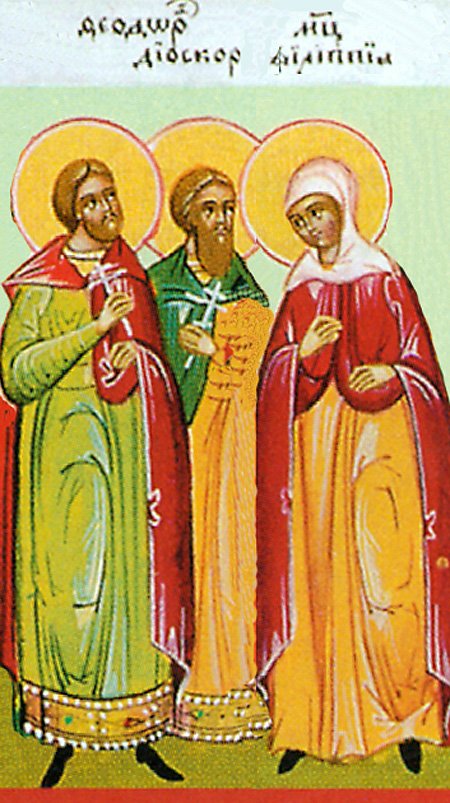
Hieromartyr Theodore of Perge in Pamphylia, his mother, Philippa, and Martyrs Dioscorus, Socrates, and Dionysius
The Holy Martyrs Theodore, his mother Philippa, Dioscorus, Socrates and Dionysius suffered during the reign of the emperor Antoninus Pius (138-161) in Perge, Pamphylia. When they were conscripting robust and healthy young men for military service, then they led the youth Theodore and the others to the military commander Theodotus.
The Holy Martyrs Theodore, his mother Philippa, Dioscorus, Socrates and Dionysius suffered during the reign of the emperor Antoninus Pius (138-161) in Perge, Pamphylia. When they were conscripting robust and healthy young men for military service, then they led the youth Theodore and the others to the military commander Theodotus.
The military commander ordered the youth to offer sacrifice to idols, but the martyr submitted neither to persuasion nor threats. Then the military commander had him placed on a red-hot plate and poured liquid tar on him. Suddenly, there was an earthquake, and a torrent of water gushed forth from the ground and extinguished the fire.
The martyr Theodore remained unharmed, and gave praise to God. The commander ascribed his deliverance to sorcery, so Saint Theodore suggested that he test the power of his gods by putting the pagan priest Dioscorus through the same trials.
The commander told Dioscorus to lie upon the red-hot plate, and call on the help of Zeus. Saint Dioscorus replied that he believed in Christ, and he was prepared to throw the idol of Zeus into the fire. Again the military commander commanded him to get on the heated plate. Saint Dioscorus fell at the knees of Saint Theodore, asking that he pray for him. Then he got onto the plate, crying out: “I thank You, Lord Jesus Christ, that You have numbered me among Your servants. Accept my soul in peace.” Then he died, having been delivered from terrible torment.
They continued to torture Saint Theodore. They tied him to wild horses, which began to run. But at the city walls the horses fell down and collapsed, and the martyr Theodore remained unharmed. Two soldiers, Socrates and Dionysius, saw how a fiery chariot came down from the heavens to Saint Theodore, on which the martyr was carried off.
The astonished soldiers shouted: “Great is the God of the Christians!” They seized them and on the next day threw them into a fiery furnace with the martyr Theodore. But a heavenly dew cooled the furnace, and the saints remained alive.
In the morning, the military commander ordered soldiers to look upon the burned bodies of the martyrs. The soldiers returned and reported that the three youths were unharmed. Saint Theodore’s mother, Philippa, encouraged the martyrs in their act.
The military commander told Saint Philippa to save her son, by urging him to offer sacrifice to the idols. Saint Philippa said that when her son was born it was revealed to her that he would be crucified for Christ. Hearing this, the military commander commanded them to crucify Saint Theodore, and to cut off the heads of the other martyrs. Saint Theodore hung on the cross for three days, offering prayers to God until he finally died.
Troparion - Tone 4
By sharing in the ways of the Apostles, / you became a successor to their throne. / Through the practice of virtue, you found the way to divine contemplation, O divinely-inspired one; by rightly dividing the word of truth without error, you defended the Faith, / even to the shedding of your blood. / O Hieromartyr Theodore, entreat Christ God to save our souls.
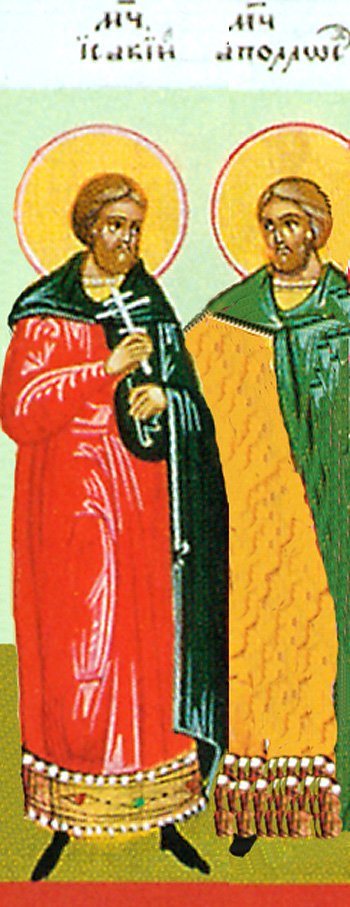
Martyrs Isaac, Apollos, and Quadratus, of Nicomedia
The Holy Martyrs Isaac, Apollos and Quadratus were pagans who served at the court of the emperor Diocletian (284-305). They were among the spectators who witnessed the sufferings of the Holy Great Martyr George (April 23).
His faith, valor and miracles caused them to believe in Christ. The saints openly declared themselves Christians, and reproached the emperor for his impiety and cruelty.
The Holy Martyrs Isaac, Apollos and Quadratus were pagans who served at the court of the emperor Diocletian (284-305). They were among the spectators who witnessed the sufferings of the Holy Great Martyr George (April 23).
His faith, valor and miracles caused them to believe in Christ. The saints openly declared themselves Christians, and reproached the emperor for his impiety and cruelty. They were sentenced to death. The martyr Quadratus was beheaded with a sword, and the martyrs Apollos and Isaac perished by starvation (+ 303).
Troparion - Tone 4
Your holy martyrs Isaac, Apollos, and Quadratus, O Lord, / through their sufferings have received incorruptible crowns from You, our God. / For having Your strength, they laid low their adversaries, / and shattered the powerless boldness of demons. / Through their intercessions, save our souls!
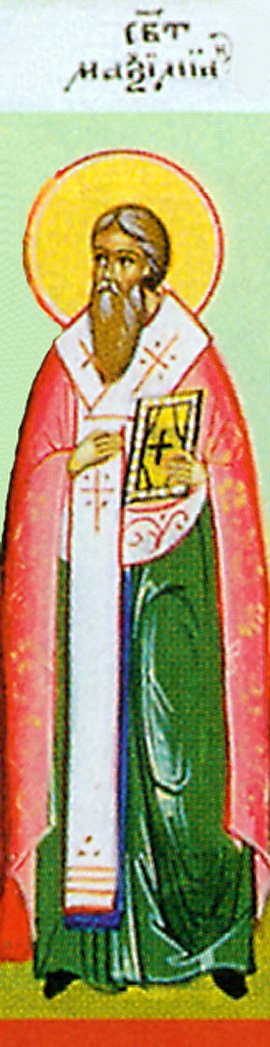
Saint Maximian, Patriarch of Constantinople
Saint Maximian (or Maximus) was born in Rome to wealthy and pious parents. He was a guiless man who preferred to live far from worldly vanity. He was also learned, intelligent, and was known for his many virtues, the integrity of his life, and his incomparable character. Because of his pure and holy life, Patriarch Sisinίos of Constantinople ordained him as a priest.
Saint Maximian (or Maximus) was born in Rome to wealthy and pious parents. He was a guiless man who preferred to live far from worldly vanity. He was also learned, intelligent, and was known for his many virtues, the integrity of his life, and his incomparable character. Because of his pure and holy life, Patriarch Sisinίos of Constantinople ordained him as a priest. At his own expense, Saint Maximian would pay for the burial of persons who were conspicuous for the holiness of their lives.
After the heresiarch Nestorios was deposed and exiled, Saint Maximian became Patriarch on October 25, 431, with the fervent support of both the reigning Emperor Theodosios the Younger (408-450), and the faithful people.
Saint Maximian reposed peacefully on April 21, 434 (Great and Holy Thursday).
Troparion - Tone 4
In truth you were revealed to your flock as a rule of faith, / an image of humility and a teacher of abstinence; / your humility exalted you; / your poverty enriched you. / Hierarch Father Maximian, / entreat Christ our God / that our souls may be saved.
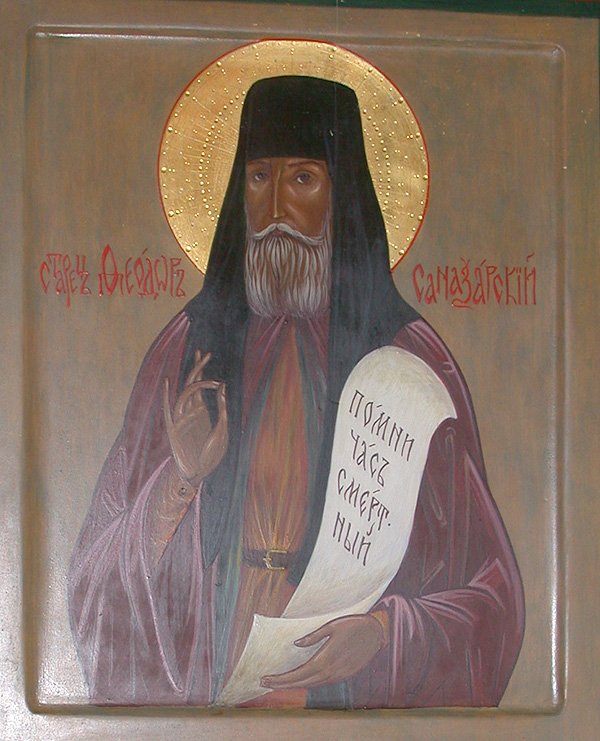
The Recovery of the Relics of Saint Theodore of Sanaxar
The Relics of Hieromonk Theodore (Ushakov) the restorer of the Monastery, were recovered on April 21, 1999, and he was glorified for local veneration on June 28/July 11, 1999.
Present at the celebrations and the rite of canonization, which was performed by the ruling Bishop, His Grace Bishop Barsanuphios of Saransk and Mordovia, the Archimandrite of the Monastery, and ruling bishops from the neighboring dioceses: His Eminence Archbishop Seraphim of Penza and Kuznetsk, and His Eminence Archbishop Proklos of Simbirsk and Melekes.
The Relics of Hieromonk Theodore (Ushakov) the restorer of the Monastery, were recovered on April 21, 1999, and he was glorified for local veneration on June 28/July 11, 1999.
Present at the celebrations and the rite of canonization, which was performed by the ruling Bishop, His Grace Bishop Barsanuphios of Saransk and Mordovia, the Archimandrite of the Monastery, and ruling bishops from the neighboring dioceses: His Eminence Archbishop Seraphim of Penza and Kuznetsk, and His Eminence Archbishop Proklos of Simbirsk and Melekes.
Saint Theodore is commemorated on February 19, (the day of his blessed repose), on April 21/May 21 (the recovery of his holy relics), and on May 23/June 5 (the Synaxis of the Saints of Rostov and Yaroslavl).
The relics of Saint Theodore of Sanaxar now rest in the cathedral church of Saint John the Baptist.
Troparion - Tone 4
From your youth you loved Christ with filial love, / and desiring to serve only the Lord, / you have chosen the good part, which shall not be taken away by death.1 / You devoted yourself to the one thing needful, and to the Giver of Life, / and you were found worthy to receive from Him the gifts of divine teaching and spiritual discernment, / guiding all who have recourse to you, seeking the salvation of their souls, / O divinely-wise Elder Theodore of Sanaxar.1 Luke 10:42.
Kontakion
From your youth you loved Christ with filial love, / and desiring to serve only the Lord, / you have chosen the good part, which shall not be taken away by death.1 / You devoted yourself to the one thing needful, and to the Giver of Life, / and you were found worthy to receive from Him the gifts of divine teaching and spiritual discernment, / guiding all who have recourse to you, seeking the salvation of their souls, / O divinely-wise Elder Theodore of Sanaxar.
Scripture Readings
☩Epistle
Acts 4:1-10
1
And as they spake unto the people, the priests, and the captain of the temple, and the Sadducees, came upon them,
2
Being grieved that they taught the people, and preached through Jesus the resurrection from the dead.
3
And they laid hands on them, and put them in hold unto the next day: for it was now eventide.
4
Howbeit many of them which heard the word believed; and the number of the men was about five thousand.
5
And it came to pass on the morrow, that their rulers, and elders, and scribes,
6
And Annas the high priest, and Caiaphas, and John, and Alexander, and as many as were of the kindred of the high priest, were gathered together at Jerusalem.
7
And when they had set them in the midst, they asked, By what power, or by what name, have ye done this?
8
Then Peter, filled with the Holy Ghost, said unto them, Ye rulers of the people, and elders of Israel,
9
If we this day be examined of the good deed done to the impotent man, by what means he is made whole;
10
Be it known unto you all, and to all the people of Israel, that by the name of Jesus Christ of Nazareth, whom ye crucified, whom God raised from the dead, even by him doth this man stand here before you whole.
☩Gospel
John 3:16-21
16
For God so loved the world, that he gave his only begotten Son, that whosoever believeth in him should not perish, but have everlasting life.
17
For God sent not his Son into the world to condemn the world; but that the world through him might be saved.
18
He that believeth on him is not condemned: but he that believeth not is condemned already, because he hath not believed in the name of the only begotten Son of God.
19
And this is the condemnation, that light is come into the world, and men loved darkness rather than light, because their deeds were evil.
20
For every one that doeth evil hateth the light, neither cometh to the light, lest his deeds should be reproved.
21
But he that doeth truth cometh to the light, that his deeds may be made manifest, that they are wrought in God.
Liturgical data sourced from OCA.org and orthocal.info