Venerable Theodore Trichinas “the Hair-Shirt Wearer” and Hermit Near Constantinople
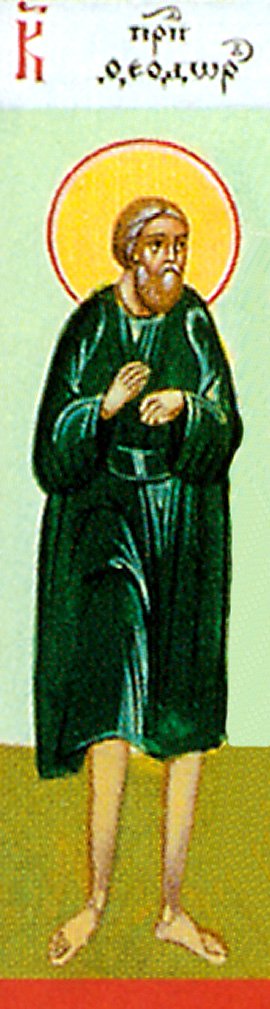
Saint Theodore Trichinas was born in Constantinople, the son of wealthy and pious parents. From childhood Saint Theodore was inclined toward monasticism, so he left his home, family, and former life in order to enter a monastery in Thrace. There he began his arduous ascetic struggles. He dressed in a hair-shirt, from which he derived the name “Trichinas,” (or “Hair-Shirt Wearer”). He even
Saint Theodore Trichinas was born in Constantinople, the son of wealthy and pious parents. From childhood Saint Theodore was inclined toward monasticism, so he left his home, family, and former life in order to enter a monastery in Thrace. There he began his arduous ascetic struggles. He dressed in a hair-shirt, from which he derived the name “Trichinas,” (or “Hair-Shirt Wearer”). He even slept on a stone in order avoid bodily comfort, and to prevent himself from sleeping too much.
His life was adorned with miracles, and he had the power to heal the sick. He reposed at the end of the fourth century, or the beginning of the fifth century. A healing myrrh flows from his relics.
The name of Saint Theodore Trichinas is one of the most revered in the history of Orthodox monasticism. Saint Joseph the Hymnographer (April 4) has composed a Canon to the saint.
Troparion - Tone 3
Holy Father Theodore, / you were a temple of abstinence and a vessel of dispassion; / you served God by your works, / and were found worthy of His gifts. / Now pray to Christ our God to grant us His great mercy.
Kontakion - Tone 2
God-bearing Theodore, / treasury of virtue, storehouse of grace / and adornment of monks; / pray for the forgiveness of our sins and for our salvation, / for you are the protector of the faithful.
Venerable Alexander, Abbot of Oshevensk
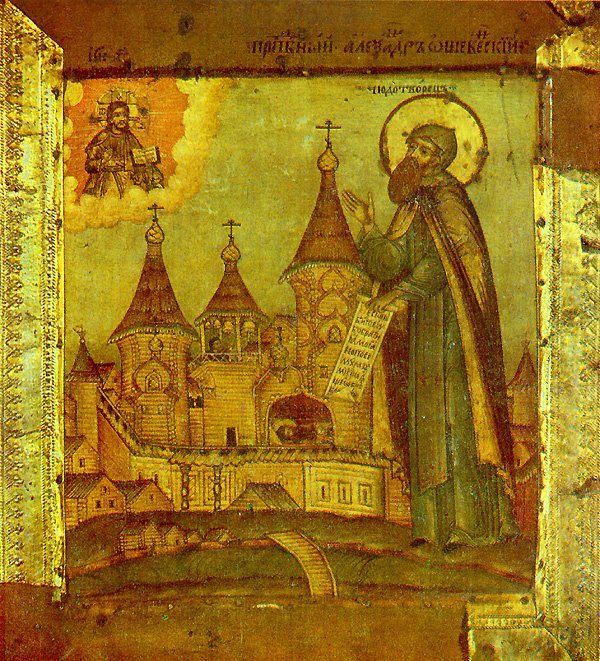
Saint Alexander of Oshevensk (+ 1479) was the founder of the Oshevensk Dormition Monastery and enlightener of the Kargopol area, and was tonsured in the White Lake Monastery. He appeared to Saint Diodorus of George Hill (November 27) in the seventeenth century when his Holy Trinity Monastery ran out of supplies, and the brethren complained because there was nowhere to buy food in the wilderness.
Saint Alexander of Oshevensk (+ 1479) was the founder of the Oshevensk Dormition Monastery and enlightener of the Kargopol area, and was tonsured in the White Lake Monastery. He appeared to Saint Diodorus of George Hill (November 27) in the seventeenth century when his Holy Trinity Monastery ran out of supplies, and the brethren complained because there was nowhere to buy food in the wilderness. Saint Alexander reminded Diodorus of how the Lord had fed the five thousand in the wilderness, and ordered him to go fishing. Saint Diodorus, fearing that the vision was a demonic delusion, ignored it. When Saint Alexander appeared a third time, Diodorus, wishing to test him, asked him to say a prayer. Saint Alexander recited “It is Truly Meet,” and his face shone with a radiant light. The saint revealed himself as Alexander, the igumen of Oshevensk Dormition Monastery, and repeated his order to go fishing. Obeying this command, the monks went out and caught many fish.
Troparion - Tone 8
By a flood of tears you made the desert fertile, / and your longing for God brought forth fruits in abundance. / By the radiance of miracles you illumined the whole universe! / O our holy father Alexander, pray to Christ our God to save our souls!
Childmartyr Gabriel of Bialystok
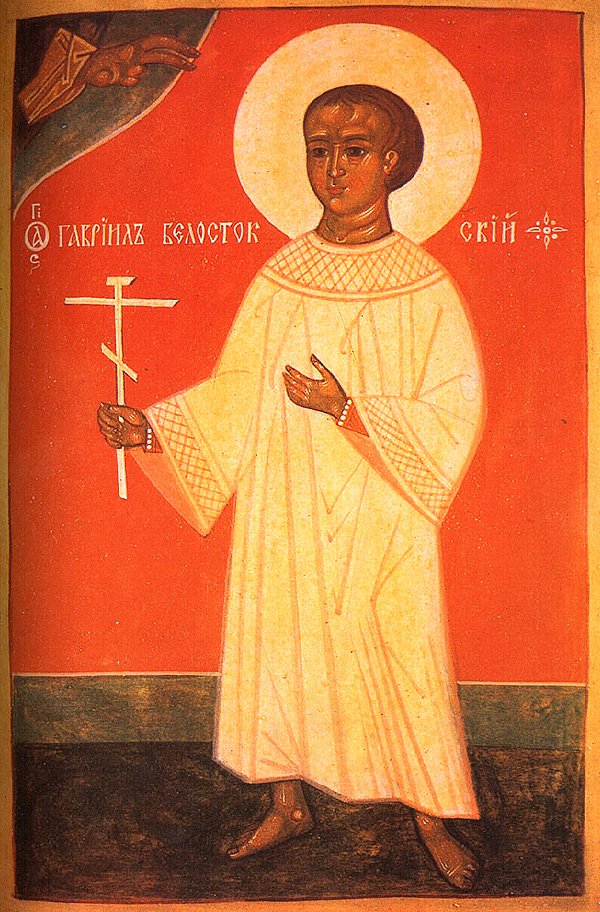
Child Martyr Gabriel of Bialystok (+ 1690) was killed in Poland when he was only six years old. One day when his parents were not home, he was lured out of his house by a man named Schutko, and then killed. After thirty years, the martyred child’s body was found to be incorrupt.
Troparion - Tone 3
Your holy martyr Gabriel, O Lord, / through his sufferings has received an incorruptible crown from You, our God. / For having Your strength, he laid low his adversaries, / and shattered the powerless boldness of demons. / Through his intercessions, save our souls!
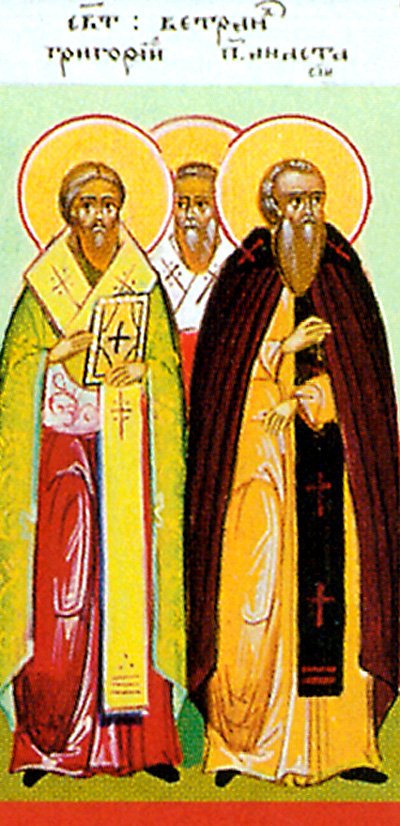
Blessed Gregory, Patriarch of Antioch
No information available at this time.
Troparion - Tone 4
In truth you were revealed to your flock as a rule of faith, / an image of humility and a teacher of abstinence; / your humility exalted you; / your poverty enriched you. / Hierarch Father Gregory, / entreat Christ our God / that our souls may be saved.
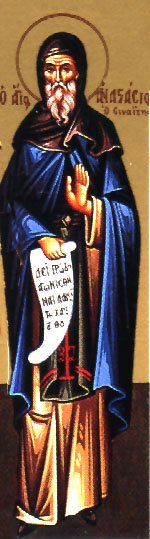
Venerable Anastasius, Abbot of Sinai
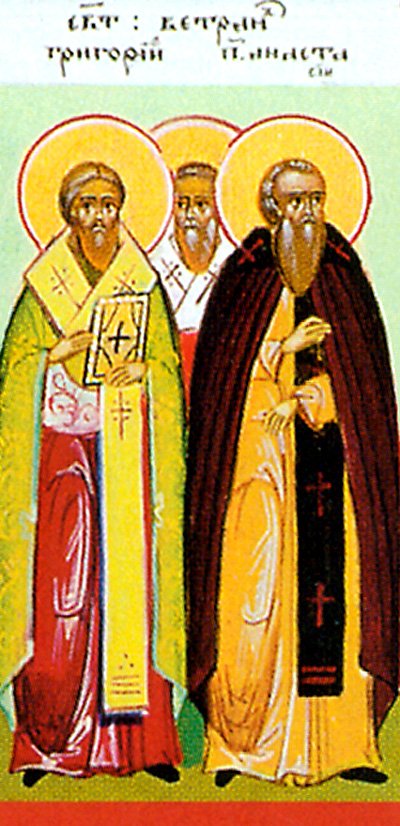
Saint Anastasius of Sinai lived in the seventh century, and was one of the great ascetics who flourished on Mt. Sinai.
From his youth, he was raised in great piety and love for God. When he reached manhood, Saint Anastasius left the world and entered a monastery to take upon himself the yoke of Christ (Mt.11:29).
Saint Anastasius of Sinai lived in the seventh century, and was one of the great ascetics who flourished on Mt. Sinai.
From his youth, he was raised in great piety and love for God. When he reached manhood, Saint Anastasius left the world and entered a monastery to take upon himself the yoke of Christ (Mt.11:29). Wishing to perfect himself in virtue, he went to Saint Catherine’s Monastery on Mt. Sinai, where Saint John of the Ladder (March 30) was abbot. There he profited from the example of many holy men who were proficient in monasticism.
Because of his humility, Saint Anastasius received wisdom and spiritual discernment from God. He wrote the Lives of several holy Fathers, as well as other spiritually instructive books. In time, he was found worthy of ordination to the holy priesthood.
Following Saint John and his brother George, Saint Anastasius became abbot of Sinai. He was most zealous in his opposition to heresy, exposing it, refuting it, and covering its adherents with shame. He even traveled to Syria, Egypt, and Arabia to uproot heresy and strengthen the Church of Christ.
Saint Anastasius taught that God gives each Christian an angel to care for him throughout his life. However, we can drive our Guardian Angel away by our sins, just as bees are driven away by smoke. While the demons work to deprive us of the heavenly Kingdom, the holy angels guide us to do good. Therefore, only the most foolish individuals would drive away their Guardian Angel from themselves.
After a long life of faithfully serving God, Saint Anastasius fell asleep in the Lord in the year 685. He and the other ascetics of Mt. Sinai are also commemorated on Bright Wednesday, the Synaxis of the Monastic Fathers of Sinai.
Troparion - Tone 8
By a flood of tears you made the desert fertile, / and your longing for God brought forth fruits in abundance. / By the radiance of miracles you illumined the whole universe! / O our holy father Anastasius, pray to Christ our God to save our souls!
Saint Betran, Bishop of Lesser Scythia
No information available at this time.
Troparion - Tone 4
In truth you were revealed to your flock as a rule of faith, / an image of humility and a teacher of abstinence; / your humility exalted you; / your poverty enriched you. / Hierarch Father Betran, / entreat Christ our God / that our souls may be saved.
Saint Theotimus, Bishop of Lesser Scythia
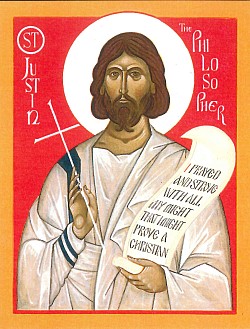
Saint Theotimus the Scythian was Bishop of Tomis in Scythia. He was a native of Dacia Pontica, and was part Roman. He is believed to have been the teacher of Saint John Cassian (February 29) and Saint Germanus, because he was once living in the same monastery as they were.
Somewhere between 385-390, Saint Theotimus succeeded Saint Germanus as Bishop of Tomis.
Saint Theotimus the Scythian was Bishop of Tomis in Scythia. He was a native of Dacia Pontica, and was part Roman. He is believed to have been the teacher of Saint John Cassian (February 29) and Saint Germanus, because he was once living in the same monastery as they were.
Somewhere between 385-390, Saint Theotimus succeeded Saint Germanus as Bishop of Tomis. Saint Jerome mentions him in his book ON ILLUSTRIUS MEN. He describes Saint Theotimus as a good pastor, a wise theologian, and a talented writer. He also says that Saint Theotimus used to write short works in the form of dialogues, which reveal his training in rhetoric and philosophy.
In his writings, Saint Theotimus speaks of the role of the mind and the heart in prayer. Perhaps because of this he is considered to be the Father of the Romanian PHILOKALIA.
Saint Theotimus sometimes endured hardships from wandering barbarians, but he impressed them with the holiness of his life and the miracles he performed. He also had close ties with Saint John Chrysostom, and visited Constantinople at least twice.
Sometime around 410, Saint Theotimus fell asleep in the Lord. Ancient historians also refer to him as “the Philosopher.”
Troparion
Since you are a pillar of the Church of Christ, you have overthrown
the heresy of Arius, O wise Theotimus; / therefore, our God has adorned you,
O most blessed hierarch Theotimus. / By your prayers, O all-holy one;
guard the entire flock and the city of Tomis.
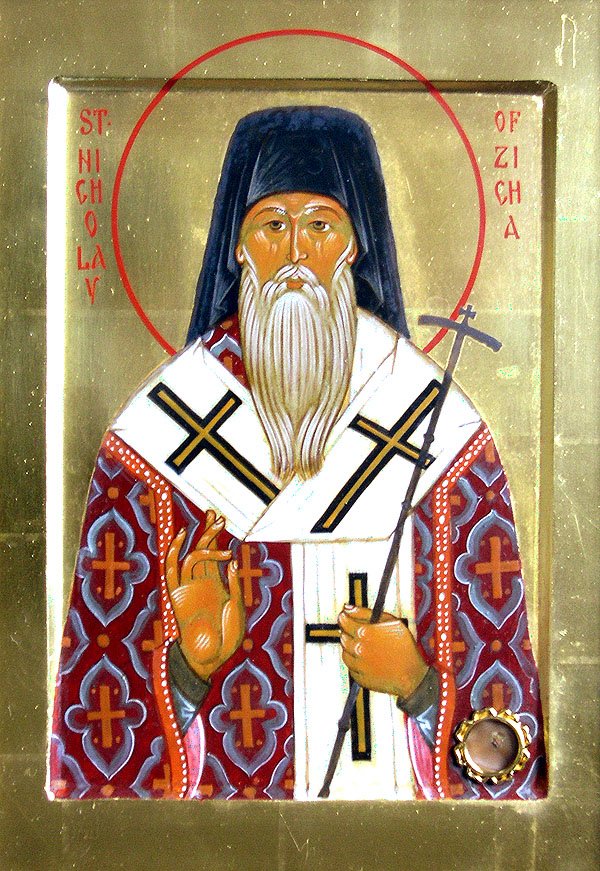
Translation of the relics of Saint Nikolai of Zhicha
No information available at this time.
Troparion - Tone 8
O golden-tongued preacher proclaiming the risen Christ, / everlasting guide of the cross-bearing Serbian people, / resounding harp of the Holy Spirit, and dear to monastics who rejoice in you, / pride and boast of the priesthood, teacher of repentance, master for all nations, / guide of those in the army of Christ as they pray to God, / Holy Nikolai teacher in America and pride of the Serbian people, / with all the saints, implore the only Lover of mankind / to grant us peace and joy in his heavenly kingdom!
Kontakion - Tone 3
Born at Lelich in Serbia, / you served as archpastor at the church of Saint Nahum in Ochrid. / You presided on the throne of Saint Savva at Zhicha, / teaching the people of God and enlightening them with the Gospel, / bringing them to repentance and love for Christ. / And for His sake you endured suffering at Dachau. / Therefore, Nicholai, we glorify you as one newly well pleasing to God.
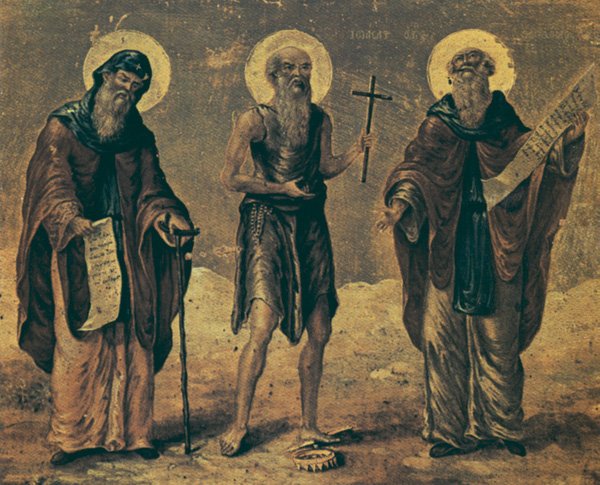
Saint Joseph of Serbia
No information available at this time.
Troparion - Tone 8
In you the image was preserved with exactness, O Father, / for taking up your cross, you followed after Christ. / By so doing, you taught us to disregard the flesh, for it passes away, / but to care instead for the soul, since it is immortal. / Therefore, most venerable Father Joseph your spirit rejoices with the Angels.
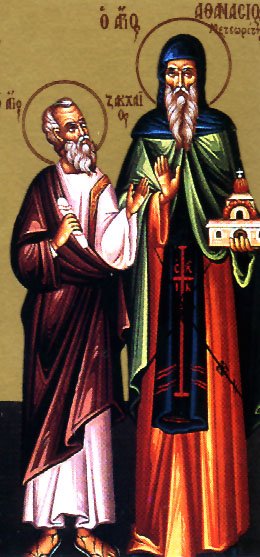
Apostle Zacchaeus
The holy Apostle Zacchaeus was a rich publican at Jericho. Since he was short of stature, he climbed a sycamore tree in order to see the Savior passing by. After the Ascension of the Lord, Saint Zacchaeus accompanied Saint Peter on his travels. Tradition says he became the Bishop of Caesarea in Palestine, where he died in peace.
The Gospel (Luke 19:1-10) describing Zacchaeus’ encounter with Christ is read on the Sunday before the Triodion begins.
Troparion - Tone 3
Holy Apostle Zacchaeus, / entreat the merciful God, / to grant our souls forgiveness of transgressions.
Saint Athanasius of Meteora
Saint Athanasios, the son of wealthy parents, was born in 1302 at Hypátē, the well-known medieval town of New Patras, and was named Andronikos in Holy Baptism. His mother died during childbirth, and after a short time his father also reposed. Thus, young Andronikos lost both of his parents in a very early age. T
Saint Athanasios, the son of wealthy parents, was born in 1302 at Hypátē, the well-known medieval town of New Patras, and was named Andronikos in Holy Baptism. His mother died during childbirth, and after a short time his father also reposed. Thus, young Andronikos lost both of his parents in a very early age. Then he found sympathy, affection, and love from his father's brother, who saw to his education, taking care of all his needs, and taught him to read and write.
After the capture of his hometown by the Catalans in 1318/19, the chief of the Franks took Andronikos into his home. At the first opportunity, Andronikos escaped and was free. He hastened to rejoin his uncle, who had been banished to a distant place. Andronikos found him, and the two booked passage on a ship bound for Thessaloniki. The godly uncle suffered from a chronic joint disease, however, and after some time, he reposed at Akapniou Monastery.
Andronikos then went to live with the imperial secretary of the military command, who became his guardian for a short time. Andronikos wanted to be trained in secular learning and classical studies. Since he had no money to pay the instructors, he would stand outside and listen while the students were being taught. Some of the school's philosophers noticed his love of learning and his eagerness, so they they taught him without asking for a fee.
After benefitting from his teachers' knowledge, Andronikos became quite educated and cultured. Then he decided to go on pilgrimage. When he was seventeen years old, Andronikos traveled to Mount Athos, where he conversed with many holy Fathers, seeking their prayers and blessings. The Athonite Fathers, however, refused to allow the boy to remain, since he was still a beardless youth.
Andronikos made his way to Constantinople, visiting churches, and venerating the relics of the Saints. While there he met several prominent and virtuous Fathers, such as Gregory of Sinai, the future Ecumenical Patriarch Isidore (1347-1350), who supported Saint Gregory Palamas, and then made him Metropolitan of Thessaloniki, Daniel the Hesychast, and other notable persons of the monastic community. With their help he was initiated into the secrets of the hesychastic life and, like a bee, he gathered whatever was useful and necessary to acquire virtue.
He traveled to Crete in 1325 where he stayed for a certain time and lived as an ascetic, receiving hospitality from a virtuous and charitable Cretan man. When he noticed this man was trying to lure him back into the world in order to marry his daughter, he decided to forsake the world. Therefore, he returned to Mount Athos in 1332, by which time he was approximately thirty years old. At Milea on the Holy Mountain he was accepted as a novice by two virtuous anchorites, Gregory and Moses, who had attained the heights of virtue. Subsequently, he was tonsured by Hieromonk Gregory, taking the name Anthony. He quickly distinguished himself and then received his new monastic name of Athanasios when he was tonsured into the Great Schema.
However, the predatory incursions of the Turks and the unfavorable circumstances prevailing at that time forced Saint Athanasios to leave Mount Athos together with his Spiritual Father Gregory, and another disciple, Gabriel. At Thessaloniki and Beroia many important men were willing to give them hospitality, but the two monks did not consent to stay because Athanasios had a great aversion to secular society and to the noise of the city.
So on the advice of Bishop Jacob of Servia (a city between northern Thessaly and southern Macedonia), they went to the Thessalian rocks of Stagoi, which the biographer of Athanasios describes as "the largest and highest rocks created by God since the beginning of the world." Following the bishop's advice they found the rocks, but there was nothing living on them but vultures and crows.
Hieromonk Gregory and Saint Athanasios settled on the rock of Stylos, which today is called the Rock of the Holy Spirit. Gregory remained there for an entire decade. After a certain period of time, Father Athanasios withdrew, with his mentor’s blessing, to a cave in the rock. There in prayer and solitude, he spent his time weaving baskets so that he was never idle, and so he was kept safe from the danger of falling into temptation.
Seeking even more seclusion and serenity, always with Elder Gregory’s blessing, he selected another rock, “a place for anchorites, a rock which rose high into the skies,” where he went around the year 1340, this time for good. The rock is the so-called Platylithos (Wide Rock), which Athanasios himself called Meteoron, a name that was preserved through the centuries, and applied, in general, to the whole complex of the surrounding monasteries which became famous far beyond the borders of Greece.
Equipped with the wings of the Holy Spirit, and with unwavering will and faith, the humble monk Athanasios almost flew, and at last stepped onto this sun-drenched rock, hitherto touched only by the rays of the sun, as it is mentioned in a sigillion (April 1580) of the Ecumenical Patriarch Mētrophánēs III: “Motivated by divine love, the holy monk Athanasios, taking the wings of the Holy Spirit, first flew to this sun-drenched rock which dominated in Stagoi, and justifiably called Meteoron, being the highest of all. There he found a holy place, a true paradise containing, instead of fruit-bearing trees, men who bore the divine fruits of the Holy Spirit."
There Athanasios built his ascetic refuge and organized the first systematic monastic community with a strict cenobitic Rule which he formulated himself. The brotherhood under Athanasios had fourteen members. Initially, the holy anchorite built the church of the Mother of God, to whom he also dedicated the Monastery, as he himself said to his fellow ascetics shortly before his death: “I entrust you to the protection of the Most Holy Theotokos and Ever-Virgin Mary, to whom this Monastery is dedicated.” He built another church in honor of the Transfiguration of Christ, which later became the katholikon of the Monastery and gave it its final name of Transfiguration Monastery, which is preserved until today.
Saint Athanasios made this steep and inaccessible rock into an easy path to our Lord, Who is the Cornerstone of our Church: "This hard stone, Father, you labored hard to make it a path to the Cornerstone."
Today as one climbs up the rocky stairway to the monastery, on the left just before the entrance, one can see the Hermitage of Saint Athanasios within the natural crevice in the rock arranged as a humble and basic dwelling with a small chapel. Here, according to tradition, the holy hermit first lived alone after he had climbed the Wide Rock, and before he built a church on the rocky ledge, with cells for the monks who began to gather there.
As humble as Athanasios had been all his life, he remained an ordinary monk. Perhaps due to his great humility, he did not leave any written texts, although he was very knowledgeable and well educated.
According to his biographer, he reposed peacefully after a brief illness (gall bladder and liver) at the age of seventy-eight, probably in the year 1380, on April 20th. Shortly before his death, Saint Athanasios chose Hieromonk Makarios to be the Spiritual Father of the Great Meteoron after his death: “I command that you have Hieromonk Makarios as the Protos and Spiritual Father. This is because, from the beginning, before I became ill, I entrusted him with the supervision of the daily and practical needs of the Monastery. Now it would be beneficial for him to guide and regulate your spiritual conduct."
Yet this only lasted a short time, since by November 1381 the former king John Urosh, and now the monk Joasaph, assumed the role as successor to Saint Athanasios, with his blessing while alive and with the mutual consent of the entire brotherhood, he became the second founder and builder of the Great Meteoron.
Troparion - Tone 3
You are an unshakable pillar, a steadfast wall, / a battlement and protection for your flock, O wise Athanasios. / Shelter us beneath the wings of your intercessions with Christ God, / O Righteous Father, / for we lovingly praise and glorify your memory.
Scripture Readings
☩Epistle
Acts 3:19-26
19
Repent ye therefore, and be converted, that your sins may be blotted out, when the times of refreshing shall come from the presence of the Lord;
20
And he shall send Jesus Christ, which before was preached unto you:
21
Whom the heaven must receive until the times of restitution of all things, which God hath spoken by the mouth of all his holy prophets since the world began.
22
For Moses truly said unto the fathers, A prophet shall the Lord your God raise up unto you of your brethren, like unto me; him shall ye hear in all things whatsoever he shall say unto you.
23
And it shall come to pass, that every soul, which will not hear that prophet, shall be destroyed from among the people.
24
Yea, and all the prophets from Samuel and those that follow after, as many as have spoken, have likewise foretold of these days.
25
Ye are the children of the prophets, and of the covenant which God made with our fathers, saying unto Abraham, And in thy seed shall all the kindreds of the earth be blessed.
26
Unto you first God, having raised up his Son Jesus, sent him to bless you, in turning away every one of you from his iniquities.
☩Gospel
John 2:1-11
1
And the third day there was a marriage in Cana of Galilee; and the mother of Jesus was there:
2
And both Jesus was called, and his disciples, to the marriage.
3
And when they wanted wine, the mother of Jesus saith unto him, They have no wine.
4
Jesus saith unto her, Woman, what have I to do with thee? mine hour is not yet come.
5
His mother saith unto the servants, Whatsoever he saith unto you, do it.
6
And there were set there six waterpots of stone, after the manner of the purifying of the Jews, containing two or three firkins apiece.
7
Jesus saith unto them, Fill the waterpots with water. And they filled them up to the brim.
8
And he saith unto them, Draw out now, and bear unto the governor of the feast. And they bare it.
9
When the ruler of the feast had tasted the water that was made wine, and knew not whence it was: (but the servants which drew the water knew;) the governor of the feast called the bridegroom,
10
And saith unto him, Every man at the beginning doth set forth good wine; and when men have well drunk, then that which is worse: but thou hast kept the good wine until now.
11
This beginning of miracles did Jesus in Cana of Galilee, and manifested forth his glory; and his disciples believed on him.