Fasting Rules

Meat not allowed Meat Abstain
Fish not allowed Fish Abstain
Dairy not allowed Dairy Abstain
Oil not allowed Oil Abstain
Wine not allowed Wine Abstain

Saints & Commemorations

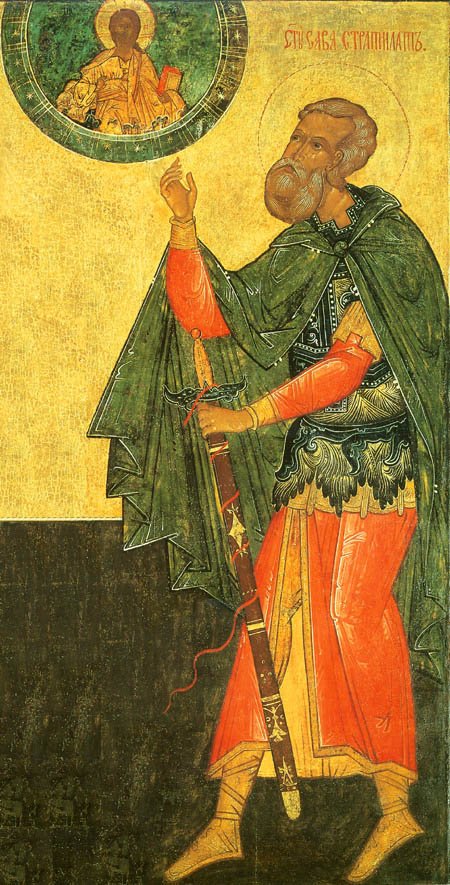
Martyr Savva Stratelates “the General” of Rome,  and 70 soldiers with him

Martyr Savva Stratelates “the General” of Rome, and 70 soldiers with him

Saint Savva Stratelates came from a Gothic tribe. For his bravery he attained the high rank of military commander or “stratelates,” and he served under the Roman emperor Aurelian (270-275). From his youth, Savva was a Christian and he fervently followed the commands of Christ. He helped the needy, and visited Christians in prison. Bec Saint Savva Stratelates came from a Gothic tribe. For his bravery he attained the high rank of military commander or “stratelates,” and he served under the Roman emperor Aurelian (270-275). From his youth, Savva was a Christian and he fervently followed the commands of Christ. He helped the needy, and visited Christians in prison. Because of his pure and virtuous life the saint received from the Lord the gift of wonderworking, healing the sick and casting out demons in the name of Christ. When the emperor learned that Saint Savva was a Christian, he demanded that he apostasize. The martyr threw down his military belt and declared that he would not forsake his faith. They beat him, burned him with torches, and threw him into a cauldron with tar, but the martyr remained unharmed. Looking on at his torments, seventy soldiers came to believe in Christ. They were beheaded by the sword. Saint Savva was thrown in prison. At midnight, while he was praying, Christ appeared to the martyr and shone on him the light of His Glory. The Savior bade him not to fear, but to stand firm. Encouraged, the Martyr Savva underwent new torture in the morning, and was drowned in a river in 272.

Troparion - Tone 5

You abandoned earthly rank and honor, / and as an athlete, confessed Christ God before the false and tyrannical emperors. / For His sake, you endured much suffering, O glorious one. / Therefore, splendidly adorned with the armies of heaven, / you have been crowned with a beautiful wreath of victory / by the King who reigns over all. / As you stand before Him, O Savva, / pray that He may save our souls.

Kontakion - Tone 4

You were shown to be an invincible athlete, most blessed Savva, / overcoming the snares of the barbarians. / You contended with faithfulness, / conquering a multitude of the invisible enemy. / Therefore, you have woven a wreath of victory. / Most glorious one, entreat Christ for those who honor you with faith.
Venerable Savva the Recluse of the Kiev Far Caves

Venerable Savva the Recluse of the Kiev Far Caves

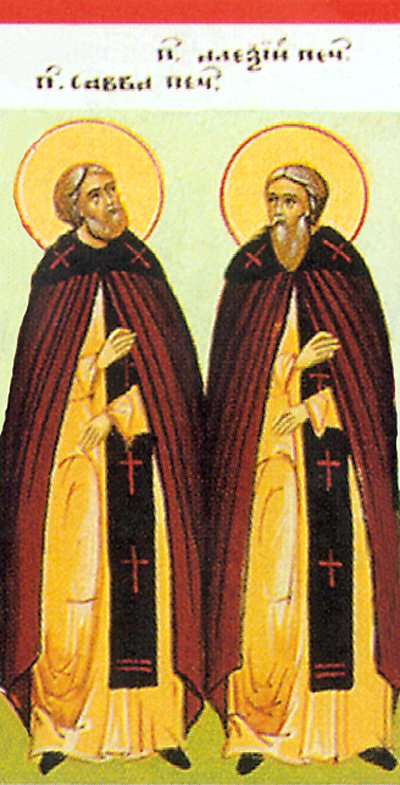
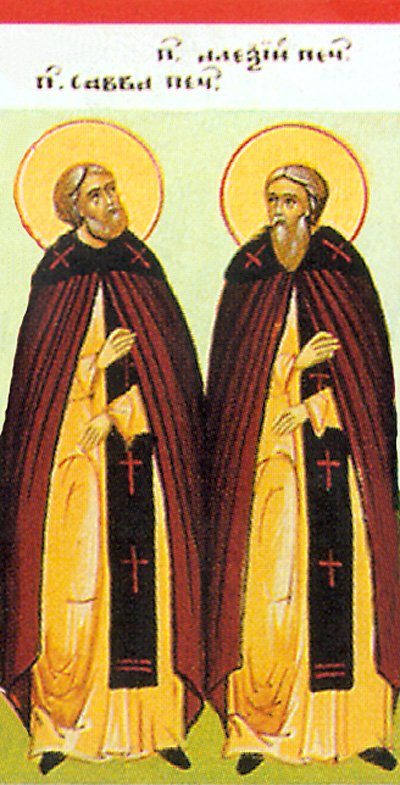
Saint Savva lived in the Near Caves of the Kiev Caves monastery during the thirteenth century. In the manuscripts, in the “Book of the Saints,” and in the Canon of the Services to the Fathers of the Kiev Caves, he is called a wonderworker. His memory is celebrated on April 24 because of his namesake, the Holy Martyr Savva Stratelates. The Saint Savva lived in the Near Caves of the Kiev Caves monastery during the thirteenth century. In the manuscripts, in the “Book of the Saints,” and in the Canon of the Services to the Fathers of the Kiev Caves, he is called a wonderworker. His memory is celebrated on April 24 because of his namesake, the Holy Martyr Savva Stratelates. The memory of Saint Savva is also celebrated on the Synaxis of the Monastic Fathers of the Near Caves (September 28), and on the Synaxis of all the Wonderworkers of the Kiev Caves (Second Sunday of Great Lent).

Troparion - Tone 8

By a flood of tears you made the desert fertile, / and your longing for God brought forth fruits in abundance. / By the radiance of miracles you illumined the whole universe! / O our holy father Savva, pray to Christ our God to save our souls!
Venerable Alexius the Recluse of the Kiev Far Caves

Venerable Alexius the Recluse of the Kiev Far Caves

Saint Alexius lived a life of asceticism in the Near Caves of the Kiev Caves monastery during the thirteenth century. His relics were uncovered after 1675. The memory of Saint Alexius is celebrated on April 24, because his relics rest beside the relics of Saint Savva of Caves. His memory is also celebrated on the Synaxis of the Monastic Fathers of Saint Alexius lived a life of asceticism in the Near Caves of the Kiev Caves monastery during the thirteenth century. His relics were uncovered after 1675. The memory of Saint Alexius is celebrated on April 24, because his relics rest beside the relics of Saint Savva of Caves. His memory is also celebrated on the Synaxis of the Monastic Fathers of the Near Caves (September 28) and on the Synaxis of all the Wonderworkers of the Kiev Caves (Second Sunday of Great Lent).

Troparion - Tone 8

By a flood of tears you made the desert fertile, / and your longing for God brought forth fruits in abundance. / By the radiance of miracles you illumined the whole universe! / O our holy father Alexius, pray to Christ our God to save our souls!
Martyrs Valentine and Pasikrates in Moesia, Bulgaria

Martyrs Valentine and Pasikrates in Moesia, Bulgaria

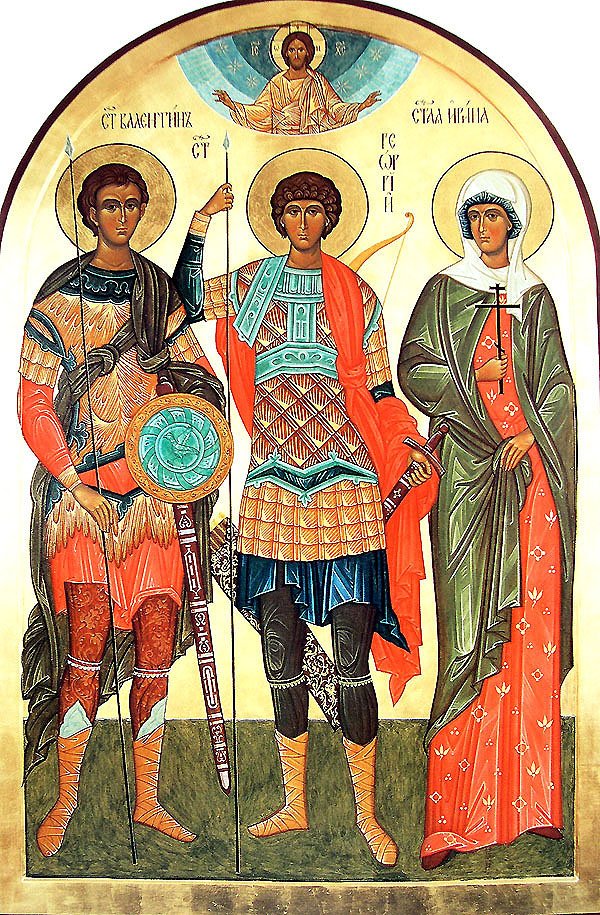
The Martyrs Valentine and Pasikrates came from the city of Durostorum, Silistria (now Bulgaria) and were soldiers under the governor Absolanus. Pasikrates was twenty-two years old, and Valentine was thirty. When a persecution against Christians began, Saints Pasikrates and Valentine openly confessed their faith in Christ. The Martyrs Valentine and Pasikrates came from the city of Durostorum, Silistria (now Bulgaria) and were soldiers under the governor Absolanus. Pasikrates was twenty-two years old, and Valentine was thirty. When a persecution against Christians began, Saints Pasikrates and Valentine openly confessed their faith in Christ. At the trial Pasikrates spit at the idol of Apollo, and refused to offer sacrifice. The brother of Saint Pasikrates wept and urged him merely to appear to offer sacrifice to the idols. The martyr placed his hand on the sacrifice in the fire and said, “The body is mortal and burns in the fire, the soul, however, is immortal and is not harmed by these torments.” Saint Valentine also showed his readiness to suffer for Christ. When they led the martyrs to execution, the mother of Saint Pasikrates followed them and exhorted her son not to fear death for Christ. Both martyrs were tortured and then beheaded in 288.

Troparion - Tone 4

Your holy martyrs Valentine and Pasikrates, O Lord, / through their sufferings have received incorruptible crowns from You, our God. / For having Your strength, they laid low their adversaries, / and shattered the powerless boldness of demons. / Through their intercessions, save our souls!
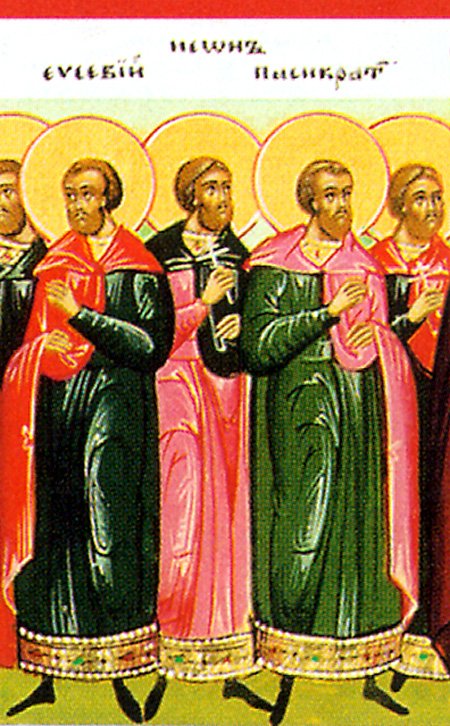
Martyrs Eusebius, Neon, Leontius, Longinus, and others, at Nicomedia

Martyrs Eusebius, Neon, Leontius, Longinus, and others, at Nicomedia

The Martyrs Eusebius, Neon, Leontius, Longinus, and 40 Others were present at the sufferings of the Great Martyr George (April 23), through which they came to believe in Christ. They were then locked up in prison. After the execution of Saint George, the emperor Diocletian (284-305) issued an edict stating that all the prisoners were to offer sacrifice to the idols. The Martyrs Eusebius, Neon, Leontius, Longinus, and 40 Others were present at the sufferings of the Great Martyr George (April 23), through which they came to believe in Christ. They were then locked up in prison. After the execution of Saint George, the emperor Diocletian (284-305) issued an edict stating that all the prisoners were to offer sacrifice to the idols. The martyrs refused. They were beaten with iron rods, almost exposing their inner organs, and then their heads were cut off with a sword.

Troparion - Tone 4

Your holy martyrs O Lord, / through their sufferings have received incorruptible crowns from You, our God. / For having Your strength, they laid low their adversaries, / and shattered the powerless boldness of demons. / Through their intercessions, save our souls!

Venerable Thomas the Fool of Syria

Saint Thomas the Fool-for-Christ was a monk in one of the monasteries in Caesarea of Cappadocia (Asia Minor). His obedience was to collect alms for the monastery. When the Blessed Thomas arrived in the city of Antioch, Syria he began his exploit of foolishness for the sake of Christ. The steward of one of the churches, a certain Anastasius, became annoyed with the entreaties of Saint Thomas, and struck him on the cheek. Saint Thomas the Fool-for-Christ was a monk in one of the monasteries in Caesarea of Cappadocia (Asia Minor). His obedience was to collect alms for the monastery. When the Blessed Thomas arrived in the city of Antioch, Syria he began his exploit of foolishness for the sake of Christ. The steward of one of the churches, a certain Anastasius, became annoyed with the entreaties of Saint Thomas, and struck him on the cheek. Those present reproached Anastasius for his inappropriate manner of dealing with the fool, but Saint Thomas quieted them saying, “From this moment I shall accept nothing further from Anastasius, nor will Anastasius be able to give me anything further.” These words proved prophetic. Anastasius died the very next day, and the saint also died along the road to his monastery, at the church of Saint Euthymius in the suburb of Daphne. They buried him at a place set aside for the burial of strangers. After a certain while they buried another stranger in the saint’s grave. After four hours the ground on the grave of the stranger was thrown aside. They again covered the grave, but in the morning the ground on the grave again lay open. They reburied the stranger in another place. The same thing happened when they buried two women nearby. Everyone realized that Saint Thomas did not wish to have a woman buried over him. The occurrence was reported to Patriarch Domnus of Antioch (546-560). At his command the relics of Saint Thomas were transferred to Antioch and placed in a cemetery where the relics of many holy martyrs rested. A small church was built over these relics, from which many healings occurred. Through the prayers of Saint Thomas a deadly plague ceased at Antioch. From that time the inhabitants began to honor the memory of Saint Thomas every year.

Troparion - Tone 8

By a flood of tears you made the desert fertile, / and your longing for God brought forth fruits in abundance. / By the radiance of miracles you illumined the whole universe! / O our holy father Thomas, pray to Christ our God to save our souls!
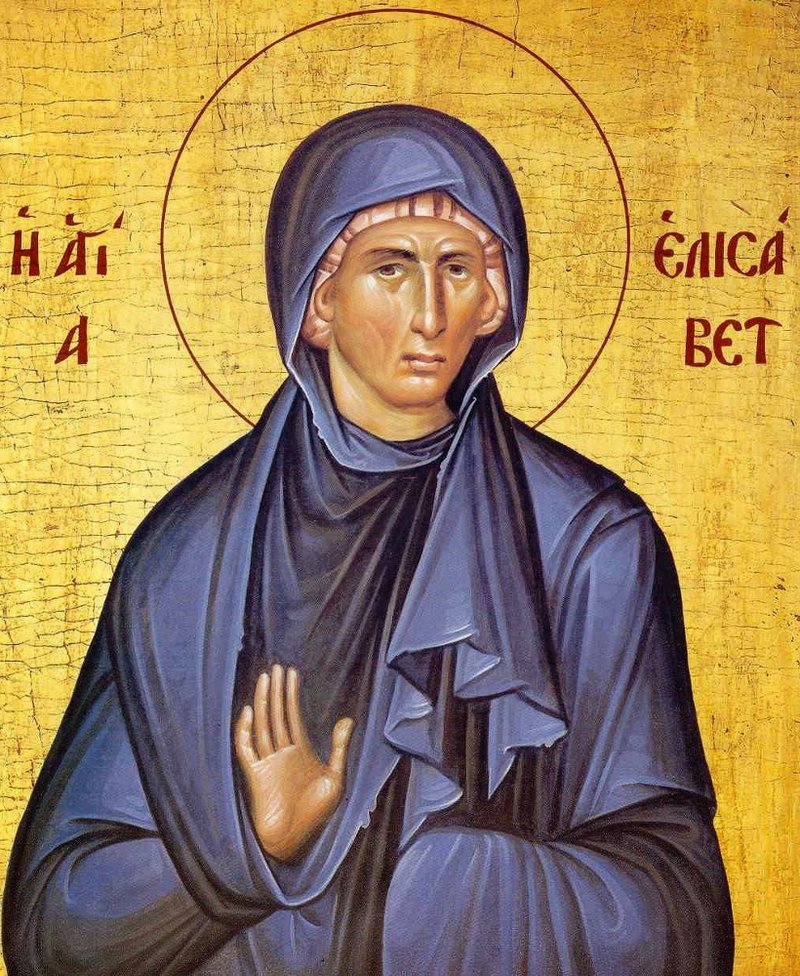
Saint Elizabeth, Wonderworker of Constantinople

Saint Elizabeth, Wonderworker of Constantinople

Saint Elizabeth the Wonderworker was from Constantinople, and was chosen for the service of God at birth. It was revealed to her mother that the girl would become a chosen vessel of the Lord (Acts 9:15). The parents sent their daughter to a monastery as a child. She grew up in an atmosphere of fasting and constant prayer, and received the gift of healing physical and spiritual infirmities. Saint Elizabeth the Wonderworker was from Constantinople, and was chosen for the service of God at birth. It was revealed to her mother that the girl would become a chosen vessel of the Lord (Acts 9:15). The parents sent their daughter to a monastery as a child. She grew up in an atmosphere of fasting and constant prayer, and received the gift of healing physical and spiritual infirmities. The sisters chose her to be abbess of the Saints Cosmas and Damian Monastery. She wore a coarse hairshirt all year round. Her body was chilled in winter, but her spirit blazed with ardent love for God. The saint’s asceticism was very strict. For many years she ate only grass and vegetables, but would not partake of bread, wine, or oil. Many times Saint Elizabeth ate nothing at all during the forty days of the Great Fast. Imitating the Publican in humility, for three years she did not lift up her eyes to the heavens, but she looked constantly to God with her spiritual eyes. At midnight prayers, the saint shone with a heavenly light. Saint Elizabeth performed many miracles: a vicious serpent was killed by her prayer, she healed a woman with issue of blood who had been ill for many years, and she cast out unclean spirits from people. At her tomb many were healed of various illnesses, and the blind received their sight. Many were cured with just some earth from her grave. Once, when the Divine Liturgy was being served, after the Cherubic Hymn, she saw an indescribable radiant light envelop the priest who stood before the Holy Table, and the All-Holy Spirit descended into the Altar. She was filled with astonishment and surprise. She did not tell anyone about this, however, until the day of her departure from this life drew near. As her time approached, she had a great desire to see her homeland once more. So she went to Heraclea and worshipped at the sacred churches of the Saints. And there, in the church of Mother of God, she had a vision of the All-Holy Virgin, who welcomed her. She recognized the face of the Theotokos from an icon she saw when she arrived at the church of the Holy Martyr Romanos. The voice of the Most Pure Virgin told her to return to her Monastery, because the time of her repose was near. So when Saint Elizabeth went back, she went to the Lord in peace. Her holy relics were buried in the church of Saint George, and remained whole and incorrupt. We do not know exactly when Saint Elizabeth lived, but it was probably between the sixth and ninth centuries.

Troparion - Tone 8

In you, O Mother, was preserved with exactness what is according to the image; / for you took up the Cross and followed Christ. / By so doing, you taught us to disregard the flesh, for it passes away; / but to care for the soul, since it is immortal. / Therefore, O Venerable Elizabeth, your spirit rejoices with the Angels.

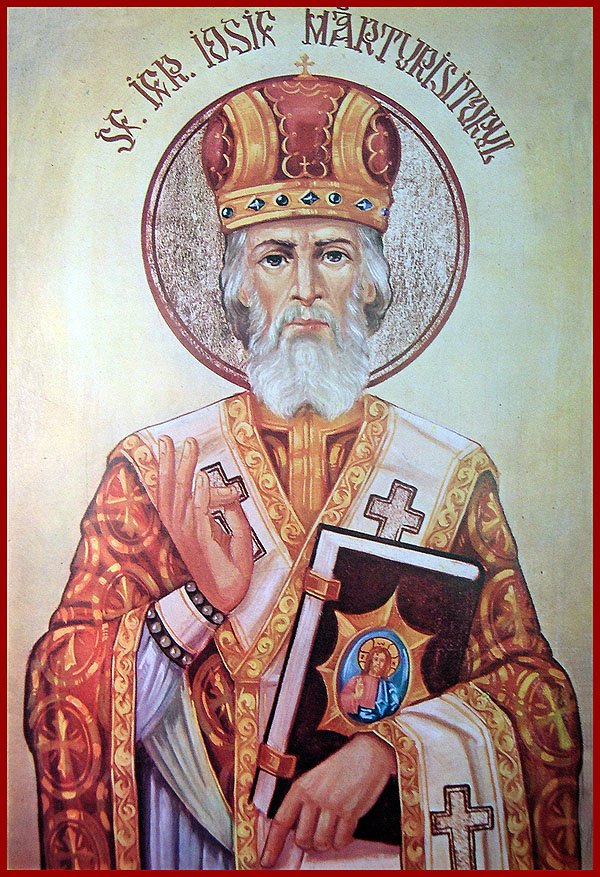
Saint Iorest, Metropolitan of Ardeal, Confessor of Romania

Saint Iorest the Confessor was born into a family of Transylvanian peasants and received the name Elias at Holy Baptism. At a young age, he entered Puta Monastery and was tonsured with the name Iorest. Then, after completing the spiritual school at that Lavra, he made great progress in the monastic life. Saint Iorest the Confessor was born into a family of Transylvanian peasants and received the name Elias at Holy Baptism. At a young age, he entered Puta Monastery and was tonsured with the name Iorest. Then, after completing the spiritual school at that Lavra, he made great progress in the monastic life. He was also a calligrapher and an iconographer. Because of the purity of his virtuous life, the Igoumen of the Monastery recommended him for ordination as a Hieromonk. Saint Iorest served in the altar with great compunction and in the fear of God, edifying others by his sermons. Word of the Saint's spiritual stature reached Basil Lupu, the Voivode (military leader) of Moldova. So, after the repose of Metropolitan Gennádios of Transylvania in the autumn of 1640, Venerable Iorest of Putna was elected as the Primate of the Transylvanian Church, by God's will, After his consecration by the Metropolitan of the Romanian Land (Ţării Româneşti) in 1641, the gentle Hierarch Iorest was installed in the Metropolitan cathedral at Alba Iulia. For three years, while shepherding the Church of Christ as a true Confessor, Saint Iorest defended the true Orthodox Faith from false Calvinist teachings, and from all the cunning snares of the devil. He traveled throughout his diocese, appointing energetic priests, consecrating churches, and instructing the people. In 1643, Saint Iorest was thrown into prison because of his vehement opposition to the activities of foreign missionaries who wanted to convert the Orthodox faithful. He had to endure beatings and abuse, and he was prepared to suffer martyrdom and give his life in defense of the Orthodox Faith, and for the salvation of the flock which God had entrusted to him. After nine months, the true shepherd was released and forced to pay a fine. Arriving in Moldavia once again, between 1656–1657, he served as Bishop of Huşi. Here too, he shepherded the Church of Christ well, and labored for the salvation of his spiritual children. Christ called Saint Iorest to Himself on April 24, 1657, and he was numbered among the Holy Confessors. The Holy Hierarch Iorest was glorified by the Romanian Orthodox Church in 1955.

Troparion - Tone 8

Confessors of Orthodoxy and good archpastors of the Church of Christ, / you directed the people, O blessed hierarchs and victory-bearers, Saints Iorest and Savva, / you who are worthy of the crown of life, / pray the Lord to save our souls.

Kontakion - Tone 4

(Special Melody: “You have appeared today...“) Most blessed Hierarchs of the Orthodox Faith, / and defenders of the Church of Christ, / protect all Orthodox Christians who always sing: / Rejoice, Holy Hierarchs Iorest and Savva, / wondrous Confessors of the Lord.

Saint Savva Brancovici, Metropolitan of Ardeal, Confessor of Romania

Saint Savva was born into an old Serbian family from Hertzegovina who took refuge near Arad in Transylvania at the end of the sixteenth century. The future saint was born at Inau around 1620, and received the name Simeon in Baptism. His parents were named John and Maria. At first he was tutored at home, then he traveled in Hungary, Serbia and Bulgaria. Saint Savva was born into an old Serbian family from Hertzegovina who took refuge near Arad in Transylvania at the end of the sixteenth century. The future saint was born at Inau around 1620, and received the name Simeon in Baptism. His parents were named John and Maria. At first he was tutored at home, then he traveled in Hungary, Serbia and Bulgaria. After visiting his uncle, Metropolitan Longinus, at the Comana Monastery south of Bucharest, he decided to stay there to complete his education. The Metropolitan tutored him in religious and secular subjects. After completing his studies, Simeon returned home and got married at the age of thirty. He was ordained to the holy priesthood, but his wife died soon after this. Not long afterward, his mother became a nun. Father Simeon continued to serve in the Lord’s vineyard for ten years, converting many Moslems, and reconverting Christians who had embraced Islam. In 1656, a council of clergy and laymen at Alba Iulia elected the widowed Father Simeon as Metropolitan of Ardeal in Transylvania (western Romania). He traveled to the cathedral in Tirgovishte in Wallachia, and there he received monastic tonsure with the name Savva. On September 16, 1656 he was consecrated as a bishop by Metropolitan Stephen of Wallachia. Saint Savva’s episcopal service was plagued by the missionary activities of Calvinists who tried to convert the Orthodox, and who were supported by the princes of Transylvania. In addition, frequent wars threatened the stability of the area during his first years as Metropolitan. The saint, however, proved to be a faithful defender of the Church. In the face of these difficulties, Saint Savva set up a print shop and published service books, manuals of instruction for clergy and laity, and a catechism. He also preached sermons based on the writings of Fathers, and using the Lives of the Saints as models for his flock. Saint Savva was driven from his See between 1660-1662 because of his labors to strengthen his flock in Orthodoxy. Although he returned to his duties and served without interruption until 1680, Metropolitan Savva was often harassed because of his refusal to cooperate with the prince and the Calvinists. In 1668 Metropolitan Savva journeyed to Russia seeking help. This led to his persecution by Prince Michael Apaffi and Protestant leaders, who did not appreciate his fierce opposition to their attempts to convert the Orthodox of Transylvania to Calvinism. In February of 1669 the prince issued a decree imposing many duties and restrictions on him. Saint Savva convened a council at Alba Iulia in 1675. Among other things, the council decided to celebrate the Liturgy in the Romanian language rather than Slavonic, and to improve the spiritual and moral life of the clergy and laity. In 1680 the Calvinist Superintendent of Transylvania made false accusations against Saint Savva and had him put on trial and thrown into prison. This effectively ended his career. Old and sickly, the Metropolitan endured three years of cruel torture in the Blaj Castle prison. He was finally released through the efforts of Prince Sherban of Wallachia, but died of his injuries on April 24, 1683. Saint Savva served as Metropolitan for almost twenty-five years under very trying circumstances. In spite of this, he defended his clergy and his flock against the activities of the proselytizers. Since he endured all things with Christian patience, even the bitter sufferings to which he was subjected at the end of his life, Saint Savva is regarded as a martyr and a Confessor of the Orthodox Faith. Saint Savva was glorified by the Church of Romania on October 21, 1955.

Troparion - Tone 8

Champion of Orthodoxy, teacher of purity and of true worship, / the enlightener of the universe and the adornment of hierarchs: / all-wise father Savva, your teachings have gleamed with light upon all things. / Intercede before Christ God to save our souls.

Hieromartyr and Confessor Elijah (Ilie) the Wallachian

No information available at this time.

Troparion - Tone 4

By sharing in the ways of the Apostles, / you became a successor to their throne. / Through the practice of virtue, you found the way to divine contemplation, O inspired one of God; / by teaching the word of truth without error, you defended the Faith, / even to the shedding of your blood. / Hieromartyr Elijah, entreat Christ God to save our souls.

Icon of the Mother of God of Molcha

There are, in fact, two wonderworking Icons called Molcha. One of them is located in the Molcha Sophroniev Nativity of the Theotokos men's Monastery. The other is in the women's Monastery of the Nativity of the Theotokos at Molcha. Both monasteries are located in the Putivl Konotop Diocese, in Ukraine (formerly Kursk province). There are, in fact, two wonderworking Icons called Molcha. One of them is located in the Molcha Sophroniev Nativity of the Theotokos men's Monastery. The other is in the women's Monastery of the Nativity of the Theotokos at Molcha. Both monasteries are located in the Putivl Konotop Diocese, in Ukraine (formerly Kursk province). Tradition says that in the early XIV century, two monks moved into this area from the Tatar-ravaged city of Kiev. They settled in a cave on Wondrous Mountain not far from the Molcha swamp. These monks brought with them an Icon of the Most Holy Theotokos, before which they prayed. When the hermits departed to the Lord, they were gradually forgotten, and the place where they had lived became overgrown with dense forests. On September 18, 1405, a beekeeper who was searching for wild bees in the forest, saw the Icon of the Theotokos in a linden tree, surrounded by a bright light, and he heard a voice say: "Let a church be built in this place, and dedicated to the Most Holy Theotokos." The beekeeper hastened to Putivl with news of this unusual phenomenon. The clergy and many of the people went at once to the specified place, and they all saw the Icon shining with a wondrous radiance. A Moleben was served before it, and many people received healing from their various illnesses. Subsequently, the Molcha Nativity of the Theotokos men's Monastery was built on this site. In 1605 the Monastery was plundered by the Poles, so the Igoumen and the brethren were forced to leave their ruined cloister and the Icon was transferred to the city's Putivl Monastery on April 24, 1605. Since the monks had brought the Molcha Icon with them, the Putivl Monastery was also called Molcha. In 1653, the Nativity of the Theotokos Monastery was restored through the efforts of a certain builder named Sophronios, that is why the Monastery received yet another name - Sophroniev. The wonderworking Icon was destroyed in a fire at the Monastery in 1752, but fortunately several ancient copies of the Icon were preserved, which were also renowned for their many miracles. During the Soviet era, the monastery was destroyed and the Icon was believed to be lost. Both Molcha Monasteries were restored in the nineteen-nineties. A lost Icon was also found. It turned out that the Icon had been hidden by the residents in order to save it from being desecrated. On May 7, 1995 there was a Cross Procession to transfer the Icon to the Transfiguration of the Savior Cathedral of the Molcha Putivl Monastery. There is also a wonderworking copy of the Molcha Icon of the Mother of God, which appeared in the village of Businovo near Moscow. Currently, this Molcha Icon of the Theotokos is located in the temple of Saint Sergius of Radonezh in Businov. According to Tradition, the Icon was brought to the temple in the XIX century by a blind girl who lived in the village of Businovo

Troparion - Tone 4

Today the glorious city of Moscow rejoices resplendently, / and in Putivl there is a great celebration as they honor the Mother of God and her wondrous Icon, / which permits everyone to quench their spiritual thirst with the honey of grace.

Kontakion - Tone 6

Come, O people, let us run to our Sovereign Lady, / for she has given us her Molcha Icon, which exudes streams of healing, / granting all manner of help for spiritual and bodily illnesses, / and leading to eternal life.

Hieromartyr Branko (Dobrosavljevic) the Newmartyr

No information available at this time.

Troparion - Tone 4

By sharing in the ways of the Apostles, / you became a successor to their throne. / Through the practice of virtue, you found the way to divine contemplation, O inspired one of God; / by teaching the word of truth without error, you defended the Faith, / even to the shedding of your blood. / Hieromartyr Branko, entreat Christ God to save our souls.
Saint Joseph the Confessor of Maramures

Saint Joseph the Confessor of Maramures

Saint Joseph was born in the seventeenth century, and was consecrated as a bishop in Moldavia (northern Romania) in 1690 by Metropolitan Dositheus. This was a period of great trials and sufferings for the people of Maramures (in northern Romania) because the Roman Catholic authorities wanted to wipe out Orthodoxy in the region. Saint Joseph was born in the seventeenth century, and was consecrated as a bishop in Moldavia (northern Romania) in 1690 by Metropolitan Dositheus. This was a period of great trials and sufferings for the people of Maramures (in northern Romania) because the Roman Catholic authorities wanted to wipe out Orthodoxy in the region. St Joseph was a zealous defender of the Orthodox Faith, and therefore he was jailed by the civil authorities. He died in 1711 after suffering for the truth and defending his flock. St Joseph the Confessor was glorified by the Orthodox Church of Romania in 1992.

Troparion - Tone 4

Great servant of God, Holy Hierarch Father Joseph, / we honor and remember your name in songs. / For by confessing Christ in Maramureş1 and defending the true Faith, / you became the protector of your flock. / Therefore, pray to Christ God to save our souls.

Kontakion - Tone 4

You were revealed to your flock as a guide and most gentle teacher of the faithful, / and serving with humility, you confessed Christ. / Wherefore, with ceaseless praise we sing to you saying, / “Rejoice, Holy Hierarch Father Joseph, / protector of the Orthodox of Maramureş.”1 Pronounced Mara MUR esh.

Hieromartyr Branko, parish priest of Veljusa

No information available at this time.

Troparion - Tone 4

By sharing in the ways of the Apostles, / you became a successor to their throne. / Through the practice of virtue, you found the way to divine contemplation, O inspired one of God; / by teaching the word of truth without error, you defended the Faith, / even to the shedding of your blood. / Hieromartyr Branko, entreat Christ God to save our souls.

Scripture Readings

Epistle

Acts 5:1-11

1 But a certain man named Ananias, with Sapphira his wife, sold a possession,
2 And kept back part of the price, his wife also being privy to it, and brought a certain part, and laid it at the apostles’ feet.
3 But Peter said, Ananias, why hath Satan filled thine heart to lie to the Holy Ghost, and to keep back part of the price of the land?
4 Whiles it remained, was it not thine own? and after it was sold, was it not in thine own power? why hast thou conceived this thing in thine heart? thou hast not lied unto men, but unto God.
5 And Ananias hearing these words fell down, and gave up the ghost: and great fear came on all them that heard these things.
6 And the young men arose, wound him up, and carried him out, and buried him.
7 And it was about the space of three hours after, when his wife, not knowing what was done, came in.
8 And Peter answered unto her, Tell me whether ye sold the land for so much? And she said, Yea, for so much.
9 Then Peter said unto her, How is it that ye have agreed together to tempt the Spirit of the Lord? behold, the feet of them which have buried thy husband are at the door, and shall carry thee out.
10 Then fell she down straightway at his feet, and yielded up the ghost: and the young men came in, and found her dead, and, carrying her forth, buried her by her husband.
11 And great fear came upon all the church, and upon as many as heard these things.

Gospel

John 5:30-6:2

30 I can of mine own self do nothing: as I hear, I judge: and my judgment is just; because I seek not mine own will, but the will of the Father which hath sent me.
31 If I bear witness of myself, my witness is not true.
32 There is another that beareth witness of me; and I know that the witness which he witnesseth of me is true.
33 Ye sent unto John, and he bare witness unto the truth.
34 But I receive not testimony from man: but these things I say, that ye might be saved.
35 He was a burning and a shining light: and ye were willing for a season to rejoice in his light.
36 But I have greater witness than that of John: for the works which the Father hath given me to finish, the same works that I do, bear witness of me, that the Father hath sent me.
37 And the Father himself, which hath sent me, hath borne witness of me. Ye have neither heard his voice at any time, nor seen his shape.
38 And ye have not his word abiding in you: for whom he hath sent, him ye believe not.
39 Search the scriptures; for in them ye think ye have eternal life: and they are they which testify of me.
40 And ye will not come to me, that ye might have life.
41 I receive not honour from men.
42 But I know you, that ye have not the love of God in you.
43 I am come in my Father’s name, and ye receive me not: if another shall come in his own name, him ye will receive.
44 How can ye believe, which receive honour one of another, and seek not the honour that cometh from God only?
45 Do not think that I will accuse you to the Father: there is one that accuseth you, even Moses, in whom ye trust.
46 For had ye believed Moses, ye would have believed me: for he wrote of me.
47 But if ye believe not his writings, how shall ye believe my words?
1 After these things Jesus went over the sea of Galilee, which is the sea of Tiberias.
2 And a great multitude followed him, because they saw his miracles which he did on them that were diseased.

Liturgical data sourced from OCA.org and orthocal.info