Fasting Rules
 Meat
Allowed
Meat
Allowed
 Fish
Allowed
Fish
Allowed
 Dairy
Allowed
Dairy
Allowed
 Oil
Allowed
Oil
Allowed
 Wine
Allowed
Wine
Allowed
Saints & Commemorations
Saint Basil of Poiana Marului
Saint Basil, the Elder of Saint Paisius Velichkovsky (November 15), was born toward the end of the seventeenth century. He received monastic tonsure at Dalhautsi-Focshani Skete in 1705 or 1706, laboring in asceticism with great fervor.
Saint Basil was ordained to the holy priesthood, and became igumen of Dalhautsi in 1715.
Saint Basil, the Elder of Saint Paisius Velichkovsky (November 15), was born toward the end of the seventeenth century. He received monastic tonsure at Dalhautsi-Focshani Skete in 1705 or 1706, laboring in asceticism with great fervor.
Saint Basil was ordained to the holy priesthood, and became igumen of Dalhautsi in 1715. He remained in that position for twenty years, and was a wise instructor of monks, teaching them obedience, humility, and the art of the Jesus Prayer.
The fame of this great spiritual Father began to spread, so that even Prince Constantine Mavrocordat heard of him. Saint Basil’s community became known as a spiritual school of hesychasm, based on the wisdom of the Holy Fathers. When the number of his disciples increased until there was no longer room for all of them at Dalhautsi, they settled in other Sketes in the area. In this way, his influence and teaching spread to other places, inspiring a spiritual renewal of Romanian monastic life in the eighteenth century.
Saint Basil renovated the Poiana Marului (Apple Orchard) Skete near the city of Romni-Sarat between 1730-1733, then moved there with twelve disciples. In addition to his duties as Igumen of Poiana Marului, Saint Basil was the spiritual guide of all the Sketes in the Buzau Mountains. One of his most famous disciples was Saint Paisius Velichkovsky, whom he tonsured on Mount Athos in 1750.
The holy Elder Basil also wrote introductions to the writings of Saints Gregory of Sinai, Nilus of Sora, and others who wrote about the spiritual life, guarding the mind, and on the Jesus Prayer. He taught that the Holy Scriptures are a “saving medicine” for the soul, and recommended reading the Holy Fathers in order to obtain a correct understanding of Scripture, and to avoid being led astray through misunderstanding. Saint Basil also warned against any inclination to excuse ourselves and our sins, for this hinders true repentance.
Saint Basil fell asleep in the Lord on April 25, 1767, leaving behind many disciples. His influence has been felt in other Orthodox countries beyond the borders of Romania.
Troparion - Tone 8
O Teacher of the true worship of God, guide of monks, preacher of grace, / instructor of noetic prayer as one who labored with vigilance, / O Venerable Father Basil, always entreat Christ God that our souls may be saved.
Apostle and Evangelist Mark
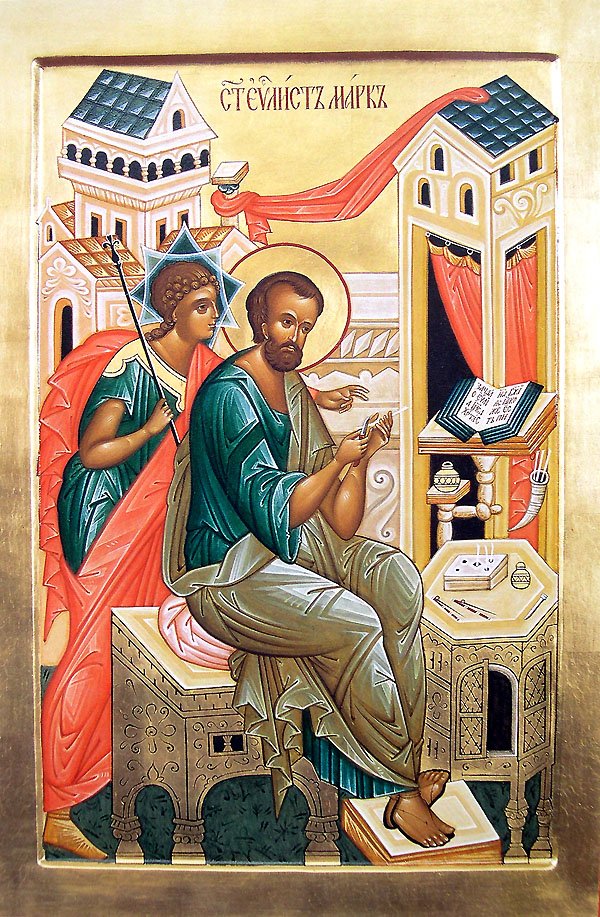
The Holy Apostle and Evangelist Mark, also known as John Mark (Acts 12:12), was one of the Seventy Apostles, and was also a nephew of Saint Barnabas (June 11). He was born at Jerusalem. The house of his mother Mary adjoined the Garden of Gethsemane. As Church Tradition relates, on the night that Christ was betrayed he followed after Him, wrapped only in a linen cloth.
The Holy Apostle and Evangelist Mark, also known as John Mark (Acts 12:12), was one of the Seventy Apostles, and was also a nephew of Saint Barnabas (June 11). He was born at Jerusalem. The house of his mother Mary adjoined the Garden of Gethsemane. As Church Tradition relates, on the night that Christ was betrayed he followed after Him, wrapped only in a linen cloth. He was seized by soldiers, and fled away naked, leaving the cloth behind (Mark 14:51-52). After the Ascension of the Lord, the house of his mother Mary became a place where Christians gathered, and a place of lodging for some of the Apostles (Acts 12:12).
Saint Mark was a very close companion of the Apostles Peter and Paul (June 29) and Barnabas. Saint Mark was at Seleucia with Paul and Barnabas, and from there he set off to the island of Cyprus, and he traversed the whole of it from east to west. In the city of Paphos, Saint Mark witnessed the blinding of the sorcerer Elymas by Saint Paul (Acts 13:6-12).
After working with the Apostle Paul, Saint Mark returned to Jerusalem, and then went to Rome with the Apostle Peter. From there, he set out for Egypt, where he established a local Church.
Saint Mark met Saint Paul in Antioch. From there he went with Saint Barnabas to Cyprus, and then he went to Egypt again, where he and Saint Peter founded many churches. Then he went to Babylon. From this city the Apostle Peter sent an Epistle to the Christians of Asia Minor, in which he calls Saint Mark his son (1 Pet 5:13).
When the Apostle Paul came to Rome in chains, Saint Mark was at Ephesus, where Saint Timothy (January 22) was bishop. Saint Mark went with him to Rome. There he also wrote his holy Gospel (ca. 62-63).
From Rome Saint Mark traveled to Egypt. In Alexandria he started a Christian school, which later produced such famous Fathers and teachers of the Church as Clement of Alexandria, Saint Dionysius of Alexandria (October 5), Saint Gregory Thaumatourgos (November 5), and others. Zealous for Church services, Saint Mark composed a Liturgy for the Christians of Alexandria.
Saint Mark preached the Gospel in the inner regions of Africa, and he was in Libya at Nektopolis.
During these journeys, Saint Mark was inspired by the Holy Spirit to go again to Alexandria and confront the pagans. There he visited the home of Ananias, and healed his crippled hand. The dignitary happily took him in, listened to his words, and received Baptism.
Following the example of Ananias, many of the inhabitants of that part of the city where he lived were also baptized. This roused the enmity of the pagans, and they wanted to kill Saint Mark. Having learned of this, Saint Mark made Ananias a bishop, and the three Christians Malchos, Sabinos, and Kerdinos were ordained presbyters to provide the church with leadership after his death.
The pagans seized Saint Mark when he was serving the Liturgy. They beat him, dragged him through the streets and threw him in prison. There Saint Mark was granted a vision of the Lord Jesus Christ, Who strengthened him before his sufferings. On the following day, the angry crowd again dragged the saint through the streets to the courtroom, but along the way Saint Mark died saying, “Into Your hands, O Lord, I commend my spirit.”
The pagans wanted to burn the saint’s body, but when they lit the fire, everything grew dark, thunder crashed, and there was an earthquake. The pagans fled in terror, and Christians took up the body of Saint Mark and buried it in a stone crypt. This was on April 4, 63. The Church celebrates his memory on April 25.
In the year 310, a church was built over the relics of Saint Mark. In 820, when the Moslem Arabs had established their rule in Egypt and oppressed the Christian Church, the relics of Saint Mark were transferred to Venice and placed in the church named for him.
In the ancient iconographic tradition, which adopted symbols for the holy Evangelists borrowed from the vision of Saint John the Theologian (Rev 4:7) and the prophecy of Ezekiel (Ez. 1:10), the holy Evangelist Mark is represented by a lion, symbolizing the might and royal dignity of Christ (Rev 5:5).
Saint Mark wrote his Gospel for Gentile Christians, emphasizing the words and deeds of the Savior which reveal His divine Power. Many aspects of his account can be explained by his closeness to Saint Peter. The ancient writers say that the Gospel of Mark is a concise record of Saint Peter’s preaching.
One of the central theological themes in the Gospel of Saint Mark is the power of God achieving what is humanly impossible. The Apostles performed remarkable miracles with Christ (Mark 16:20) and the Holy Spirit (Mark 13:11) working through them. His disciples were told to go into the world and preach the Gospel to all creatures (Mark 13:10, 16:15), and that is what they did.
Troparion - Tone 4
From your childhood the light of truth enlightened you, O Mark, / and you loved the labor of Christ the Savior. / Therefore, you followed Peter with zeal / and served Paul well as a fellow laborer, / and you enlighten the world with your holy Gospel.
Kontakion - Tone 2
When you received the grace of the Spirit from on high, O Apostle, / you broke the snares of the philosophers and gathered all nations into your net, / bringing them to your Lord, O glorious Mark, / by the preaching of the divine Gospel.
Venerable Sylvester, Abbot of Obnora
Venerable Sylvester of Obnora lived in the XIV century and was the contemporary of Saint Alexei, Metropolitan of Moscow, and one of the disciples of Saint Sergius of Radonezh. The long Life of Saint Sylvester has not survived. From his youth he had a great love of solitude. After receiving the blessing of his instructor Saint Sergius, the Igoumen of Holy Trinity Monastery, the monk Sylvester went to look for a remote place to live in silence.
Venerable Sylvester of Obnora lived in the XIV century and was the contemporary of Saint Alexei, Metropolitan of Moscow, and one of the disciples of Saint Sergius of Radonezh. The long Life of Saint Sylvester has not survived. From his youth he had a great love of solitude. After receiving the blessing of his instructor Saint Sergius, the Igoumen of Holy Trinity Monastery, the monk Sylvester went to look for a remote place to live in silence. He set up a cross in the dense forest on the bank of the Obnora River, about 20 kilometers from the former town of Lyubima in the land of Yaroslavl, in the remote wilderness. After building a small cell, the holy hermit began to spend his days and nights in tireless prayer and strict fasting. Tradition says that one day, as he went to the river for water, the Saint received a revelation that the wilderness he had chosen for his ascetical labors would become known and would attract many monks.
After some time, the Saint's cell was discovered by a traveler who had lost his way. The traveler told the Saint that the inhabitants of the surrounding villages used to see bright rays, or a column of cloud hovering over his habitation. Saint Sylvester wept when he realized that his isolation had been discovered. He told the traveler that he had been there a long time, eating the bark of trees and roots. Since he had no bread, at first he would grow weak and fall on the ground. But after an Angel appeared to him in the form of a certain wondrous man and touched his hand, he no longer suffered from physical deprivation. Shortly afterward, as more people heard about the hermit, they came to see him, and others started coming to him for his advice and blessing, seeking his spiritual guidance. Saint Sylvester refused no one, but came out of his cell to bless the pilgrims, and he had long conversations with them.
Soon a monastic community gathered around him. Venerable Sylvester greeted everyone with love and he blessed those who wished to labor together in asceticism to build separate cells. When the number of the desert dwellers grew, Saint Sylvester decided to build a church in that place, with a monastery attached to it. He received a blessing for this from Saint Alexei, Metropolitan of Moscow († 1378), as well as an antimension for the altar. Saint Sylvester became the first Igoumen of that Monastery on the Obnora River, where later Venerable Paul of Obnora and Sergius of Nurom were glorified for their spiritual podvigs. The wooden temple at the Monastery was consecrated in honor of Christ's Resurrection. As Igoumen, Saint Sylvester provided the brethren with a constant example of prayerful struggle and tireless labor, but the love of quietude still dwelt in the holy ascetic's heart. From time to time, he would leave the Monastery and go deep into the forest for seclusion; and each time, crowds of people would be waiting for his return. They brought children and sick persons, who hoped that the Saint would heal them. The miracles worked by Saint Sylvester after his repose were recorded over many centuries.
Even during his lifetime, the place where the Saint retired was called a "protected" grove, which the locals treated with reverence from generation to generation, passing down the Holy Elder's orders not to cut any trees there. In the midst of this grove Saint Sylvester dug three wells, and a fourth on the slope of the mountain near the Obnora River, which was known and honored in the XIX century.
In 1645, Hieromonk Job, the builder of Holy Resurrection Monastery, ignored the ascetic's injunction and decided to cut down the grove. Because of this, he was punished with blindness, from which he was healed after a Moleben was served at Saint Sylvester's tomb. From that time, and to this day, no one has dared to cut down a tree in the protected grove.
When the Saint was stricken with a terminal illness, the brethren who were saddened whenever he went into solitude, were even more distressed about his impending death. "Do not grieve over this, my beloved brethren," he said to console them, "everything happens by God's will. Keep the Lord's commandments and do not be afraid to endure adversity in this life in order to receive a reward in heaven. But if I have boldness with God, and if my work pleases Him, then this holy place will not be impoverished even after my departure. Pray only that the Lord God and His Most Pure Mother will deliver you from the snares of the Evil one."
Saint Sylvester reposed on April 25, 1379, and he was buried to the right of the wooden church of the Resurrection.
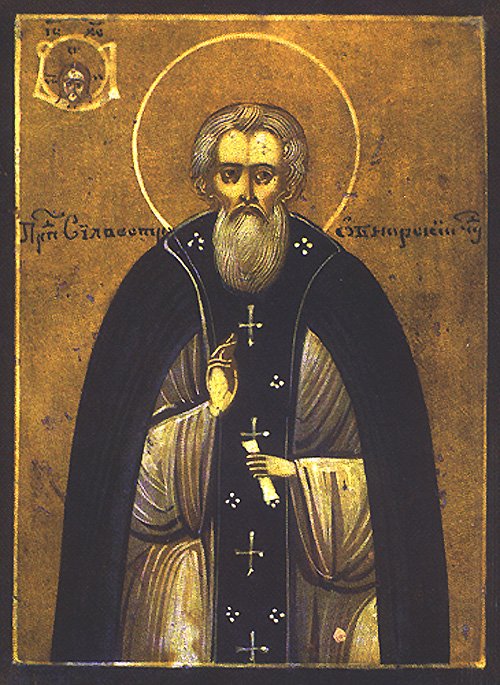
There is an icon from the XVII century, on which Saint Sylvester is depicted holding a scroll in his hand; On the scroll is part of the text of his will, which has come down to us.
Soon after the Saint's death, at the place of his spiritual conversations, a chapel was built, around which Cross Processions took place annually on the holy ascetic's Feast Day. The Saint's burial place was especially venerated, because miraculous healings took place at his tomb. Like other northern monasteries, the Resurrection Monastery was repeatedly devastated: in 1538 the Kazan Tatars attacked, in 1612 it was laid waste by the Poles. By 1647, the destroyed monastery was restored. In 1656, with the blessing of Patriarch Nikon, instead of a wooden chapel over the tomb of Saint Sylvester, a church was built in honor of the Protection of the Most Holy Theotokos. In 1764, the Monastery was abolished, and its cathedral church was turned into a parish church. church. In 1821, Archbishop Philaret of Yaroslavl (later Metropolitan of Moscow) sent a gramota blessing the construction of a stone church instead of the wooden church of the Protection–Resurrection Church, which was completed in 1825. In one of the chapels of the Resurrection church, the incorrupt relics of Saint Sylvester were placed in a bronze silver-plated tomb. In 1860 Saint Sylvester again caused people to remember him by means of several miraculous signs, a description of which was printed in the Yaroslavl and Vologda diocesan gazettes for 1860–1870.
The Saint's relics were lost in the 1920s, during a campaign to open his relics. Shortly thereafter, the church was closed. At present, his relics have been returned to the church, and services are being conducted in it.
Troparion - Tone 4
As a good disciple of the blessed Sergius, you emulated his faith and godliness, / receiving the gifts of the Holy Spirit and, for the Lord's sake, / you made great efforts for the salvation and consolation of the faithful. / Do not forsake us who come to you with faith, / O Venerable Father Sylvester.
Kontakion - Tone 6
By your struggles you have contested,1 and you brought your soul as a pure and unblemished sacrifice to God,2 / after your repose you are diligent for us before God in prayer; / therefore, turning to you with faith, we cry out: / “Rejoice, O Venerable Father Sylvester.”1 2 Timothy 4:7 “I have fought the good fight, I have finished the course.”
2 Romans 12:1 “Therefore, I beseech you, brethren, through the compassions of God, to present your bodies as a living sacrifice, holy and well-pleasing to God, which is your reasonable worship.”
Constantinople Icon of the Mother of God
The Constantinople Icon of the Theotokos is locally venerated at Moscow’s Dormition church on Malaya Dimitrovka. This image is different from the Constantinople Icon of the Most Holy Theotokos celebrated on September 17, although it appears to be a copy of it. The wonderworking Constantinople Icon appeared on April 25, 1071.
Scripture Readings
☩Epistle
Acts 5:21-33
21
And when they heard that, they entered into the temple early in the morning, and taught. But the high priest came, and they that were with him, and called the council together, and all the senate of the children of Israel, and sent to the prison to have them brought.
22
But when the officers came, and found them not in the prison, they returned, and told,
23
Saying, The prison truly found we shut with all safety, and the keepers standing without before the doors: but when we had opened, we found no man within.
24
Now when the high priest and the captain of the temple and the chief priests heard these things, they doubted of them whereunto this would grow.
25
Then came one and told them, saying, Behold, the men whom ye put in prison are standing in the temple, and teaching the people.
26
Then went the captain with the officers, and brought them without violence: for they feared the people, lest they should have been stoned.
27
And when they had brought them, they set them before the council: and the high priest asked them,
28
Saying, Did not we straitly command you that ye should not teach in this name? and, behold, ye have filled Jerusalem with your doctrine, and intend to bring this man’s blood upon us.
29
Then Peter and the other apostles answered and said, We ought to obey God rather than men.
30
The God of our fathers raised up Jesus, whom ye slew and hanged on a tree.
31
Him hath God exalted with his right hand to be a Prince and a Saviour, for to give repentance to Israel, and forgiveness of sins.
32
And we are his witnesses of these things; and so is also the Holy Ghost, whom God hath given to them that obey him.
33
When they heard that, they were cut to the heart, and took counsel to slay them.
☩Gospel
John 6:14-27
14
Then those men, when they had seen the miracle that Jesus did, said, This is of a truth that prophet that should come into the world.
15
When Jesus therefore perceived that they would come and take him by force, to make him a king, he departed again into a mountain himself alone.
16
And when even was now come, his disciples went down unto the sea,
17
And entered into a ship, and went over the sea toward Capernaum. And it was now dark, and Jesus was not come to them.
18
And the sea arose by reason of a great wind that blew.
19
So when they had rowed about five and twenty or thirty furlongs, they see Jesus walking on the sea, and drawing nigh unto the ship: and they were afraid.
20
But he saith unto them, It is I; be not afraid.
21
Then they willingly received him into the ship: and immediately the ship was at the land whither they went.
22
The day following, when the people which stood on the other side of the sea saw that there was none other boat there, save that one whereinto his disciples were entered, and that Jesus went not with his disciples into the boat, but that his disciples were gone away alone;
23
(Howbeit there came other boats from Tiberias nigh unto the place where they did eat bread, after that the Lord had given thanks:)
24
When the people therefore saw that Jesus was not there, neither his disciples, they also took shipping, and came to Capernaum, seeking for Jesus.
25
And when they had found him on the other side of the sea, they said unto him, Rabbi, when camest thou hither?
26
Jesus answered them and said, Verily, verily, I say unto you, Ye seek me, not because ye saw the miracles, but because ye did eat of the loaves, and were filled.
27
Labour not for the meat which perisheth, but for that meat which endureth unto everlasting life, which the Son of man shall give unto you: for him hath God the Father sealed.
Liturgical data sourced from OCA.org and orthocal.info