Fasting Rules
 Meat
Allowed
Meat
Allowed
 Fish
Allowed
Fish
Allowed
 Dairy
Allowed
Dairy
Allowed
 Oil
Allowed
Oil
Allowed
 Wine
Allowed
Wine
Allowed
Saints & Commemorations
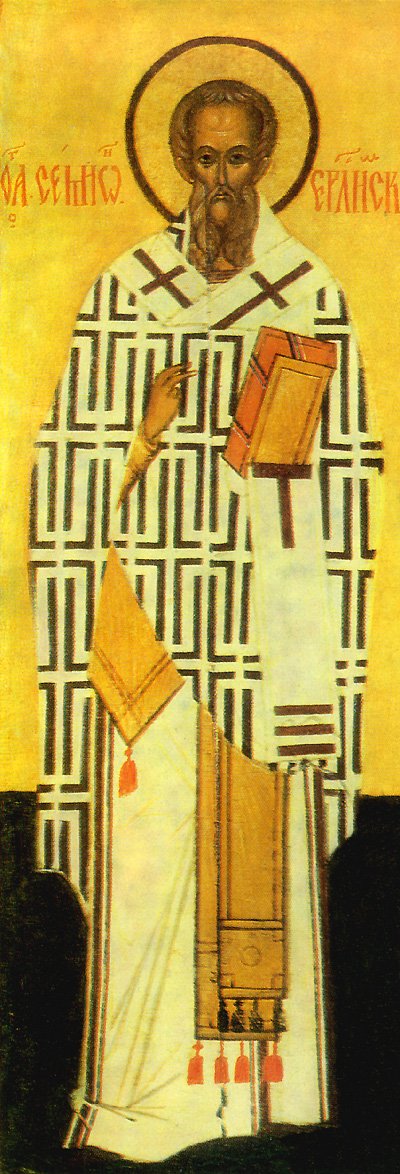
Hieromartyr Simeon, kinsman of the Lord, second Bishop of Jerusalem
The Holy Apostle and Hieromartyr Simeon, a kinsman of the Lord, was the son of Cleopas, who was the younger brother of Saint Joseph the Betrothed. Thus, Saint Simeon is Joseph's nephew, and a cousin of the Lord. As an adult, he witnessed the miracles of the Lord Jesus Christ, believed in Him, and became one of the 70 Apostles.
The Holy Apostle and Hieromartyr Simeon, a kinsman of the Lord, was the son of Cleopas, who was the younger brother of Saint Joseph the Betrothed. Thus, Saint Simeon is Joseph's nephew, and a cousin of the Lord. As an adult, he witnessed the miracles of the Lord Jesus Christ, believed in Him, and became one of the 70 Apostles. Saint Simeon proclaimed the teachings of Christ, was instructed in the truths of the holy Faith, and denounced idol worship. After the murder of the Holy Apostle James (October 23), the first Bishop of Jerusalem, Christians chose the Apostle Simeon to succeed him.
The Emperors Vespasian and Domitian had ordered that all descendants of King David be put to death. Emperor Trajan (98-117) renewed that decree, and certain heretics and some others denounced Saint Simeon as a descendant of King David, as well as a Christian.
The pagans arrested Saint Simeon, who at that time was more than one hundred and twenty years old. He astonished the judge and his attendants by enduring several days of torture, and then he was crucified in the year 107, during Trajan's reign, when Atticus was consul.
The Parisian Codices contain a Service in honor of Saint Simeon, the poem of the hymnographer Theophanēs. (Some Synaxaristes also commemorate him on September 18).
Troparion - Tone 1
The Church glorifies you as a kinsman of Christ, O Hierarch Simeon, / and as a steadfast martyr, for
courageously you destroyed all deceptions and preserved the Faith. / Therefore, we celebrate your
holy memory today, / and by your prayers, we receive the remission of our sins.
Kontakion - Tone 2
As one who has become a citizen of Zion on high, / you had been ordained to the throne of Zion below. / You guided your flock to the heavenly sheepfold, blessed Simeon, / and for the sake of Christ, you were crucified, / imitating His passion.
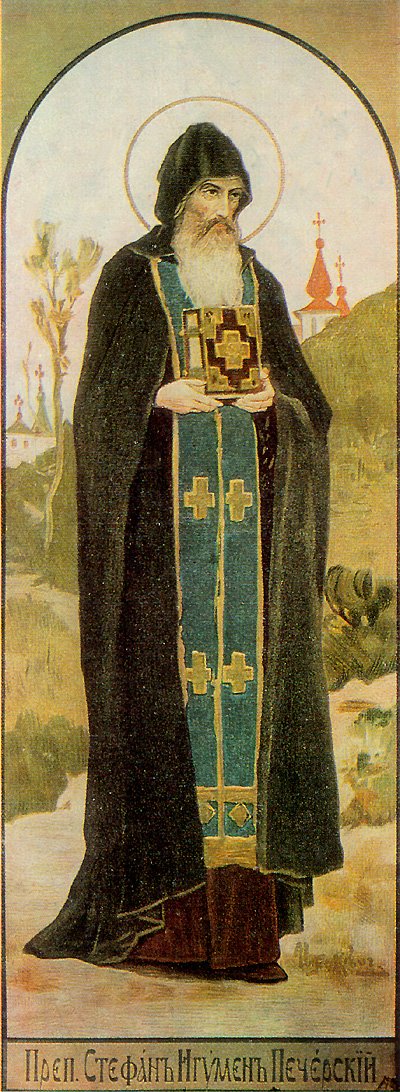
Venerable Stephen, Abbot of the Kiev Far Caves, and Bishop of Vladimir, in Volhynia
Saint Stephen, Igumen of the Caves, Bishop of Vladimir in Volhynia, pursued asceticism at the Kiev Caves monastery under the guidance of Saint Theodosius (May 3). Saint Theodosius sometimes entrusted him to exhort the brethren with edifying words.
Before the death of Saint Theodosius the monks asked him to appoint Saint Stephen as Igumen, who was the domesticus (chief arranger for the choir).
Saint Stephen, Igumen of the Caves, Bishop of Vladimir in Volhynia, pursued asceticism at the Kiev Caves monastery under the guidance of Saint Theodosius (May 3). Saint Theodosius sometimes entrusted him to exhort the brethren with edifying words.
Before the death of Saint Theodosius the monks asked him to appoint Saint Stephen as Igumen, who was the domesticus (chief arranger for the choir). “He grew up under your instruction,” they said, “and he served you. Give him to us.” So Saint Theodosius transferred the guidance of the monastery to Saint Stephen.
During his tenure as Superior, he laid the foundations of a spacious church in honor of the Dormition of the Most Holy Theotokos, begun under Saint Theodosius. The cells of the brethren were moved near the new church. At the front of the place there were several cells for monks who were entrusted with burying the dead. They served the Divine Liturgy each day, and also commemorated the dead.
In 1078 Saint Stephen was removed from office and driven from the monastery through the malice of an evil monk. He endured this meekly and without bitterness, and continued to pray for those who had turned against him.
Saint Stephen learned that master builders had come from Greece with an icon of the Theotokos, and they told him of the appearance of the Heavenly Queen at Blachernae. Because of this, Saint Stephen also built a church at Klovo in honor of the Theotokos (in memory of the Placing of Her Robe at Blachernae). The monastery was founded in thanksgiving for solicitude of the Most Holy Theotokos for the Caves monastery.
In 1091 Saint Stephen was made Bishop of Vladimir in Volhynia, and he participated in the transfer of the relics of Saint Theodosius from the cave to the monastery (August 14). He also labored to convert the inhabitants of Volhynia to Christianity.
Saint Stephen died on April 27, 1094 during the sixth hour of the night.
Troparion - Tone 8
By a flood of tears you made the desert fertile, / and your longing for God brought forth fruits in abundance. / By the radiance of miracles you illumined the whole universe! / O our holy father Stephen, pray to Christ our God to save our souls!
Saint Eulogius the Hospitable of Constantinople
Saint Eulogios lived in the Thebaid, in Egypt, and his occupation was that of a quarryman (stone cutter). He was called the Xenodokhos (one who receives strangers), because during his life, his greatest concern and pleasure was to offer hospitality in his home, and to provide every assistance to the poor and to pilgrims.
Saint Eulogios lived in the Thebaid, in Egypt, and his occupation was that of a quarryman (stone cutter). He was called the Xenodokhos (one who receives strangers), because during his life, his greatest concern and pleasure was to offer hospitality in his home, and to provide every assistance to the poor and to pilgrims.
Despite his heavy and laborious work, each evening, as soon as he finished his work, he would run to the marketplace, holding a lantern in the winter, and went looking for strangers, to offer them shelter and every other hospitality. He once hosted Abba Daniel (June 7) and his disciple, when they came to the city and were left without food and shelter.
Saint Eulogios lived for over a hundred years, benefiting his fellow men (Mark 9:41), and he reposed in peace during the VI century. As his name indicates, he was truly a most blessed man.
The Burning of Saint Sava's relics
After his death in Trnovo, Bulgaria on January 14, 1235 Saint Savva was buried in the
Cathedral of the Forty Martyrs. On May 6, 1237 his relics were carried in procession from Trnovo to Mileshevo Monastery in Serbia. When the casket was opened, the relics were found to be incorrupt, and produced an ineffable fragrance.
After his death in Trnovo, Bulgaria on January 14, 1235 Saint Savva was buried in the
Cathedral of the Forty Martyrs. On May 6, 1237 his relics were carried in procession from Trnovo to Mileshevo Monastery in Serbia. When the casket was opened, the relics were found to be incorrupt, and produced an ineffable fragrance. In 1253, the Serbian Orthodox Church glorified the holy hierarch Savva as a Saint.
Following the Battle of Kosovo on June 25, 1389, the Serbian nation fell under the Turkish Yoke. During this period the Serbs continued to visit the tomb of Saint Savva, asking him to give them the strength to endure the oppressive persecution they suffered at the hands of the Turks. His icon was placed on their flags, and the faithful turned to the Saint for encouragement, consolation, and healing.
The Serbs revolted in 1595, led by Patriarch John Kantul and others. Sinan Pasha, the Turkish military leader in Belgrade, sent soldiers to crush the rebellion. Sultan Mohammed II ordered that the relics of Saint Savva be burnt. On Great and Holy Friday, the Turks removed the Saint's relics from Mileshevo Monastery. The next day, April 27, they climbed Savinac Hill in the Vrachar district and set fire to the holy relics.
Instead of becoming despondent, the Serbs were inspired to even greater love for Christ, for Holy Orthodoxy, and for Saint Savva. Although the Saint's relics had been destroyed, the people continued to venerate him, and to remember the burning of his relics every year.
After national independence in 1879, there was a proposal to build a memorial church in honor of Saint Savva. In 1895, the three hundredth anniversary of the burning of Saint Savva's relics, plans were made to build a church on the site where his relics were burnt. A temporary chapel was constructed the following year, but it was not possible to build a large cathedral until after World War I. In 1927, Patriarch Barnabas announced a competition for architects to submit designs for the cathedral. In 1935, architects were chosen and construction began.
During World War II, work was halted when the Communists seized power. Only in 1984 did Patriarch German receive government approval to resume construction. On June 25, 1989, Patriarch German served the first Divine Liturgy in Saint Savva's Memorial Cathedral, which towers over the city of Belgrade.
There is a famous Serbian saying: "Sinan Pasha lit the flames, Savva's body burned, but Savva's memory and his glory did not burn."
Scripture Readings
☩Epistle
Acts 6:8-7:5, 47-60
8
And Stephen, full of faith and power, did great wonders and miracles among the people.
9
Then there arose certain of the synagogue, which is called the synagogue of the Libertines, and Cyrenians, and Alexandrians, and of them of Cilicia and of Asia, disputing with Stephen.
10
And they were not able to resist the wisdom and the spirit by which he spake.
11
Then they suborned men, which said, We have heard him speak blasphemous words against Moses, and against God.
12
And they stirred up the people, and the elders, and the scribes, and came upon him, and caught him, and brought him to the council,
13
And set up false witnesses, which said, This man ceaseth not to speak blasphemous words against this holy place, and the law:
14
For we have heard him say, that this Jesus of Nazareth shall destroy this place, and shall change the customs which Moses delivered us.
15
And all that sat in the council, looking stedfastly on him, saw his face as it had been the face of an angel.
1
Then said the high priest, Are these things so?
2
And he said, Men, brethren, and fathers, hearken; The God of glory appeared unto our father Abraham, when he was in Mesopotamia, before he dwelt in Charran,
3
And said unto him, Get thee out of thy country, and from thy kindred, and come into the land which I shall shew thee.
4
Then came he out of the land of the Chaldeans, and dwelt in Charran: and from thence, when his father was dead, he removed him into this land, wherein ye now dwell.
5
And he gave him none inheritance in it, no, not so much as to set his foot on: yet he promised that he would give it to him for a possession, and to his seed after him, when as yet he had no child.
47
But Solomon built him an house.
48
Howbeit the most High dwelleth not in temples made with hands; as saith the prophet,
49
Heaven is my throne, and earth is my footstool: what house will ye build me? saith the Lord: or what is the place of my rest?
50
Hath not my hand made all these things?
51
Ye stiffnecked and uncircumcised in heart and ears, ye do always resist the Holy Ghost: as your fathers did, so do ye.
52
Which of the prophets have not your fathers persecuted? and they have slain them which shewed before of the coming of the Just One; of whom ye have been now the betrayers and murderers:
53
Who have received the law by the disposition of angels, and have not kept it.
54
When they heard these things, they were cut to the heart, and they gnashed on him with their teeth.
55
But he, being full of the Holy Ghost, looked up stedfastly into heaven, and saw the glory of God, and Jesus standing on the right hand of God,
56
And said, Behold, I see the heavens opened, and the Son of man standing on the right hand of God.
57
Then they cried out with a loud voice, and stopped their ears, and ran upon him with one accord,
58
And cast him out of the city, and stoned him: and the witnesses laid down their clothes at a young man’s feet, whose name was Saul.
59
And they stoned Stephen, calling upon God, and saying, Lord Jesus, receive my spirit.
60
And he kneeled down, and cried with a loud voice, Lord, lay not this sin to their charge. And when he had said this, he fell asleep.
☩Gospel
John 4:46-54
46
So Jesus came again into Cana of Galilee, where he made the water wine. And there was a certain nobleman, whose son was sick at Capernaum.
47
When he heard that Jesus was come out of Judea into Galilee, he went unto him, and besought him that he would come down, and heal his son: for he was at the point of death.
48
Then said Jesus unto him, Except ye see signs and wonders, ye will not believe.
49
The nobleman saith unto him, Sir, come down ere my child die.
50
Jesus saith unto him, Go thy way; thy son liveth. And the man believed the word that Jesus had spoken unto him, and he went his way.
51
And as he was now going down, his servants met him, and told him, saying, Thy son liveth.
52
Then enquired he of them the hour when he began to amend. And they said unto him, Yesterday at the seventh hour the fever left him.
53
So the father knew that it was at the same hour, in the which Jesus said unto him, Thy son liveth: and himself believed, and his whole house.
54
This is again the second miracle that Jesus did, when he was come out of Judea into Galilee.
Liturgical data sourced from OCA.org and orthocal.info