Fasting Rules
 Meat
Allowed
Meat
Allowed
 Fish
Allowed
Fish
Allowed
 Dairy
Allowed
Dairy
Allowed
 Oil
Allowed
Oil
Allowed
 Wine
Allowed
Wine
Allowed
Saints & Commemorations
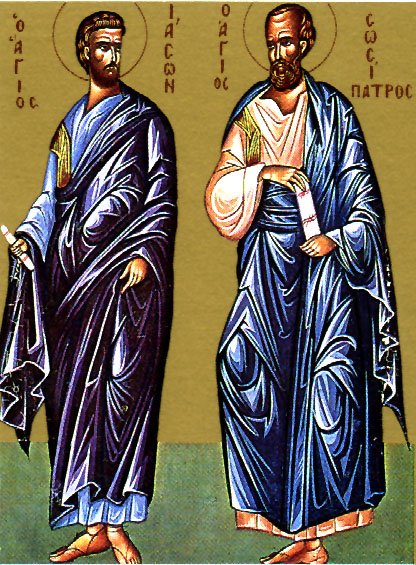
Apostles Jason and Sosipater of the Seventy, the Virgin Kerkyra, and those with them
The Apostle Jason was from Tarsus (Asia Minor). He was the first Christian in the city. The Apostle Sosipater was a native of Patra, Achaia. He is thought to be the same Sosipater mentioned in Acts 20:4. They both became disciples of Saint Paul, who even called them his kinsmen (Rom 16:21). Saint John Chrysostom (Homily 32 on Romans) says that this is the same Jason who is mentioned in Acts 17:5-9.
The Apostle Jason was from Tarsus (Asia Minor). He was the first Christian in the city. The Apostle Sosipater was a native of Patra, Achaia. He is thought to be the same Sosipater mentioned in Acts 20:4. They both became disciples of Saint Paul, who even called them his kinsmen (Rom 16:21). Saint John Chrysostom (Homily 32 on Romans) says that this is the same Jason who is mentioned in Acts 17:5-9. Saint Jason was made bishop in his native city of Tarsus, and Saint Sosipater in Iconium. They traveled west preaching the Gospel, and in 63 they reached the island of Kerkyra [Korfu] in the Ionian Sea near Greece.
There they built a church in the name of the Protomartyr Stephen and they baptized many. The governor of the island learned of this and locked them up in prison, where they met seven thieves: Saturninus, Iakischolus, Faustianus, Januarius, Marsalius, Euphrasius and Mammius. The Apostles converted them to Christ. For their confession of Christ, the seven prisoners died as martyrs in a cauldron of molten tar, wax and sulfur.
The prison guard, after witnessing their martyrdom, declared himself a Christian. For this they cut off his left hand, then both feet and finally his head. The governor ordered the Apostles Jason and Sosipater to be whipped and again locked up in prison.
When the daughter of the governor of Kerkyra (Korfu), the maiden Kerkyra, learned how Christians were suffering for Christ, she declared herself a Christian and gave away all her finery to the poor. The infuriated governor attempted to persuade his daughter to deny Christ, but Saint Kerkyra stood firm against both persuasion and threats. Then the enraged father devised a terrible punishment for his daughter: he gave orders that she be placed in a prison cell with the robber and murderer Murinus, so that he might defile the betrothed of Christ
But when the robber approached the door of the prison cell, a bear attacked him. Saint Kerkyra heard the noise and she drove off the beast in the name of Christ. Then, by her prayers, she healed the wounds of Murinus. Then Saint Kerkyra enlightened him with the faith of Christ, and Saint Murinus declared himself a Christian and was executed.
The governor gave orders to burn down the prison, but the holy virgin remained alive. Then on her enraged father’s order, she was suspended upon a tree, choked with bitter smoke and shot with arrows. After her death, the governor decided to execute all the Christians on the island of Kerkyra. The Martyrs Zeno, Eusebius, Neon and Vitalis, after being enlightened by Saints Jason and Sosipater, were burned alive.
The inhabitants of Kerkyra, escaping from the persecution, crossed to an adjoining island. The governor set sail with a detachment of soldiers, but was swallowed up by the waves. The governor succeeding him gave orders to throw the Apostles Jason and Sosipater into a cauldron of boiling tar. When he beheld them unharmed, he cried out with tears, “O God of Jason and Sosipater, have mercy on me!”
Having been set free, the Apostles baptized the governor and gave him the name Sebastian. With his help, the Apostles Jason and Sosipater built several churches on the island, and increased the flock of Christ by their fervent preaching. They lived there until they reached old age.
Troparion - Tone 3
O holy Apostles Jason and Sosipater, / pray to the merciful God, / that He may grant to our souls / remission of our transgressions.
Kontakion - Tone 2
O Jason, source of healing, / and Sosipater, glory of the martyrs of Christ: / You were enlightened by the preaching of Paul, / both becoming a great consolation to the world through your miracles. / Thrice-holy and God-bearing Apostles and defenders of those who suffer, / intercede with Christ God that He may save our souls.
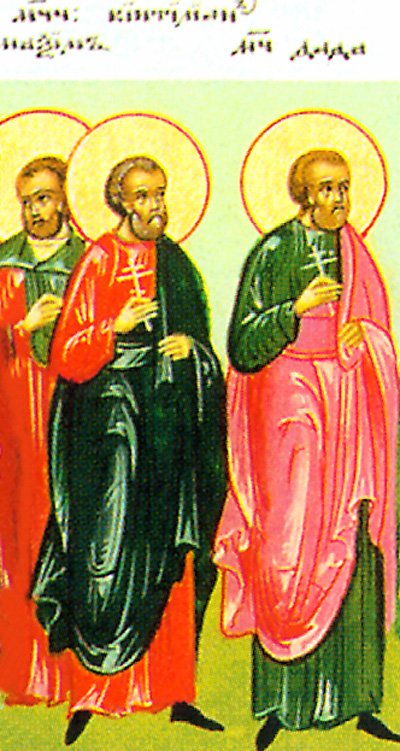
Martyrs Dada, Maximus, and Quinctilian, at Dorostolum
The Martyrs Dada, Maximus and Quinctilian suffered under the emperor Diocletian (284-305), who issued a decree requiring everyone to offer sacrifice to the pagan gods during the public festivals, and to put Christians to death.
Tarquinius and Gabinius, the emperor’s representatives in Dorostolum, made a sumptuous feast, attended not only by the inhabitants of the city, but also people from the surrounding villages.
The Martyrs Dada, Maximus and Quinctilian suffered under the emperor Diocletian (284-305), who issued a decree requiring everyone to offer sacrifice to the pagan gods during the public festivals, and to put Christians to death.
Tarquinius and Gabinius, the emperor’s representatives in Dorostolum, made a sumptuous feast, attended not only by the inhabitants of the city, but also people from the surrounding villages.
After the festivities, someone reported to the emperor that three brothers, Dada, Maximus and Quinctilian, did not obey the imperial decree and withdrew themselves into the Ozovia forest. Soldiers were sent after them, who caught the holy brothers at prayer and led them forth for trial.
The governors interrogated the brothers, who confessed themselves Christians. Tarquinius offered to make Saint Maximus a pagan priest of Zeus, but the saint called Zeus a foul adulterer and again confessed the True God.
Tarquinius attempted to reason with Saints Dada and Quinctilian. They said that their brother was well versed in the Holy Scripture and they would follow him in everything. They threw the martyrs into prison, but they thought only of the salvation of their souls. At midnight when the saints were asleep, the devil appeared to them. When the martyrs woke, they beheld an angel who said, “Fear not, for God your hope brings you to Himself. He is not far from you and will sustain you.”
In the morning, Tarquinius told the brothers that the gods had revealed their will to him in a dream: they were to be put to death if they did not offer sacrifice. The martyrs answered that the Lord had commanded them to endure torments for His sake.
The tortures and interrogations continued for several days from morning to evening. Finally, they sentenced the martyrs to death, led them out under guard to their forest and beheaded them with a sword.
Troparion - Tone 4
Your holy martyrs Dada, Maximus, and Quinctilian, O Lord, / through their sufferings have received incorruptible crowns from You, our God. / For having Your strength, they laid low their adversaries, / and shattered the powerless boldness of demons. / Through their intercessions, save our souls!
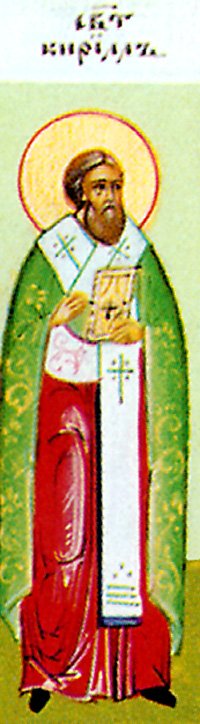
Saint Cyril, Bishop of Turov
Saint Cyril, Bishop of Turov, was born of rich parents in the thirties of the twelfth century in the city of Turov at the River Pripyat.
From his early years Saint Cyril eagerly read the sacred books and attained a profound understanding of them. He studied not only in Russian, but also in Greek. When he reached maturity Saint Cyril refused his inheritance and was tonsured in Turov’s Saint Boris and Gleb monastery. H
Saint Cyril, Bishop of Turov, was born of rich parents in the thirties of the twelfth century in the city of Turov at the River Pripyat.
From his early years Saint Cyril eagerly read the sacred books and attained a profound understanding of them. He studied not only in Russian, but also in Greek. When he reached maturity Saint Cyril refused his inheritance and was tonsured in Turov’s Saint Boris and Gleb monastery. He struggled much in fasting and prayer and taught the monks to obey the igumen. A monk who is not obedient to the igumen does not fulfill his vow, and therefore is not able to be saved.
Three writings of Saint Cyril on monastic life have survived, one of which, “A Narrative on the Black Clergy from the Old Law and from the New,” may be ascribed to a period of his being in the monastery.
After a certain while Saint Cyril lived on a pillar, where he increased his asceticism, and meditated on the Holy Scripture. Many turned to him for counsel in the spiritual life.
Saint Cyril’s holiness of life and profound enlightenment became known to many, and so he was chosen as Bishop of Turov. In 1169 Saint Cyril took part in a council censuring Bishop Theodore, who occupied the Vladimir-Suzdal cathedra and who sought to separate from the metropolitanate of Kiev. Saint Cyril denounced the heresy of Theodore and wrote many letters to the holy prince Andrew Bogoliubsky (July 4), in which he provided him instruction and guidance in discovering the cause of church disorders in the Rostov region.
Because of his love for solitude, Saint Cyril left his See (by the year 1182, Bishop Laurence is mentioned as the Bishop of Turov) and he devoted himself fully to spiritual writing. He composed a discourse on the yearly cycle of the Lord’s Feasts, but not all of them have been preserved. The works of Saint Cyril deserve a place beside the works of the holy Fathers in book collections.
The most complete collection of works by Saint Cyril of Turov, published by Bishop Eugenius of Turov in 1880, includes:
Sermon on Palm Sunday, from Gospel accounts
Sermon on Holy Pascha on the Radiant Day of the Resurrection of Christ, from the prophetic accounts
Sermon on the Sunday after Pascha, on the Renewal of the Resurrection, on the Artos [loaf blessed on Pascha], and on Thomas Touching the Side of the Lord
Sermon on Taking down the Body of Christ and on the Myrrh-bearing Women, from the Gospel account, and in praise of Joseph on the Third Sunday After Pascha
Sermon on the Paralytic from Genesis and from the Gospel account, on the Fourth Sunday After Pascha
Sermon on the Blind man and the enmity of the Jews from the Gospel account, on the Fourth Sunday After Pascha
Sermon on the Ascension of the Lord, on Thursday of the Sixth Week After Pascha, from prophetic decrees, and on Raising the Race of Adam from Hades
Sermon on the Holy 318 Fathers, from the Holy Books, on Christ the Son of God, and in praise of the Fathers of the Holy Council of Nicea, on the Sunday Before Pentecost
Parable on the Blind and the Lame
Parable on the Human Soul, and on the Body, and on Breaking God’s Commandments, and on the Resurrection of the Human Body, and on the Future Judgment, and on the Torment
Narrative on the Black Clergy, from the Old Testament and from the New, bearing a common form, and the accomplishing of this matter
To Igumen Basil: a Parable on the White Clergy, and on Monasticism, and on the Soul, and on Repentance
Letter of a certain Elder to the Blessed Archimandrite Basil on the Schema
Four Prayers on Sunday (after Matins, Hours, and two after Vespers)
Five Prayers on Wednesday (after Matins, Hours, and three after Vespers)
Three Prayers on Thursday (after Matins, Hours, Vespers)
Four Prayers on Friday (after Matins, Hours, and two after Vespers)
Six Prayers on Saturday (two after Matins, one after Hours, and three after Vespers)
Later, the “Sermon on the Enlightenment of our Lord Jesus Christ” was discovered. The saint also composed a “Great Canon of Repentance to the Lord in Alphabetic Chapters.” As a theologian Saint Cyril believed his task was to discern the true and hidden meaning of various texts of Holy Scripture.
Saint Cyril died on April 28, 1183. His contemporaries regarded him as a Russian Chrysostom. The saint humbly wrote of himself: “I am not a harvester, but I gather sheaves of grain; I am not an artist in literary matters.” He was always conscious of the sublime hierarchical service to which the Lord had called him: “If I were to speak of my own opinions, you would do well not to come to church, but I proclaim to you the Word of God. I read to you the accounts of Christ. I present to you the words of God, finer than gold or other stones, sweeter than mead or honeycomb, and you would be deprived of them by not coming to church, ... but I praise and bless those of you who do come.”
Troparion - Tone 4
In truth you were revealed to your flock as a rule of faith, / an image of humility and a teacher of abstinence; / your humility exalted you; / your poverty enriched you. / Hierarch Father Cyril, / entreat Christ our God / that our souls may be saved.
Scripture Readings
☩Epistle
Acts 8:5-17
5
Then Philip went down to the city of Samaria, and preached Christ unto them.
6
And the people with one accord gave heed unto those things which Philip spake, hearing and seeing the miracles which he did.
7
For unclean spirits, crying with loud voice, came out of many that were possessed with them: and many taken with palsies, and that were lame, were healed.
8
And there was great joy in that city.
9
But there was a certain man, called Simon, which beforetime in the same city used sorcery, and bewitched the people of Samaria, giving out that himself was some great one:
10
To whom they all gave heed, from the least to the greatest, saying, This man is the great power of God.
11
And to him they had regard, because that of long time he had bewitched them with sorceries.
12
But when they believed Philip preaching the things concerning the kingdom of God, and the name of Jesus Christ, they were baptized, both men and women.
13
Then Simon himself believed also: and when he was baptized, he continued with Philip, and wondered, beholding the miracles and signs which were done.
14
Now when the apostles which were at Jerusalem heard that Samaria had received the word of God, they sent unto them Peter and John:
15
Who, when they were come down, prayed for them, that they might receive the Holy Ghost:
16
(For as yet he was fallen upon none of them: only they were baptized in the name of the Lord Jesus.)
17
Then laid they their hands on them, and they received the Holy Ghost.
☩Gospel
John 6:27-33
27
Labour not for the meat which perisheth, but for that meat which endureth unto everlasting life, which the Son of man shall give unto you: for him hath God the Father sealed.
28
Then said they unto him, What shall we do, that we might work the works of God?
29
Jesus answered and said unto them, This is the work of God, that ye believe on him whom he hath sent.
30
They said therefore unto him, What sign shewest thou then, that we may see, and believe thee? what dost thou work?
31
Our fathers did eat manna in the desert; as it is written, He gave them bread from heaven to eat.
32
Then Jesus said unto them, Verily, verily, I say unto you, Moses gave you not that bread from heaven; but my Father giveth you the true bread from heaven.
33
For the bread of God is he which cometh down from heaven, and giveth life unto the world.
Liturgical data sourced from OCA.org and orthocal.info