Fasting Rules
 Meat
Allowed
Meat
Allowed
 Fish
Allowed
Fish
Allowed
 Dairy
Allowed
Dairy
Allowed
 Oil
Allowed
Oil
Allowed
 Wine
Allowed
Wine
Allowed
Saints & Commemorations
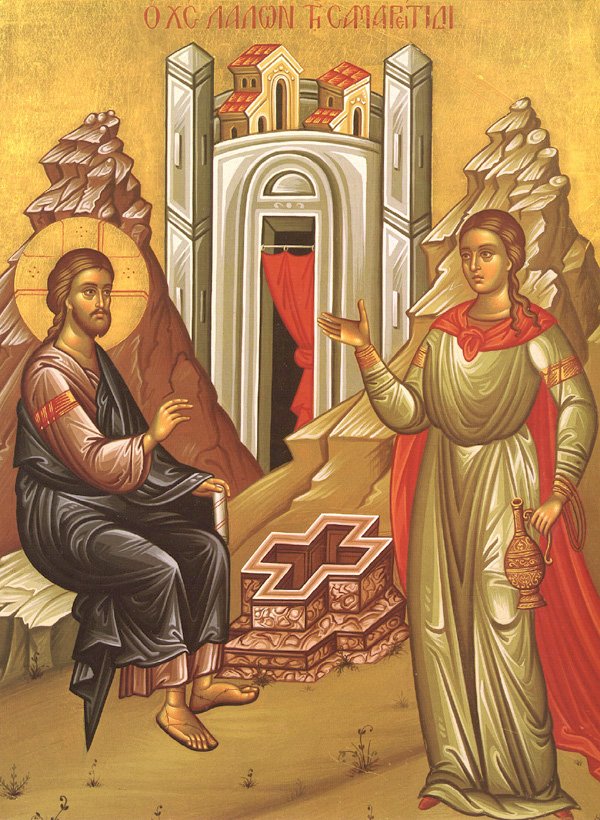
Sunday of the Samaritan Woman
The Holy Martyr Photina (Svetlana) the Samaritan Woman, her sons Victor (named Photinus) and Joses; and her sisters Anatola, Phota, Photis, Paraskevḗ, Kyriake; Nero’s daughter Domnina; and the Martyr Sebastian: The holy Martyr Photina was the Samaritan Woman, with whom the Savior conversed at Jacob’s Well (John. 4:5-4
The Holy Martyr Photina (Svetlana) the Samaritan Woman, her sons Victor (named Photinus) and Joses; and her sisters Anatola, Phota, Photis, Paraskevḗ, Kyriake; Nero’s daughter Domnina; and the Martyr Sebastian: The holy Martyr Photina was the Samaritan Woman, with whom the Savior conversed at Jacob’s Well (John. 4:5-42).
During the time of the emperor Nero (54-68), who displayed excessive cruelty against Christians, Saint Photina lived in Carthage with her younger son Joses and fearlessly preached the Gospel there. Her eldest son Victor fought bravely in the Roman army against barbarians, and was appointed military commander in the city of Attalia (Asia Minor). Later, Nero called him to Italy to arrest and punish Christians.
Sebastian, an official in Italy, said to Saint Victor, “I know that you, your mother and your brother, are followers of Christ. As a friend I advise you to submit to the will of the emperor. If you inform on any Christians, you will receive their wealth. I shall write to your mother and brother, asking them not to preach Christ in public. Let them practice their faith in secret.”
Saint Victor replied, “I want to be a preacher of Christianity like my mother and brother.” Sebastian said, “O Victor, we all know what woes await you, your mother and brother.” Then Sebastian suddenly felt a sharp pain in his eyes. He was dumbfounded, and his face was somber.
For three days he lay there blind, without uttering a word. On the fourth day he declared, “The God of the Christians is the only true God.” Saint Victor asked why Sebastian had suddenly changed his mind. Sebastian replied, “Because Christ is calling me.” Soon he was baptized, and immediately regained his sight. Saint Sebastian’s servants, after witnessing the miracle, were also baptized.
Reports of this reached Nero, and he commanded that the Christians be brought to him at Rome. Then the Lord Himself appeared to the confessors and said, “Fear not, for I am with you. Nero, and all who serve him, will be vanquished.” The Lord said to Saint Victor, “From this day forward, your name will be Photinus, because through you, many will be enlightened and will believe in Me.” The Lord then told the Christians to strengthen and encourage Saint Sebastian to peresevere until the end.
All these things, and even future events, were revealed to Saint Photina. She left Carthage in the company of several Christians and joined the confessors in Rome.
At Rome the emperor ordered the saints to be brought before him and he asked them whether they truly believed in Christ. All the confessors refused to renounce the Savior. Then the emperor gave orders to smash the martyrs’ finger joints. During the torments, the confessors felt no pain, and their hands remained unharmed.
Nero ordered that Saints Sebastian, Photinus and Joses be blinded and locked up in prison, and Saint Photina and her five sisters Anatola, Phota, Photis, Paraskevḗ and Kyriake were sent to the imperial court under the supervision of Nero’s daughter Domnina. Saint Photina converted both Domnina and all her servants to Christ. She also converted a sorcerer, who had brought her poisoned food to kill her.
Three years passed, and Nero sent to the prison for one of his servants, who had been locked up. The messengers reported to him that Saints Sebastian, Photinus and Joses, who had been blinded, had completely recovered, and that people were visiting them to hear their preaching, and indeed the whole prison had been transformed into a bright and fragrant place where God was glorified.
Nero then gave orders to crucify the saints, and to beat their naked bodies with straps. On the fourth day the emperor sent servants to see whether the martyrs were still alive. But, approaching the place of the tortures, the servants fell blind. An angel of the Lord freed the martyrs from their crosses and healed them. The saints took pity on the blinded servants, and restored their sight by their prayers to the Lord. Those who were healed came to believe in Christ and were soon baptized.
In an impotent rage Nero gave orders to flay the skin from Saint Photina and to throw the martyr down a well. Sebastian, Photinus and Joses had their legs cut off, and they were thrown to dogs, and then had their skin flayed off. The sisters of Saint Photina also suffered terrible torments. Nero gave orders to cut off their breasts and then to flay their skin. An expert in cruelty, the emperor readied the fiercest execution for Saint Photis: they tied her by the feet to the tops of two bent-over trees. When the ropes were cut the trees sprang upright and tore the martyr apart. The emperor ordered the others beheaded. Saint Photina was removed from the well and locked up in prison for twenty days.
After this Nero had her brought to him and asked if she would now relent and offer sacrifice to the idols. Saint Photina spit in the face of the emperor, and laughing at him, said, “O most impious of the blind, you profligate and stupid man! Do you think me so deluded that I would consent to renounce my Lord Christ and instead offer sacrifice to idols as blind as you?”
Hearing such words, Nero gave orders to again throw the martyr down the well, where she surrendered her soul to God (ca. 66).
On the Greek Calendar, Saint Photina is commemorated on February 26.
Troparion
The Samaritan Woman came to the well in faith; / she saw You, the Water of Wisdom, and drank abundantly / she inherited the Kingdom on High and is ever glorified!
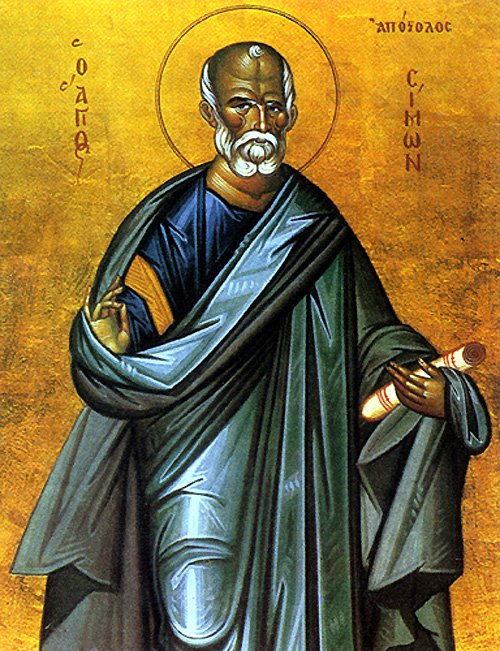
Apostle Simon the Zealot
Saint Simon was from Cana in Galilee, and was known to the Lord and His Mother. Tradition says that he was the bridegroom at the wedding where the Savior performed His first miracle. After witnessing the miracle of the water which had been turned into wine, he became a zealous follower of Christ. For this reason, he is known as Saint Simon the Zealot.
Saint Simon was from Cana in Galilee, and was known to the Lord and His Mother. Tradition says that he was the bridegroom at the wedding where the Savior performed His first miracle. After witnessing the miracle of the water which had been turned into wine, he became a zealous follower of Christ. For this reason, he is known as Saint Simon the Zealot.
Saint Simon was one of the twelve Apostles, and received the Holy Spirit with the others on Pentecost. He traveled to many places from Britain to the Black Sea, proclaiming the Gospel of Christ. After winning many pagans to the Lord, Saint Simon suffered martyrdom by crucifixion.
Saint Demetrius of Rostov says that this Saint Simon is to be distinguished from the Apostle Simon Peter, and from the Lord’s relative Simon (Mt.13:55), who was the second Bishop of Jerusalem.
Saint Simon is also commemorated on June 30 with the other Apostles.
Troparion - Tone 3
Holy Apostle Simon / entreat the merciful God / to grant our souls forgiveness of transgressions.
Kontakion - Tone 2
With praise let us all bless Simon, the herald of God, / who established the doctrines of wisdom securely in the souls of the pious. / Now he stands before the throne of glory, / and rejoicing with the angels, he unceasingly prays for us all.
Saint Simon, Bishop of Vladimir and Suzdal of the Kiev Near Caves
Saint Simon, Bishop of Vladimir and Suzdal was an author of the Kiev Caves Paterikon , and he became a monk at the Monastery of the Caves, sometime in the second half of the twelfth century.
In the year 1206 he was appointed igumen of the Vladimir Monastery of the Nativity of the Theotokos, and in 1214, at the wish of Prince George Vsevolodovich (+ 1238), he was made the first bishop of Vladimir-on-the-Klyazma and Suzdal.
Saint Simon, Bishop of Vladimir and Suzdal was an author of the Kiev Caves Paterikon , and he became a monk at the Monastery of the Caves, sometime in the second half of the twelfth century.
In the year 1206 he was appointed igumen of the Vladimir Monastery of the Nativity of the Theotokos, and in 1214, at the wish of Prince George Vsevolodovich (+ 1238), he was made the first bishop of Vladimir-on-the-Klyazma and Suzdal.
In 1218 he consecrated a church at the Nativity monastery, and in the year 1225, a cathedral church at Suzdal. The Great Prince, who deeply respected Saint Simon, was prepared to establish a new bishop’s See at Suzdal for his friend, the monk Polycarp of the Kiev Caves monastery, who sought after spiritual glory. Saint Simon, seeing that Polycarp was not yet ready to assume such an office, talked the Great Prince out of his idea, and he wrote a deeply moving letter to Polycarp, in which he offered his friend advice on overcoming his spiritual shortcomings. Saint Simon’s own inner life, character, and virtue are also revealed in the epistle.
Saint Simon was known as a learned teacher, and his epistle to Polycarp was placed at the beginning of the Kiev Caves Paterikon . On the eve of his repose in 1226, the saint received the schema.
Initially his body was buried at Vladimir, but later, in accordance with the saint’s last wishes, his body was transferred to the Kiev Caves Lavra, where it rests in the Antoniev Caves.
Troparion - Tone 4
In truth you were revealed to your flock as a rule of faith, / an image of humility and a teacher of abstinence; / your humility exalted you; / your poverty enriched you. / Hierarch Father Simeon, / entreat Christ our God / that our souls may be saved.
Martyrs Philadelphus, Cyprian, Alphius, Onesimus, Erasmus, and 14 others, in Sicily
The Holy Martyrs Philadelphus, Alphaeus, Cyprian, Onesimus, Erasmus and 14 others with them, lived during the third century and came from Italy. Alphaeus, Philadelphus and Cyprian were sons of a governor in Italy, named Vitalius. They were enlightened by faith in Christ and baptized by Saint Onesimus.
The Holy Martyrs Philadelphus, Alphaeus, Cyprian, Onesimus, Erasmus and 14 others with them, lived during the third century and came from Italy. Alphaeus, Philadelphus and Cyprian were sons of a governor in Italy, named Vitalius. They were enlightened by faith in Christ and baptized by Saint Onesimus.
During this period the emperor Licinius issued orders to seek out and hand over the Christians for torture. The brothers went to Rome together with Onesimus, Erasmus and fourteen other Christians. At Rome the pagans crushed the chest of Saint Onesimus with a heavy stone, which killed him. Erasmus and the fourteen Martyrs were beheaded.
The brothers Alphaeus, Philadelphus and Cyprian suffered in the city of Mesopolis Leontini in Sicily, where they had been sent from Rome. Saint Philadelphus was burned over an iron lattice in the year 251, in the reign of the emperor Decius.
In the year 1517 their incorrupt relics were discovered at Leontini [Lentini]. Saints Alphaeus, Philadelphus and Cyprian appeared to Saint Euthalia (March 2) and told her that she would be healed of an affliction after she was baptized.
Troparion - Tone 4
Your holy martyrs O Lord, / through their sufferings have received incorruptible crowns from You, our God. / For having Your strength, they laid low their adversaries, / and shattered the powerless boldness of demons. / Through their intercessions, save our souls!
Martyr Hesychius of Antioch
The Holy Martyr Hesychius of Antioch lived in Antioch during the reign of Maximian Galerius (305-311), and he occupied a high official position. Maximian issued an edict by which all Christians were to be deprived of military rank and expelled from military service. Those who would not renounce Christianity were stripped of their soldier’s belt and military insignia, and degraded to the level of hired servants. S
The Holy Martyr Hesychius of Antioch lived in Antioch during the reign of Maximian Galerius (305-311), and he occupied a high official position. Maximian issued an edict by which all Christians were to be deprived of military rank and expelled from military service. Those who would not renounce Christianity were stripped of their soldier’s belt and military insignia, and degraded to the level of hired servants. Saint Hesychius was one of these.
Maximian ordered Hesychius to remove his robes of office, put on common attire, and to be placed among the women servants. After several days he summoned Hesychius and asked, “Are you not ashamed to remain in such dishonor?” Saint Hesychius answered, “The honors which I had from you were only temporal.”
Then Maximian gave orders to drown Saint Hesychius in a river, with a millstone tied about his neck. The exact year of the martyr’s death is not known.
Troparion - Tone 3
Your holy martyr Hesychius, O Lord, / through his sufferings has received an incorruptible crown from You, our God. / For having Your strength, he laid low his adversaries, / and shattered the powerless boldness of demons. / Through his intercessions, save our souls!
Blessed Isidora the Fool of Tabenna in Egypt
Saint Isidora, Fool-for-Christ, struggled in the Tabenna monastery in Egypt during the sixth century. Taking upon herself the feat of folly, she acted like one insane, and did not eat food with the other sisters of the monastery. Many of them regarded her with contempt, but Isidora bore all this with great patience and meekness, blessing God for everything.
Saint Isidora, Fool-for-Christ, struggled in the Tabenna monastery in Egypt during the sixth century. Taking upon herself the feat of folly, she acted like one insane, and did not eat food with the other sisters of the monastery. Many of them regarded her with contempt, but Isidora bore all this with great patience and meekness, blessing God for everything.
She worked in the kitchen and fulfilled the dirtiest, most difficult tasks at the monastery, cleaning the monastery of every impurity. Isidora covered her head with a plain rag, and instead of cooked food she drank the dirty wash water from the pots and dishes. She never became angry, never insulted anyone with a word, never grumbled against God or the sisters, and was given to silence.
Once, a desert monk, Saint Pitirim, had a vision. An angel of God appeared to him and said, “Go to the Tabenna monastery. There you will see a sister wearing a rag on her head. She serves them all with love, and endures their contempt without complaint. Her heart and her thoughts rest always with God. You, on the other hand, sit in solitude, but your thoughts flit about all over the world.”
The Elder set out for the Tabenna monastery, but he did not see the one indicated to him in the vision among the sisters. Then they led Isidora to him, considering her a demoniac. Isidora fell down at the knees of the Elder, asking his blessing. Saint Pitirim bowed down to the ground to her and said, “Bless me first, venerable Mother!”
To the astonished questions of the sisters the Elder replied, “Before God, Isidora is higher than all of us!” Then the sisters began to repent, confessing their mistreatment of Isidora, and they asked her forgiveness. The saint, however, distressed over her fame, secretly hid herself away from the monastery, and her ultimate fate remained unknown. It is believed that she died around the year 365.
Troparion - Tone 8
In you the image was preserved with exactness, O Mother, / for taking up your cross, you followed after Christ. / By so doing, you taught us to disregard the flesh, for it passes away, / but to care instead for the soul, since it is immortal. / Therefore, most venerable Mother Isidora your spirit rejoices with the Angels.
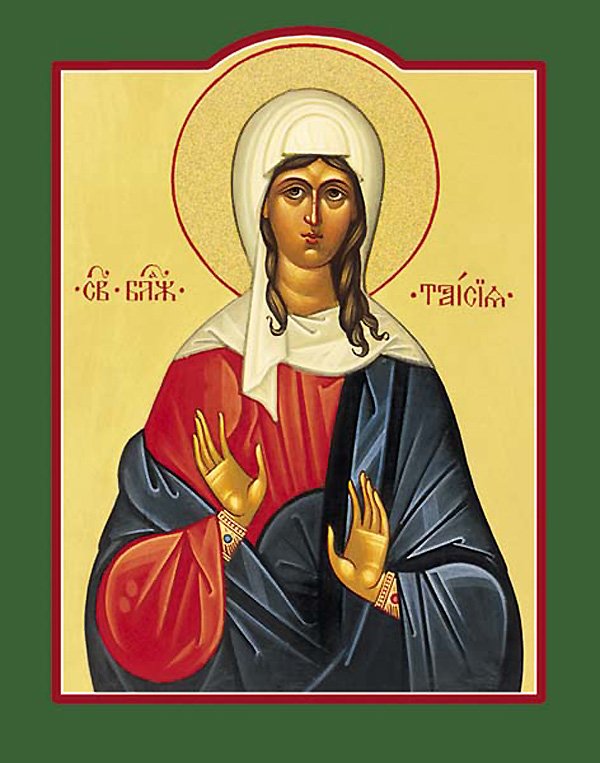
Blessed Thais of Egypt
Saint Thais lived in Egypt in the fifth century. Left an orphan after the death of her wealthy parents, she led a pious life, distributing her wealth to the poor, and she gave shelter to pilgrims on her estate. She decided that she would never marry, but would devote her life to serving Christ.
After spending all her inheritance, Thais was tempted to acquire more money by any means, and began to lead a sinful life.
Saint Thais lived in Egypt in the fifth century. Left an orphan after the death of her wealthy parents, she led a pious life, distributing her wealth to the poor, and she gave shelter to pilgrims on her estate. She decided that she would never marry, but would devote her life to serving Christ.
After spending all her inheritance, Thais was tempted to acquire more money by any means, and began to lead a sinful life. The Elders of Sketis near Alexandria heard of her fall, and asked Saint John the Dwarf (November 9) to go to Thais and persuade her to repent. “She was kind to us,” they said, “now perhaps we can help her. You, Father, are wise. Go and try to save her soul, and we will pray that the Lord will help you.”
The Elder went to her home, but Thais’s servant did not want to allow him into the house. Saint John said, “Tell your mistress that I have brought her something very precious.” Thais, knowing that the monks sometimes found pearls at the shore, told her servant to admit the visitor. Saint John sat down and looked her in the face, and then began to weep. Thais asked him why he was crying. “How can I not weep,” he asked, “when you have forsaken your Bridegroom, the Lord Jesus Christ, and are pleasing Satan by your deeds?”
The Elder’s words pierced the soul of Thais like a fiery arrow, and at once she realized how sinful her present life had become. In fear, she asked him if God would accept the repentance of a sinner like her. Saint John replied that the Savior awaited her repentance. That is why He came, to seek and to save the perishing. “He will welcome you with love,” he said, “and the angels will rejoice over you. As the Savior said Himself, one repentant sinner causes the powers of Heaven to rejoice” (Luke 15:7).
A feeling of repentance enveloped her, and regarding the Elder’s words as a call from the Lord Himself to return to Him, Thais trembled and thought only of finding the path of salvation. She stood up and left her house without speaking to her servants, and without making any sort of disposition of her property, so that even Saint John was amazed.
Following Saint John into the wilderness, she hastened to return to God through penitence and prayer. Night fell, and the Elder prepared a place for Thais to lay down and sleep. He made a pillow for her from the sand, and he went off somewhat farther, and went to sleep after his evening prayers.
In the middle of the night, he was wakened by a light coming down from the heavens to the place where Thais was at rest. In the radiant light he saw holy angels bearing her soul to Paradise. When he went over to Thais, he found her dead.
Saint John prayed and asked God to reveal to him whether Thais had been saved. An angel of God appeared and told him, “Abba John, her one hour of repentance was equal to many years, because she repented with all her soul, and a compunctionate heart.”
After burying the body of the saint, Saint John returned to Sketis and told the monks what had happened. All offered thanks to God for His mercy toward Thais who, like the wise thief, repented in a single moment.
Troparion - Tone 8
By a flood of tears you made the desert fertile, / and your longing for God brought forth fruits in abundance. / By the radiance of miracles you illumined the whole universe! / O our holy mother Thais, pray to Christ our God to save our souls!
Kontakion - Tone 2
In you the image was preserved with exactness, O Mother, / for taking up your cross, you followed after Christ. / By so doing, you taught us to disregard the flesh, for it passes away, / but to care instead for the soul, since it is immortal. / Therefore, most venerable Mother Thais your spirit rejoices with the Angels.
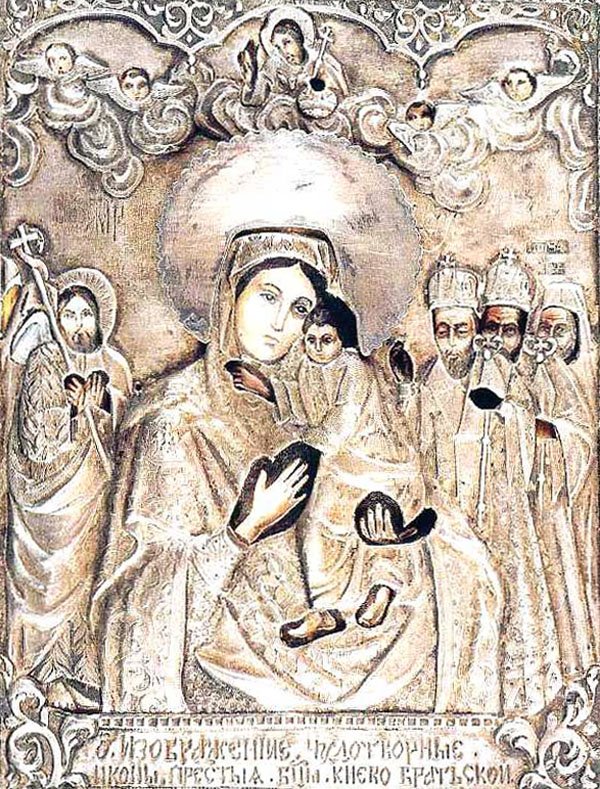
“Kiev-Bratsk” Icon of the Mother of God
The wonderworking Kiev-Bratsk (i.e. "Brotherhood") Icon of the Mother of God was revealed in 1654, and was originally kept in the church of Saints Boris and Gleb in the city of Vyshgorod (Kiev), and was placed in a shrine to the left of the Royal Doors on the iconostasis.
On May 10, 1662, during a war with Poland (1659–1667), the city suffered great damage from the Poles and Crimean Tatars who fought against Russia. T
The wonderworking Kiev-Bratsk (i.e. "Brotherhood") Icon of the Mother of God was revealed in 1654, and was originally kept in the church of Saints Boris and Gleb in the city of Vyshgorod (Kiev), and was placed in a shrine to the left of the Royal Doors on the iconostasis.
On May 10, 1662, during a war with Poland (1659–1667), the city suffered great damage from the Poles and Crimean Tatars who fought against Russia. The church of the Holy Passion-Bearers Boris and Gleb was ravaged and looted by enemy soldiers, who took all the jewels and icons, but the relics of the Saints were hidden under a crypt. By God's Providence, the wonderworking Icon of the Mother of God was preserved.
Some devout Christians, at the risk of their very lives, rescued the Icon of the Mother of God from the unclean hands of those who had stolen it. Since they were unable to hide the Icon, they had to consign it to the Dnieper River, praying that God's will would be done. To their amazement, the Icon did not sink, but floated upright down the river.
Leaving Vyshgorod, the Tatars began to cross the Dnieper, but they were drowned during a storm. Only one of them escaped by clinging to the Icon of the Mother of God as though it were a raft. The river carried the holy Icon to the bank of the Podil in Kiev, where it stopped before the Bratsk Monastery. The Tatar was afraid of drowning, and cried desperately for help. A boat was sent from the Monastery, into which the monks received the Icon and the Tatar.
The Tatar, whose life was spared by God, believed in Jesus Christ and was baptized. The Icon was placed in the wooden church of Saints Boris and Gleb, where it remained for a long time. An inventory of the church property in the Kiev-Bratsk Monastery, compiled in 1807, gives a description of the miraculous Icon.
In 1919, the Bratsk Monastery was closed, and the Kiev-Bratsk Icon of the Mother of God was thought to be lost. For a long time, the lack of information about the shrines of the Monastery until the 90s of the XX century was perceived as confirmation that the Icon was lost. In recent years, however, studies have shown that the Icon is one of the five most valuable icons in the Monastery. It was transferred to the Kiev Caves Lavra in 1926.
In 1948, this group of icons was first recorded in the ledger of the National Art Museum of Ukraine (NHMU) with a note saying their fate before they came to the museum was unknown. The reacquisition of the Kiev-Bratsk Icon occurred in the early 2000s, when employees of the NHMU established a connection between these monuments and the Bratsk Monastery.
Currently the Kiev-Bratsk Icon is in the collection of NHMU. It's reacquisition is regarded as confirmation of the Icon's miraculous qualities.
There is an exact copy of the Icon, which is located in the Kievan Monastery of the Protection of the Mother of God.
The Kiev-Bratsk Icon of the Mother of God is commemorated on September 6, May 10, June 2, and on Saturday of the Fifth Week of Great Lent.
Troparion - Tone 4
Let all of us, who are burdened with sins, fall on our knees before the Theotokos, / bowing before her wonderworking Icon of Tenderness, / kissing it and crying aloud with tears: / “O Sovereign Lady, accept the prayer of your unworthy servants, / and to us who ask, grant your great mercy.”
Kontakion - Tone 6
We have no other help, we have no other hope but you, O Lady. / Help us, for in you do we hope, / and of you do we boast, for we are your servants. / Let us not be put to shame.
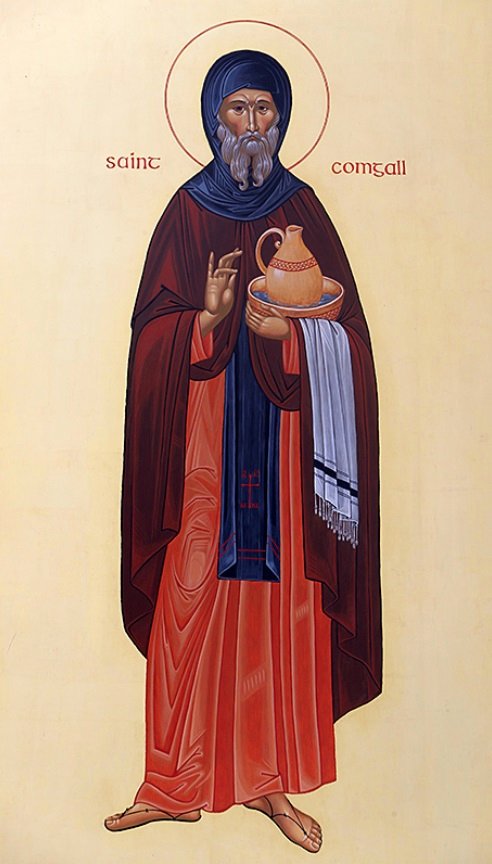
Venerable Comgall of Bangor
Saint Comgall (Comhghall), “the Father of Monks,” was born in Ireland at Dalaradia, Co. Ulster sometime between 510 and 520. Unlike many of the early Irish saints, Saint Comgall was not of noble birth. He served as a soldier, then studied with Saint Finnian of Moville (September 10). He was ordained to the holy priesthood by Bishop Lugaid before the age of forty.
Sa
Saint Comgall (Comhghall), “the Father of Monks,” was born in Ireland at Dalaradia, Co. Ulster sometime between 510 and 520. Unlike many of the early Irish saints, Saint Comgall was not of noble birth. He served as a soldier, then studied with Saint Finnian of Moville (September 10). He was ordained to the holy priesthood by Bishop Lugaid before the age of forty.
Saint Comgall and several companions lived for a time on an island in Lough Erne in the county of Ulster, where they lived a very strict ascetical life. Although his desire was to be a missionary in Scotland, Bishop Lugaid asked him to stay in Ireland and establish a monastery at Bangor (Bennchor) on the southern shore of Belfast Loch (in modern Co. Down). The monastery was founded sometime between 552-555.
It is believed that over four thousand monks were trained by Saint Comgall at Bangor, including Saint Columbanus of Luxeuil (November 21, or 23) and Saint Moluag (June 25). Saint Comgall often prayed while standing in the water for several hours. Sometimes at night his cell seemed to be ablaze with a heavenly radiance.
Later Saint Comgall did visit Scotland, where he became very close to Saint Columba of Iona (June 9), by whose prayers Comgall was once saved from drowning.
Saint Comgall lived to an advanced age, then suffered from a prolonged illness. He completed the course of his earthly life at Bangor on May 10, 602, after receiving Holy Communion from Saint Fiacre (August 30).
Troparion - Tone 3
Having learned of the goodness of the Grace that comes from the Highest / and girded yourself from your youth in a clear conscience, / O Comgall, imitator of Christ, you were a pillar of patience / and a preacher of the Word of God, / you confirmed the teachings of the faith and subdued the imaginations of the superstitious, / by so doing you gladly suffered for the truth being an example of suffering. / Since you possess boldness before Christ our God / do not cease to pray for us, who in love revere your holy memory.
Scripture Readings
☩Epistle
Acts 11:19-26, 29-30
19
Now they which were scattered abroad upon the persecution that arose about Stephen travelled as far as Phenice, and Cyprus, and Antioch, preaching the word to none but unto the Jews only.
20
And some of them were men of Cyprus and Cyrene, which, when they were come to Antioch, spake unto the Grecians, preaching the Lord Jesus.
21
And the hand of the Lord was with them: and a great number believed, and turned unto the Lord.
22
Then tidings of these things came unto the ears of the church which was in Jerusalem: and they sent forth Barnabas, that he should go as far as Antioch.
23
Who, when he came, and had seen the grace of God, was glad, and exhorted them all, that with purpose of heart they would cleave unto the Lord.
24
For he was a good man, and full of the Holy Ghost and of faith: and much people was added unto the Lord.
25
Then departed Barnabas to Tarsus, for to seek Saul:
26
And when he had found him, he brought him unto Antioch. And it came to pass, that a whole year they assembled themselves with the church, and taught much people. And the disciples were called Christians first in Antioch.
29
Then the disciples, every man according to his ability, determined to send relief unto the brethren which dwelt in Judea:
30
Which also they did, and sent it to the elders by the hands of Barnabas and Saul.
☩Gospel
John 4:5-42
5
Then cometh he to a city of Samaria, which is called Sychar, near to the parcel of ground that Jacob gave to his son Joseph.
6
Now Jacob’s well was there. Jesus therefore, being wearied with his journey, sat thus on the well: and it was about the sixth hour.
7
There cometh a woman of Samaria to draw water: Jesus saith unto her, Give me to drink.
8
(For his disciples were gone away unto the city to buy meat.)
9
Then saith the woman of Samaria unto him, How is it that thou, being a Jew, askest drink of me, which am a woman of Samaria? for the Jews have no dealings with the Samaritans.
10
Jesus answered and said unto her, If thou knewest the gift of God, and who it is that saith to thee, Give me to drink; thou wouldest have asked of him, and he would have given thee living water.
11
The woman saith unto him, Sir, thou hast nothing to draw with, and the well is deep: from whence then hast thou that living water?
12
Art thou greater than our father Jacob, which gave us the well, and drank thereof himself, and his children, and his cattle?
13
Jesus answered and said unto her, Whosoever drinketh of this water shall thirst again:
14
But whosoever drinketh of the water that I shall give him shall never thirst; but the water that I shall give him shall be in him a well of water springing up into everlasting life.
15
The woman saith unto him, Sir, give me this water, that I thirst not, neither come hither to draw.
16
Jesus saith unto her, Go, call thy husband, and come hither.
17
The woman answered and said, I have no husband. Jesus said unto her, Thou hast well said, I have no husband:
18
For thou hast had five husbands; and he whom thou now hast is not thy husband: in that saidst thou truly.
19
The woman saith unto him, Sir, I perceive that thou art a prophet.
20
Our fathers worshipped in this mountain; and ye say, that in Jerusalem is the place where men ought to worship.
21
Jesus saith unto her, Woman, believe me, the hour cometh, when ye shall neither in this mountain, nor yet at Jerusalem, worship the Father.
22
Ye worship ye know not what: we know what we worship: for salvation is of the Jews.
23
But the hour cometh, and now is, when the true worshippers shall worship the Father in spirit and in truth: for the Father seeketh such to worship him.
24
God is a Spirit: and they that worship him must worship him in spirit and in truth.
25
The woman saith unto him, I know that Messias cometh, which is called Christ: when he is come, he will tell us all things.
26
Jesus saith unto her, I that speak unto thee am he.
27
And upon this came his disciples, and marvelled that he talked with the woman: yet no man said, What seekest thou? or, Why talkest thou with her?
28
The woman then left her waterpot, and went her way into the city, and saith to the men,
29
Come, see a man, which told me all things that ever I did: is not this the Christ?
30
Then they went out of the city, and came unto him.
31
In the mean while his disciples prayed him, saying, Master, eat.
32
But he said unto them, I have meat to eat that ye know not of.
33
Therefore said the disciples one to another, Hath any man brought him ought to eat?
34
Jesus saith unto them, My meat is to do the will of him that sent me, and to finish his work.
35
Say not ye, There are yet four months, and then cometh harvest? behold, I say unto you, Lift up your eyes, and look on the fields; for they are white already to harvest.
36
And he that reapeth receiveth wages, and gathereth fruit unto life eternal: that both he that soweth and he that reapeth may rejoice together.
37
And herein is that saying true, One soweth, and another reapeth.
38
I sent you to reap that whereon ye bestowed no labour: other men laboured, and ye are entered into their labours.
39
And many of the Samaritans of that city believed on him for the saying of the woman, which testified, He told me all that ever I did.
40
So when the Samaritans were come unto him, they besought him that he would tarry with them: and he abode there two days.
41
And many more believed because of his own word;
42
And said unto the woman, Now we believe, not because of thy saying: for we have heard him ourselves, and know that this is indeed the Christ, the Saviour of the world.
Liturgical data sourced from OCA.org and orthocal.info