In 324 the holy Emperor Constantine (May 21) decided that the imperial capital had to be closer to the Eastern provinces, and yet have direct communication with the West. The city of Byzantium fulfilled these requirements, and on November 8, 324 the site of the new capital was consecrated.
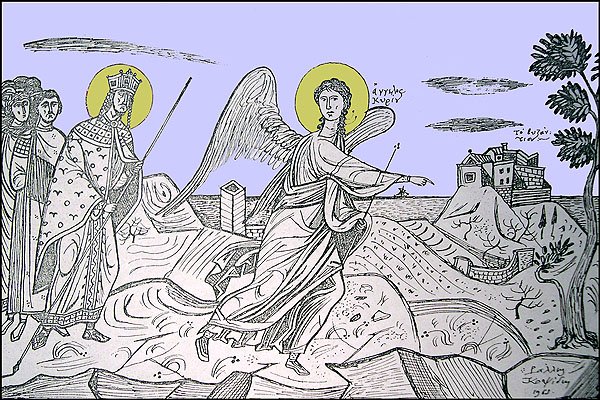
Tradition tells us that the Emperor was tracing the boundaries of the city with a spear, when his courtiers became astonished by the magnitude of the new dimensions of the capital.
In 324 the holy Emperor Constantine (May 21) decided that the imperial capital had to be closer to the Eastern provinces, and yet have direct communication with the West. The city of Byzantium fulfilled these requirements, and on November 8, 324 the site of the new capital was consecrated.
Tradition tells us that the Emperor was tracing the boundaries of the city with a spear, when his courtiers became astonished by the magnitude of the new dimensions of the capital. “Lord,” they asked, “how long will you keep going?”
Constantine replied, “I shall keep going until the one who walks ahead of me stops.”
Then they understood that the emperor was being guided by some divine power. There is an iconographic sketch by Rallis Kopsides showing an angel of the Lord going before Saint Constantine as he traces the new boundaries of the city.
Construction of the main buildings was begun in 325, and pagan monuments from Rome, Athens, and other cities were used to beautify the new capital. The need for the new city is partially explained by the changing requirements of government, the Germanic invasion of the West, and commercial benefits, but the new city was also to be a Christian capital. For this, a new foundation was required.
In 330, the work had progressed to the point where it was possible for Constantine to dedicate the new capital. The dedication took place on May 11, followed by forty days of joyous celebration. Christian Constantinople was placed under the protection of the Most Holy Theotokos, and overshadowed pagan Byzantium. Saint Constantine was the first Emperor to submit voluntarily to Christ, and Constantinople became the symbol of a Christian Empire which lasted for a thousand years.
Troparion - Tone 4
The city of the Theotokos / dedicates its foundation as an offering to the Theotokos. / For it has been established to remain in Her, / and it lives and is strengthened through Her, / crying out to Her, / “Hail, the hope of all the ends of the earth.”
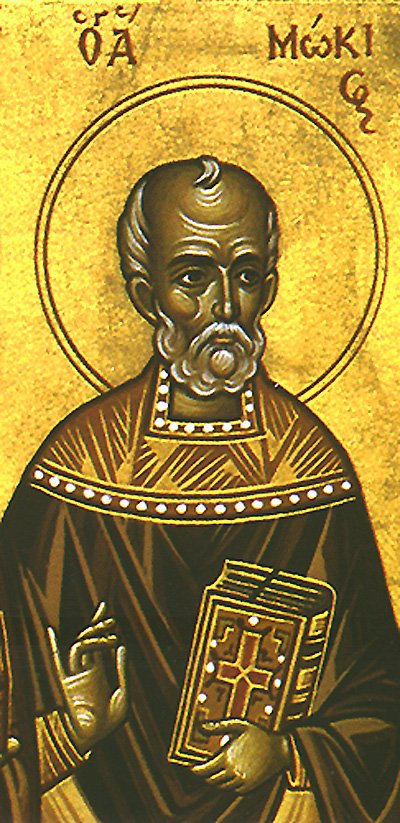
Hieromartyr Mocius the Presbyter of Amphipolis in Macedonia
Saint Mocius was a presbyter in Macedonia in the city of Amphipolis. During a persecution against Christians under the emperor Diocletian (284-305), Saint Mocius exhorted the pagans who had assembled for the pagan festival of Dionysus (Bacchus), to abandon iniquity and the vile customs which accompanied this celebration.
Saint Mocius was a presbyter in Macedonia in the city of Amphipolis. During a persecution against Christians under the emperor Diocletian (284-305), Saint Mocius exhorted the pagans who had assembled for the pagan festival of Dionysus (Bacchus), to abandon iniquity and the vile customs which accompanied this celebration. He urged them to repent and be converted to the Lord Jesus Christ, and be cleansed through holy Baptism.
The saint was brought to trial before the governor of Laodicea. When threatened with torture, he replied, “My death for Christ is a great accomplishment for me.” Saint Mocius was subjected to torture, which he bore with marvelous endurance, and did not cease to denounce the idol-worshippers.
Taken to the pagan temple of Dionysus, the saint shattered the idols when he called upon Jesus Christ. After this he was put into a red-hot oven, where he remained unharmed, but the flames coming out of the oven scorched the governor.
Again the commander subjected Saint Mocius to fierce torture, which he endured with the help of God. He was given to wild beasts to be eaten, but they did not touch him. The lions lay down at his feet. The people, seeing such miracles, urged that the saint be set free. The governor ordered the saint to be sent to the city of Perinth, and from there to Byzantium, where Saint Mocius was executed.
Before his death he gave thanks to the Lord for giving him the strength to persevere to the very end. His last words were, “Lord, receive my spirit in peace.” Then he was beheaded. Saint Mocius died about the year 295. Later, the emperor Constantine built a church in honor of the hieromartyr Mocius and transferred his holy passion-bearing relics into it.
Troparion - Tone 4
By sharing in the ways of the Apostles, / you became a successor to their throne. / Through the practice of virtue, you found the way to divine contemplation, O inspired one of God; / by teaching the word of truth without error, you defended the Faith, / even to the shedding of your blood. / Hieromartyr Mocius, entreat Christ God to save our souls.
Equals of the Apostles and Teachers of the Slavs, Cyril and Methodius
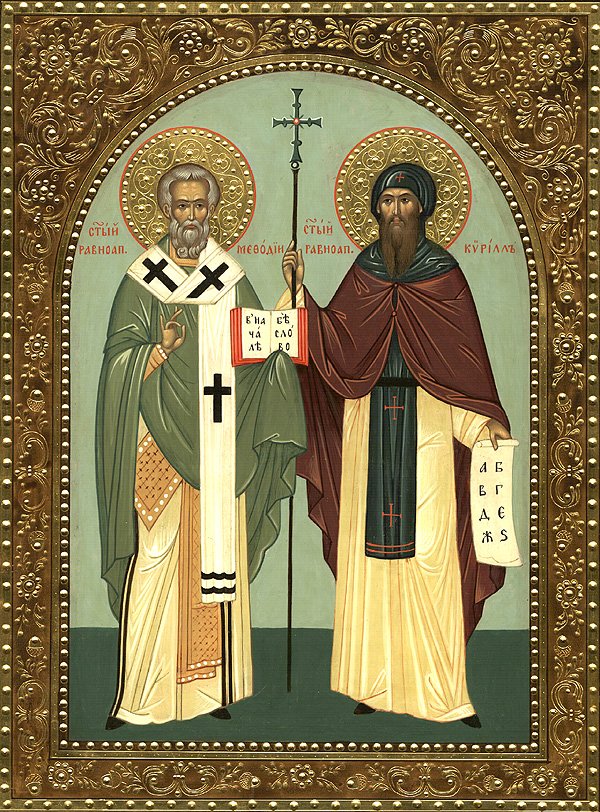
Saints Cyril and Methodius, Equals of the Apostles, and Enlighteners of the Slavs came from an illustrious and pious family living in the Greek city of Thessalonica. Saint Methodius was the oldest of seven brothers, Saint Constantine [Cyril was his monastic name] was the youngest. At first Saint Methodius was in the military and was governor in one of the Slavic principalities dependent on the Byzantine Empire, probably Bulgaria, which made it possible for him to learn the Slavic language.
Saints Cyril and Methodius, Equals of the Apostles, and Enlighteners of the Slavs came from an illustrious and pious family living in the Greek city of Thessalonica. Saint Methodius was the oldest of seven brothers, Saint Constantine [Cyril was his monastic name] was the youngest. At first Saint Methodius was in the military and was governor in one of the Slavic principalities dependent on the Byzantine Empire, probably Bulgaria, which made it possible for him to learn the Slavic language. After living there for about ten years, Saint Methodius later received monastic tonsure at one of the monasteries on Mount Olympus (Asia Minor).
Saint Constantine distinguished himself by his great aptitude, and he studied with the emperor Michael under the finest teachers in Constantinople, including Saint Photius, the future Patriarch of Constantinople (February 6).
Saint Constantine studied all the sciences of his time, and also knew several languages. He also studied the works of Saint Gregory the Theologian. Because of his keen mind and penetrating intellect, Saint Constantine was called “Philosopher” (wise). Upon the completion of his education, Saint Constantine was ordained to the holy priesthood and was appointed curator of the patriarchal library at the church of Hagia Sophia. He soon left the capital and went secretly to a monastery.
Discovered there, he returned to Constantinople, where he was appointed as instructor in philosophy. The young Constantine’s wisdom and faith were so great that he won a debate with Ananias, the leader of the heretical iconclasts. After this victory Constantine was sent by the emperor to discuss the Holy Trinity with the Saracens, and again he gained the victory. When he returned, Saint Constantine went to his brother Saint Methodius on Olympus, spending his time in unceasing prayer and reading the works of the holy Fathers.
The emperor soon summoned both of the holy brothers from the monastery and sent them to preach the Gospel to the Khazars. Along the way they stayed in the city of Korsun, making preparations for their missionary activity. There the holy brothers miraculously discovered the relics of the hieromartyr Clement, Pope of Rome (November 25).
There in Korsun Saint Constantine found a Gospel and Psalter written in Russian letters [i.e. Slavonic], and a man speaking the Slavic tongue, and he learned from this man how to read and speak this language. After this, the holy brothers went to the Khazars, where they won a debate with Jews and Moslems by preaching the Gospel. On the way home, the brothers again visited Korsun and, taking up the relics of Saint Clement, they returned to Constantinople. Saint Constantine remained in the capital, but Saint Methodius was made igumen of the small Polychronion monastery near Mount Olympus, where he lived a life of asceticism as before.
Soon messengers came to the emperor from the Moravian prince Rostislav, who was under pressure from German bishops, with a request to send teachers to Moravia who would be able to preach in the Slavic tongue. The emperor summoned Saint Constantine and said to him, “You must go there, but it would be better if no one knows about this.”
Saint Constantine prepared for the new task with fasting and prayer. With the help of his brother Saint Methodius and the disciples Gorazd, Clement, Savva, Naum and Angelyar, he devised a Slavonic alphabet and translated the books which were necessary for the celebration of the divine services: the Gospel, Epistles, Psalter, and collected services, into the Slavic tongue. This occurred in the year 863.
After completing the translation, the holy brothers went to Moravia, where they were received with great honor, and they began to teach the services in the Slavic language. This aroused the malice of the German bishops, who celebrated divine services in the Moravian churches in Latin. They rose up against the holy brothers, convinced that divine services must be done in one of three languages: Hebrew, Greek or Latin.
Saint Constantine said, “You only recognize three languages in which God may be glorified. But David sang, ‘Praise the Lord, all nations, praise the Lord all peoples (Ps 116/117:1).’ And the Gospel of Saint Matthew (28:18) says, ‘Go and teach all nations....’” The German bishops were humiliated, but they became bitter and complained to Rome.
The holy brothers were summoned to Rome for a decision on this matter. Taking with them the relics of Saint Clement, Saints Constantine and Methodius set off to Rome. Knowing that the holy brothers were bringing these relics with them, Pope Adrian met them along the way with his clergy. The holy brothers were greeted with honor, the Pope gave permission to have divine services in the Slavonic language, and he ordered the books translated by the brothers to be placed in the Latin churches, and to serve the Liturgy in the Slavonic language.
At Rome Saint Constantine fell ill, and the Lord revealed to him his approaching death. He was tonsured into the monastic schema with the name of Cyril. On February 14, 869, fifty days after receiving the schema, Saint Cyril died at the age of forty-two.
Saint Cyril commanded his brother Saint Methodius to continue with their task of enlightening the Slavic peoples with the light of the true Faith. Saint Methodius entreated the Pope to send the body of his brother for burial in their native land, but the Pope ordered the relics of Saint Cyril to be placed in the church of Saint Clement, where miracles began to occur from them.
After the death of Saint Cyril, the Pope sent Saint Methodius to Pannonia, after consecrating him as Archbishop of Moravia and Pannonia, on the ancient throne of Saint Andronicus (July 30). In Pannonia Saint Methodius and his disciples continued to distribute services books written in the Slavonic language. This again aroused the wrath of the German bishops. They arrested and tried Saint Methodius, who was sent in chains to Swabia, where he endured many sufferings for two and a half years.
After being set free by order of Pope John VIII of Rome, and restored to his archdiocese, Saint Methodius continued to preach the Gospel among the Slavs. He baptized the Czech prince Borivoi and his wife Ludmilla (September 16), and also one of the Polish princes. The German bishops began to persecute the saint for a third time, because he did not accept the erroneous teaching about the procession of the Holy Spirit from both the Father and the Son. Saint Methodius was summoned to Rome, but he justified himself before the Pope, and preserved the Orthodox teaching in its purity, and was sent again to the capital of Moravia, Velehrad.
Here in the remaining years of his life Saint Methodius, assisted by two of his former pupils, translated the entire Old Testament into Slavonic, except for the Book of Maccabbees, and even the Nomocanon (Rule of the Holy Fathers) and Paterikon (book of the Holy Fathers).
Sensing the nearness of death, Saint Methodius designated one of his students, Gorazd, as a worthy successor to himself. The holy bishop predicted the day of his death and died on April 6, 885 when he was about sixty years old. The saint’s burial service was chanted in three languages, Slavonic, Greek, and Latin. He was buried in the cathedral church of Velehrad.
Troparion - Tone 4
Divinely-wise Cyril and Methodius, / equals-to-the-apostles and teachers of the Slavs, / entreat the Master of all / to strengthen all nations in Orthodoxy and unity of mind, / to grant peace to the world and to save our souls.
Kontakion - Tone 3
Let us honor the sacred pair, who translated divine scripture / pouring forth a fountain of divine knowledge from which we still draw today. / Now as you stand before the throne of the Most-high / we call you blessed, Cyril and Methodius, / as you fervently pray for our souls.
Venerable Sophronius the Recluse of the Kiev Far Caves
The Relics of Saint Sophronius were buried in the Far Caves of the Kiev Caves monastery. In the Canon to the monks of the Far Caves the saint’s solitary ascetical struggles are mentioned. He was deemed worthy to hear angels singing. The memory of Saint Sophronius is also celebrated on March 11.
Troparion - Tone 8
By a flood of tears you made the desert fertile, / and your longing for God brought forth fruits in abundance. / By the radiance of miracles you illumined the whole universe! / O our holy father Sophronius, pray to Christ our God to save our souls!
Saint Joseph, Metropolitan of Astrakhan
The Hieromartyr Joseph, First Metropolitan of Astrakhan, was born at Astrakhan in 1579. After becoming a monk, Saint Joseph was made Archimandrite of the Astrakhan Trinity monastery at the age of fifty-two.
In 1656 he was at Moscow, after which he was chosen to be Metropolitan of Astrakhan. On May 11,1672, during an uprising of the townspeople, Saint Joseph suffered martyrdom at Astrakhan.
The Hieromartyr Joseph, First Metropolitan of Astrakhan, was born at Astrakhan in 1579. After becoming a monk, Saint Joseph was made Archimandrite of the Astrakhan Trinity monastery at the age of fifty-two.
In 1656 he was at Moscow, after which he was chosen to be Metropolitan of Astrakhan. On May 11,1672, during an uprising of the townspeople, Saint Joseph suffered martyrdom at Astrakhan. This sad event was recorded in detail by two eyewitnesses, priests of the Astrakhan cathedral, Cyril and Peter.
The priests took the body of the martyr, dressed it in bishop’s vestments, and placed it in a prepared grave. On the following day, after serving a Panikhida, the saint’s body was taken to a chapel, and it remained unburied for nine days. The relics of the holy hierarch were placed into the grave, and were soon glorified by miracles.
Saint Joseph was glorified at the Council of the Russian Orthodox Church in April 1918.
Troparion - Tone 6
You fought the good fight,1 crowning your life with torments for the truth, / you have moved to the heavenly abodes, / where, before the Throne of the Holy Trinity, O Hierarch Joseph, / you pray for the city of Astrakhan, and for our earthly homeland to be saved.
Kontakion - Tone 2
You shone as a bright star in Astrakhan, where you were born and raised, / and for your faithfulness to God, you suffered a martyric death. / Honoring your martyrdom, we cry to you: / “O Hierarch Joseph, who were killed by the rebels, pray to Christ God for our souls.”1 2 Timothy 4:7.
Saint Nikodemos, Archbishop of Serbia
Saint Nikodemos (Νikόdēmos) the Archbishop of Serbia, a gifted ecclesiastical writer and learned theologian, like many Serbian bishops, first contested on Holy Mount Athos where he was tonsured, and then he was chosen as Igoumen of Hilandar Monastery (1312–1316). The Hieromonk Gervasius wrote that the Saint was a native of "a western country, the land of Raska, called Serbia."
After the death of the Serbian Archbishop Sava III, Saint Nikodemos was elected as Archbishop of All Serbia and the Land of Pomor, and ascended the primatial throne in 1317.
The
Saint Nikodemos (Νikόdēmos) the Archbishop of Serbia, a gifted ecclesiastical writer and learned theologian, like many Serbian bishops, first contested on Holy Mount Athos where he was tonsured, and then he was chosen as Igoumen of Hilandar Monastery (1312–1316). The Hieromonk Gervasius wrote that the Saint was a native of "a western country, the land of Raska, called Serbia."
After the death of the Serbian Archbishop Sava III, Saint Nikodemos was elected as Archbishop of All Serbia and the Land of Pomor, and ascended the primatial throne in 1317.
The Hierarch translated the Rule of Saint Savva the Sanctified from Greek into Serbian. In the Synaxarion he included the dates of the repose of the Serbian rulers and Archbishops in order to commemorate the departed with festive services (if they were glorified as Saints). In his translation of the Jerusalem Typikon, Archbishop Nikodemos reminds us that even Saint Savva of Serbia wanted his churches to be built like the churches of Jerusalem, and the Lavra of Savva the Sanctified. In the preface to this work, he says: "Almighty God, Who knows our weakness, gives us spiritual strength if we first show our work." In a note dating back to the year 1319, the Saint indicates that he undertook the translation of the Typikon, fulfilling the will of Saint Savva. He concludes his exhortation with the following words: "I beseech those who come after me to complete that which remains unfinished because of the shortness of my life."
While he was still the Igoumen of Hilandar, Blessed Nikodemos, at the request of Kings Milutin and Dragutin, and the entire council of the Serbian land, went to Constantinople to Patriarch Nikon and Emperor Andronikos, in order to promote the reconciliation of the warring brothers. As Archbishop, the Saint stood at the head of the embassy of Hilandar Monastery, which had arrived in Serbia to ask King Milutin for forgiveness and his son, Stephen of Decani (Dečani), was returned from exile. This was reported by the Church writer Archbishop Daniel II, who also took part in the reconciliation process. "And this Bishop," writing about Saint Nikodemos, "truly had boldness... approaching him, he began to speak sweet and prudent words, by which it was possible to turn his great wrath into meekness."
On January 6, 1321, Saint Nikodemos crowned Stephen Uros (Uroš) III of Decani with the royal crown. George Tsamblak described this event as follows: "He was met by the Hierarch Archbishop Nikodemos... with great joy and royal honors. In the temple, Archbishop Nikodemos took the royal crown of the kingdom and placed it on Stephen's head, showing him to be the rightful king.
Saint Nikodemos was the builder of the church of Saint Demetrios in the Patriarchate of Pec (Peč), and the church of Saint Savva of Serbia at Lizitsya. He restored Zicha (Žiča) Monastery and took special care of the cell of Saint Savva in Karyes on Mount Athos. The Saint left a testament that the Serbian Archbishops should deliver to this cell everything that Saint Savva himself once specified.
Sincerely devoted to Christ's teachings, and to his people, the Hierarch was an irreconcilable fighter against false teachings and heresies, especially the Bogomils 1 . In the Church Service in honor of Saint Nikodemos, composed by Bishop Mark between 1404 and 1412, it is reported that the Saint waged a fierce struggle against heretics, including the Latins. The hymnographer likened the Hierarch to an axe cutting down the intentions of heretics who came from foreign countries.
The Hierarch's biographer reports that he was Archbishop "for only eight years of his short life," and departed to the Lord as a relatively old man. This occurred on May 11, 1324. The relics of Saint Nikodemos were placed in the church of Saint Demetrios at Pec. The exact date of their discovery unknown, but already by 1391 they had been placed in a special ark. The glorification of Nikodemos as a Saint happened quite early. Just as early, the Church veneration of this Saint appeared in Russia. Icons of Saint Nikodemos can be found in the frescoes in the monastery of Morača, the church of Saint Nicholas near Moraca (Morača), and in the monastery of Orahovica.
Saint Nikodemos reposed on May 11, 1325. He is also commemorated on August 30, the Synaxis of the Serbian Hierarchs , and at the Synaxis of All Saints of Mount Athos (a movable Feast on the Second Sunday after Pentecost).
1 They were dualists, or Gnostics, who believed in a world within the body and a world outside the body. They rejected the Christian hierarchy, the Cross, and they did not build churches, since they regarded their body as a temple. This gave rise to various practices to cleanse themselves through fasting or dancing.
Troparion - Tone 4
The truth of things revealed you to your flock as a rule of faith, / a model of meekness, and a teacher of abstinence. / Therefore, through humility, you attained the heights; / and through poverty, riches. / O Hierarch Nikodemos our Father, entreat Christ God that our souls may be saved.
Kontakion - Tone 4
You ascended to the heights of the virtues, through which you approached God; / O Hierarch Nikodemos, / pray for us who lovingly glorify you as a pastor and teacher.
Saint Rostislav, Prince of Great Moravia
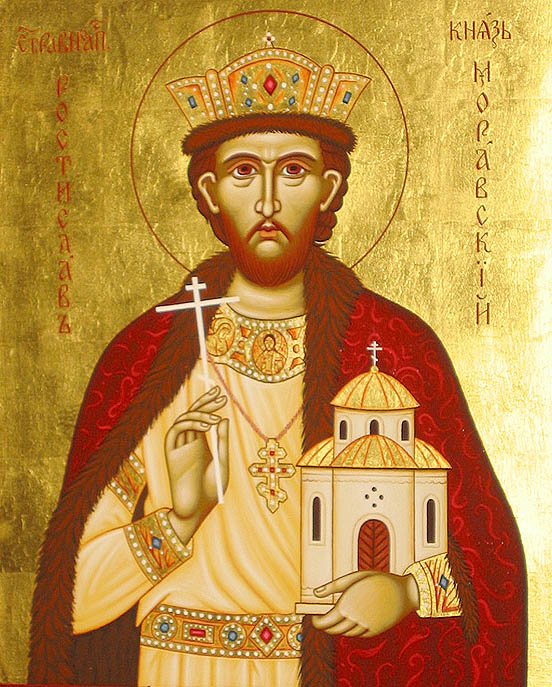
Saint Rostislav (Rastislav) the Prince of Great Moravia, and Equal of the Apostles, became Prince in 846, following the death of his uncle Mojmir I. At that time, missionaries from Greece, the Balkans, and Germany were already preaching in the territory of Great Moravia. Prince Rostislav was among those who received Holy Baptism, and soon afterward he decided to enlighten the entire country with the light of the Christian Faith.
Saint Rostislav (Rastislav) the Prince of Great Moravia, and Equal of the Apostles, became Prince in 846, following the death of his uncle Mojmir I. At that time, missionaries from Greece, the Balkans, and Germany were already preaching in the territory of Great Moravia. Prince Rostislav was among those who received Holy Baptism, and soon afterward he decided to enlighten the entire country with the light of the Christian Faith.
Wary of the German missionaries, who were subject to Louis the German, the King of East Francia, Prince Rostislav understood that for the preaching of the Gospel to be successful, it must be proclaimed in the language of the people.
At first, Rostislav asked the Roman Pope Nicholas I to send him some missionaries who knew the Slavic language. When his request was refused, he turned to the Byzantine Emperor Michael III. On the advice of Patriarch Photios of Constantinople (February 6), Michael sent Prince Rostislav two brothers, Saints Cyril and Methodios, who translated the Bible, the Divine Liturgy, and other books into Slavonic. Icons and other items which were required for the Church Services were also provided, and Christian schools were established. Christianity spread rapidly throughout Great Moravia with the full support of Prince Rostislav.
In 870, Prince Rostislav's nephew Svatopluk betrayed him to Carloman, the son of King Louis, after acknowledging him as his overlord. In return, Carloman promised that Svatopluk would rule in Great Moravia. Prince Rostislav was blinded and confined in a castle at Regensburg in the State of Bavaria, where he reposed that same year.
Saint Rostislav was glorified by the Orthodox Church of the Czech Lands and Slovakia at Prešov in October of 1994.
New Martyr Dioscorus
No information available at this time.
Troparion - Tone 3
Your holy martyr Dioscorus, O Lord, / through his sufferings has received an incorruptible crown from You, our God. / For having Your strength, he laid low his adversaries, / and shattered the powerless boldness of demons. / Through his intercessions, save our souls!
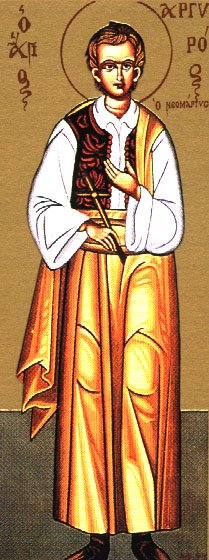
New Martyr Argyrus
No information available at this time.
Troparion - Tone 3
Your holy martyr Argyrus, O Lord, / through his sufferings has received an incorruptible crown from You, our God. / For having Your strength, he laid low his adversaries, / and shattered the powerless boldness of demons. / Through his intercessions, save our souls!
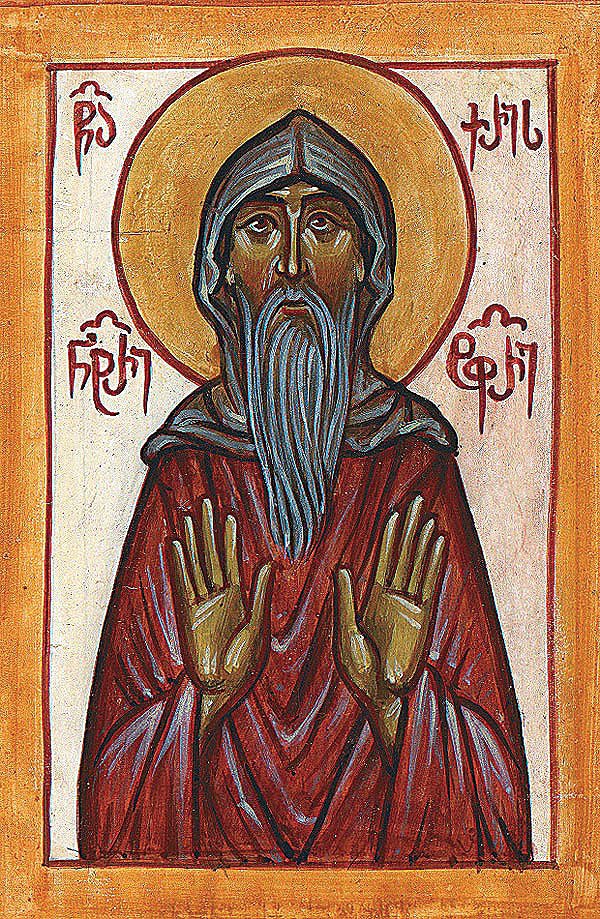
Blessed Christopher, called Christesia
Blessed Christesia’s family was from Egrisi in western Georgia. From his youth Christesia longed for the divine services and the solitary life, but he was forced by his master to marry, and by this marriage he begot a son. Later, when both his wife and son had died, his master insisted that he marry again, but the pious Christesia would not heed his master’s order.
In
Blessed Christesia’s family was from Egrisi in western Georgia. From his youth Christesia longed for the divine services and the solitary life, but he was forced by his master to marry, and by this marriage he begot a son. Later, when both his wife and son had died, his master insisted that he marry again, but the pious Christesia would not heed his master’s order.
Instead he related the order to his spiritual father, who advised him to depart from the world and journey to the Davit-Gareji Wilderness. Deeply inspired by his spiritual father’s counsel, Christesia abandoned his possessions and his life in the world and withdrew to the Monastery of Saint John the Baptist in the Davit-Gareji Wilderness.
The holy father spent many years in humble service to the Lord. He was assigned to gather firewood and bring water for the monastery, and he performed these tasks obediently and in perfect meekness. Every day he walked over four miles to fill a pitcher with water and then carried it to a small hut nearby. He hung the pitcher at the entrance to make it visible from a distance, and travelers who passed by would come to quench their thirst.
He also kept a small vegetable garden to feed the passers-by. Every Saturday he prepared kolio (a dish of wheat and honey traditionally offered to commemorate the departed) and divided it in three parts: one part commemorated the family and loved ones of those who had donated the wheat and honey; the second, the deceased fathers of the monastery; and the last, all departed Orthodox Christians.
It always disturbed Saint Christesia to see his brothers and sisters at odds with one another, so when he heard that two people were quarreling, he would go and reconcile them. “My children!” he would say, “If you do not heed my words, I will leave in sorrow, and the devil, who is always resistant to peace, will rejoice and send more tribulations upon you. I came to you hungry, and I will depart hungry!” His words warmed the hearts of those whom he counseled and helped them to be reconciled with one another.
One hot evening after Vespers, Saint Christesia set off on foot for a certain village. He left during twilight, and when night fell the sky was without a moon and extraordinarily dark. Before long it became difficult to walk any farther, so Saint Christesia stopped to pray, and a bright light appeared before him to light the way. The divine light guided him all through the night, until he reached the village of Sartichala.
Saint Christesia’s cell was poor and cramped. He slept on a bed of wooden planks that he covered in sheepskin, and instead of a pillow he rested his head on a stone. The pious ascetic wore a sheepskin coat and sandals made of bark. Whatever he received he gave to the poor. Having placed complete trust in God, he would not permit himself to worry about the morrow, nor did he bother to store up food or supplies for the harsh winter months.
Father Christesia was already advanced in age when he was tonsured a monk and given the new name Christopher. He reposed peacefully in 1771, at the age of eighty.
Troparion - Tone 8
By a flood of tears you made the desert fertile, / and your longing for God brought forth fruits in abundance. / By the radiance of miracles you illumined the whole universe! / O our holy father Christopher, pray to Christ our God to save our souls!
Holy Monastic Martyrs Olympia and Euphrosynē
Saint Olympia (Ολυμπία) was born to devout parents who were from Constantinople. Her father was a priest, and her mother was the daughter of a priest. They fled Constantinople for some unknown reason and went to the Peloponnesos. At the age of ten, Saint Olympia lost her parents, and her relatives sent her to Karyes Monastery at Therme on the island of Lesbos, where her aunt Dorothy was the Igoumeness. Origin
Saint Olympia (Ολυμπία) was born to devout parents who were from Constantinople. Her father was a priest, and her mother was the daughter of a priest. They fled Constantinople for some unknown reason and went to the Peloponnesos. At the age of ten, Saint Olympia lost her parents, and her relatives sent her to Karyes Monastery at Therme on the island of Lesbos, where her aunt Dorothy was the Igoumeness. Originally this was a womens' monastery, but today it is Saint Raphael's Monastery.
At the age of nineteen, Saint Olympia was tonsured as a nun. When she was twenty-five, she succeeded her aunt as Igoumeness. About ten years later, on May 11, 1235, pirates arrived on Lesbos and went to the monastery where there were thirty nuns. Some of them were raped by the pirates, but others fled to the mountains.
Igoumeness Olympia and Eldress Euphrosynē (Ευφροσύνη) were subjected to frightful torments. Saint Euphrosynē was hanged from a tree and was burnt. Saint Olympia was burnt all over her body with torches, and after that they took a red-hot iron rod and passed it from one ear and out through the other. Finally, her tortured body was nailed to a board with twenty nails, and this board was buried with her. Then the pirates went away.
The account of the lives and martyrdom of these two holy women became known in 1959 when, by divine revelation, the relics of these saints were found at Therme. Twenty nails were found in Saint Olympia's tomb. Sometimes she has appeared together with Saint Raphael.
Saint Olympia and Saint Euphrosynē are commemorated on May 11 and also on Bright Tuesday with Saints Raphael, Nicholas, and Irene.
Troparion - Tone 4
Your lambs Olympia and Euphrosynē, O Jesus, / call out to You in a loud voice: / I love You, O my bridegroom, / and in seeking You, I endure suffering. / In Baptism I was crucified so that I might reign in You, / and died so that I might live with You. / Accept me as a pure sacrifice, / for I have offered myself in love. / By their prayers save our souls, since You are merciful.
Kontakion - Tone 2
As venerable and proven ascetics, as honorable and renowned martyrs, / and as models of the desert life, O most exalted Olympia and Euphrosynē, / we sing hymns of praise to you, / for you have trampled upon serpents.
Scripture Readings
☩Epistle
Acts 12:12-17
12
And when he had considered the thing, he came to the house of Mary the mother of John, whose surname was Mark; where many were gathered together praying.
13
And as Peter knocked at the door of the gate, a damsel came to hearken, named Rhoda.
14
And when she knew Peter’s voice, she opened not the gate for gladness, but ran in, and told how Peter stood before the gate.
15
And they said unto her, Thou art mad. But she constantly affirmed that it was even so. Then said they, It is his angel.
16
But Peter continued knocking: and when they had opened the door, and saw him, they were astonished.
17
But he, beckoning unto them with the hand to hold their peace, declared unto them how the Lord had brought him out of the prison. And he said, Go shew these things unto James, and to the brethren. And he departed, and went into another place.
☩Gospel
John 8:42-51
42
Jesus said unto them, If God were your Father, ye would love me: for I proceeded forth and came from God; neither came I of myself, but he sent me.
43
Why do ye not understand my speech? even because ye cannot hear my word.
44
Ye are of your father the devil, and the lusts of your father ye will do. He was a murderer from the beginning, and abode not in the truth, because there is no truth in him. When he speaketh a lie, he speaketh of his own: for he is a liar, and the father of it.
45
And because I tell you the truth, ye believe me not.
46
Which of you convinceth me of sin? And if I say the truth, why do ye not believe me?
47
He that is of God heareth God’s words: ye therefore hear them not, because ye are not of God.
48
Then answered the Jews, and said unto him, Say we not well that thou art a Samaritan, and hast a devil?
49
Jesus answered, I have not a devil; but I honour my Father, and ye do dishonour me.
50
And I seek not mine own glory: there is one that seeketh and judgeth.
51
Verily, verily, I say unto you, If a man keep my saying, he shall never see death.
 Meat
Allowed
Meat
Allowed
 Fish
Allowed
Fish
Allowed
 Dairy
Allowed
Dairy
Allowed
 Oil
Allowed
Oil
Allowed
 Wine
Allowed
Wine
Allowed