Fasting Rules
 Meat
Allowed
Meat
Allowed
 Fish
Allowed
Fish
Allowed
 Dairy
Allowed
Dairy
Allowed
 Oil
Allowed
Oil
Allowed
 Wine
Allowed
Wine
Allowed
Saints & Commemorations
Memorial Saturday
Today we remember all pious and Orthodox Christians who have fallen asleep in the Lord, and also recall the dread Day of Judgment. May Christ our God be merciful to them, and to us.
Two Epistles (Acts 28:1-31, I Thess. 4:13-17) and two Gospels (JN 21:14-25, JN 5:24-30) are appointed to be read at Liturgy.
Today we remember all pious and Orthodox Christians who have fallen asleep in the Lord, and also recall the dread Day of Judgment. May Christ our God be merciful to them, and to us.
Two Epistles (Acts 28:1-31, I Thess. 4:13-17) and two Gospels (JN 21:14-25, JN 5:24-30) are appointed to be read at Liturgy. The readings from Acts and the Gospel of Saint John, which began on Pascha, now come to an end. The book of Acts does not end, as might be expected, with the death of Saints Peter and Paul, but remains open-ended.
In his article “With all the Saints,” Father Justin Popovich says that the Lives of the Saints are nothing less than a “continuation of the Acts of the Apostles.” Just as the book of Acts describes the works of Christ which the Apostles accomplished through Christ, Who was dwelling in them and working through them, the saints also preach the same Gospel, live the same life, manifest the same righteousness, love, and power from on High. As we prepare for the Sunday of All Saints, we are reminded that each of us is called to a life of holiness.
On this seventh Saturday of Pascha, Saint John Chrysostom’s “Homily on Patience and Gratitude” is appointed to be read in church. It is also prescribed to be read at the funeral service of an Orthodox Christian.
Troparion - Tone 8
Only Creator, with wisdom profound, You mercifully order all things, / and give that which is needed to all men: / Give rest, O Lord, to the souls of Your servants who have fallen asleep, / for they have placed their trust in You, our Maker and Fashioner, and our God.
Kontakion - Tone 8
With the saints give rest, O Christ, to the souls of Your servants, / where there is neither sickness nor sorrow, and no more sighing, / but life everlasting.
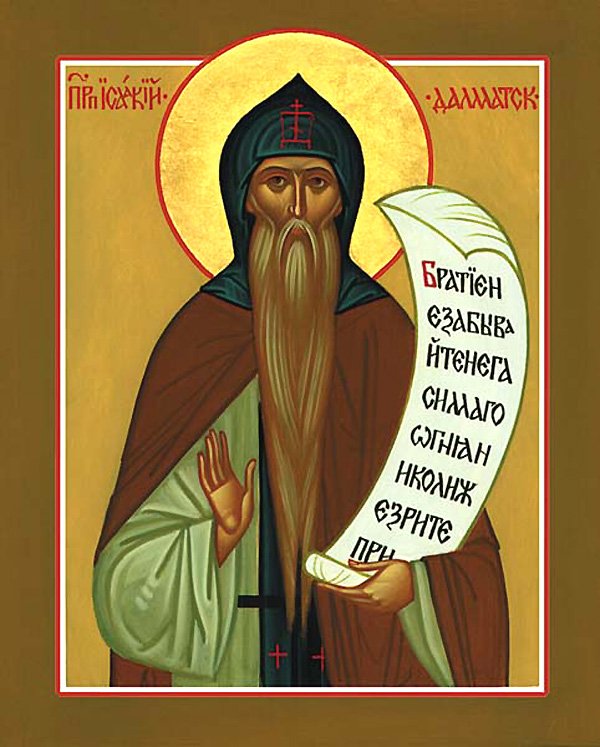
Venerable Isaac, Founder of Dalmátos Monastery at Constantinople
Saint Isaac lived during the IV century, received the monastic tonsure and pursued ascetic labors in the desert. During the reign of Emperor Valens (364-378), a zealous adherent of the Arian heresy, there was a persecution of the Orthodox, and churches were closed and destroyed.
Hearing of the persecution, Saint Isaac left the wilderness and went to Constantinople to console and encourage the Orthodox, and to fight against the heretics.
Saint Isaac lived during the IV century, received the monastic tonsure and pursued ascetic labors in the desert. During the reign of Emperor Valens (364-378), a zealous adherent of the Arian heresy, there was a persecution of the Orthodox, and churches were closed and destroyed.
Hearing of the persecution, Saint Isaac left the wilderness and went to Constantinople to console and encourage the Orthodox, and to fight against the heretics. At that time, barbarian Goths along the Danube River were making war against the Empire. They seized Thrace and advanced toward Constantinople.
When Emperor Valens was leaving the capital with his soldiers, Saint Isaac cried out, “Emperor, reopen the churches of the Orthodox, and then the Lord will aid you!” But the Emperor, disdaining the Saint's words, continued confidently on his way. The Saint repeated his request and prophecy three times. The angry Emperor ordered Saint Isaac to be thrown into a deep ravine, filled with thorns and mud, from which it was impossible to escape.
Saint Isaac remained alive by God’s help, and when he emerged he overtook the Emperor and said, “You wanted to destroy me, but three Angels pulled me from the mire. Hear me, reopen the churches for the Orthodox and you shall defeat the enemy. If you do not heed me, then you shall not return. You will be captured and burnt alive.” The Emperor was astonished at the Saint's boldness and ordered his attendants Saturninus and Victor to seize him and hold him in prison until his return.
Saint Isaac’s prophecy was soon fulfilled. The Goths defeated and pursued the Greek army. The Emperor and his Arian generals took refuge in a barn filled with straw, and the attackers set it ablaze. After news of the Emperor's death was received in Constantinople, Saint Isaac was released and honored as a prophet.
Then the holy Emperor Theodosios the Great (379-395) came to the throne. On the advice of Saturninus and Victor, he summoned the Elder, treating him with great respect. Obeying his instructions, he banished the Arians from Constantinople and restored the churches to the Orthodox. Saint Isaac wanted to return to his desert, but Saturninus and Victor begged him not to leave the city, but to remain and protect it by his prayers.
Saturninus built a monastery for Saint Isaac in Constantinople, where monks gathered around him. Saint Isaac was the Monastery’s Igoumen and spiritual guide. He also nourished laypeople, and helped many of the poor and suffering.
When he had reached an advanced age, Saint Isaac made Saint Dalmátos (August 3) Igoumen. The Monastery was later named for Dalmátos.
Saint Isaac reposed in the year 383, and his memory is also celebrated on March 22.
The Monastery of Saint Isaac in Saint Petersburg is dedicated to this Saint.
Saint Emmeleίa
Saint Emmeleia was from a pious family of Caesarea in Cappadocia. Her father became a Martyr during the last persecutions. Her life was a good root which produced sweet fruits (her children) who emerged as prominent members of society, and most of them were also Saints of the Church, such as Basil the Great, Gregory of Nyssa, Peter of Sebasteίa, the nun Makrina, and the monk Naukratios.
Saint Emmeleia was from a pious family of Caesarea in Cappadocia. Her father became a Martyr during the last persecutions. Her life was a good root which produced sweet fruits (her children) who emerged as prominent members of society, and most of them were also Saints of the Church, such as Basil the Great, Gregory of Nyssa, Peter of Sebasteίa, the nun Makrina, and the monk Naukratios. From a holy root come holy shoots; that is, from holy parents come blessed and holy children.
Saint Emmeleίa experienced many sorrows in her life, as is usually the case with the elect. Some of these were the death of her parents, even before she married, the death of her husband, as soon as their son Peter was born, the untimely death of her son Naukratios, and raising her children alone in the discipline and admonition of the Lord, but she faced these with exemplary faith, courage, and patience. She taught her children mainly by her own example. Along with her milk, she gave them the unadulterated milk of faith, and taught them the mysteries of the Church.
She ended her days in a Monastery, where her daughter Saint Makrina (July 19) was the Igoumeness.
Saint Emmeleίa is commemorated on January 1 in Slavic usage, and on May 30 in Greek usage.
Scripture Readings
☩Epistle
Acts 28:1-31
1
And when they were escaped, then they knew that the island was called Melita.
2
And the barbarous people shewed us no little kindness: for they kindled a fire, and received us every one, because of the present rain, and because of the cold.
3
And when Paul had gathered a bundle of sticks, and laid them on the fire, there came a viper out of the heat, and fastened on his hand.
4
And when the barbarians saw the venomous beast hang on his hand, they said among themselves, No doubt this man is a murderer, whom, though he hath escaped the sea, yet vengeance suffereth not to live.
5
And he shook off the beast into the fire, and felt no harm.
6
Howbeit they looked when he should have swollen, or fallen down dead suddenly: but after they had looked a great while, and saw no harm come to him, they changed their minds, and said that he was a god.
7
In the same quarters were possessions of the chief man of the island, whose name was Publius; who received us, and lodged us three days courteously.
8
And it came to pass, that the father of Publius lay sick of a fever and of a bloody flux: to whom Paul entered in, and prayed, and laid his hands on him, and healed him.
9
So when this was done, others also, which had diseases in the island, came, and were healed:
10
Who also honoured us with many honours; and when we departed, they laded us with such things as were necessary.
11
And after three months we departed in a ship of Alexandria, which had wintered in the isle, whose sign was Castor and Pollux.
12
And landing at Syracuse, we tarried there three days.
13
And from thence we fetched a compass, and came to Rhegium: and after one day the south wind blew, and we came the next day to Puteoli:
14
Where we found brethren, and were desired to tarry with them seven days: and so we went toward Rome.
15
And from thence, when the brethren heard of us, they came to meet us as far as Appii forum, and The three taverns: whom when Paul saw, he thanked God, and took courage.
16
And when we came to Rome, the centurion delivered the prisoners to the captain of the guard: but Paul was suffered to dwell by himself with a soldier that kept him.
17
And it came to pass, that after three days Paul called the chief of the Jews together: and when they were come together, he said unto them, Men and brethren, though I have committed nothing against the people, or customs of our fathers, yet was I delivered prisoner from Jerusalem into the hands of the Romans.
18
Who, when they had examined me, would have let me go, because there was no cause of death in me.
19
But when the Jews spake against it, I was constrained to appeal unto Cesar; not that I had ought to accuse my nation of.
20
For this cause therefore have I called for you, to see you, and to speak with you: because that for the hope of Israel I am bound with this chain.
21
And they said unto him, We neither received letters out of Judea concerning thee, neither any of the brethren that came shewed or spake any harm of thee.
22
But we desire to hear of thee what thou thinkest: for as concerning this sect, we know that every where it is spoken against.
23
And when they had appointed him a day, there came many to him into his lodging; to whom he expounded and testified the kingdom of God, persuading them concerning Jesus, both out of the law of Moses, and out of the prophets, from morning till evening.
24
And some believed the things which were spoken, and some believed not.
25
And when they agreed not among themselves, they departed, after that Paul had spoken one word, Well spake the Holy Ghost by Esaias the prophet unto our fathers,
26
Saying, Go unto this people, and say, Hearing ye shall hear, and shall not understand; and seeing ye shall see, and not perceive:
27
For the heart of this people is waxed gross, and their ears are dull of hearing, and their eyes have they closed; lest they should see with their eyes, and hear with their ears, and understand with their heart, and should be converted, and I should heal them.
28
Be it known therefore unto you, that the salvation of God is sent unto the Gentiles, and that they will hear it.
29
And when he had said these words, the Jews departed, and had great reasoning among themselves.
30
And Paul dwelt two whole years in his own hired house, and received all that came in unto him,
31
Preaching the kingdom of God, and teaching those things which concern the Lord Jesus Christ, with all confidence, no man forbidding him.
☩Gospel
John 21:15-25
15
So when they had dined, Jesus saith to Simon Peter, Simon, son of Jonas, lovest thou me more than these? He saith unto him, Yea, Lord; thou knowest that I love thee. He saith unto him, Feed my lambs.
16
He saith to him again the second time, Simon, son of Jonas, lovest thou me? He saith unto him, Yea, Lord; thou knowest that I love thee. He saith unto him, Feed my sheep.
17
He saith unto him the third time, Simon, son of Jonas, lovest thou me? Peter was grieved because he said unto him the third time, Lovest thou me? And he said unto him, Lord, thou knowest all things; thou knowest that I love thee. Jesus saith unto him, Feed my sheep.
18
Verily, verily, I say unto thee, When thou wast young, thou girdedst thyself, and walkedst whither thou wouldest: but when thou shalt be old, thou shalt stretch forth thy hands, and another shall gird thee, and carry thee whither thou wouldest not.
19
This spake he, signifying by what death he should glorify God. And when he had spoken this, he saith unto him, Follow me.
20
Then Peter, turning about, seeth the disciple whom Jesus loved following; which also leaned on his breast at supper, and said, Lord, which is he that betrayeth thee?
21
Peter seeing him saith to Jesus, Lord, and what shall this man do?
22
Jesus saith unto him, If I will that he tarry till I come, what is that to thee? follow thou me.
23
Then went this saying abroad among the brethren, that that disciple should not die: yet Jesus said not unto him, He shall not die; but, If I will that he tarry till I come, what is that to thee?
24
This is the disciple which testifieth of these things, and wrote these things: and we know that his testimony is true.
25
And there are also many other things which Jesus did, the which, if they should be written every one, I suppose that even the world itself could not contain the books that should be written. Amen.
Liturgical data sourced from OCA.org and orthocal.info