Fasting Rules
 Meat
Abstain
Meat
Abstain
 Fish
Abstain
Fish
Abstain
 Dairy
Abstain
Dairy
Abstain
 Oil
Abstain
Oil
Abstain
 Wine
Abstain
Wine
Abstain
Saints & Commemorations
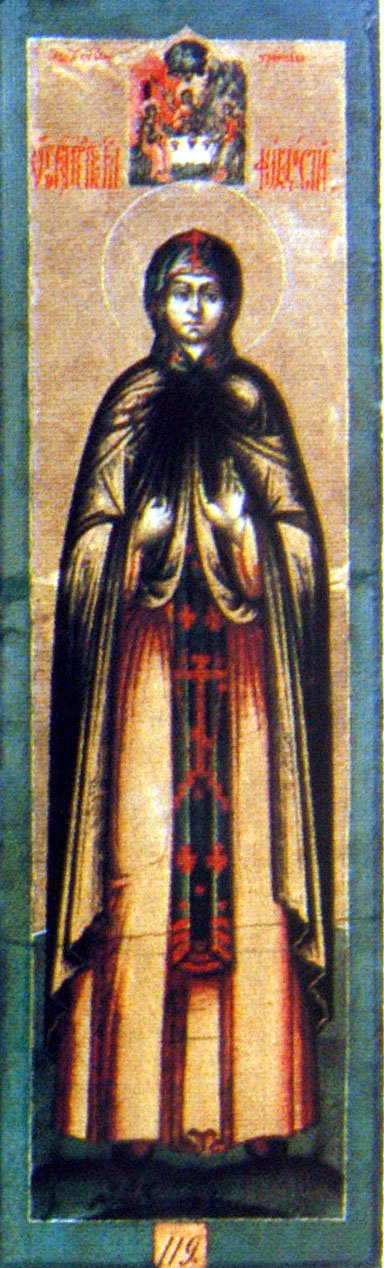
Holy Virgin Martyr Theodosίa of Tyre
Saint Theodosίa of Tyre lived during the III and IV centuries. Once, during a persecution against Christians, which had already lasted for five years, the seventeen-year-old Theodosίa visited some condemned Christian prisoners in the Praetorium at Caesarea in Palestine. It was the day of Holy Pascha, and the Martyrs were speaking about the Kingdom of God. S
Saint Theodosίa of Tyre lived during the III and IV centuries. Once, during a persecution against Christians, which had already lasted for five years, the seventeen-year-old Theodosίa visited some condemned Christian prisoners in the Praetorium at Caesarea in Palestine. It was the day of Holy Pascha, and the Martyrs were speaking about the Kingdom of God. Saint Theodosίa asked them to remember her when they appeared before the Lord.
When the soldiers saw that the girl had bowed to the prisoners, they seized her and led her before the governor, Urban. The governor urged the Saint to offer sacrifice to the idols, but she refused, professing her faith in Christ. Then she was subjected to cruel tortures; her sides and breasts were raked with iron claws until her bones were exposed. She endured this in silence with astonishing courage. Again Urban told her to sacrifice, but she mocked him saying: “Foolish man, why do you persist? Can you not see that I have received everything I prayed for, and that I am honored to share the fate of these Martyrs for Christ?"
After saying this, she was tormented even more severely than before. The holy virgin was cast into the sea with a stone tied around her neck, but Angels rescued her from the depths. Then they tossed her into the arena to be eaten by wild animals. Seeing that the beasts would not touch her, the soldiers beheaded her.
That night Saint Theodosίa appeared to her parents, who had tried to persuade their daughter not to let herself be tortured. She wore radiant garments, a crown upon her head, and held a luminous gold cross in her hand. She said to them, “Behold the great glory of which you wished to deprive me!”
The Holy Virgin Martyr Theodosίa of Tyre suffered for Christ on April 3 in the year 307 or 308. She is also commemorated on May 29 (the transfer of her relics to Constantinople, and later to Venice).
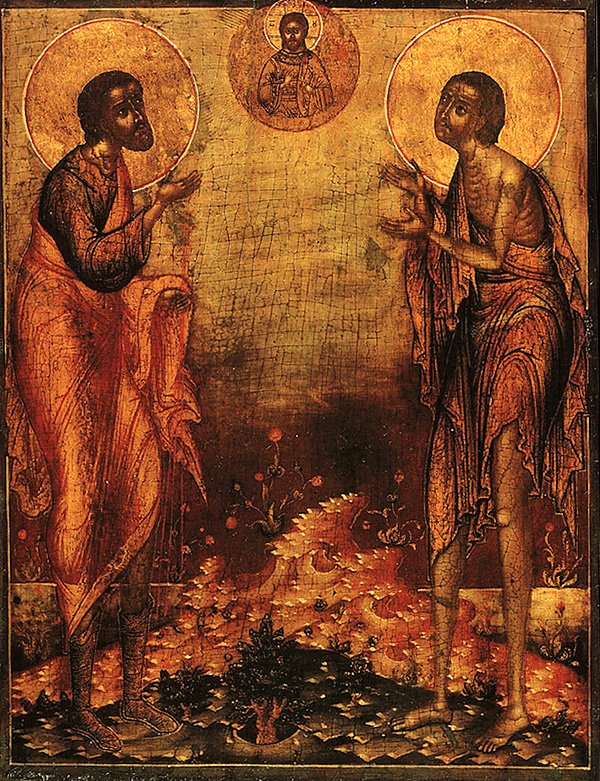
Repose of the Blessed John of Ustiug the Fool-for-Christ
Blessed John, the Fool-for-Christ and Wonderworker of Ustiug, was born in the village of Pukhovo, near Old Ustiug, of pious parents Savva and Maria. From his youth he distinguished himself by a strict life of fasting. On Wednesdays and Fridays he ate nothing, and on other days he ate only bread and water.
Blessed John, the Fool-for-Christ and Wonderworker of Ustiug, was born in the village of Pukhovo, near Old Ustiug, of pious parents Savva and Maria. From his youth he distinguished himself by a strict life of fasting. On Wednesdays and Fridays he ate nothing, and on other days he ate only bread and water. His parents moved to the city of Orlets along the Iug River, forty versts from Ustiug. Left as a widow, the Saint’s mother was tonsured at Holy Trinity Monastery in Orlets with the monastic name Natalia. The young John began by keeping silence, and then he embraced the path of foolishness for the sake of Christ.
Going about the city of Ustiug, he lived in a hut that had been built for him, and spent his nights at unceasing prayer. By day, however, he went through the streets of the city barefoot and in rags all year long, resting sometimes on a dung heap. He endured much abuse and derision from the people of the city.
Even during his lifetime, the Saint was granted the gift of wonderworking. He reposed at a young age on May 29, 1494, and was buried near the Dormition cathedral in the city of Ustiug. Later, a church dedicated to him was built over his relics.
The Service to Blessed John of Ustiug was composed in the XVI century. His Life was written in 1554, based on the recollections of people who had known him. The holy ascetic was famed as an intercessor during the invasions of enemies, and as a healer of those afflicted with various ailments.
Blessed John of Ustiug is also commemorated on the Third Sunday after Pentecost (Synaxis of the Vologda Saints).
Troparion - Tone 8
By a flood of tears you made the desert fertile, / and your longing for God brought forth fruits in abundance. / By the radiance of miracles you illumined the whole universe! / O our holy father John, pray to Christ our God to save our souls!
Kontakion - Tone 1
O most wise John, you did not love earthly glory, / so you became a fool, / desiring to inherit the Kingdom of Heaven, / you received beatings and insults, and endured nakedness and heat; / now that you rejoice with the Angels, / pray to Christ God for our souls.
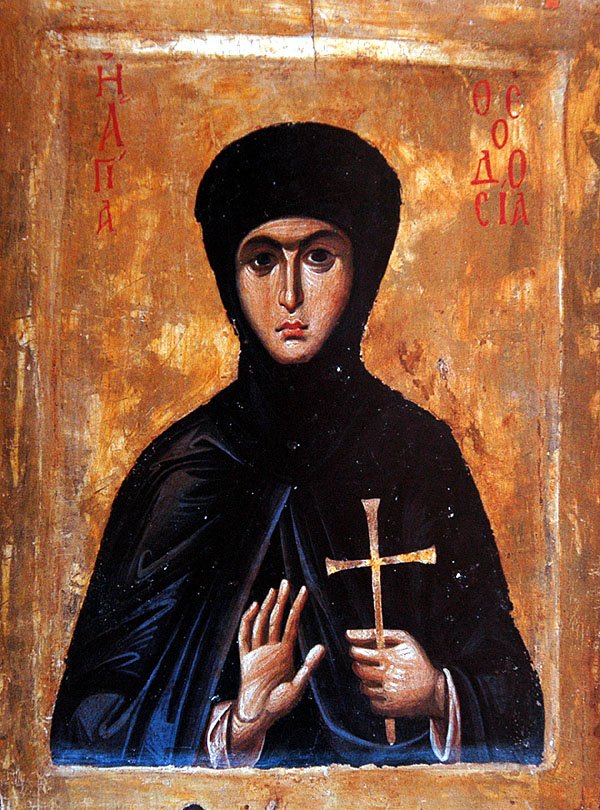
Virgin Martyr Theodosia the Nun of Constantinople
The Virgin Martyr Theodosia of Constantinople lived during the eighth century. She was born in answer to the fervent prayers of her parents. After their death, she was raised at the women’s monastery of the holy Martyr Anastasia in Constantinople. Saint Theodosia became a nun after she distributed to the poor of what remained of her parental inheritance. S
The Virgin Martyr Theodosia of Constantinople lived during the eighth century. She was born in answer to the fervent prayers of her parents. After their death, she was raised at the women’s monastery of the holy Martyr Anastasia in Constantinople. Saint Theodosia became a nun after she distributed to the poor of what remained of her parental inheritance. She used part of the money to commission gold and silver icons of the Savior, the Theotokos, and Saint Anastasia.
When Leo the Isaurian (717-741) ascended the imperial throne, he issued an edict to destroy holy icons everywhere. Above the Bronze Gates at Constantinople was a bronze icon of the Savior, which had been there for more than 400 years. In 730, the iconoclast Patriarch Anastasius ordered the icon removed.
The Virgin Martyr Theodosia and other women rushed to protect the icon and toppled the ladder with the soldier who was carrying out the command. Then they stoned the impious Patriarch Anastasius, and Emperor Leo ordered soldiers to behead the women. Saint Theodosia, an ardent defender of icons, was locked up in prison. For a week they gave her a hundred lashes each day. On the eighth day, they led her about the city, fiercely beating her along the way. One of the soldiers stabbed the nun in the throat with a ram’s horn, and she received the crown of martyrdom.
The body of the holy virgin martyr was reverently buried by Christians in the monastery of Saint Euphemia in Constantinople, near a place called Dexiokratis. The tomb of Saint Theodosia was glorified by numerous healings of the sick.
Troparion - Tone 4
Your lamb Theodosia, O Jesus, / calls out to You in a loud voice: / I love You, O my bridegroom, / and in seeking You, I endure suffering. / In Baptism I was crucified so that I might reign in You, / and died so that I might live with You. / Accept me as a pure sacrifice, / for I have offered myself in love. / By her prayers save our souls, since You are merciful.
Kontakion - Tone 2
Through your striving, O venerable Theodosia, / you inherited a life of peace. / By shedding your blood, you vanquished the enemy of the Church of Christ. / As you rejoice now in His presence, ever pray to Him for us all!
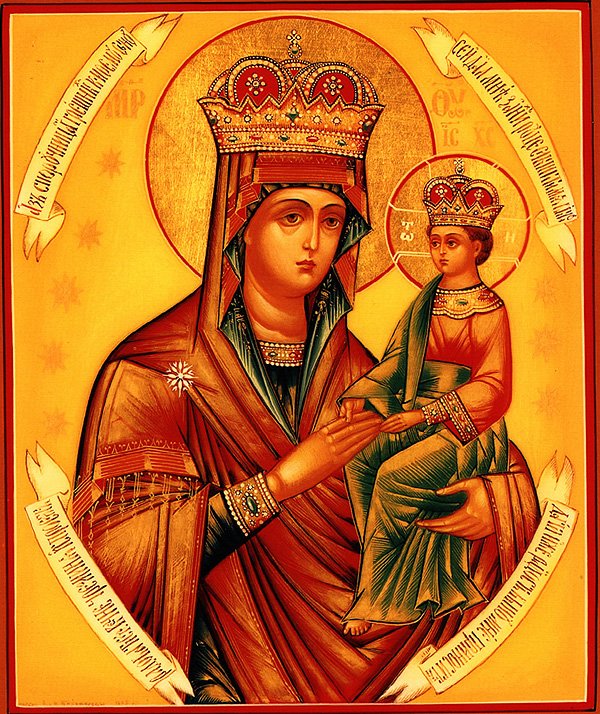
Icon of the Mother of God “the Surety of Sinners”
The Icon of the Mother of God “Surety of Sinners” is known by this name because of the inscription on the icon: “I am the Surety of sinners for My Son Who has entrusted Me to hear them, and those who bring Me the joy of hearing them will receive eternal joy through Me.” The Mother of God embraces Her Child, Who holds Her right hand with both His hands so that Her thumb is in His right hand, and Her small finger in His left hand. This is
The Icon of the Mother of God “Surety of Sinners” is known by this name because of the inscription on the icon: “I am the Surety of sinners for My Son Who has entrusted Me to hear them, and those who bring Me the joy of hearing them will receive eternal joy through Me.” The Mother of God embraces Her Child, Who holds Her right hand with both His hands so that Her thumb is in His right hand, and Her small finger in His left hand. This is the gesture of one who gives surety for another.
Although we do not know when or by whom the icon was originally painted, it is believed that the basis of the icon is to be found in the Akathist to the Protection of the Most Holy Theotokos: “Rejoice, You Who offer Your hands in surety for us to God.”
This icon was first glorified by miracles at the Saint Nicholas Odrino men’s monastery of the former Orlov gubernia in the mid-nineteenth century (The “Assuage My Sorrows Icon” commemorated on October 9 is also from this monastery). The “Surety of Sinners” icon of the Mother of God was in an old chapel beyond the monastery gates, and stood between two other ancient icons. Because it was so faded and covered with dust, it was impossible to read the inscription.
In 1843 it was revealed to many of the people in dreams that the icon was endowed with miraculous power. They solemnly brought the icon into the church. Believers began to flock to it to pray for the healing of their sorrows and sicknesses. The first to receive healing was a crippled child, whose mother prayed fervently before the icon in 1844. The icon was glorified during a cholera epidemic, when many people fell deathly ill, and were restored to health after praying before the icon.
A large stone church with three altars was built at the monastery in honor of the wonderworking icon.
In 1848, through the zeal of Lt. Col. Demetrius Boncheskul, a copy of the wonderworking image was made and placed in his home. Soon it began to exude a healing myrrh, which was given to many so they might recover their health after grievous illnesses. Boncheskul donated this wonderworking copy to the church of Saint Nicholas at Khamovniki in Moscow, where a chapel was built in honor of the icon.
The “Surety of Sinners” Icon is also commemorated on March 7 and on Thursday of the week of All Saints.
Troparion
You have been an honorable dwelling of the inexpressible Divine nature, beyond words and beyond understanding; / and are a Surety for sinners, granting grace and healing; / as the Mother of Him Who rules all, / pray to your Son that we may receive mercy on the Day of Judgment.
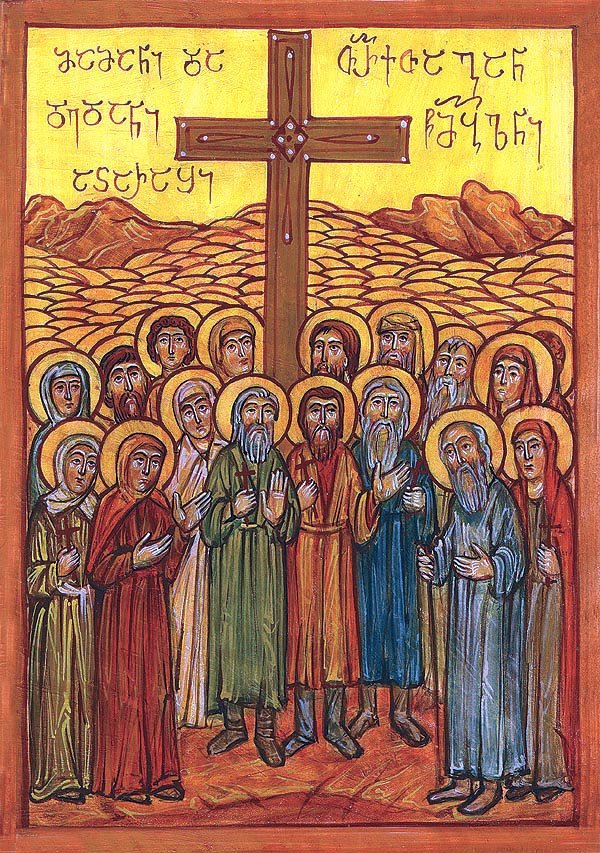
Martyred Fathers and Mothers of Atchara
Atchara has been a Christian stronghold since apostolic times. It was through this region that Saint Andrew the First-called entered Georgia, preaching the Gospel for the first time in the Iberian land. In this land, in the village of Gonio, the holy relics of the martyred Apostle Matthias are buried.
Atchara has been a Christian stronghold since apostolic times. It was through this region that Saint Andrew the First-called entered Georgia, preaching the Gospel for the first time in the Iberian land. In this land, in the village of Gonio, the holy relics of the martyred Apostle Matthias are buried.
Since the 16th century Atchara has been subject to constant assaults by the Turks. Having attained a victory in the Ottoman-Persian War, the Turks gained a large part of southern and western Georgia: Samtskhe, Atchara, and Chaneti were declared Turkish provinces. The invaders knew well that, in order to completely conquer the Georgian people, it was necessary to uproot Christianity. Thus they instituted a systematic campaign of forced conversion to Islam.
When they failed to achieve their goal with bribery and deception, they resorted to violence.
In his work The Islamization of Georgia, or the Spread of Islam in Western Georgia in the 17th-18th Centuries , the renowned early twentieth-century scholar Zakaria Chichinadze retold a story he had heard from one elderly Atcharan man: “In Atchara the implanting of Islam faced a powerful opposition. Many of the elderly men and the majority of women stood firmly by the Christian Faith, and even challenged and debated the Turkish mullahs.... The number of these aged men in Atchara was considerably high. In the end an order was issued: to arrest all dissidents, forcibly convert them to Islam, and execute those who resisted. Before long all the elderly Christians of Atchara were arrested and cast in prison. Then they were led to the River Atcharistsqali, to a 12th-century bridge known as the ‘Bridge of Queen Tamar.’ On that bridge the Ottomans erected a guillotine.
“They chopped off the heads of the elderly people, sent the ends of their tongues to the pasha, and threw their bodies into the river. This happened one hundred years ago, in the year 1790.”
Gallows and a guillotine were erected in the villages of Atcharistsqali, Keda, Chakvi, Khulo, Machakhela, and Gonio. The documents preserved in the manuscript collection at Akhaltsikhe Museum describe in even more horrific detail the martyrdom of the Atcharan Christians: “The human tongue is powerless to describe the tortures that the Georgians suffered in those years for confessing Christianity. While they were still alive their flesh was stripped and their bodies quartered; they were slashed to pieces with swords, their bellies ripped open; they were roasted over campfires. They were pierced with flaming rods, thrown into cauldrons of boiling water; molten lead was poured down their throats; they were tossed into pools of hot lime....”
The Georgian Apostolic Church has numbered among the saints all the holy fathers and mothers of Atchara who sacrificed their lives in defense of the Christian Faith.
Troparion - Tone 4
Your holy martyrs, O Lord, / through their sufferings have received an incorruptible crown from You, our God. / For having Your strength, they laid low their adversaries, / and shattered the powerless boldness of demons. / Through their intercessions, save our souls!
Scripture Readings
☩Epistle
Acts 27:1-44
1
And when it was determined that we should sail into Italy, they delivered Paul and certain other prisoners unto one named Julius, a centurion of Augustus’ band.
2
And entering into a ship of Adramyttium, we launched, meaning to sail by the coasts of Asia; one Aristarchus, a Macedonian of Thessalonica, being with us.
3
And the next day we touched at Sidon. And Julius courteously entreated Paul, and gave him liberty to go unto his friends to refresh himself.
4
And when we had launched from thence, we sailed under Cyprus, because the winds were contrary.
5
And when we had sailed over the sea of Cilicia and Pamphylia, we came to Myra, a city of Lycia.
6
And there the centurion found a ship of Alexandria sailing into Italy; and he put us therein.
7
And when we had sailed slowly many days, and scarce were come over against Cnidus, the wind not suffering us, we sailed under Crete, over against Salmone;
8
And, hardly passing it, came unto a place which is called The fair havens; nigh whereunto was the city of Lasea.
9
Now when much time was spent, and when sailing was now dangerous, because the fast was now already past, Paul admonished them,
10
And said unto them, Sirs, I perceive that this voyage will be with hurt and much damage, not only of the lading and ship, but also of our lives.
11
Nevertheless the centurion believed the master and the owner of the ship, more than those things which were spoken by Paul.
12
And because the haven was not commodious to winter in, the more part advised to depart thence also, if by any means they might attain to Phenice, and there to winter; which is an haven of Crete, and lieth toward the south west and north west.
13
And when the south wind blew softly, supposing that they had obtained their purpose, loosing thence, they sailed close by Crete.
14
But not long after there arose against it a tempestuous wind, called Euroclydon.
15
And when the ship was caught, and could not bear up into the wind, we let her drive.
16
And running under a certain island which is called Clauda, we had much work to come by the boat:
17
Which when they had taken up, they used helps, undergirding the ship; and, fearing lest they should fall into the quicksands, strake sail, and so were driven.
18
And we being exceedingly tossed with a tempest, the next day they lightened the ship;
19
And the third day we cast out with our own hands the tackling of the ship.
20
And when neither sun nor stars in many days appeared, and no small tempest lay on us, all hope that we should be saved was then taken away.
21
But after long abstinence Paul stood forth in the midst of them, and said, Sirs, ye should have hearkened unto me, and not have loosed from Crete, and to have gained this harm and loss.
22
And now I exhort you to be of good cheer: for there shall be no loss of any man’s life among you, but of the ship.
23
For there stood by me this night the angel of God, whose I am, and whom I serve,
24
Saying, Fear not, Paul; thou must be brought before Cesar: and, lo, God hath given thee all them that sail with thee.
25
Wherefore, sirs, be of good cheer: for I believe God, that it shall be even as it was told me.
26
Howbeit we must be cast upon a certain island.
27
But when the fourteenth night was come, as we were driven up and down in Adria, about midnight the shipmen deemed that they drew near to some country;
28
And sounded, and found it twenty fathoms: and when they had gone a little further, they sounded again, and found it fifteen fathoms.
29
Then fearing lest we should have fallen upon rocks, they cast four anchors out of the stern, and wished for the day.
30
And as the shipmen were about to flee out of the ship, when they had let down the boat into the sea, under colour as though they would have cast anchors out of the foreship,
31
Paul said to the centurion and to the soldiers, Except these abide in the ship, ye cannot be saved.
32
Then the soldiers cut off the ropes of the boat, and let her fall off.
33
And while the day was coming on, Paul besought them all to take meat, saying, This day is the fourteenth day that ye have tarried and continued fasting, having taken nothing.
34
Wherefore I pray you to take some meat: for this is for your health: for there shall not an hair fall from the head of any of you.
35
And when he had thus spoken, he took bread, and gave thanks to God in presence of them all: and when he had broken it, he began to eat.
36
Then were they all of good cheer, and they also took some meat.
37
And we were in all in the ship two hundred threescore and sixteen souls.
38
And when they had eaten enough, they lightened the ship, and cast out the wheat into the sea.
39
And when it was day, they knew not the land: but they discovered a certain creek with a shore, into the which they were minded, if it were possible, to thrust in the ship.
40
And when they had taken up the anchors, they committed themselves unto the sea, and loosed the rudder bands, and hoised up the mainsail to the wind, and made toward shore.
41
And falling into a place where two seas met, they ran the ship aground; and the forepart stuck fast, and remained unmoveable, but the hinder part was broken with the violence of the waves.
42
And the soldiers’ counsel was to kill the prisoners, lest any of them should swim out, and escape.
43
But the centurion, willing to save Paul, kept them from their purpose; and commanded that they which could swim should cast themselves first into the sea, and get to land:
44
And the rest, some on boards, and some on broken pieces of the ship. And so it came to pass, that they escaped all safe to land.
☩Gospel
John 17:18-26
18
As thou hast sent me into the world, even so have I also sent them into the world.
19
And for their sakes I sanctify myself, that they also might be sanctified through the truth.
20
Neither pray I for these alone, but for them also which shall believe on me through their word;
21
That they all may be one; as thou, Father, art in me, and I in thee, that they also may be one in us: that the world may believe that thou hast sent me.
22
And the glory which thou gavest me I have given them; that they may be one, even as we are one:
23
I in them, and thou in me, that they may be made perfect in one; and that the world may know that thou hast sent me, and hast loved them, as thou hast loved me.
24
Father, I will that they also, whom thou hast given me, be with me where I am; that they may behold my glory, which thou hast given me: for thou lovedst me before the foundation of the world.
25
O righteous Father, the world hath not known thee: but I have known thee, and these have known that thou hast sent me.
26
And I have declared unto them thy name, and will declare it: that the love wherewith thou hast loved me may be in them, and I in them.
Liturgical data sourced from OCA.org and orthocal.info