Fasting Rules

Meat allowed Meat Allowed
Fish allowed Fish Allowed
Dairy allowed Dairy Allowed
Oil allowed Oil Allowed
Wine allowed Wine Allowed

Saints & Commemorations
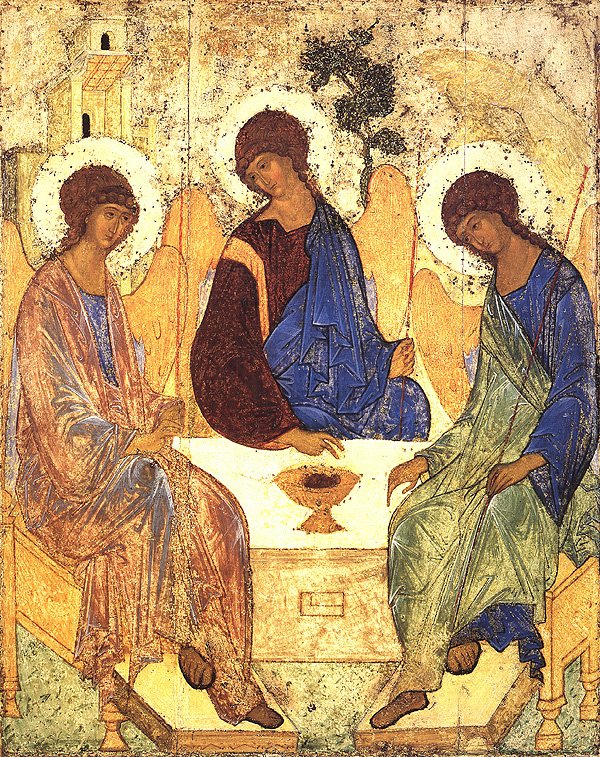
Postfeast of Pentecost — 3rd Day of the Trinity

Postfeast of Pentecost — 3rd Day of the Trinity

Many of the hymns of Pentecost are repeated in the postfestal services of this week, and references to the Holy Spirit, and to fire, abound. In particular, we are reminded of the Unburnt Bush (Exodus 3:2), the zealous Prophet Elias who ascended to Heaven in a chariot of fire, the three youths in the fiery furnace, and the Lord descending on Mt. Many of the hymns of Pentecost are repeated in the postfestal services of this week, and references to the Holy Spirit, and to fire, abound. In particular, we are reminded of the Unburnt Bush (Exodus 3:2), the zealous Prophet Elias who ascended to Heaven in a chariot of fire, the three youths in the fiery furnace, and the Lord descending on Mt. Sinai in fire (Exodus 19:18). As we commemorate the Holy Spirit this week, we look forward to the Sunday of All Saints, those righteous men and women of all nations and in every age, who were perfected and sanctified by the same Holy Spirit.

Troparion - Tone 8

Blessed are You O Christ Our God / You have revealed the fishermen as most wise / by sending down upon them the Holy Spirit / through them You drew the world into Your net / O Lover of Man, Glory to You!

Kontakion - Tone 8

When the most High came down and confused the tongues, / He divided the nations; / but when he distributed the tongues of fire / He called all to unity. / Therefore, with one voice, we glorify the All-holy Spirit!

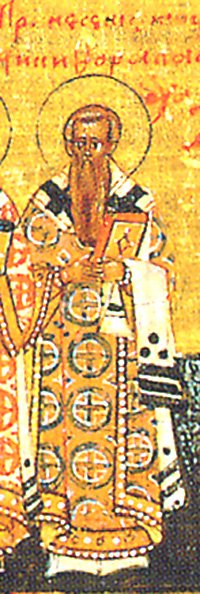
St Nicephorus the Confessor

Saint Nikephoros the Confessor, Patriarch of Constantinople

Saint Nikephoros the Confessor, Patriarch of Constantinople

Saint Nikephoros (Nikēphóros) was a dignitary at the court of the Empress Irene (797-802). After embracing monasticism, he became widely known for his piety. He assumed the Patriarchal Throne of Constantinople in 806 and became a zealous defender of the holy Icons. In 815, the Iconoclast Emperor Leo the Armenian (813-820) exiled him to Prokonnis, where he fell asleep in the Lord in 828. Saint Nikephoros (Nikēphóros) was a dignitary at the court of the Empress Irene (797-802). After embracing monasticism, he became widely known for his piety. He assumed the Patriarchal Throne of Constantinople in 806 and became a zealous defender of the holy Icons. In 815, the Iconoclast Emperor Leo the Armenian (813-820) exiled him to Prokonnis, where he fell asleep in the Lord in 828. Saint Nikephoros left behind three writings against Iconoclasm. In 846, the relics of Patriarch Nikephoros were returned to Constantinople and placed in the Great Church of Hagia Sophia for one day before being transferred to and enshrined in the Church of the Holy Apostles.

Troparion - Tone 3

Through your inspired confession, / you gained victory for the Church, holy Hierarch Nicephorus. / You suffered unjust exile / because of your reverence for the icon of God the Word. / Righteous Father, entreat Christ our God to grant us His great mercy.
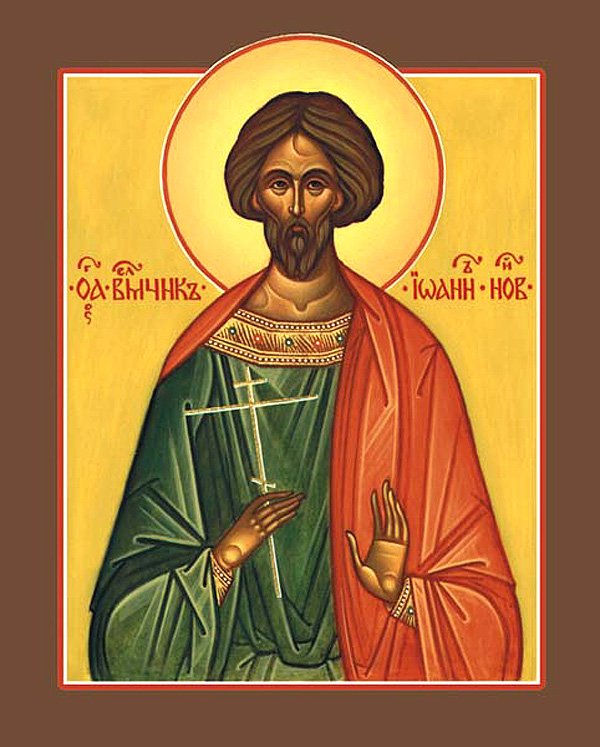
New Martyr John the New of Sochi, who suffered at Belgrade

New Martyr John the New of Sochi, who suffered at Belgrade

The Holy Great Martyr John the New of Sochi, lived in the fourteenth century in the city of Trebizond. He was a merchant, devout and firm in his Orthodoxy, and generous to the poor. Once, he happened to be sailing on a ship while pursuing his trading activities. The captain of the ship was not Orthodox, but got into an argument about the Faith with Saint John. The Holy Great Martyr John the New of Sochi, lived in the fourteenth century in the city of Trebizond. He was a merchant, devout and firm in his Orthodoxy, and generous to the poor. Once, he happened to be sailing on a ship while pursuing his trading activities. The captain of the ship was not Orthodox, but got into an argument about the Faith with Saint John. Having been vanquished by the saint’s words, the captain resolved to make trouble for him when they got to Belgrade. During the ship’s stay at Belgrade, the captain went to the city ruler, a fire-worshipper, and suggested that on his ship was a studious man who also desired to become a fire-worshipper. The city ruler invited Saint John to join the fire-worshippers and renounce his faith in Christ. The saint prayed secretly, calling on the help of Him Who said, “When they shall lead you, and deliver you up, take no thought beforehand what you shall speak, neither do you premeditate; but whatsoever will be given you in that hour, speak that, for it is not you that speaks, but the Holy Spirit” (Mark 13:11). And the Lord gave him the courage and understanding to counter all the claims of the impious and firmly confess himself a Christian. After this, the saint was so fiercely beaten with rods that his entire body was lacerated, and the flesh came off in pieces. The holy martyr thanked God for being found worthy to shed his blood for Him and thereby wash away his sins. Afterwards they put him in chains and dragged him away to prison. In the morning the city ruler ordered the saint brought forth again. The martyr came before him with a bright and cheerful face. The intrepid martyr absolutely refused to deny Christ, denouncing the governor as a tool of Satan. Then they beat him again with rods, so that all his insides were laid bare. The gathering crowd could not bear this horrible spectacle and they began to shout angrily, denouncing the governor for tormenting a defenseless man. The governor, having the beating stopped, gave orders to tie the Great Martyr to the tail of a wild horse to drag him by the legs through the streets of the city. Residents of the Jewish quarter particularly scoffed at the martyr and threw stones at him. Finally, someone took a sword and cut off his head. Saint John’s body with his severed head lay there until evening, and none of the Christians dared to take him away. By night a luminous pillar was seen over him, and a multitude of burning lamps. Three light-bearing men sang Psalms and censed the body of the saint. One of the Jews, thinking that these were Christians coming to take up the remains of the martyr, grabbed a bow and tried to shoot an arrow at them, but he was restrained by the invisible power of God, and became rigid. In the morning the vision vanished, but the archer continued to stand motionless. Having told the gathering inhabitants of the city about the vision and what was done to him by the command of God, he was freed from his invisible bonds. Having learned about the occurrence, the ruler gave permission to bury the body of the martyr in the local church. This occurred between the years 1330 and 1340. There is some question about the year of the saint’s martyrdom. Saint Νikόdēmos of the Holy Mountain gives the year as 1642, while others say it was 1492. The captain who had betrayed Saint John repented of his deed, and decided secretly to convey the relics to his own country, but the saint appeared in a dream to the priest of the church, and prevented this. After seventy years the relics were transferred to Sochi, the capital of the Moldo-Valachian principality, and placed in the cathedral church.

Troparion - Tone 3

Your holy martyr John, O Lord, / through his sufferings has received an incorruptible crown from You, our God. / For having Your strength, he laid low his adversaries, / and shattered the powerless boldness of demons. / Through his intercessions, save our souls!

Holy New Martyr Constantine (1819)

He was born a Muslim on the island of Lesbos (Mitylene), but became convinced of the truth of Christ after he was healed of a serious illness by the aid of holy water in a church. He traveled to the Holy Mountain and was baptised at the monastery of Kapsokalyvia. Later, he was seized by the Turks, who first tortured him viciously and, when he would not deny the Faith, hanged him in Constantinople.

Uncovering of the relics of Venerable Juliana, Princess of Vyazma

The relics of the holy Princess Juliana of Vyazma were uncovered in 1819. Saint Juliana’s body was buried in the Torzhok cathedral on the right side by the south doors in 1407. Later, a tomb for her relics was built at the Savior-Transfiguration cathedral, where she healed many. In connection with the glorification of Saint Juliana on June 2, 1819 a chapel was built on the right-hand side, and dedicated to her In 1906 church was built and dedicated to Saint Juliana at the cathedral of the Transfiguration of the Lord, where previously there had been a chapel over the saint’s grave. Sa The relics of the holy Princess Juliana of Vyazma were uncovered in 1819. Saint Juliana’s body was buried in the Torzhok cathedral on the right side by the south doors in 1407. Later, a tomb for her relics was built at the Savior-Transfiguration cathedral, where she healed many. In connection with the glorification of Saint Juliana on June 2, 1819 a chapel was built on the right-hand side, and dedicated to her In 1906 church was built and dedicated to Saint Juliana at the cathedral of the Transfiguration of the Lord, where previously there had been a chapel over the saint’s grave. Saint Juliana is also commemorated on December 21.

Troparion - Tone 2

Living devoutly according to the Law, and adorned with good deeds, / you appeared as a hard diamond, O Holy Right-believing Princess Juliana, / despising perishable glory and bodily beauty, / you defeated the insidious Enemy, and you were martyred for the sake of chastity. / Therefore, you were crowned by Christ God with an imperishable and eternal crown, / and now you rejoice in the assembly of the Martyrs. / Therefore, we cry out to you: / “Entreat Christ God for all of us, who with faith and love revere your sufferings.”

Kontakion - Tone 2

Today let us sing to God, the Benefactor of all, / Who glorified the divinely-wise Juliana in Russia, / that by her prayers He may grant to our souls / the forgiveness of sins and great mercy.

Hieromartyr Erazmo of Ochrid (303)

“This saint was born in Antioch and lived in the reigns of Diocletian and Maximian. He lived in strict asceticism on Mount Lebanon, and was endowed by God with great wonderworking gifts. As a bishop, he set out to preach the Gospel. Arriving at the city of Ochrid, he restored the son of a man called Anastasius to life by his prayers, and baptised him. A “This saint was born in Antioch and lived in the reigns of Diocletian and Maximian. He lived in strict asceticism on Mount Lebanon, and was endowed by God with great wonderworking gifts. As a bishop, he set out to preach the Gospel. Arriving at the city of Ochrid, he restored the son of a man called Anastasius to life by his prayers, and baptised him. At this time, Erazmo baptised many other pagans and tore down the idolatrous altar in Ochrid. For this he was denounced to the Emperor Maximian, who was at that time staying in Illyria. The Emperor brought him before the copper image of Zeus, and ordered him to bring sacrifices and worship the idol. St Erazmo, by his power, caused a terrible dragon to come out of the statue, which terrified all the people. The saint then worked another wonder, and the dragon died. Then the saint preached Christ and baptised 20,000 souls. The furious Emperor commanded that all 20,000 be beheaded, and put Erazmo to harsh torture, before throwing him into prison. But an angel of God appeared to him, as once to the Apostle Peter, and led him out of the prison. After that, this servant of God went to Campania, where he preached the Gospel to the people, then returned again to the town of Hermelia, where he withdrew to a cave and lived in asceticism for the rest of his days. At the time of his death, he prostrated three times towards the East and, with upraised hands, prayed to God to forgive and give eternal life to all those who would, with faith, call upon his name. At the end of his prayer, a voice was heard from heaven: ‘Let it be as thou hast asked, My little healer Erazmo!’ The saint looked up once more to heaven with great joy and saw a wreath of glory descending upon him, and a choir of angels, prophets, apostles and martyrs waiting to receive his holy soul. He finally cried: ‘Lord, receive my spirit!’, and breathed his last, in about the year 303. The cave and chapel of St Erazmo stand to this day not far from Ochrid, and from there is proclaimed to this day the great power of the man of God, Erazmo the hieromartyr.” (Prologue) Note: St Erazmo is commemorated on May 4th in the Slavonic Menaion, but St Nikolai Velomirovich gives today as the date on which he was been commemorated in Ochrid “from time immemorial”.
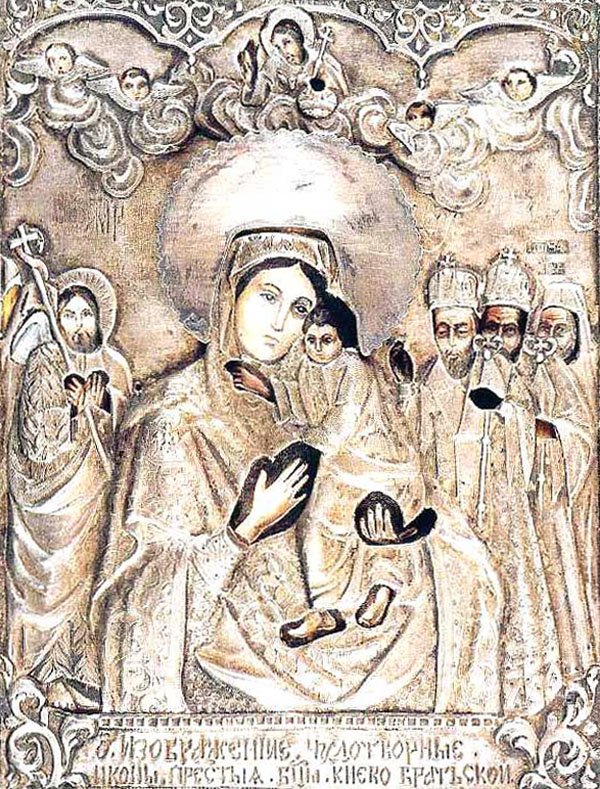
Icon of the Mother of God of Kiev-Bratsk

Icon of the Mother of God of Kiev-Bratsk

The Kiev-Bratsk Icon of the Mother of God is also commemorated on September 6, May 10, and on Saturday of the Fifth Week of Great Lent.
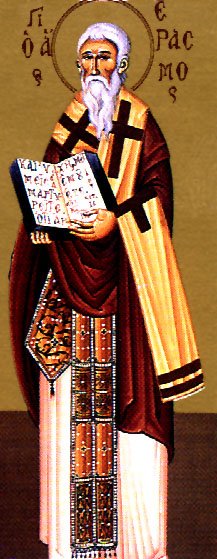
Venerable Erasmus of Ochrid

Venerable Erasmus of Ochrid

No information available at this time.

Troparion - Tone 8

By a flood of tears you made the desert fertile, / and your longing for God brought forth fruits in abundance. / By the radiance of miracles you illumined the whole universe! / O our holy father Erasmus, pray to Christ our God to save our souls!

Scripture Readings

Epistle

Romans 1:1-7, 13-17

1 Paul, a servant of Jesus Christ, called to be an apostle, separated unto the gospel of God,
2 (Which he had promised afore by his prophets in the holy scriptures,)
3 Concerning his Son Jesus Christ our Lord, which was made of the seed of David according to the flesh;
4 And declared to be the Son of God with power, according to the spirit of holiness, by the resurrection from the dead:
5 By whom we have received grace and apostleship, for obedience to the faith among all nations, for his name:
6 Among whom are ye also the called of Jesus Christ:
7 To all that be in Rome, beloved of God, called to be saints: Grace to you and peace from God our Father, and the Lord Jesus Christ.
13 Now I would not have you ignorant, brethren, that oftentimes I purposed to come unto you, (but was let hitherto,) that I might have some fruit among you also, even as among other Gentiles.
14 I am debtor both to the Greeks, and to the Barbarians; both to the wise, and to the unwise.
15 So, as much as in me is, I am ready to preach the gospel to you that are at Rome also.
16 For I am not ashamed of the gospel of Christ: for it is the power of God unto salvation to every one that believeth; to the Jew first, and also to the Greek.
17 For therein is the righteousness of God revealed from faith to faith: as it is written, The just shall live by faith.

Gospel

Matthew 4:25-5:13

25 And there followed him great multitudes of people from Galilee, and from Decapolis, and from Jerusalem, and from Judea, and from beyond Jordan.
1 And seeing the multitudes, he went up into a mountain: and when he was set, his disciples came unto him:
2 And he opened his mouth, and taught them, saying,
3 Blessed are the poor in spirit: for theirs is the kingdom of heaven.
4 Blessed are they that mourn: for they shall be comforted.
5 Blessed are the meek: for they shall inherit the earth.
6 Blessed are they which do hunger and thirst after righteousness: for they shall be filled.
7 Blessed are the merciful: for they shall obtain mercy.
8 Blessed are the pure in heart: for they shall see God.
9 Blessed are the peacemakers: for they shall be called the children of God.
10 Blessed are they which are persecuted for righteousness’ sake: for theirs is the kingdom of heaven.
11 Blessed are ye, when men shall revile you, and persecute you, and shall say all manner of evil against you falsely, for my sake.
12 Rejoice, and be exceeding glad: for great is your reward in heaven: for so persecuted they the prophets which were before you.
13 Ye are the salt of the earth: but if the salt have lost his savour, wherewith shall it be salted? it is thenceforth good for nothing, but to be cast out, and to be trodden under foot of men.

Liturgical data sourced from OCA.org and orthocal.info