Fasting Rules
 Meat
Allowed
Meat
Allowed
 Fish
Allowed
Fish
Allowed
 Dairy
Allowed
Dairy
Allowed
 Oil
Allowed
Oil
Allowed
 Wine
Allowed
Wine
Allowed
Saints & Commemorations
Martyr Lucillian and those who suffered with him at Byzantium
Saint Lucillian was a pagan priest during the reign of the Roman emperor Aurelian (270-275). In his old age he became persuaded of the falseness of the pagan religion, and with all his heart he turned to the faith in Christ the Savior, and was baptized.
Under the influence of his preaching many pagans were converted to Christianity.
Saint Lucillian was a pagan priest during the reign of the Roman emperor Aurelian (270-275). In his old age he became persuaded of the falseness of the pagan religion, and with all his heart he turned to the faith in Christ the Savior, and was baptized.
Under the influence of his preaching many pagans were converted to Christianity. Then certain Jews, seeing that he was spreading faith in Christ Whom they crucified, reported Lucillian to the Nicomedia prefect Silvanus, who urged the old man to return to idol-worship. When he refused, they smashed the saint’s jawbone, beat him with rods and suspended him head downward, and then they locked him in prison. Here he met four youths who were confessors of Christianity: Claudius, Hypatius, Paul and Dionysius. Saint Lucillian urged them to stand firm in the Faith, and to fear neither tortures nor death.
After a while they brought them to trial and then threw them into a red-hot furnace. Suddenly, rain fell and extinguished the flames, and the martyrs remained unharmed. The governor sentenced them to death, sending them to Byzantium to be executed. The holy youths were beheaded by the sword, and the holy martyr Lucillian was nailed to a cross with many nails.
The holy virgin Paula witnessed the contest of the holy martyrs. She had dedicated herself to the service of those suffering for Christ. She provided food to Christian prisoners, washed their wounds, brought medications, and also buried the bodies of martyrs. After the death of Saint Lucillian and the four young men, she returned to Nicomedia and continued with her holy service. The holy virgin was arrested and cast into a furnace, but by the power of God she remained unharmed. Then they sent her off to Byzantium, where the holy martyr was beheaded.
Troparion - Tone 1
By your faith, you shone like a radiant star in the dark night of error; / you fought the good fight and slew the crafty enemy, O Lucillian. / Together with venerable Paula and the four martyred children / entreat Christ our God to save our souls.
Kontakion - Tone 2
You attained the dignity of the martyrs of Christ / through the torments that you courageously endured, O Lucillian. / Together with Paula and the four martyred children, / you sing to the Creator: / “Like sheep we are slaughtered for love of You, O Savior.”
Martyr Lucillian and His Companions
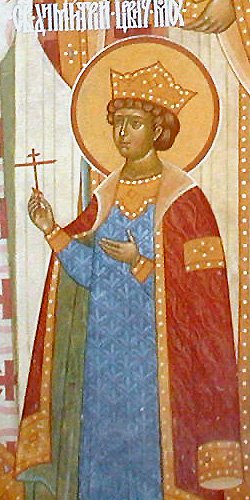
Translation of the relics of slain Crown Prince Demetrius of Moscow
The Tsarevich Saint Demetrius, murdered on May 15, 1591, was glorified in the year 1606 “to stop lying lips and blind unbelieving eyes from saying that the Tsarevich had escaped alive from the hands of the murderers” after the appearance of a pretender, who declared himself to be the Tsarevich Demetrius.
Th
The Tsarevich Saint Demetrius, murdered on May 15, 1591, was glorified in the year 1606 “to stop lying lips and blind unbelieving eyes from saying that the Tsarevich had escaped alive from the hands of the murderers” after the appearance of a pretender, who declared himself to be the Tsarevich Demetrius.
The holy relics were solemnly transferred and placed in the Arkhangelsk cathedral of the Moscow Kremlin, “in the side altar of John the Forerunner, where his father and his brothers were buried.”
After numerous miracles of healing from the holy relics, three feastdays for the Tsarevich Demetrius were established during this same year of 1606, his birthday (October 19), his murder (May 15), and the transfer of his relics to Moscow (June 3).
Holy Martyr Dimitri, Tsarevich of Russia (1591)
He was murdered at the age of eight by the evil designs of Boris Godunov, in the town of Uglich. After his death he appeared to a monk and accurately foretold Boris Godunov’s death. Countless miracles were worked at the grave of the Tsarevich. When his tomb was opened fifteen years after his death, his relics were found whole and incorrupt, and were solemnly buried in the Church of the Archangel Michael in Moscow.
T
He was murdered at the age of eight by the evil designs of Boris Godunov, in the town of Uglich. After his death he appeared to a monk and accurately foretold Boris Godunov’s death. Countless miracles were worked at the grave of the Tsarevich. When his tomb was opened fifteen years after his death, his relics were found whole and incorrupt, and were solemnly buried in the Church of the Archangel Michael in Moscow.
The circumstances of Boris Godunov’s death are worth telling. He first tried to kill the Tsarevich using the strongest poison, but it had no effect. He then had the child publicly beheaded. Not long afterwards a ‘false Dimitri’ arose, claiming to be the Tsarevich, and rallied a great army against Godunov. Godunov was driven to such a desperate position that he took his own life by poison, the ‘remedy’ he had intended for the true Dimitri.
Hieromartyr Lucian, Bishop of Beauvais, and those with him in France
He was a Roman nobleman, a disciple of the Apostle Peter. Pope Clement sent him, along with St Dionysius the Areopagite, to preach the Gospel in Gaul, ordaining them both as bishops before they left. The Emperor Domitian later sent soldiers to Rome to seize Christian evangelists. They killed St Dionysius in Rome, then, hearing of the work of St Lucian, tracked him until found him in what is now Belgium.
He was a Roman nobleman, a disciple of the Apostle Peter. Pope Clement sent him, along with St Dionysius the Areopagite, to preach the Gospel in Gaul, ordaining them both as bishops before they left. The Emperor Domitian later sent soldiers to Rome to seize Christian evangelists. They killed St Dionysius in Rome, then, hearing of the work of St Lucian, tracked him until found him in what is now Belgium. There he was beheaded along with his two fellow-missionaries, Maxianus the priest and Julian the deacon. A church was built over his relics.
Troparion - Tone 4
Your holy martyrs O Lord, / through their sufferings have received incorruptible crowns from You, our God. / For having Your strength, they laid low their adversaries, / and shattered the powerless boldness of demons. / Through their intercessions, save our souls!
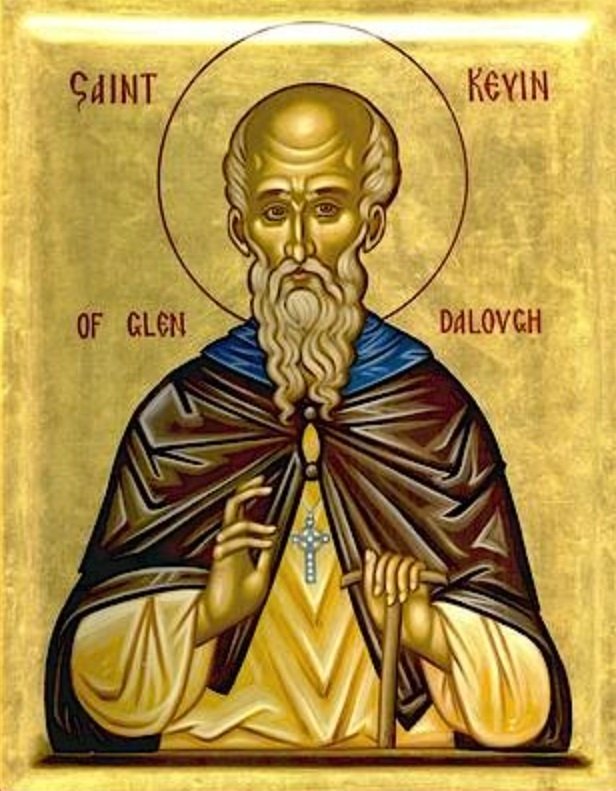
Saint Kevin of Glendalough
Saint Kevin (Coemgen) was born in Leinster in the early decades of the sixth century, the age of Saints Columba (June 9), Columbanus of Luxeuil (November 21), Comgall of Bangor (May 10), Finnian of Clonard (December 12), Kieran of Clonmacnoise (September 9), and many other great saints.
This holy ascetic belonged to a noble family which had included several Kings of Leinster.
Saint Kevin (Coemgen) was born in Leinster in the early decades of the sixth century, the age of Saints Columba (June 9), Columbanus of Luxeuil (November 21), Comgall of Bangor (May 10), Finnian of Clonard (December 12), Kieran of Clonmacnoise (September 9), and many other great saints.
This holy ascetic belonged to a noble family which had included several Kings of Leinster. He himself, however, was a model of humility and self-denial. There are several miraculous stories connected with his birth and childhood, but most are unreliable.
The holy youth was baptized by a priest named Cronan and was named Kevin, which means "fair-begotten." There are so many saints named Cronan that it is not clear which one baptized Saint Kevin. When he was seven years old, his parents sent him to be taught by Saint Petroc (June 4), who happened to be visiting Ireland at the time.
As a boy of twelve, Saint Kevin was placed in the charge of three holy Elders: Eogoin of Ardstraw (August 23), Lochan, and Enna. Little is known of these teachers or where their establishment was located. His secular studies were certainly enhanced by spiritual instruction. He learned to read the Holy Scriptures, and to profit from the example of the virtuous men and women of the Old and New Testaments.
Saint Kevin was so handsome that a young girl named Kathleen became inflamed with desire for him, but the holy youth resisted all her allurements. She pestered him so much with her attentions that he fled from her, just as Joseph fled from Potiphar's wife (Genesis 39:12). Kathleen followed him and found him alone in a field, so she approached him and threw her arms around him. Arming himself with the Sign of the Cross, and filled with the Holy Spirit, Saint Kevin broke away from her and ran into the woods. She soon discovered him hiding in a bed of nettles. Grabbing a bunch of nettles, the saint struck her about the face, hands and feet. Wounded by the nettles, the girl's passion quickly cooled. She fell on her knees in repentance, begged forgiveness from God and from Saint Kevin, and promised to become a nun.
After successfully resisting the temptations of the flesh, Saint Kevin continued to devote himself to his studies, and longed to live the monastic life as a hermit. This was a common practice in the Celtic Church, which was influenced by the lives of the Egyptian desert dwellers, and by monks who had come from Gaul. Saint Kevin was anxious to leave the monastery, but his three Elders would not let him go. However, he had acquired a reputation for holiness, and people from the surrounding area came to seek his advice. Desiring to flee from such unwelcome attention, he left the monastery in secret and went into the wilderness.
It is said that an angel led him to Glendalough (the Vale of the Two Lakes) where he lived in the hollow of a tree somewhere by the shores of the Upper Lake. The ascetic remained in this place for several days, living on wild herbs and water. A cow wandered off and came to the tree where the Saint was living, and began to lick his clothing. After some time had passed, the cow showed an unusual increase in its milk, so her owner told his herdsman follow the animal. She led him to Glendalough, and there the herdsman discovered Saint Kevin, weak with hunger, and hiding in the tree.
The herdsman had to remove Saint Kevin on a litter by force, since the holy ascetic did not wish to leave. As he was being carried off, the trees bent down to make way for them. Saint Kevin then bestowed his blessing on the forest.
News of Saint Kevin reached his three Elders, who came to bring him back to their monastery. Recognizing the holiness of his life, they understood that they had nothing more to teach him, so they blessed him to leave the monastery.
A certain Bishop Lugidus ordained Saint Kevin to the priesthood, and sent him and a few other monks to found a new church. He spent a little time converting people at Cluainduach, but later moved back to Glendalough.
Guided by an angel, Saint Kevin crossed the Wicklow Mountains and established a monastery in the lower part of the valley where two rivers flow together. Once the monastery was organized, he appointed one of the monks as abbot, and then he retired to the upper valley a mile away to resume his life of solitude. He built a small dwelling on a narrow place between the mountain and the lake, where there were dense woods and clear rivulets. Some sources say that Saint Kevin lived there for four years, while others say seven years.
During this period of his life, wild animals would come to drink water out of his hands. Once during Lent, Saint Kevin stood praying in his hut with his hand sticking out of the window. Just then a blackbird nested in his hand and laid an egg. So gentle and compassionate was the Saint that he remained in this position until the eggs hatched and the fledglings were able to fly away.
There is a small cave above the Upper Lake known as Saint Kevin's Bed. One year he retired there for Lent, and an angel came and told him he would have to move because a rock was about to fall on that spot. Saint Kevin told the angel he could not interrupt his Lenten struggles or leave that place. On the eve of Pascha the angel returned to take him away. The venerable one protested that he would like to remain there for the rest of his life. He was persuaded to go, however, by the angel's promise that great benefits would follow for all who would come there in the future, both to live in the monastic city and to be buried there. Just as he was leaving with the angel, the rock came tumbling down and landed on the very spot where he had been standing.
Crossing over the lake, they discussed the problem of finding sufficient space for so many people. The angel said that if Saint Kevin wished, God could transform the four mountains surrounding the valley to level fields, fruitful and easy to work. The holy ascetic replied that he would not want God's creatures to perish on his account. All of the animals of those mountains were tame and humble toward him, and they would be saddened by this proposal.
When they arrived at the chosen spot, Saint Kevin saw that the ground was rocky and unsuitable for burial. The angel fixed that by clearing all the stones away. The site is to the east of the smaller (Lower) lake. Saint Kevin told the local chieftain Dimma and his sons to cut away the thorns and thistles, and to make this a beautiful spot. It is not certain just where in the valley Saint Kevin fell asleep in the Lord. It was not at the hermitage, however, because he sent a party of monks there to pray for him. Local tradition says that Saint Kevin is buried in the church of the Mother of God in that vicinity.
Saint Kevin was succeeded as abbot by his nephew Molibba (Jan. 8), who seems to have been the first bishop there. According to the Annals of Ulster, the holy abbot and confessor Kevin departed to Christ on June 3, 618.
Troparion - Tone 8
In you, O Father, was preserved with exactness what was according to the image; / for you took up the Cross and followed Christ. / By so doing, you taught us to disregard the flesh, for it passes away; / but to care for the soul, since it is immortal. / Therefore, O Venerable Kevin, your spirit rejoices with the Angels.
Scripture Readings
☩Epistle
Romans 1:18-27
18
For the wrath of God is revealed from heaven against all ungodliness and unrighteousness of men, who hold the truth in unrighteousness;
19
Because that which may be known of God is manifest in them; for God hath shewed it unto them.
20
For the invisible things of him from the creation of the world are clearly seen, being understood by the things that are made, even his eternal power and Godhead; so that they are without excuse:
21
Because that, when they knew God, they glorified him not as God, neither were thankful; but became vain in their imaginations, and their foolish heart was darkened.
22
Professing themselves to be wise, they became fools,
23
And changed the glory of the uncorruptible God into an image made like to corruptible man, and to birds, and fourfooted beasts, and creeping things.
24
Wherefore God also gave them up to uncleanness through the lusts of their own hearts, to dishonour their own bodies between themselves:
25
Who changed the truth of God into a lie, and worshipped and served the creature more than the Creator, who is blessed for ever. Amen.
26
For this cause God gave them up unto vile affections: for even their women did change the natural use into that which is against nature:
27
And likewise also the men, leaving the natural use of the woman, burned in their lust one toward another; men with men working that which is unseemly, and receiving in themselves that recompence of their error which was meet.
☩Gospel
Matthew 5:20-26
20
For I say unto you, That except your righteousness shall exceed the righteousness of the scribes and Pharisees, ye shall in no case enter into the kingdom of heaven.
21
Ye have heard that it was said by them of old time, Thou shalt not kill; and whosoever shall kill shall be in danger of the judgment:
22
But I say unto you, That whosoever is angry with his brother without a cause shall be in danger of the judgment: and whosoever shall say to his brother, Raca, shall be in danger of the council: but whosoever shall say, Thou fool, shall be in danger of hell fire.
23
Therefore if thou bring thy gift to the altar, and there rememberest that thy brother hath ought against thee;
24
Leave there thy gift before the altar, and go thy way; first be reconciled to thy brother, and then come and offer thy gift.
25
Agree with thine adversary quickly, whiles thou art in the way with him; lest at any time the adversary deliver thee to the judge, and the judge deliver thee to the officer, and thou be cast into prison.
26
Verily I say unto thee, Thou shalt by no means come out thence, till thou hast paid the uttermost farthing.
Liturgical data sourced from OCA.org and orthocal.info