Fasting Rules
 Meat
Allowed
Meat
Allowed
 Fish
Allowed
Fish
Allowed
 Dairy
Allowed
Dairy
Allowed
 Oil
Allowed
Oil
Allowed
 Wine
Allowed
Wine
Allowed
Saints & Commemorations
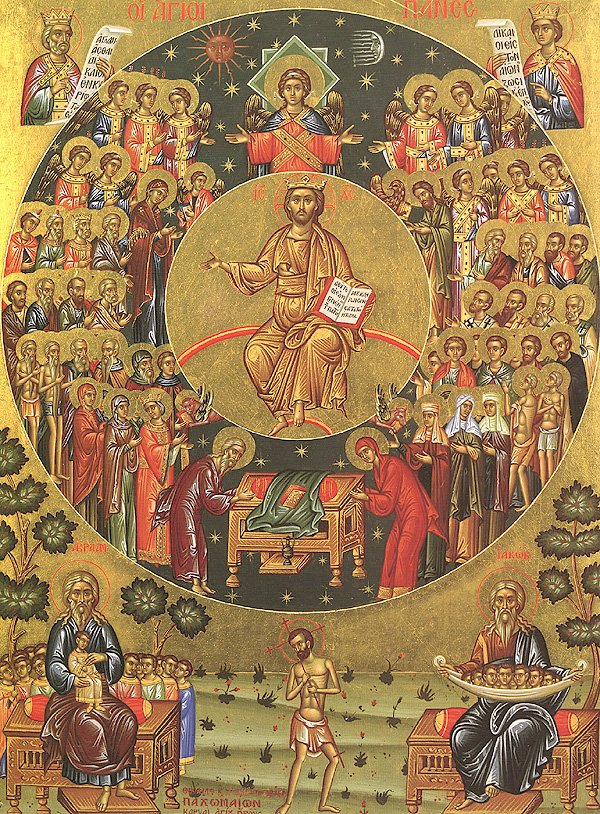
Synaxis of All Saints
The Sunday following Pentecost is dedicated to All Saints, both those who are known to us, and those who are known only to God. There have been saints at all times, and they have come from every corner of the earth. They were Apostles, Martyrs, Prophets, Hierarchs, Monastics, and Righteous, yet all were perfected by the same Holy Spirit.
The Sunday following Pentecost is dedicated to All Saints, both those who are known to us, and those who are known only to God. There have been saints at all times, and they have come from every corner of the earth. They were Apostles, Martyrs, Prophets, Hierarchs, Monastics, and Righteous, yet all were perfected by the same Holy Spirit.
The Descent of the Holy Spirit makes it possible for us to rise above our fallen state and to attain sainthood, thereby fulfilling God’s directive to “be holy, for I am holy” (Lev. 11:44, 1 Peter 1:16, etc.). Therefore, it is fitting to commemorate All Saints on the first Sunday after Pentecost.
This feast may have originated at an early date, perhaps as a celebration of all martyrs, then it was broadened to include all men and women who had borne witness to Christ by their virtuous lives, even if they did not shed their blood for Him.
Saint Peter of Damascus, in his “Fourth Stage of Contemplation,” mentions five categories of saints: Apostles, Martyrs, Prophets, Hierarchs, and Monastic Saints ( Philokalia [in English] Vol. 3, p.131). He is actually quoting from the Octoechos , Tone 2 for Saturday Matins, kathisma after the first stichology.
Saint Νikόdēmos of the Holy Mountain (July 14) adds the Righteous to Saint Peter’s five categories. The list of Saint Νikόdēmos is found in his book The Fourteen Epistles of Saint Paul (Venice, 1819, p. 384) in his discussion of I Corinthians 12:28.
The hymnology for the feast of All Saints also lists six categories: “Rejoice, assembly of the Apostles, Prophets of the Lord, loyal choirs of the Martyrs, divine Hierarchs, Monastic Fathers, and the Righteous....”
Some of the saints are described as Confessors, a category which does not appear in the above lists. Since they are similar in spirit to the martyrs, they are regarded as belonging to the category of Martyrs. They were not put to death as the Martyrs were, but they boldly confessed Christ and came close to being executed for their faith. Saint Maximus the Confessor (January 21) is such a saint.
The order of these six types of saints seems to be based on their importance to the Church. The Apostles are listed first, because they were the first to spread the Gospel throughout the world.
The Martyrs come next because of their example of courage in professing their faith before the enemies and persecutors of the Church, which encouraged other Christians to remain faithful to Christ even unto death.
Although they come first chronologically, the Prophets are listed after the Apostles and Martyrs. This is because the Old Testament Prophets saw only the shadows of things to come, whereas the Apostles and Martyrs experienced them firsthand. The New Testament also takes precedence over the Old Testament.
The holy Hierarchs comprise the fourth category. They are the leaders of their flocks, teaching them by their word and their example.
The Monastic Saints are those who withdrew from this world to live in monasteries, or in seclusion. They did not do this out of hatred for the world, but in order to devote themselves to unceasing prayer, and to do battle against the power of the demons. Although some people erroneously believe that monks and nuns are useless and unproductive, Saint John Climacus had a high regard for them: “Angels are a light for monks, and the monastic life is a light for all men” (LADDER, Step 26:31).
The last category, the Righteous, are those who attained holiness of life while living “in the world.” Examples include Abraham and his wife Sarah, Job, Saints Joachim and Anna, Saint Joseph the Betrothed, Saint Juliana of Lazarevo, and others.
The feast of All Saints achieved great prominence in the ninth century, in the reign of the Byzantine Emperor Leo VI the Wise (886-911). His wife, the Holy Empress Theophano (December 16) lived in the world, but was not attached to worldly things. She was a great benefactor to the poor, and was generous to the monasteries. She was a true mother to her subjects, caring for widows and orphans, and consoling the sorrowful.
Even before the death of Saint Theophano in 893 or 894, her husband started to build a church, intending to dedicate it to Theophano, but she forbade him to do so. It was this emperor who decreed that the Sunday after Pentecost be dedicated to All Saints. Believing that his wife was one of the righteous, he knew that she would also be honored whenever the Feast of All Saints was celebrated.
Troparion - Tone 4
Adorned in the blood of Your Martyrs throughout all the world, / as if clothed in purple and linen, / through them Your Church cries out to You, O Christ God: / “Bestow Your bounties upon Your people, / grant peace to Your habitation, and great mercy to our souls.”
Kontakion - Tone 8
(Original Melody)
As the first fruits of nature offered to the Planter of all creation, O Lord, / the inhabited earth brings the God-bearing Martyrs. / By their supplications, and the intercession of the Theotokos, / preserve Your Church in profound peace, O greatly Merciful One.
Icon of the Mother of God “The Unbreakable Wall”
The “Unbreakable (or “Indestructible”) Wall” Icon of the Most Holy Theotokos is commemorated on the Sunday of All Saints. It is an XI century mosaic icon of the Blachernae type, above the main altar of Kiev's Holy Wisdom Cathedral. The Mother of God is depicted against a golden background, standing with upraised hands on a quadrangular gold platform.
In som
The “Unbreakable (or “Indestructible”) Wall” Icon of the Most Holy Theotokos is commemorated on the Sunday of All Saints. It is an XI century mosaic icon of the Blachernae type, above the main altar of Kiev's Holy Wisdom Cathedral. The Mother of God is depicted against a golden background, standing with upraised hands on a quadrangular gold platform.
In some Icons of this type [but not in the mosaic Icon], Christ is depicted within a mandorla, an oval or circle, symbolizing the glory of Heaven, or the Divine Light.
The Icon is called the "Unbreakable Wall" because for ten centuries it has remained intact, in spite of the fact that both Kiev's Holy Wisdom Cathedral and the city have been damaged several times. An ancient description of this Icon has been preserved: "A gigantic full-length portrait of the Theotokos.... She stands upon a gold stone, as an unshakable foundation for all who resort to her protection. Her chiton is blue, and she wears a scarlet belt. Hanging from it is an embroidered cloth with which she wipes away so many tears.
There are several possible sources for this Icon's title:
The Prophet-King David wrote "God is in the midst of her (i. e. the city of God); she shall not be moved: God shall help her with his countenance" (Psalm 45/46:5).
"Thus the Lord showed me; and behold, he stood upon a wall of adamant..." (Amos 7:7, LXX).
The Akathist to the Mother of God, Ikos 12. "Rejoice, indestructible wall of kingdoms" - Ikos XII).
According to Kievan tradition, the wall of the church will not perish while the hands of the Mother of God are extended over it.
Troparion - Tone 4
Let us, sinful and humbled, now run earnestly to the Theotokos, / and let us fall down in repentance, crying from the depths of our soul: / "Help us, O Sovereign Lady, and have compassion on us. / Make haste, for we perish from the multitude of our sins. / Do not turn your servants empty away, for we have you as our only hope.
Kontakion - Tone 6
We have no other help, we have no other hope, but you, O Sovereign Lady. / Help us, for in you
do we hope, / and of you do we boast, for we are your servants. / Let us not be put to shame.
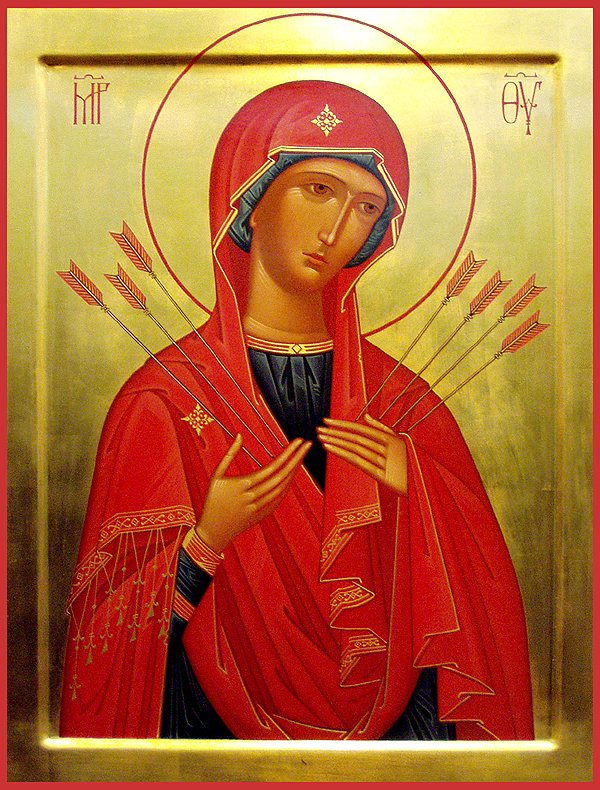
"Seven Arrows" Icon of the Mother of God
On the Seven Arrows Icon, the Most Holy Theotokos is depicted without the Divine Infant. She inclines her head toward her right shoulder, and her heart is pierced with seven arrows or swords, of which four are on the left side and three on the right. A similar image of the Mother of God is also found on the icons "Softener of Evil Hearts," and "Simeon's Prophecy," on which the swords are placed somewhat differently: three on the right and left, and the seventh at the bottom.
On the Seven Arrows Icon, the Most Holy Theotokos is depicted without the Divine Infant. She inclines her head toward her right shoulder, and her heart is pierced with seven arrows or swords, of which four are on the left side and three on the right. A similar image of the Mother of God is also found on the icons "Softener of Evil Hearts," and "Simeon's Prophecy," on which the swords are placed somewhat differently: three on the right and left, and the seventh at the bottom.
The "Seven Arrows" Icon is at least 600 years old. For a long time, the holy image was at the landing in the bell tower of the church of the Apostle John the Theologian (near Vologda). The Icon, facing downward, was mistaken for an ordinary board on which people walked, until a paralyzed man in the city of Kadnikov had a vision in which it was revealed that he would receive healing after praying before this Icon. A Moleben was served before the Icon, and the man recovered.
The Icon became especially famous in 1830 during an outbreak of cholera in Vologda.
The real, authentic image (the "Seven Arrows" Icon) is now in the church of Saint Lazarus, in Vologda. The Icon has been in that temple since 1945, after the Great Patriotic War.
Muscovites can pray before the wonderworking copies located in the Moscow region. There are two images of the "Seven Arrows" Mother of God. Both exude an amazing myrrh - an oily liquid which inexplicably appeared on them.
The first copy of the "Seven Arrows" Icon is now in the church dedicated to the Holy Archangel Michael, located in Moscow. The second copy is in the village of Bachurino in the Moscow region.
The Feast Day of this Icon is celebrated on August 13, and on the Sunday of All Saints (First Sunday after Pentecost).
The same Troparion and Kontakion are used for the "Seven Arrows" Icon (August 13), and the "Softener of Evil Hearts" Icon (Sunday of All Saints).
Troparion - Tone 5
Soften our evil hearts, O Theotokos, and repel the attacks of those who hate us, / and loosen all the rigidity of our soul. / For beholding your holy image, / we are filled with compunction by your compassion and loving kindness toward us, / and we kiss your wounds; / for we are terrified by the darts with which we wound you. / O Compassionate Mother, / do not let us perish because of our hardness of heart, / or our neighbor's hardness of heart, / for you are truly the Softener of Evil Hearts.
Kontakion - Tone 2
By your grace, O Sovereign Lady, / soften the hearts of evildoers, / send down benefactors who will preserve them from all evil; / with gratitude and zeal, we pray to you before your revered icons.
St Daniel of Skete in Egypt (5th c.)
He was a disciple of St Arsenios the great and abbot of the Scetis in Egypt (the monastic system known as the “Skete” takes its name from Scetis). He lived the communal monastic life for forty years, then in 420 retired to the desert, where he remained until his repose.
From the Prologue: “A saint has a very sensitive conscience. What
He was a disciple of St Arsenios the great and abbot of the Scetis in Egypt (the monastic system known as the “Skete” takes its name from Scetis). He lived the communal monastic life for forty years, then in 420 retired to the desert, where he remained until his repose.
From the Prologue: “A saint has a very sensitive conscience. What ordinary people may consider a small sin, a saint sees as a great crime. It is said of Abba Daniel that highwaymen attacked him on three occasions and took him off to the mountains. Twice he was rescued, but the third time, in attempting to escape, he struck one of them with a stone and killed him, and then made his escape. That murder lay on his conscience like a lead weight. In perplexity as to what he should do, he went to Timothy, the Patriarch of Alexandria, and asked his advice. The Patriarch soothed him, and released him from all penance. But his conscience continued to gnaw at him, and he went to Rome, to the Pope. The Pope gave him the same reply as had the Patriarch. Still dissatisfied, Daniel visited the remaining patriarchs in turn; going to Constantinople, Antioch and Jerusalem, confessing to each of them and asking for advice. But he could find no peace. So he returned home to Alexandria and declared himself to the authorities as a murderer, and was flung into prison. At his trial before the governor, Daniel told how everything had come about, and pleaded that he might be killed too, that his soul might be saved from eternal fire. The governor was amazed at the whole thing, and said to him: ‘Go your way, Father, and pray to God for me, even if you kill seven more!’ Still dissatisfied with this, Daniel resolved to take a leper into his cell and care for him until he died, and then find another. He did as he had resolved, and in this way brought peace to his conscience.”
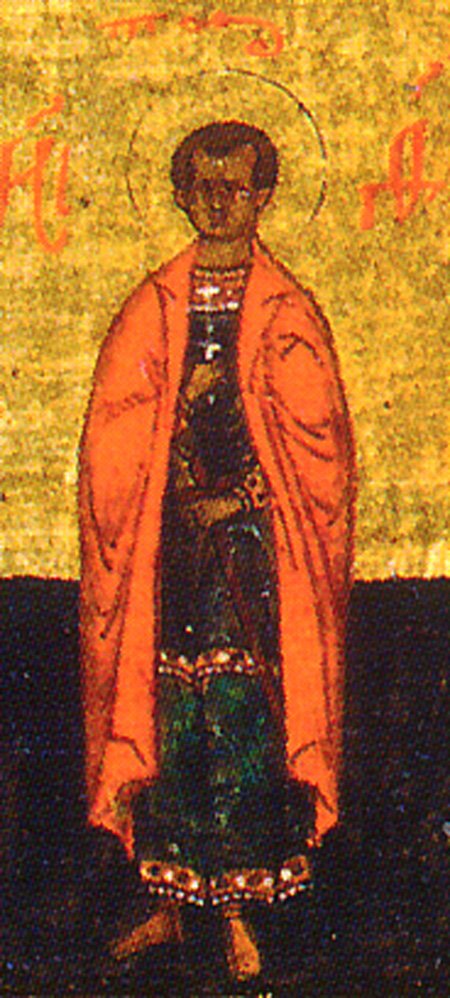
Hieromartyr Theodotus, Bishop of Ancyra
The Holy Martyr Theodotus lived in Ancyra of Galatia in the third century. He was distinguished by his kindliness and concern. At the height of the persecution under Diocletian (284-305) he provided Christians with everything they needed, and gave them shelter in his home. There they secretly celebrated church services.
The Holy Martyr Theodotus lived in Ancyra of Galatia in the third century. He was distinguished by his kindliness and concern. At the height of the persecution under Diocletian (284-305) he provided Christians with everything they needed, and gave them shelter in his home. There they secretly celebrated church services.
Saint Theodotus visited the Christian captives in prison, paid their bail, and reverently buried the bodies of martyrs who had been thrown to the wild beasts. Once he buried the bodies of seven holy women martyrs, who were drowned in the sea (May 18). This was reported to the governor.
After refusing to offer sacrifice to idols, and denouncing the folly of paganism, Saint Theodotus confessed Christ as God, for which they subjected him to terrible tortures and beheaded him with a sword. They wanted to burn the holy martyr’s body, but could not do so because of a storm which had arisen, so they gave his holy relics to a certain Christian for burial.
Saint Theodotus is also commemorated on May 18.
Troparion - Tone 4
Your holy martyr Theodotus and his companions, O Lord, / through their sufferings have received incorruptible crowns from You, our God. / For having Your strength, they laid low their adversaries, / and shattered the powerless boldness of demons. / Through their intercessions, save our souls!
Hieromartyr Marcellinus, Pope of Rome, and those with him
“When the Emperor Diocletian summoned him and threatened him with torture, he offered sacrifice to idols and was, because of this, rewarded by the Emperor with a costly garment. But Marcellinus repented bitterly and began to weep both day and night for his rejection of Christ, even as the Apostle Peter had before him. A
“When the Emperor Diocletian summoned him and threatened him with torture, he offered sacrifice to idols and was, because of this, rewarded by the Emperor with a costly garment. But Marcellinus repented bitterly and began to weep both day and night for his rejection of Christ, even as the Apostle Peter had before him. A synod of bishops was held at that time in Campania, and the Pope dressed himself in sackcloth and sprinkled ashes on his head, and, going before the Synod, confessed his sin and asked them to judge him. The fathers said: ‘Let him judge himself.’ Then he said: ‘I strip myself of the sacerdotal rank of which I am not worthy; and, further, let my body not be buried after my death, but let it be thrown to the dogs.’ Having said this, he pronounced a curse on any who should dare to bury him. He then went to the Emperor Diocletian and, casting the precious garment in front of him, confessed his faith in Christ and cursed the idols. The enraged Emperor ordered that he be tortured and killed outside the city, together with three other men: Claudius, Cyrinus and Antoninus. The bodies of these three were buried at once, but the Pope’s body lay there for thirty-six days. Then St Peter appeared to Marcellus, the new Pope, and told him to bury Marcellinus’ body, saying: ‘Whoso humbleth himself shall be exalted.’ ” (Prologue)
Troparion - Tone 4
Your holy martyrs O Lord, / through their sufferings have received incorruptible crowns from You, our God. / For having Your strength, they laid low their adversaries, / and shattered the powerless boldness of demons. / Through their intercessions, save our souls!
Hieromartyr Sisinius the Deacon of Rome and those with him
Saint Sisinius the deacon suffered at Rome along with the hieromartyr Marcellinus, Bishop of Rome, the holy deacon Cyriacus; also Smaragdus, Largus, Apronian, Saturninus, Crescentian, Papias and Maurus and the holy women martyrs Priscilla, Lucy and the Emperor’s daughter Artemia during the persecution of Diocletian and Maximian (284-305) and their successors, Galerius (305-311) and Maxentius (305-312).
Saint Sisinius the deacon suffered at Rome along with the hieromartyr Marcellinus, Bishop of Rome, the holy deacon Cyriacus; also Smaragdus, Largus, Apronian, Saturninus, Crescentian, Papias and Maurus and the holy women martyrs Priscilla, Lucy and the Emperor’s daughter Artemia during the persecution of Diocletian and Maximian (284-305) and their successors, Galerius (305-311) and Maxentius (305-312).
The emperor Maximian, ruler of the Western Roman Empire, deprived all Christians of military rank and sent them into penal servitude.
A certain rich Christian, Thrason, sent food and clothing to the prisoners through the Christians Sisinius, Cyriacus, Smaragdus and Largus. Marcellus thanked Thrason for his generosity, and ordained Sisinius and Cyriacus as deacons.
While rendering aid to the captives, Sisinius and Cyriacus also were arrested and condemned to harsh labor. They fulfilled not only their own work quota, but worked also for the dying captive Saturninus. Therefore, Maximian sent Sisinius to Laodicius, the governor of the district.
They locked the saint in prison. The head of the prison, Apronian, summoned Sisinius for interrogation but, seeing his face shine with a heavenly light, he believed in Christ and was baptized. Later, he went with Sisinius to Marcellus and received Chrismation. Marcellus served the Liturgy, and they partook of the Holy Mysteries.
On June 7, Saints Sisinius and Saturninus were brought before Laodicius in the company of Apronian. Apronian confessed that he was a Christian, and was beheaded. Saints Sisinius and Saturninus were thrown into prison. Then Laodicius gave orders to bring them to a pagan temple to offer sacrifice. Saturninus said, “If only the Lord would turn the pagan idols into dust!”
At that very moment the tripods, on which incense burned before the idols, melted. Seeing this miracle, the soldiers Papias and Maurus confessed Christ. After prolonged tortures Sisinius and Saturninus were beheaded, and Papias and Maurus were locked up in prison, where they prayed to receive illumination by holy Baptism. The Lord fulfilled their desire. Leaving the prison without being noticed, they received Baptism from Marcellus and returned to the prison.
At the trial they again confessed themselves Christians and died under terrible tortures. Their holy bodies were buried by the priest John and Thrason.
Saints Cyriacus, Smaragdus, Largus and other Christian prisoners continued to languish at hard labor.
Diocletian’s daughter Artemia suffered from demonic oppression. Having learned that the prisoner Cyriacus could heal infirmities and cast out devils, the emperor summoned him to the sick girl. In gratitude for the healing of his daughter, the emperor freed Cyriacus, Smaragdus and Largus. Soon the emperor sent Cyriacus to Persia to heal the daughter of the Persian emperor.
Upon his return to Rome, Cyriacus was arrested on orders of the emperor Galerius, the son-in-law of Diocletian, who had abdicated and retired as emperor. Galerius was very annoyed at his predecessor because his daughter Artemia had converted to Christianity. He gave orders to drag Cyriacus behind his chariot stripped, bloodied, and in chains, to be shamed and ridiculed by the crowds.
Marcellus denounced the emperor openly before everyone for his cruelty toward innocent Christians. The emperor ordered the holy bishop to be beaten with rods, and dealt severely with him. Saints Cyriacus, Smaragdus, Largus, and another prisoner, Crescentian, died under torture. And at this time the emperor’s daughter Artemia and another twenty-one prisoners were also executed with Cyriacus.
Marcellus was secretly freed by Roman clergy. Exhuming the bodies of the holy martyrs Cyriacus, Smaragdus and Largus, they reburied them on the estates of two Christian women, Priscilla and Lucy, on the outskirts of Rome, after they had transformed Lucy’s house into a church.
Ascending the throne, Maxentius gave orders to destroy the church and turn it into a stockyard, and he sentenced the holy bishop to herd the cattle. Exhausted by hunger and cold, and wearied by the tortures of the soldiers, Marcellus became ill and died in the year 310.
Troparion - Tone 4
Your holy martyrs O Lord, / through their sufferings have received incorruptible crowns from You, our God. / For having Your strength, they laid low their adversaries, / and shattered the powerless boldness of demons. / Through their intercessions, save our souls!
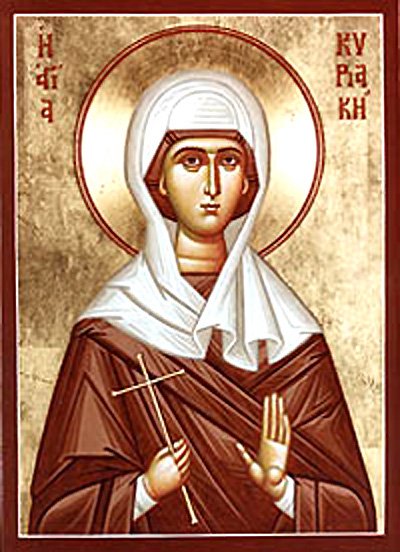
Martyrs Kyriake, Kaleria, and Mary of Caesarea, in Palestine
The holy women martyrs Kyriake, Kaleria (Valeria), and Mary lived in Palestinian Caesarea during the persecution under Diocletian (284-305). Having received instruction in the Christian Faith, they abandoned paganism, settled in a solitary place and spent their lives in prayer, beseeching the Lord that the persecution against Christians would come to an end, and that the Faith of Christ would shine throughout all the world.
The holy women martyrs Kyriake, Kaleria (Valeria), and Mary lived in Palestinian Caesarea during the persecution under Diocletian (284-305). Having received instruction in the Christian Faith, they abandoned paganism, settled in a solitary place and spent their lives in prayer, beseeching the Lord that the persecution against Christians would come to an end, and that the Faith of Christ would shine throughout all the world.
The governor tried to force them to worship idols, but they bravely confessed their faith in Christ. For this reason, they were tortured and received the crown of martyrdom.
Troparion - Tone 1
As reasonable lambs, you were guided by Christ, the Chief Shepherd, / along the path of martyrdom. / You finished your course and kept the faith; / therefore, honored Kyra, Valerie, and Mary, / with joyful hearts, we magnify Christ today, as we honor your holy memory!
Kontakion - Tone 2
Passion-bearers Kyra, Valerie and Mary, / you loved the faithful promises of God; / you clung to the faith of Christ, / looking for eternal life and the blessedness of Paradise! / You endured torture with steadfastness / and bowed your necks beneath the sword. / Therefore, you have been crowned by the hand of the Lord / and glorious is your memory. / Entreat Christ God, the Judge of the contest, / on behalf of those who honor your struggles with faith!
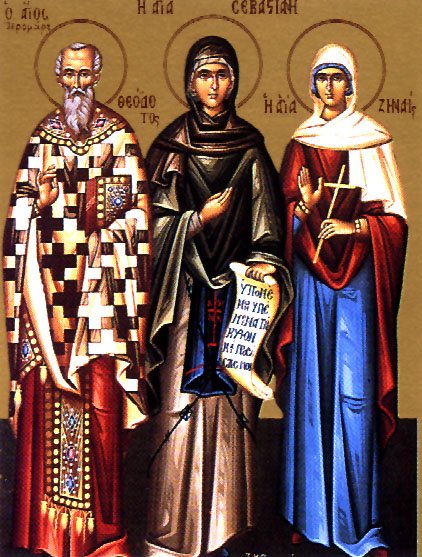
Martyr Zēnaίda (Zenais) of Caesarea in Palestine
There is very little information about Saint Zēnaίda, except that she was born in 284, in Caesarea of Palestine, and that she was found worthy of the charism of working miracles. She ended the course of her life with a martyric death.
The Byzantine Synaxarion mentions that Saint Zēnaίda's veneration was widespread in Constantinople, where her Synaxis took place on June 6, at a church dedicated to her in the Basilisk district.
Th
There is very little information about Saint Zēnaίda, except that she was born in 284, in Caesarea of Palestine, and that she was found worthy of the charism of working miracles. She ended the course of her life with a martyric death.
The Byzantine Synaxarion mentions that Saint Zēnaίda's veneration was widespread in Constantinople, where her Synaxis took place on June 6, at a church dedicated to her in the Basilisk district.
There are a number of hagiographic sources which mention the name of Saint Zēnaίda. Among them, a Neapolitan calendar of the IX century (June 7); a printed Greek Menaion (Venice, 1591; and the Synaxaristes of Saint Νikόdēmos of the Holy Mountain.
In the Roman Martyrology of Cardinal Caesar Baronius, Zēnaίda is mistakenly listed under June 5 with the martyrs Valeria, Kyriakḗ, and Maria.
Troparion - Tone 4
Your holy martyr Zēnaίda, O Lord, / through her sufferings has received an incorruptible crown from You, our God. / For having Your strength, she laid low her adversaries, / and shattered the powerless boldness of demons. / Through her intercessions, save our souls!
Venerable Daniel of Sketis
Abba Daniel lived in the sixth century, becoming a monk at Sketis when he was a young boy. He was taken prisoner when Sketis was attacked by barbarians, who held him captive for two years. Saint Daniel was was bought by a devout Christian, but then he was recaptured. After six months, while attempting to escape, he struck one of his captors with a stone and killed him, and then he made his escape and returned to Sketis.
Abba Daniel lived in the sixth century, becoming a monk at Sketis when he was a young boy. He was taken prisoner when Sketis was attacked by barbarians, who held him captive for two years. Saint Daniel was was bought by a devout Christian, but then he was recaptured. After six months, while attempting to escape, he struck one of his captors with a stone and killed him, and then he made his escape and returned to Sketis. The sin of murder was a heavy burden on his conscience. Uncertain about what he ought to do, he went to Patriarch Timothy of Alexandria, and asked for his advice.
The Patriarch heard his Confession, but did not give him a penance. Still his conscience continued to trouble him, and he went to Rome to see the Pope. The Pope gave him the same reply as the Patriarch had done. Disappointed, Abba Daniel visited the other Patriarchs in turn, going to Constantinople, Antioch and Jerusalem, confessing to each of them and asking for advice. He found no peace, however. So he returned home to Alexandria and surrendered himself to the civil authorities as a murderer, and was thrown into prison. At his trial before the governor, Daniel told him all that had happened, and begged to be executed, so that his soul might be saved from the eternal fire. The governor was astonished by his story, and said to him, "Go your way, Father, and pray to God for me, and I wish you had killed seven more!"
Still dissatisfied with this, Daniel resolved to take a leper into his cell and care for him until he died, and then he would find another. He did as he had resolved, and in this way brought peace to his conscience.
Once, as Abba Daniel and Abba Ammon were walking together, Abba Ammon said, "When will we sit in our own cell, Father?" Abba Daniel replied, "Who can separate us from God? God is in the cell, and God is also outside of it."
He became so renowned for his virtues that he was named Igoumen of Sketis and he was revered throughout Egypt as "a new Abraham, and the host of Christ." He visited Saint Anastasia the Patrician (March 10) on the day of her death. She had disguised herself as a eunuch and lived in a men's monastery eighteen miles from Sketis. Saint Daniel discovered that she was a woman when he prepared her body for burial.
Abba Daniel encountered saints who wished to remain hidden, such as the Mark the Fool of Alexandria, or the nun at the Ermopoleos Monastery of Abba Jeremiah. She feigned drunkenness, earning the contempt of the other nuns. Saint Daniel and his disciple sought shelter in the monastery, and at night they saw that nun lifting her arms to Heaven, weeping copiously, and making prostrations. The following night they had the Igoumeness watch with them so she could see how that despised nun spent her nights. When her holy life became known, she left the monastery so that she would not be praised by the other nuns.
Saint Daniel is also mentioned in the Life of Saint Thomais, who was killed by her father-in-law because she wished to preserve her chastity (April 13 in Slavic usage, April 14 in Greek usage), in the Life of Saint Eulogios the Hospitable (April 27), in the Life of Saints Andronikos and Athanasia (October 9), as well as in the Life of Abba Doula.
Troparion - Tone 8
By a flood of tears you made the desert fertile, / and your longing for God brought forth fruits in abundance. / By the radiance of miracles you illumined the whole universe! / O our holy father Daniel, pray to Christ our God to save our souls!
Saint Potamiani of Alexandria
Saint Potamiani (Potamiaίnē) lived at the end of the III century in Alexandria during the reign of Emperor Maximian (286 – 305). She was a slave, but also a Christian; that is to say, her soul was free through Jesus Christ. She was purchased from her former master by another man, who was also a pagan. Sin
Saint Potamiani (Potamiaίnē) lived at the end of the III century in Alexandria during the reign of Emperor Maximian (286 – 305). She was a slave, but also a Christian; that is to say, her soul was free through Jesus Christ. She was purchased from her former master by another man, who was also a pagan. Since Potamiani was very beautiful in appearance, he believed that it was his right to enjoy her body. But her stubborn resistance surprised and angered him. For the first time he was refused by a female slave. Therefore, he asked her to speak. She concealed nothing from him and said: "I am a Christian and I value my honor far more than my life. My only possession is my Faith and my purity. I will not deny either. Kill me, and I will not complain, but do not touch me, or I shall kill myself. For our holy Faith prohibits suicide, except when death remains the only way of protecting our honor from brutal violence."
Then the pagan master handed her over to the prefect, who ordered that she be placed into a cauldron of boiling tar. With spiritual joy, Saint Potamiani heard her sentence, for in this way she would preserve her most precious possessions - her virginity and her Christian Faith. Those who watched her horrible torments were astonished by her endurance and composure. Thus, she surrendered her pure and clean 1 soul to God.
Scripture Readings
☩Epistle
Hebrews 11:33-12:2
33
Who through faith subdued kingdoms, wrought righteousness, obtained promises, stopped the mouths of lions,
34
Quenched the violence of fire, escaped the edge of the sword, out of weakness were made strong, waxed valiant in fight, turned to flight the armies of the aliens.
35
Women received their dead raised to life again: and others were tortured, not accepting deliverance; that they might obtain a better resurrection:
36
And others had trial of cruel mockings and scourgings, yea, moreover of bonds and imprisonment:
37
They were stoned, they were sawn asunder, were tempted, were slain with the sword: they wandered about in sheepskins and goatskins; being destitute, afflicted, tormented;
38
(Of whom the world was not worthy:) they wandered in deserts, and in mountains, and in dens and caves of the earth.
39
And these all, having obtained a good report through faith, received not the promise:
40
God having provided some better thing for us, that they without us should not be made perfect.
1
Wherefore seeing we also are compassed about with so great a cloud of witnesses, let us lay aside every weight, and the sin which doth so easily beset us, and let us run with patience the race that is set before us,
2
Looking unto Jesus the author and finisher of our faith; who for the joy that was set before him endured the cross, despising the shame, and is set down at the right hand of the throne of God.
☩Gospel
Matthew 10:32-33, 37-38, 19:27-30
32
Whosoever therefore shall confess me before men, him will I confess also before my Father which is in heaven.
33
But whosoever shall deny me before men, him will I also deny before my Father which is in heaven.
37
He that loveth father or mother more than me is not worthy of me: and he that loveth son or daughter more than me is not worthy of me.
38
And he that taketh not his cross, and followeth after me, is not worthy of me.
27
Then answered Peter and said unto him, Behold, we have forsaken all, and followed thee; what shall we have therefore?
28
And Jesus said unto them, Verily I say unto you, That ye which have followed me, in the regeneration when the Son of man shall sit in the throne of his glory, ye also shall sit upon twelve thrones, judging the twelve tribes of Israel.
29
And every one that hath forsaken houses, or brethren, or sisters, or father, or mother, or wife, or children, or lands, for my name’s sake, shall receive an hundredfold, and shall inherit everlasting life.
30
But many that are first shall be last; and the last shall be first.
Liturgical data sourced from OCA.org and orthocal.info