Fasting Rules

Meat allowed Meat Allowed
Fish allowed Fish Allowed
Dairy allowed Dairy Allowed
Oil allowed Oil Allowed
Wine allowed Wine Allowed

Saints & Commemorations
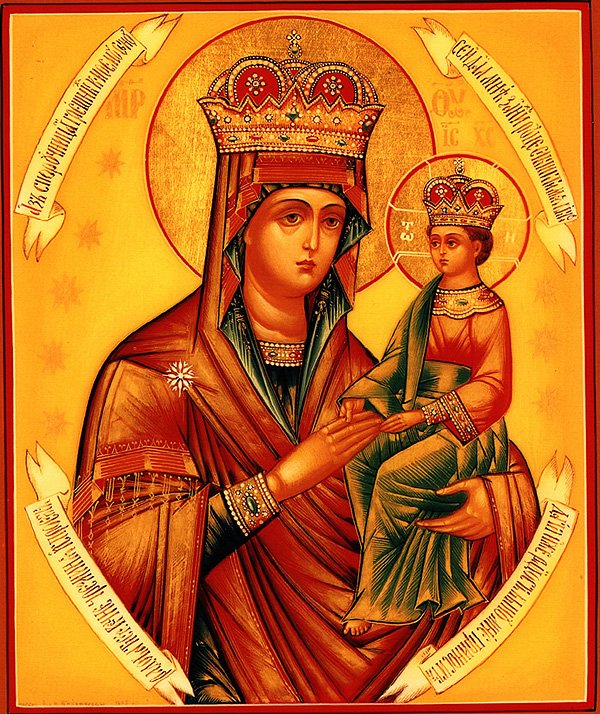
“Surety of Sinners” Icon of the Mother of God of Korets

“Surety of Sinners” Icon of the Mother of God of Korets

This ancient icon of the Mother of God "Surety of Sinners" of Korets was kept in the castle of the Korets Princes for a long time, and it was called "blessed." After the death of Samuel, the last of the Orthodox Princes of Korets, his brother John offered to let his sister, Igoumeness Seraphima take the Icon from the Prince's chapel to Holy Resurrection Korets Maidens' Monastery. This ancient icon of the Mother of God "Surety of Sinners" of Korets was kept in the castle of the Korets Princes for a long time, and it was called "blessed." After the death of Samuel, the last of the Orthodox Princes of Korets, his brother John offered to let his sister, Igoumeness Seraphima take the Icon from the Prince's chapel to Holy Resurrection Korets Maidens' Monastery. The solemn transfer of the Icon took place in 1622, on the Thursday after Pentecost. On that day, a Feast Day was established in honor of the "Surety of Sinners" Icon of Korets. From 1752 to 1795, the fate of the Korets Icon was closely associated with the history of Korets Monastery, which was under the control of the Uniates. According to some reports, the Icon was moved several times during this period, and the "Surety of Sinners" Icon of Korets remained in the possession of the Catholics, who also revered it miraculous. In 1795, by decree of Empress Catherine II, part of the Monastery was given to Orthodox nuns. The "Surety of Sinners" Icon of Korets was also returned to the Orthodox Monastery. On August 19, 1797 there was a fire in the Monastery. Some of the buildings were destroyed, but the wonderworking Icon was saved. After the Monastery's restoration, the "Surety of Sinners" Icon was placed in the High Place 1 in the new church of the Dormition, rebuilt with materials from the former trapeza. At this time a gilded silver oklad (with enamels) was made for the Icon. After reconstruction and repairs in 1880, the consecration of Holy Trinity Monastery took place. The nuns of Holy Resurrection Monastery moved, and the Korets Holy Trinity Stavropegial Convent was formed. Its main shrine is the wonderworking "Surety of Sinners" Icon of Korets. On August 17, 1998, Igoumeness Natalia (Ilchuk) of Korets Holy Trinity Monastery, sent a petition to Patriarch Alelxei II of Moscow and All Russia to include the Korets Icon of the Mother of God in its list of wonderworking icons of the Mother of God in the Patriarchal Church Calendar. With the Patriarch's blessing, the celebration of the Korets Icon was approved. In November 2001, there was an attempt to steal the Icon, but the thieves managed to take only her precious oklad. Through public donations a new riza was made, which is a copy of the lost one. More than once the wonderworking Icon revealed its grace-filled help for the suffering – in 1923, on the Feast of the Holy Trinity, a young man who was possessed by an unclean spirit was healed before the Icon. The following year, from the Feast of the Ascension until the Thursday after Pentecost, there were incessant showers in Volhynia. Miraculously, after a Cross Procession around the church with the Icon, the rain subsided. Many of the faithful who turned to the Queen of Heaven for her help and intercession in case of any disorders, family problems, and particularly "afflictions of the soul," indicated that after praying before the Icon they received spiritual relief and peace, for she is truly the "Surety of Sinners." The "Surety of Sinners" Icon of the Mother of God belongs to the Hodegetria (Hodēgḗtria) type. It is a half-length image of the Most Holy Theotokos with the Divine Infant on her left hand, Who holds her right hand with both hands. The word "surety" means one who acts as a guarantor for us before God. The Most Holy Theotokos prays for all of us, good and evil, sinners and righteous, forgiving all, accepting all with equal love. The inscription on the Icon reads: “I am the Surety of Sinners for my Son Who has entrusted me to hear them, and those who bring me the joy of hearing them shall receive everlasting joy through me.” The "Surety of Sinners" Icon of Korets is painted on a wooden board measuring 102 x 76 centimeters. In contrast to the "Surety of Sinners" Icon of the Mother of God at Saint Nicholas Monastery in Odrino (March 7 and May 29), the Korets Icon shows the Mother of God and the Divine Infant inclined toward each other with their cheeks touching. The Icon is located in Holy Trinity Convent at Korets. 1 That is, the area behind the altar.

Troparion - Tone 3

To you, the ever-flowing source of mercy and Intercessor for sinners, / O Theotokos, we your unworthy servants, bow down in sorrow, crying out: / “Save us from our troubles, O Sovereign Lady, / and by your maternal intercession ask eternal salvation for all of us.”

Kontakion - Tone 1

As the revered dwelling place of the ineffable Divine nature, beyond words and understanding; / and an intercessor for sinners, granting grace and healing; / as the Mother of Him Who reigns over all, / pray to your Son that we may receive mercy on the Day of Judgment.
Saint Metrophanes, first Patriarch of Constantinople

Saint Metrophanes, first Patriarch of Constantinople

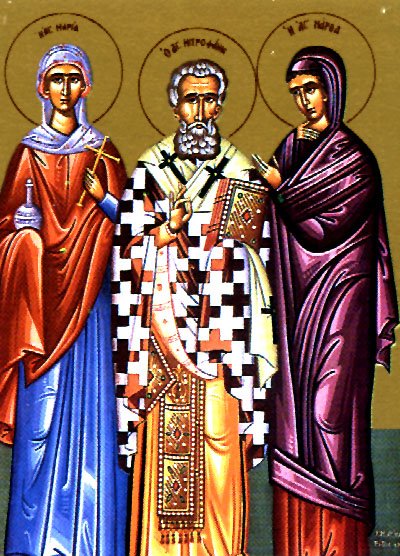
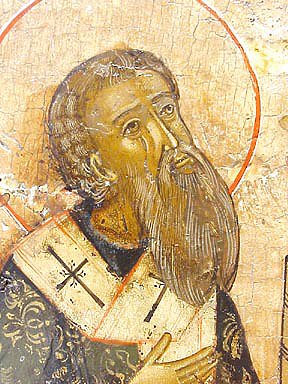
Saint Metrophanes, Patriarch of Constantinople, was a contemporary of Saint Constantine the Great (306-337). His father, Dometius, was a brother of the Roman emperor Probus (276-282). Seeing the falseness of the pagan religion, Dometius came to believe in Christ. During a time of terrible persecution of Christians at Rome, Saint Dometius set off to Byzantium with two of his sons, Probus and Metrophanes. Saint Metrophanes, Patriarch of Constantinople, was a contemporary of Saint Constantine the Great (306-337). His father, Dometius, was a brother of the Roman emperor Probus (276-282). Seeing the falseness of the pagan religion, Dometius came to believe in Christ. During a time of terrible persecution of Christians at Rome, Saint Dometius set off to Byzantium with two of his sons, Probus and Metrophanes. They were instructed in the law of the Lord by Bishop Titus, a man of holy life. Seeing the ardent desire of Dometius to labor for the Lord, Saint Titus ordained him presbyter. After the death of Titus first Dometius (272-303) was elevated to the bishop’s throne, and thereafter his sons, Probus (303-315) and in 316 Saint Metrophanes. The emperor Constantine once came to Byzantium, and was delighted by the beauty and comfortable setting of the city. And having seen the holiness of life and sagacity of Saint Metrophanes, the emperor took him back to Rome. Soon Constantine the Great transferred the capital from Rome to Byzantium and he brought Saint Metrophanes there. The First Ecumenical Council was convened in 325 to resolve the Arian heresy. Constantine the Great had the holy Fathers of the Council bestow upon Saint Metrophanes the title of Patriarch. Thus, the saint became the first Patriarch of Constantinople. Saint Metrophanes was very old, and was not able to be present at the Council, and he sent in his place the chorepiscopos (vicar bishop) Alexander. At the close of the Council the emperor and the holy Fathers visited with the ailing Patriarch. At the request of the emperor, the saint named a worthy successor to himself, Bishop Alexander. He foretold that Paul (at that time a Reader) would succeed to the patriarchal throne after Alexander. He also revealed to Patriarch Alexander of Alexandria that his successor would be the archdeacon Saint Athanasius. Saint Metrophanes reposed in the year 326, at age 117. His relics rest at Constantinople in a church dedicated to him. It should be noted that the Canons to the Holy Trinity in the Midnight Office in the Octoechos were not composed by this Metrophanes, but by Bishop Metrophanes of Smyrna, who lived in the middle of the ninth century.

Troparion - Tone 1

You proclaimed the great mystery of the Trinity, O good shepherd, / and manifested Christ’s dispensation to all, / dispersing the spiritual wolves who menaced your rational flock, / saving the lambs of Christ who cry: / Glory to him who has strengthened you! / Glory to him who has exalted you! / Glory to him who through you has fortified the Orthodox Faith!

Kontakion - Tone 2

In truth you were revealed to your flock as a rule of faith, / an image of humility and a teacher of abstinence; / your humility exalted you; your poverty enriched you. / Hierarch Father Metrophanes, / entreat Christ our God that our souls may be saved.
Righteous Martha and Mary, the sisters of Lazarus

Righteous Martha and Mary, the sisters of Lazarus

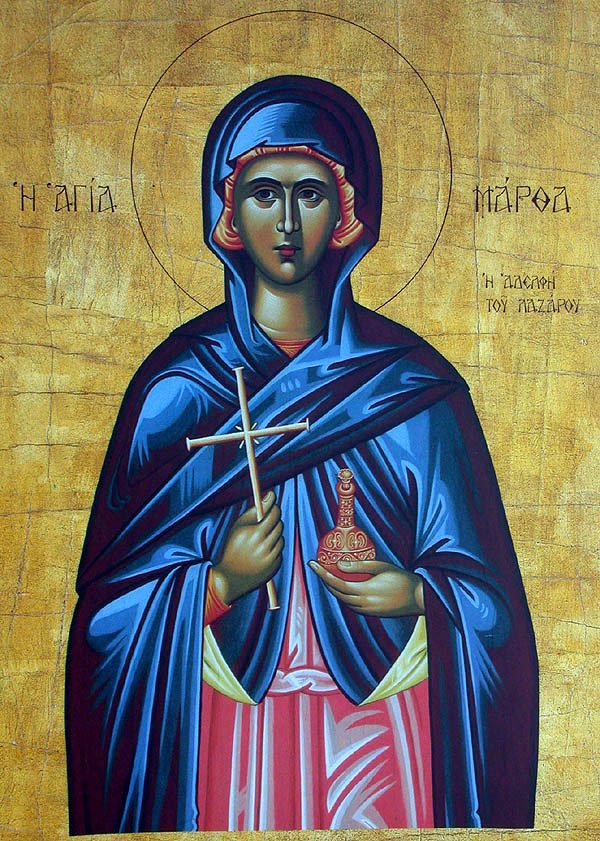
Mary and Martha, with their brother Lazarus, were especially devoted disciples of our Lord; their story up to the time of the Resurrection can be found in Luke 10 and John 11-12. Mary and Martha were among the Myrrh-bearing women. They, with their brother, reposed in Cyprus, where Lazarus became first Bishop of Kition after he was raised from death by Christ. Mary and Martha, with their brother Lazarus, were especially devoted disciples of our Lord; their story up to the time of the Resurrection can be found in Luke 10 and John 11-12. Mary and Martha were among the Myrrh-bearing women. They, with their brother, reposed in Cyprus, where Lazarus became first Bishop of Kition after he was raised from death by Christ. An ancient tradition holds that Lazarus was thirty years old when he was restored to life by the Lord, and that he lived another thirty years. After he was raised from the dead, he never again laughed; but once, when he saw someone stealing a clay pot, he smiled and said, ‘Clay stealing clay.’ His name is a Greek version of Eleazar, meaning ‘God has helped.’

Troparion - Tone 3

Appearing to the Myrrh-bearing women at the tomb, the Angel exclaimed: / “Myrrh is meet for the dead; / but Christ has shown Himself a stranger to corruption. / So proclaim: ‘The Lord is risen, granting the world great mercy.’”

Kontakion - Tone 3

When You proclaimed “Rejoice” to the Myrrhbearers, / You caused the lamentation of the foremother Eve to cease by Your Resurrection; O Christ God; / commanding Your Apostles to proclaim: / “The Savior is risen from the tomb.”

Venerable Methodius, Abbot of Peshnosha, Disciple of Venerable Sergius of Radonezh

Saint Methodius, Igumen of Peshnosha was the founder of the Peshnosha monastery. In his youth he went to Saint Sergius of Radonezh and spent several years under his guidance. Later on, with the blessing of Saint Sergius, he withdrew to a solitary place and built himself a cell in the forest beyond the River Yakhroma. Saint Methodius, Igumen of Peshnosha was the founder of the Peshnosha monastery. In his youth he went to Saint Sergius of Radonezh and spent several years under his guidance. Later on, with the blessing of Saint Sergius, he withdrew to a solitary place and built himself a cell in the forest beyond the River Yakhroma. Soon several disciples came to him in this marshy place, wishing to imitate his life. Saint Sergius visited him and advised him to build a monastery and church. Saint Methodius himself toiled at the construction of the church and the cells, “on foot carrying” wood along the river, and from that time the monastery began to be called “the Peshnosha.” In 1391 Saint Methodius became igumen of this monastery. At times he withdrew two versts from the monastery and struggled in prayer. Here also Saint Sergius came to him for spiritual conversation, therefore this spot became known as “Beseda” (“Conversation-place”). Saint Methodius died in 1392 and was buried at the monastery he founded. A church dedicated to Saints Sergius of Radonezh and Methodius of Peshnosha was built over his relics in 1732. The beginning of his local veneration dates from the late seventeenth—early eighteenth centuries. Saint Methodius is also commemorated on June 14.

Troparion - Tone 8

By a flood of tears you made the desert fertile, / and your longing for God brought forth fruits in abundance. / By the radiance of miracles you illumined the whole universe! / O our holy father Methodius, pray to Christ our God to save our souls!

Martyrs Frontasius, Severinus, Severian, and Silanus, of Gaul

The Holy Martyrs Frontasius, Severinus, Severian, and Silanus suffered for Christ under the emperor Claudius (41-54). They had been sent to preach the Word of God in southern Gaul (now France) by Bishop Frontonus of Petragorium. The governor, a pagan named Squiridonus, arrested them and demanded that they renounce Christ. The Holy Martyrs Frontasius, Severinus, Severian, and Silanus suffered for Christ under the emperor Claudius (41-54). They had been sent to preach the Word of God in southern Gaul (now France) by Bishop Frontonus of Petragorium. The governor, a pagan named Squiridonus, arrested them and demanded that they renounce Christ. But the martyrs firmly confessed their faith, saying they had but one desire, to either live or die for Christ. The enraged Squiridonus ordered that the saints be taken out before the city, tied to pillars, and have nails thrust into their heads like a crown of thorns. After this they were beheaded. Tradition says that the holy martyrs continued to live by the power of God. They picked up their heads and went to the church of the Mother of God, where the holy bishop Frontonus, who had sent them preaching, was at prayer. Placing their heads at the feet of the bishop, they crossed themselves and died.

Troparion - Tone 4

Your holy martyrs Frontasius, Severinus, Severian, and Silanus, O Lord, / through their sufferings have received incorruptible crowns from You, our God. / For having Your strength, they laid low their adversaries, / and shattered the powerless boldness of demons. / Through their intercessions, save our souls!

Martyr Concordius of Spoleto

The Holy Martyr Concordius, son of the presbyter Gordian, was raised in piety and faith in Christ, and therefore Bishop Pius of Rome made him a subdeacon. Together with his father, Saint Concordius fasted and prayed, and he generously distributed alms to the needy. With the permission of his father he settled not far from Rome with his kinsman Eutychius, spending his days in prayer and good deeds. The Holy Martyr Concordius, son of the presbyter Gordian, was raised in piety and faith in Christ, and therefore Bishop Pius of Rome made him a subdeacon. Together with his father, Saint Concordius fasted and prayed, and he generously distributed alms to the needy. With the permission of his father he settled not far from Rome with his kinsman Eutychius, spending his days in prayer and good deeds. The report of his pious life reached Torquatus, the head of the Tussa region. He summoned the saint and urged him to renounce Christ, promising to make him a priest of the pagan gods. Saint Concordius in turn urged Torquatus to turn to the true God, Jesus Christ. They beat the martyr and threw him in prison. Bishop Anthimus, a friend of Torquatus, asked him to release the prisoner to him. Saint Concordius lived with him for a while and was ordained presbyter. When Torquatus again summoned the saint and asked him what he thought about his life, the saint replied that life, for him, is Christ. They bound him and locked him up in prison, chaining him to the wall by his neck and hands. Three days later Torquatus sent his assistant to the prison, ordering the martyr to offer sacrifice to the gods, or be condemned to death. The saint cried out, “Glory to Thee, Lord Jesus Christ,” and spat on the idol of Zeus carried by the soldiers. For this, he was beheaded around the year 175. His relics rest in Italy, not far from the city of Spoleto.

Troparion - Tone 3

Your holy martyr Concordius, O Lord, / through his sufferings has received an incorruptible crown from You, our God. / For having Your strength, he laid low his adversaries, / and shattered the powerless boldness of demons. / Through his intercessions, save our souls!

Hieromartyr Astius, Bishop of Dyrrachium in Macedonia

The Hieromartyr Astius was bishop of the city of Dyrrachium (Macedonia) during the time of the emperor Trajan (98-117), a persecutor of Christians. The saint once had a dream, a foreboding of his impending suffering and death for Christ. He was arrested and beaten fiercely with leaden rods and oxhide whips, but Saint Astius did not renounce Christ. The Hieromartyr Astius was bishop of the city of Dyrrachium (Macedonia) during the time of the emperor Trajan (98-117), a persecutor of Christians. The saint once had a dream, a foreboding of his impending suffering and death for Christ. He was arrested and beaten fiercely with leaden rods and oxhide whips, but Saint Astius did not renounce Christ. They smeared his body with honey, so as to increase his suffering with the stings of hornets and flies, and crucified him. The martyr’s body was reverently buried by Christians.

Troparion - Tone 4

By sharing in the ways of the Apostles, / you became a successor to their throne. / Through the practice of virtue, you found the way to divine contemplation, O inspired one of God; / by teaching the word of truth without error, you defended the Faith, / even to the shedding of your blood. / Hieromartyr Astius, entreat Christ God to save our souls.
Venerable Father Zosima, Bishop of Babylon

Venerable Father Zosima, Bishop of Babylon

Saint Zosima, Bishop of Babylon, was born in Cilicia (Asia Minor). While still a youth he left the world and settled on Mount Sinai, and later he withdrew to a more solitary place in Lebanon. One time he encountered an elderly ascetic, who foretold that he would be bishop in Babylon. When Zosima returned to Sinai, he was sent on an errand to Alexandria. Saint Zosima, Bishop of Babylon, was born in Cilicia (Asia Minor). While still a youth he left the world and settled on Mount Sinai, and later he withdrew to a more solitary place in Lebanon. One time he encountered an elderly ascetic, who foretold that he would be bishop in Babylon. When Zosima returned to Sinai, he was sent on an errand to Alexandria. The Patriarch of Alexandria made him Bishop of Babylon, and into old age he wisely guided his flock. Sensing the approach of death, he returned to Sinai and peacefully fell asleep in the Lord (5th century).

Troparion - Tone 4

You appeared to your flock as a rule of faith, / an image of humility and a teacher of abstinence. / Because of your lowliness, heaven was opened to you; / because of your poverty, riches were granted to you. / O Holy Bishop Zosima, pray to Christ our God to save our souls!

Kontakion - Tone 2

You taught and preserved the doctrines of Christ, / greatly increasing the number of your sheep, O holy Zosima. / Therefore you now live with the angels in enjoyment of eternal life, / fervently interceding with Christ for us all.
Venerable Sophia of Ainos

Venerable Sophia of Ainos

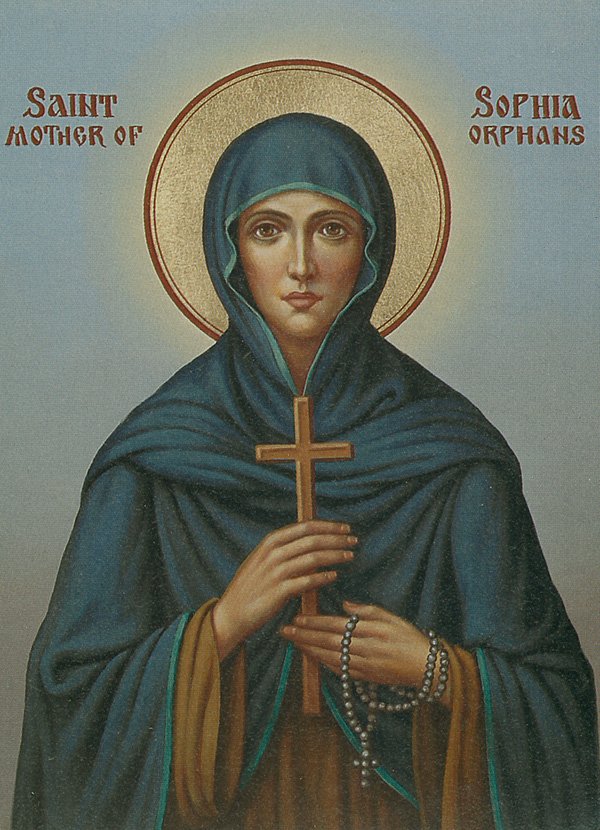
Our Venerable Mother Sophia was born in the province of Ainos in southeastern Thrace, and was the daughter of prominent and wealthy Christian parents. When she was of age, her parents arranged for her to be married. She and her husband had six children. Though she was occupied with worldly cares and responsibilities, she still kept God's commandments and lived a virtuous life. Our Venerable Mother Sophia was born in the province of Ainos in southeastern Thrace, and was the daughter of prominent and wealthy Christian parents. When she was of age, her parents arranged for her to be married. She and her husband had six children. Though she was occupied with worldly cares and responsibilities, she still kept God's commandments and lived a virtuous life. She loved to attend the Church Services, and so she progressed in virtue. After sickness carried off Sophia's husband and all her children in succession, she did not despair, but became even more devoted to God. She found solace in her grief by protecting orphans and widows. She spent her time in constant almsgiving, prayers, fasting, and everything which comforted her neighbor. Within a period of twenty years, she adopted one hundred children, and raised them to love God. For this reason, she is sometimes called Saint Sophia the Mother of Orphans. She sold her property and gave the proceeds to the poor and to widows. She led an austere life, eating nothing but bread and water. She chose to do without the necessities of life herself rather than allow any poor person to leave her home empty-handed. The Psalms of the Prophet-King David were always on her lips, and tears flowed continuously from her eyes. Because of her humility and love for the poor, God blessed her in the following way. In her home there was a barrel of wine which she kept for the poor. She noticed that no matter how much she took from the barrel, it remained full. However, as soon as she told someone about the miracle and glorified God, the barrel became empty. Saint Sophia was devastated, believing that the wine had failed because of her unworthiness. Therefore, she increased her ascetical labors until her health suffered. Saint Sophia taught everyone how the ascetic life can be applied in the world. When combined with selfless charity, God performs wondrous miracles. It is enough to live this way "in secret." Sensing that the end of her life was near, she was tonsured as a nun. From that time, she devoted herself completely to worshiping God. Saint Sophia reposed peacefully at the age of fifty-three. She lived during the X-XI centuries.

Troparion - Tone 8

In you, O Mother, was preserved with exactness what is according to the image; / for you took up the Cross and followed Christ. / By so doing, you taught us to disregard the flesh, for it passes away; / but to care for the soul, since it is immortal. / Therefore, O Venerable Sophia your spirit rejoices with the Angels.
Hieromartyr Joannicius of Serbia

Hieromartyr Joannicius of Serbia

No information available at this time.

Troparion - Tone 4

By sharing in the ways of the Apostles, / you became a successor to their throne. / Through the practice of virtue, you found the way to divine contemplation, O inspired one of God; / by teaching the word of truth without error, you defended the Faith, / even to the shedding of your blood. / Hieromartyr Joannicius, entreat Christ God to save our souls.

Hieromartyr George of Serbia

No information available at this time.

Troparion - Tone 4

By sharing in the ways of the Apostles, / you became a successor to their throne. / Through the practice of virtue, you found the way to divine contemplation, O inspired one of God; / by teaching the word of truth without error, you defended the Faith, / even to the shedding of your blood. / Hieromartyr George, entreat Christ God to save our souls.
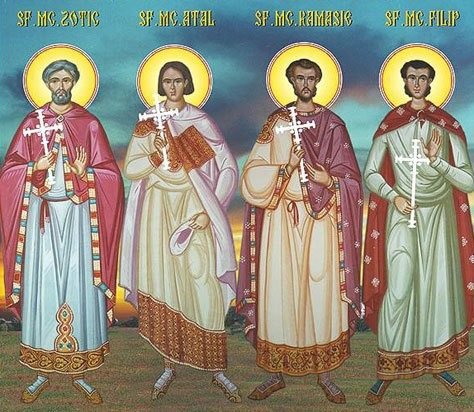
Martyrs of Niculitsel

Martyrs of Niculitsel

The graves of Saints Zoticus, Atallus, Camisius and Philip were discovered in 1971. Lesser Scythia (modern Romania), between the Danube and the Black Sea in the northeastern territory of the Roman Empire, was a place of exile or death for Christians who refused to worship the pagan gods. During the persecutions of Decius (249-251), Diocletian and Maximilian (284-305), and Licinius (308-324) thousands of people died there from cold, hunger, or torture. The graves of Saints Zoticus, Atallus, Camisius and Philip were discovered in 1971. Lesser Scythia (modern Romania), between the Danube and the Black Sea in the northeastern territory of the Roman Empire, was a place of exile or death for Christians who refused to worship the pagan gods. During the persecutions of Decius (249-251), Diocletian and Maximilian (284-305), and Licinius (308-324) thousands of people died there from cold, hunger, or torture. The relics of those who endured martyrdom because they openly proclaimed their faith in Christ were taken by Christians and buried in secret places. Accounts of the lives and sufferings of these holy martyrs were written and preserved so they would not be forgotten. When the persecutions ended, the relics were moved from their temporary resting places and placed in special crypts (martyria). Churches were built over these crypts, and the ruins of some of them may be seen today in Dobrogea. In September 1971 a creek overflowed its banks near the village of Niculitsel in the county of Tulcea, revealing one of the oldest of these martyria. The crypt, which is made of bricks, is divided into two rooms, one on top of the other. In the upper room, the relics of four martyrs were found in a single wooden coffin. All had been decapitated. The heads of three martyrs were found atop their necks, while the head of the fourth martyr was resting on his chest. An inscription on the left wall reads: “Christ’s martyrs.” The names of the four martyrs (Zoticus, Attalus, Camasius, and Philip) were scratched into the right wall. According to the records which have been preserved, these martyrs were tried by the Roman authorities of Noviodunum (modern Isaccea) and sentenced to death. They were beheaded, then buried at Niculitsel. The exact date of their martyrdom is not known. Some believe that they were slain early in the fourth century during the persecutions of Diocletian or Licinius. Others, however, think the four men may have been martyred north of the Danube during the persecution of the Gothic king Athanaric (370-372) against the Christians. About a hundred fragments of the bones of two men (aged between 45-50) were found in the lower crypt. It is thought that they died during the persecution of Decius, and then their relics were reinterred at Niculitsel around 370-380. The names of these martyrs are not known. The Syrian Martyrologion and Saint Jerome’s Martyrologion give June 4 as the date of the martyrs’ execution. The Synaxaria list these four martyrs along with six others: Eutychius, Quirinus, Julia, Saturninus, Ninita, Fortunio. Twenty-five others were also beheaded with these martyrs, but are not named. The relics of these holy martyrs were moved to the Cocosh Monastery in 1971, where they are venerated by the faithful.

Troparion - Tone 4

Your holy martyrs O Lord, / through their sufferings have received incorruptible crowns from You, our God. / For having Your strength, they laid low their adversaries, / and shattered the powerless boldness of demons. / Through their intercessions, save our souls!
New Martyr Archbishop Andronicus of Perm

New Martyr Archbishop Andronicus of Perm

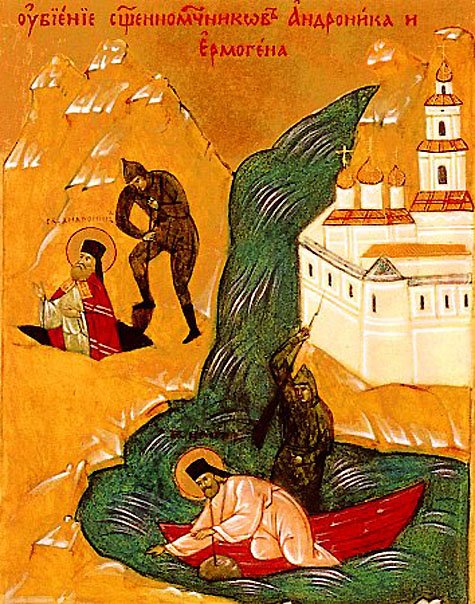
The holy New Martyr Archbishop Andronicus of Perm was an outspoken critic of the Communist decree which ordered the separation of Church and State. Upon reading the Moscow Overland Assembly’s instructions on the matter, Archbishop Andronicus ordered his archdeacon to anathematize the Communists. The Archbishop was arrested, shot by two members of the Perm CHEKA, then buried on the road from Perm to Motoviliha. The holy New Martyr Archbishop Andronicus of Perm was an outspoken critic of the Communist decree which ordered the separation of Church and State. Upon reading the Moscow Overland Assembly’s instructions on the matter, Archbishop Andronicus ordered his archdeacon to anathematize the Communists. The Archbishop was arrested, shot by two members of the Perm CHEKA, then buried on the road from Perm to Motoviliha. Bishop Theophanes, an assistant to Archbishop Andronicus, was also arrested about this time. He was then drowned in the River Kama. When they learned of the execution of the Perm bishops, the Moscow Church Assembly sent a special commission, headed by Bishop Basil of Chernigov, to investigate their murder. The Communists, however, took steps to conceal the facts from the investigators. As the members of the commission were on their way back to Moscow, their train was attacked by Red soldiers somewhere between Perm and Viatka. Bishop Basil and the others were killed, and their bodies were thrown from the coach. The bodies were buried by peasants, but were later dug up and burned by the Communists when pilgrims began flocking to the graves.

Troparion - Tone 4

By sharing in the ways of the Apostles, / you became a successor to their throne. / Through the practice of virtue, you found the way to divine contemplation, / O inspired one of God; / by teaching the word of truth without error, / you defended the Faith, even to the shedding of your blood. / Hieromartyr Andronicus entreat Christ God to save our souls.

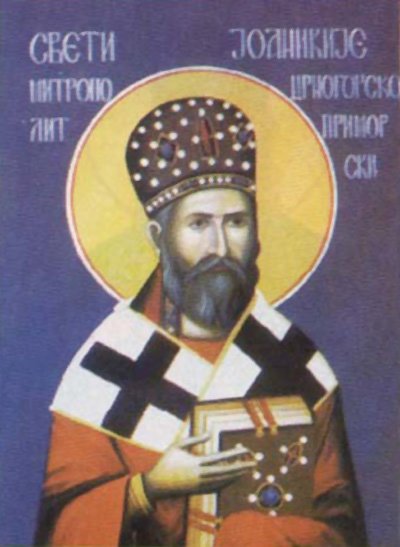
Hieromartyr Joanicus, Metropolitan of Montenegro and the Coast

No information available at this time.

Troparion - Tone 4

By sharing in the ways of the Apostles, / you became a successor to their throne. / Through the practice of virtue, you found the way to divine contemplation, O inspired one of God; / by teaching the word of truth without error, you defended the Faith, / even to the shedding of your blood. / Hieromartyr Joanicus, entreat Christ God to save our souls.

Hieromartyr Savva, Bishop of Upper Karlovac

No information available at this time.

Troparion - Tone 4

By sharing in the ways of the Apostles, / you became a successor to their throne. / Through the practice of virtue, you found the way to divine contemplation, O inspired one of God; / by teaching the word of truth without error, you defended the Faith, / even to the shedding of your blood. / Hieromartyr Savva, entreat Christ God to save our souls.

Scripture Readings

Epistle

Romans 1:28-2:9

28 And even as they did not like to retain God in their knowledge, God gave them over to a reprobate mind, to do those things which are not convenient;
29 Being filled with all unrighteousness, fornication, wickedness, covetousness, maliciousness; full of envy, murder, debate, deceit, malignity; whisperers,
30 Backbiters, haters of God, despiteful, proud, boasters, inventors of evil things, disobedient to parents,
31 Without understanding, covenantbreakers, without natural affection, implacable, unmerciful:
32 Who knowing the judgment of God, that they which commit such things are worthy of death, not only do the same, but have pleasure in them that do them.
1 Therefore thou art inexcusable, O man, whosoever thou art that judgest: for wherein thou judgest another, thou condemnest thyself; for thou that judgest doest the same things.
2 But we are sure that the judgment of God is according to truth against them which commit such things.
3 And thinkest thou this, O man, that judgest them which do such things, and doest the same, that thou shalt escape the judgment of God?
4 Or despisest thou the riches of his goodness and forbearance and longsuffering; not knowing that the goodness of God leadeth thee to repentance?
5 But after thy hardness and impenitent heart treasurest up unto thyself wrath against the day of wrath and revelation of the righteous judgment of God;
6 Who will render to every man according to his deeds:
7 To them who by patient continuance in well doing seek for glory and honour and immortality, eternal life:
8 But unto them that are contentious, and do not obey the truth, but obey unrighteousness, indignation and wrath,
9 Tribulation and anguish, upon every soul of man that doeth evil, of the Jew first, and also of the Gentile;

Gospel

Matthew 5:27-32

27 Ye have heard that it was said by them of old time, Thou shalt not commit adultery:
28 But I say unto you, That whosoever looketh on a woman to lust after her hath committed adultery with her already in his heart.
29 And if thy right eye offend thee, pluck it out, and cast it from thee: for it is profitable for thee that one of thy members should perish, and not that thy whole body should be cast into hell.
30 And if thy right hand offend thee, cut it off, and cast it from thee: for it is profitable for thee that one of thy members should perish, and not that thy whole body should be cast into hell.
31 It hath been said, Whosoever shall put away his wife, let him give her a writing of divorcement:
32 But I say unto you, That whosoever shall put away his wife, saving for the cause of fornication, causeth her to commit adultery: and whosoever shall marry her that is divorced committeth adultery.

Liturgical data sourced from OCA.org and orthocal.info