Fasting Rules
 Meat
Allowed
Meat
Allowed
 Fish
Allowed
Fish
Allowed
 Dairy
Allowed
Dairy
Allowed
 Oil
Allowed
Oil
Allowed
 Wine
Allowed
Wine
Allowed
Saints & Commemorations
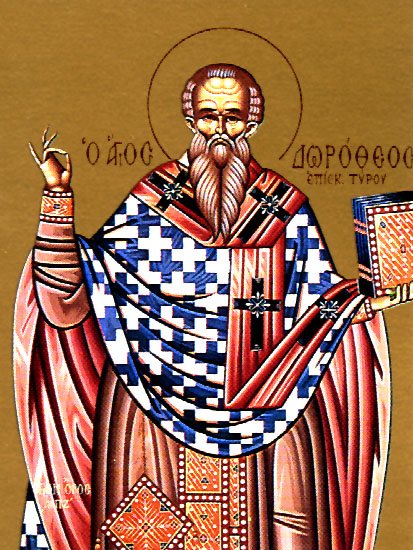
Hieromartyr Dorotheus, Bishop of Tyre
The Hieromartyr Dorotheus was bishop of the Phoenician city of Tyre, during the time of the persecution against Christians under the emperor Diocletian (284-305). Heeding the words of the Gospel (Mt.10:23), the saint withdrew from Tyre and hid from the persecutors. He returned to Tyre during the reign of Saint Constantine the Great (306-337, May 21), again occupying the bishop’s throne he guided his flock for more than fifty years, and converted many of the pagans to Christianity. W
The Hieromartyr Dorotheus was bishop of the Phoenician city of Tyre, during the time of the persecution against Christians under the emperor Diocletian (284-305). Heeding the words of the Gospel (Mt.10:23), the saint withdrew from Tyre and hid from the persecutors. He returned to Tyre during the reign of Saint Constantine the Great (306-337, May 21), again occupying the bishop’s throne he guided his flock for more than fifty years, and converted many of the pagans to Christianity. When the emperor Julian the Apostate (361-363) began openly to persecute Christians, Saint Dorotheus was already over 100 years old. He withdrew from Tyre to the Myzean city of Udum (present day Bulgarian Varna). Delegates of the emperor arrested him there for his refusal to offer sacrifice to idols. They began to torture the holy Elder, and under torture he surrendered his soul to the Lord (+ ca. 362) at the age of 107.
Some ascribe to Saint Dorotheus the compilation of a work, “The Synopsis”, a collection of sayings, and including lives of the holy prophets and apostles.
Troparion - Tone 4
O Dorotheus, wise hierarch of Christ, / you received the light of wisdom as a gift from the Father of lights. / You increased the talents given to you / and in your old age contested beyond the bounds of nature. / And now, O Hieromartyr, you even intercede for our souls!
Kontakion - Tone 3
By preaching Orthodox doctrine, O Hieromartyr, / you offered yourself as a godly and holy gift. / First you excelled in asceticism / and then in the contest of martyrdom, / attaining the victor’s prize from Christ our God!
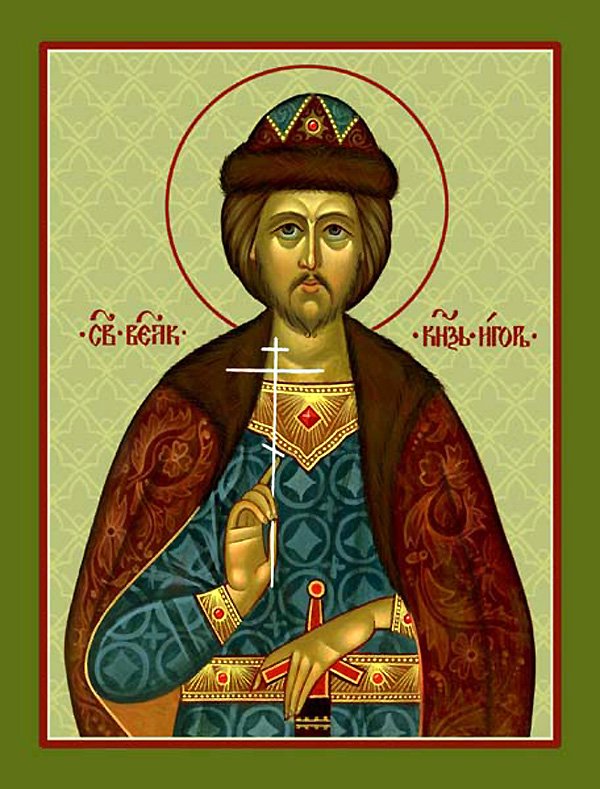
Translation of the relics of the Right-believing Igor-George, Tonsured Gabriel, Grand Prince of Chernigov, and Kiev
“Persecuted by his kinsfolk, he left the world and became a monk. The citizens of Kiev, disgusted with the Olgovitch dynasty [of which he had been prince], determined to exterminate it. They hurried to the monastery, seized the young and innocent schema-monk and killed him. For this evil-doing, much misfortune fell on the inhabitants of Kiev, but c
“Persecuted by his kinsfolk, he left the world and became a monk. The citizens of Kiev, disgusted with the Olgovitch dynasty [of which he had been prince], determined to exterminate it. They hurried to the monastery, seized the young and innocent schema-monk and killed him. For this evil-doing, much misfortune fell on the inhabitants of Kiev, but candles were several times seen to light of themselves on the grave of this blessed monk, and a fiery column appeared over the church where he was buried.” (Prologue)
Blessed Constantine, Metropolitan of Kiev
In his day there was great disorder among the princes of Russia and in the Russian Church. One of the rival princes appointed a monk named Kim as Metropolitan of Kiev without seeking the blessing of the Patriarch of Constantinople, as was still done at that time. The Patriarch sent Metropolitan Constantine to investigate, and he deposed Kim and banished the priests whom Kim had ordained.
In his day there was great disorder among the princes of Russia and in the Russian Church. One of the rival princes appointed a monk named Kim as Metropolitan of Kiev without seeking the blessing of the Patriarch of Constantinople, as was still done at that time. The Patriarch sent Metropolitan Constantine to investigate, and he deposed Kim and banished the priests whom Kim had ordained. This led to strife among the people, some of whom supported Constantine, some Kim. Finally, at the request of the princes, the Patriarch sent a third Metropolitan, and both Kim and Constantine were removed.
When Constantine died in 1159, his will ordered that he not be buried, but cast out to be eaten by dogs, since he felt that he was guilty of sowing discord in the Church. Horrified, but unwilling to go against his last wishes, the people threw his body outside as he had ordered. During the three days that it lay exposed, Kiev was wracked with thunderstorms and earth tremors, in which eight people were killed. Finally the Prince of Kiev ordered that the Metropolitan’s body be buried in the church, and the weather immediately became calm.
Troparion - Tone 4
In truth you were revealed to your flock as a rule of faith, / an image of humility and a teacher of abstinence; / your humility exalted you; / your poverty enriched you. / Hierarch Father Constantine, / entreat Christ our God / that our souls may be saved.
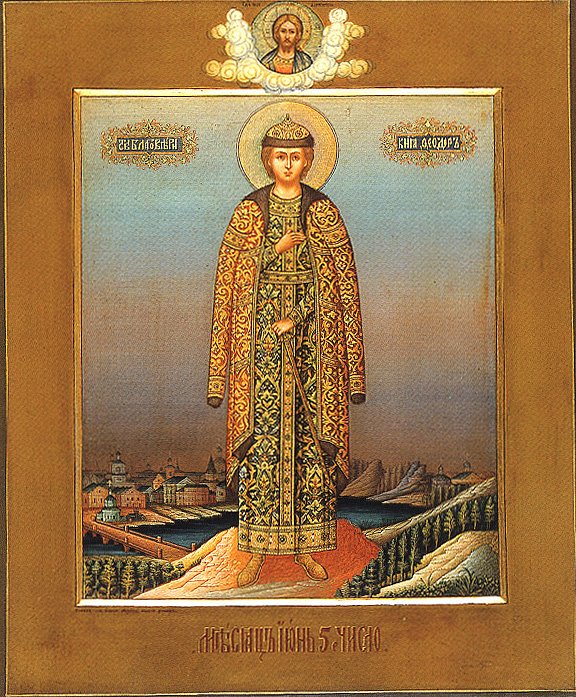
Repose of Saint Theodore Yaroslavich, older brother of Saint Alexander Nevsky
Holy Prince Theodore of Novgorod, the elder brother of Saint Alexander Nevsky, was born in the year 1218. His princely service to his native land began at a very early age. In 1229 both brothers had been left in Novgorod by their father Yaroslav Vsevolodovich as his representatives. But not even a year passed before the young princes had to quit Novgorod.
Holy Prince Theodore of Novgorod, the elder brother of Saint Alexander Nevsky, was born in the year 1218. His princely service to his native land began at a very early age. In 1229 both brothers had been left in Novgorod by their father Yaroslav Vsevolodovich as his representatives. But not even a year passed before the young princes had to quit Novgorod. The turbulent Novgorod people in their “veche” (“government council”) decided to invite another prince. But in the very next year, 1230, during a time of famine and epidemic, the Novgorodians again invited Yaroslav to rule them. On December 30, 1230 he sat as prince in Novgorod for the fourth time, but he remained in the city for only two weeks, when he installed his sons there and went off to Pereyaslavl-Zalessk. In 1232 the fourteen-year-old Theodore was already summoned to serve God not only in prayer, but also by the sword. He took part in a campaign of the Russian troops against the pagan Mordovian princes.
In the year 1233 at the wish of his father he was obliged to enter into marriage with Theodoulia, the daughter of the holy Prince Michael of Chernigov. When the guests had already gathered at the wedding feast, the bridegroom suddenly died. After the unexpected death of her groom, the princess left the world and was tonsured in one of the Suzdal monasteries, famed in her monastic efforts as Saint Euphrosynē of Suzdal (September 25).
Saint Theodore was buried in the Yuriev monastery in Novgorod. In the year 1614 the Swedes, having pillaged the monastery, broke open the tomb of the prince and finding him whole and incorrupt, they mocked the holy relics, and finally abandoned the body in the churchyard. Years later, Metropolitan Isidore of Novgorod transferred the relics to Novgorod’s cathedral of Holy Wisdom (Hagia Sophia), placing them in the chapel of the holy Prophet, Forerunner and Baptist John. There they remained until 1919, when they were removed by the Bolsheviks.
The service to Saint Theodore was compiled in the year 1787 by Metropolitan Gabriel of Petersburg and Novgorod (+ 1801).
Troparion - Tone 8
You grew up up devoutly, like a sprout from a pious root, / and though you reposed at a young age, / you fulfilled long years by your virtues1 O Right-Believing Prince Theodore. / Therefore entreat Him Who governs time, that by your prayers He may grant us long life, / and bestow upon our country great and abundant mercy.1 He, being made perfect in a short time, fulfilled a long time (Wisdom of Solomon 4:13).
Kontakion - Tone 4
Born in piety, and raised in the fear of God, / having attained chastity in his life, / and after his repose shone forth by the incorruptibility of his body. / Honoring the Right-Believing Prince Theodore as a Saint, / we humbly pray to Thee, / O Almighty Master, / and glorify our land forever with Your Saints.
Finding of the Relics of Venerable Bassian and Jonah, Monks of Pertominsk
Saints Bassian and Jonah were monks of the Solovki Transfiguration monastery and disciples of Igumen Philip, who later became Metropolitan of Moscow (January 9).
These holy monks were glorified by the Lord after their death in 1561.
Fishermen and sailors came to pray in the chapel, built in 1599 over their grave by the Trinity-Sergiev monastery Elder Mamant.
Saints Bassian and Jonah were monks of the Solovki Transfiguration monastery and disciples of Igumen Philip, who later became Metropolitan of Moscow (January 9).
These holy monks were glorified by the Lord after their death in 1561.
Fishermen and sailors came to pray in the chapel, built in 1599 over their grave by the Trinity-Sergiev monastery Elder Mamant. There in 1623 the hieromonk James founded a monastery, called Pertominsk.
Troparion - Tone 8
By a flood of tears you made the desert fertile, / and your longing for God brought forth fruits in abundance. / By the radiance of miracles you illumined the whole universe! / O our holy fathers Bassian and Jonah, pray to Christ our God to save our souls!
Martyrs Marcian, Nicander, Hyperechius, Appolonius, Leonidas, Arius, Gorgias, Pambo, Selenia, and Irene of Egypt
The Holy Martyrs Marcian, Nicander, Hyperechius, Apollonius, Leonidas, Arius, Gorgias, Pambo, and the women martyrs Selenia and Irene were natives of Egypt and suffered during the reign of Maximian (305-311). For their steadfast confession of faith in Christ they were subjected to a fierce scourging.
The Holy Martyrs Marcian, Nicander, Hyperechius, Apollonius, Leonidas, Arius, Gorgias, Pambo, and the women martyrs Selenia and Irene were natives of Egypt and suffered during the reign of Maximian (305-311). For their steadfast confession of faith in Christ they were subjected to a fierce scourging. They then threw the sufferers barely alive into prison, where an angel appeared to them and healed their wounds. The holy martyrs died in prison from hunger and thirst.
Troparion - Tone 4
Your holy martyrs O Lord, / through their sufferings have received incorruptible crowns from You, our God. / For having Your strength, they laid low their adversaries, / and shattered the powerless boldness of demons. / Through their intercessions, save our souls!
Venerable Theodore, Wonderworker and Hermit of the Jordan
He lived for many years as a hermit in the wilderness of the Jordan, and after long and hard ascetic struggle was granted the gift of wonderworking. Once he travelled by ship to Constantinople, and the ship went off course in a storm. The drinking water ran out, and the crew and passengers were near death from thirst.
He lived for many years as a hermit in the wilderness of the Jordan, and after long and hard ascetic struggle was granted the gift of wonderworking. Once he travelled by ship to Constantinople, and the ship went off course in a storm. The drinking water ran out, and the crew and passengers were near death from thirst. Theodore prayed to God, made the sign of the cross over the sea, and told the crew to drink the seawater. When they did so, they found to their astonishment that it was fresh and sweet. When the people began to honor him, he begged them only to thank God, who had worked the wonder. He reposed in peace.
Troparion - Tone 8
By a flood of tears you made the desert fertile, / and your longing for God brought forth fruits in abundance. / By the radiance of miracles you illumined the whole universe! / O our holy father Theodore, pray to Christ our God to save our souls!
Venerable Anubius the Confessor and Anchorite of Egypt
Saint Anubius the Ascetic bravely endured tortures during the time of persecutions against Christians in the fourth century, but he remained alive and withdrew into the wilderness, where he dwelt until old age. He founded a small skete, in which he lived with six monks, one of whom was his brother Saint Pimen the Great (August 27).
Saint Anubius the Ascetic bravely endured tortures during the time of persecutions against Christians in the fourth century, but he remained alive and withdrew into the wilderness, where he dwelt until old age. He founded a small skete, in which he lived with six monks, one of whom was his brother Saint Pimen the Great (August 27). Once robbers laid waste to the skete, and the monks had to hide themselves in the ruins of a pagan temple, while having given their word not to speak with each other for a week. In the morning all week long Saint Anubius threw a stone at the face of the statue of the pagan god, and in the evening he said to it, “I have sinned.”
At the end of the week the brethren asked Abba Anubius what his actions signified, and the Elder explained that just as the statue did not get angry when he struck it, nor get flattered when he asked forgiveness of it, so the brethren ought to live. Three days before his end Saint Anubius was visited by the desert-dwellers Cyrus, Isaiah, and Paul, who asked the Elder to tell them about his life for the edification of believers. The saint replied, “I do not recall that I did anything great or glorious.” However, swayed by the entreaties of his questioners, in deep humility he related to them that during the time of persecutions he confessed the Name of Christ under torture, after this he had never defiled his lips with a lie, since after he had confessed Truth, he did not want to utter falsehood.
Three days later, Saint Anubius reposed in spiritual joy. The aforementioned Fathers said that they heard the singing of angels who came to receive his soul.
His heart was ever filled with a thirst for communion with the Lord, and he had often seen angels and the holy saints of God standing before the Lord. He also beheld Satan and his angels committed to the eternal flames. He is mentioned in the LAUSIAC HISTORY of Palladius, and his sayings can be found in the Paradise of the Fathers and in the Evergetinos.
Troparion - Tone 8
Champion of Orthodoxy, teacher of purity and of true worship, / the enlightener of the universe and the adornment of hierarchs: / all-wise father Anubius, your teachings have gleamed with light upon all things. / Intercede before Christ God to save our souls.
Venerable Abba Dorotheus of Palestine
The Holy Abba Dorotheus was a disciple of Saint John the Prophet in the Palestinian monastery of Abba Seridus in the sixth century.
In his youth he had zealously studied secular science. “When I sought worldly knowledge,” wrote the abba, “it was very difficult at first. When I would come to take a book, I was like a man about to touch a wild beast. When
The Holy Abba Dorotheus was a disciple of Saint John the Prophet in the Palestinian monastery of Abba Seridus in the sixth century.
In his youth he had zealously studied secular science. “When I sought worldly knowledge,” wrote the abba, “it was very difficult at first. When I would come to take a book, I was like a man about to touch a wild beast. When I forced myself to study, then God helped me, and diligence became such a habit that I did not know what I ate, what I drank, whether I had slept, nor whether I was warm or not. I was oblivious to all this while reading. I could not be dragged away by my friends for meals, nor would I even talk with them while I was absorbed in reading. When the philosopher let us go, I went home and washed, and ate whatever was prepared for me. After Vespers, I lit a lamp and continued reading until midnight.” — so absorbed was Abba Dorotheus in his studies at that time.
He devoted himself to monastic activity with an even greater zeal. Upon entering the monastery, he says in his tenth Instruction, he decided that his study of virtue ought to be more fervent than his occupation with secular science had been.
One of the first obediences of Abba Dorotheus was to greet and to see to pilgrims arriving at the monastery. It gave him opportunity to converse with people from various different positions in life, bearing all sorts of burdens and tribulations, and contending against manifold temptations. With the means of a certain brother Saint Dorotheus built an infirmary, in which also he served. The holy abba himself described his obedience, “At the time I had only just recovered from a serious illness. Travellers would arrive in the evening, and I spent the evening with them. Then camel drivers would come, and I saw to their needs. It often happened that once I had fallen asleep, other things arose requiring my attention. Then it would be time for Vigil.” Saint Dorotheus asked one of the brethren to wake him up for for Vigil, and another to prevent him from dozing during the service. “Believe me,” said the holy abba, “I revered and honored them as though my salvation depended upon them.”
For ten years Abba Dorotheus was cell-attendant for Saint John the Prophet (Feb. 6). He was happy to serve the Elder in this obedience, even kissing the door to his cell with the same feeling as another might bow down before the holy Cross. Distressed that he was not fulfilling the word of Saint Paul that one must enter the Kingdom of Heaven through many tribulations (Acts 14:22), Abba Dorotheus revealed this thought to the Elder. Saint John replied, “Do not be sad, and do not allow this to distress you. You are in obedience to the Fathers, and this is a fitting delight to the carefree and calm.” Besides the Fathers at the monastery of Abba Seridus, Saint Dorotheus visited and listened to the counsels of other great ascetics of his time, among whom was Abba Zosima.
After the death of Saint John the Prophet, when Abba Barsanuphius took upon himself complete silence, Saint Dorotheus left the monastery of Abba Seridus and founded another monastery, the monks of which he guided until his own death.
Abba Dorotheus wrote 21 Discourses, several Letters, and 87 Questions with written Answers by Saints Barsanuphius the Great and John the Prophet. In manuscript form are 30 Talks on Asceticism, and written counsels of Abba Zosima. The works of Abba Dorotheus are imbued with a deep spiritual wisdom, distinguished by a clear and insightful style, but with a plain and comprehensible expression. The Discourses deal with the inner Christian life, gradually rising up in measure of growth in Christ. The saint resorted often to the advice of the great hierarchs, Saints Basil the Great, Gregory the Theologian, and Gregory of Nyssa. Obedience and humility, the combining of deep love for God with love for neighbor, are virtues without which spiritual life is impossible. This thought pervades all the writings of Abba Dorotheus.
In his writings the personal experience of Abba Dorotheus is felt everywhere. His disciple, Saint Dositheus (February 19), says of him, “Towards the brethren laboring with him he responded with modesty, with humility, and was gracious without arrogance or audacity. He was good-natured and direct, he would engage in a dispute, but always preserved the principle of respect, of good will, and that which is sweeter than honey, oneness of soul, the mother of all virtues.”
The Discourses of Abba Dorotheus are preliminary books for entering upon the path of spiritual action. The simple advice, how to proceed in this or that instance, together with a most subtle analysis of thoughts and stirrings of soul provide guidance for anyone who resolves to read the works of Abba Dorotheus. Monks who begin to read this book, will never part from it throughout their life.
The works of Abba Dorotheus are to be found in every monastery library and are constantly reprinted. In Russia, his soul-profiting Instruction, together with the Replies of the Monks Barsanuphius the Great and John the Prophet, were extensively copied, together with The Ladder of Divine Ascent of Saint John Climacus and the works of Saint Ephraim the Syrian. Saint Cyril of White Lake (June 9), despite his many duties as igumen, with his own hand transcribed the Discourses of Abba Dorotheus, as he did also the Ladder of Divine Ascent.
The Discourses of Abba Dorotheus pertain not only to monks; this book should be read by anyone who aspires to fulfill the commands of Christ.
Troparion - Tone 8
By a flood of tears you made the desert fertile, / and your longing for God brought forth fruits in abundance. / By the radiance of miracles you illumined the whole universe! / O our holy father Dorotheus, pray to Christ our God to save our souls!
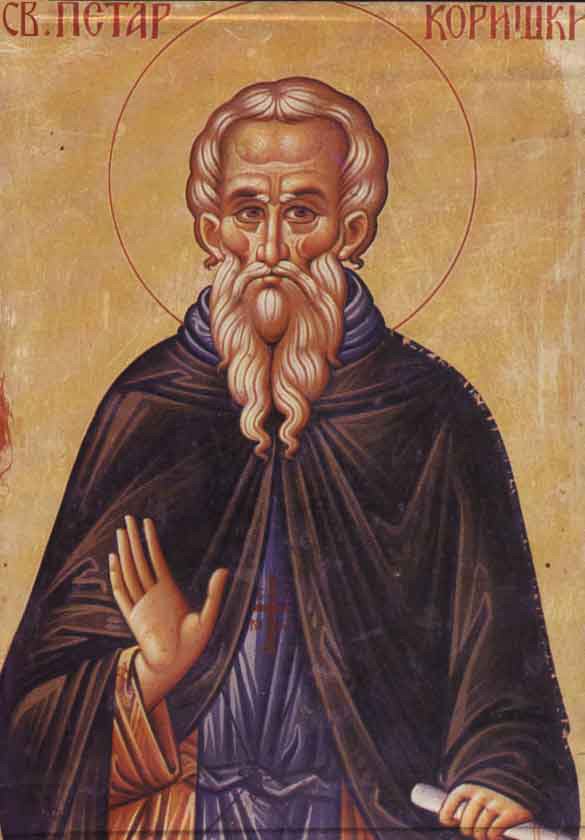
Saint Peter of Korisha
Saint Peter was born in 1211 in the village of Unjimir between the city of Pech and the Field of Kosovo. As a child, he was meek and humble, and seldom participated in children’s games. At an early age, he and his younger sister Helena devoted themselves to prayer and fasting. When he was ten years old, the future saint told his parents that he wished to serve God by becoming a monk.
Saint Peter was born in 1211 in the village of Unjimir between the city of Pech and the Field of Kosovo. As a child, he was meek and humble, and seldom participated in children’s games. At an early age, he and his younger sister Helena devoted themselves to prayer and fasting. When he was ten years old, the future saint told his parents that he wished to serve God by becoming a monk.
Saint Peter’s father died when the boy was fourteen, so he put off his plans to enter the monastery in order to care for his mother and sister. At the same time, he increased his ascetical efforts. When Saint Peter was sixteen, his beloved mother reposed. Determined to enter a monastery, he asked his sister whether she intended to be married, for his conscience would not allow him to abandon her unless he had provided for her. Helena said that it was her wish to preserve her virginity and become a nun. She said she would share his life of prayer and asceticism if only he would take her with him. Peter rejoiced and replied, “May the Lord’s will be done.”
They sold their family possessions and distributed the money to the poor. Traveling to Pec, they reached the Monastery of Saints Peter and Paul. Peter remained here, while Helena entered a nearby women’s monastery. After several years, both were granted permission to live in solitude.
Peter built two cells, one for himself and one for his sister, near the monastery. They spent their time in continual prayer and fasting, freeing themselves from worldly attachments, subduing the flesh, and struggled on the path of salvation.
These two spiritual lamps could not remain hidden for very long. People started coming to them for spiritual counsel and healing. Saint Peter and his sister agreed to avoid the snare of vainglory by moving to a more remote area. They went to Crna Reka (the town of Black River) on the Ibar River.
Saint Peter wished to move even farther into the woods for a life of even greater asceticism, but was reluctant to leave his sister. On the other hand, he was concerned that she might risk her physical and spiritual health if she were to come with him, so he decided to slip away and leave her in order to live alone on a mountain. He did not get very far before she noticed he was gone. She caught up to him and they traveled together to a mountain near the town of Prizren. On top of the mountain was a town called Korisha (modern Kabash), where they stopped to rest. Helena went to sleep there in the grass. Saint Peter wept and made the Sign of the Cross over her, then went off into the forest. When she awoke and found him gone, she wept and called his name. Finally, she went down from the mountain and lived in Prizren for the rest of her life. Saint Helena is also commemorated on June 5 with her brother, Saint Peter.
The holy ascetic lived in a cave near Korisha, where he continued his spiritual struggles in the heat of summer and in the cold of winter. He withstood the temptations and attacks of the demons which assailed him. When this happened, he sang Psalms and hymns all night until the sun came up in the morning. He fervently prayed for God to help and comfort him in his struggles. The Archangel Michael appeared to him and drove away the demons, promising Saint Peter that they would never enter his cell again. The Archangel warned him to be vigilant and to persevere, for the Devil wished to destroy him. After advising the saint to call upon the name of the Lord whenever he was attacked by the forces of evil, the holy Archangel vanished.
Saint Peter still endured temptations, but was victorious against all of them. Realizing his own weakness, he turned to Christ, Who strengthened him and sustained him. After these victories, the Lord consoled him with a vision of the Uncreated Light which lasted several days. From that time forward, Saint Peter was illumined by the grace of God, so no demon ever dared to approach him again.
Before Saint Peter’s death, many monks were sent to him by God, and he guided all of them. He blessed them and tonsured them, and permitted them to live in the caves below his cave. Forseeing the approach of death, he dug out a tomb for himself in the wall of his cell.
Acceding to the wish of his disciples, he told them the story of his life. Then he and his disciples received the Life-Giving Mysteries of Christ. After bidding each brother farewell, he surrendered his soul to God on June 5, 1275.
On the night of his blessed repose, a heavenly light was seen in his cave, and the singing of angels was heard by the other monks. In the morning, Saint Peter’s face shone with radiance, and a sweet fragrance came from his body. After the saint’s burial, many of those who came to his tomb were healed of their physical and spiritual infirmities. Seventy years later, King Dushan built a church at Korisha over Saint Peter’s relics, and dedicated it to the God-bearing ascetic.
The holy relics of Saint Peter were later transferred to the Black River monastery, then to the church of the Archangel Michael in the city of Kalashin.
Many of the icons of Saint Peter proved to be miracle working. The inscription reads: “Saint Peter of Korisha, desert-dweller and wonderworker.”
Troparion - Tone 1
You were revealed as a desert dweller, / an angel in the flesh and a wonderworker, O our God-bearing Father Peter. / You received heavenly gifts through fasting, vigils, and prayers; / you healed the infirm and the souls of those who have recourse to you with faith. / Glory to Him Who strengthened you. / Glory to Him Who crowned you. / Glory to Him Who, through you, works healings for all.
Kontakion - Tone 6
You fled from the company of men, and lived in stony caves and cliffs. / You were filled with divine desire and love for your Lord, O Peter, / from Whom you received a crown. / Pray unceasingly that our souls may be saved.
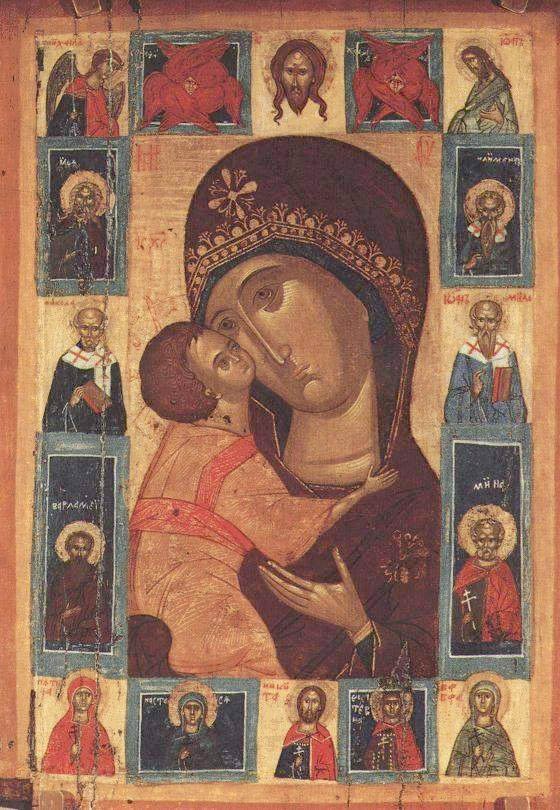
Icon of the Mother of God of Igor
The Igor Icon of the Mother of God. The holy Passion-Bearer and Great Prince of Kiev Igor Ol’govich (September 19, 1147), prayed before this icon during the last moments of his life. It was in the chapel of Saint John the Theologian in the Dormition cathedral of the Kiev Caves Lavra. This icon was of old Greek origin, and had an inscription saying that it belonged to Saint Igor.
Scripture Readings
☩Epistle
Romans 2:14-29
14
For when the Gentiles, which have not the law, do by nature the things contained in the law, these, having not the law, are a law unto themselves:
15
Which shew the work of the law written in their hearts, their conscience also bearing witness, and their thoughts the mean while accusing or else excusing one another;)
16
In the day when God shall judge the secrets of men by Jesus Christ according to my gospel.
17
Behold, thou art called a Jew, and restest in the law, and makest thy boast of God,
18
And knowest his will, and approvest the things that are more excellent, being instructed out of the law;
19
And art confident that thou thyself art a guide of the blind, a light of them which are in darkness,
20
An instructor of the foolish, a teacher of babes, which hast the form of knowledge and of the truth in the law.
21
Thou therefore which teachest another, teachest thou not thyself? thou that preachest a man should not steal, dost thou steal?
22
Thou that sayest a man should not commit adultery, dost thou commit adultery? thou that abhorrest idols, dost thou commit sacrilege?
23
Thou that makest thy boast of the law, through breaking the law dishonourest thou God?
24
For the name of God is blasphemed among the Gentiles through you, as it is written.
25
For circumcision verily profiteth, if thou keep the law: but if thou be a breaker of the law, thy circumcision is made uncircumcision.
26
Therefore if the uncircumcision keep the righteousness of the law, shall not his uncircumcision be counted for circumcision?
27
And shall not uncircumcision which is by nature, if it fulfil the law, judge thee, who by the letter and circumcision dost transgress the law?
28
For he is not a Jew, which is one outwardly; neither is that circumcision, which is outward in the flesh:
29
But he is a Jew, which is one inwardly; and circumcision is that of the heart, in the spirit, and not in the letter; whose praise is not of men, but of God.
☩Gospel
Matthew 5:33-41
33
Again, ye have heard that it hath been said by them of old time, Thou shalt not forswear thyself, but shalt perform unto the Lord thine oaths:
34
But I say unto you, Swear not at all; neither by heaven; for it is God’s throne:
35
Nor by the earth; for it is his footstool: neither by Jerusalem; for it is the city of the great King.
36
Neither shalt thou swear by thy head, because thou canst not make one hair white or black.
37
But let your communication be, Yea, yea; Nay, nay: for whatsoever is more than these cometh of evil.
38
Ye have heard that it hath been said, An eye for an eye, and a tooth for a tooth:
39
But I say unto you, That ye resist not evil: but whosoever shall smite thee on thy right cheek, turn to him the other also.
40
And if any man will sue thee at the law, and take away thy coat, let him have thy cloke also.
41
And whosoever shall compel thee to go a mile, go with him twain.
Liturgical data sourced from OCA.org and orthocal.info